Page 17 of 41

legal terms: royalty
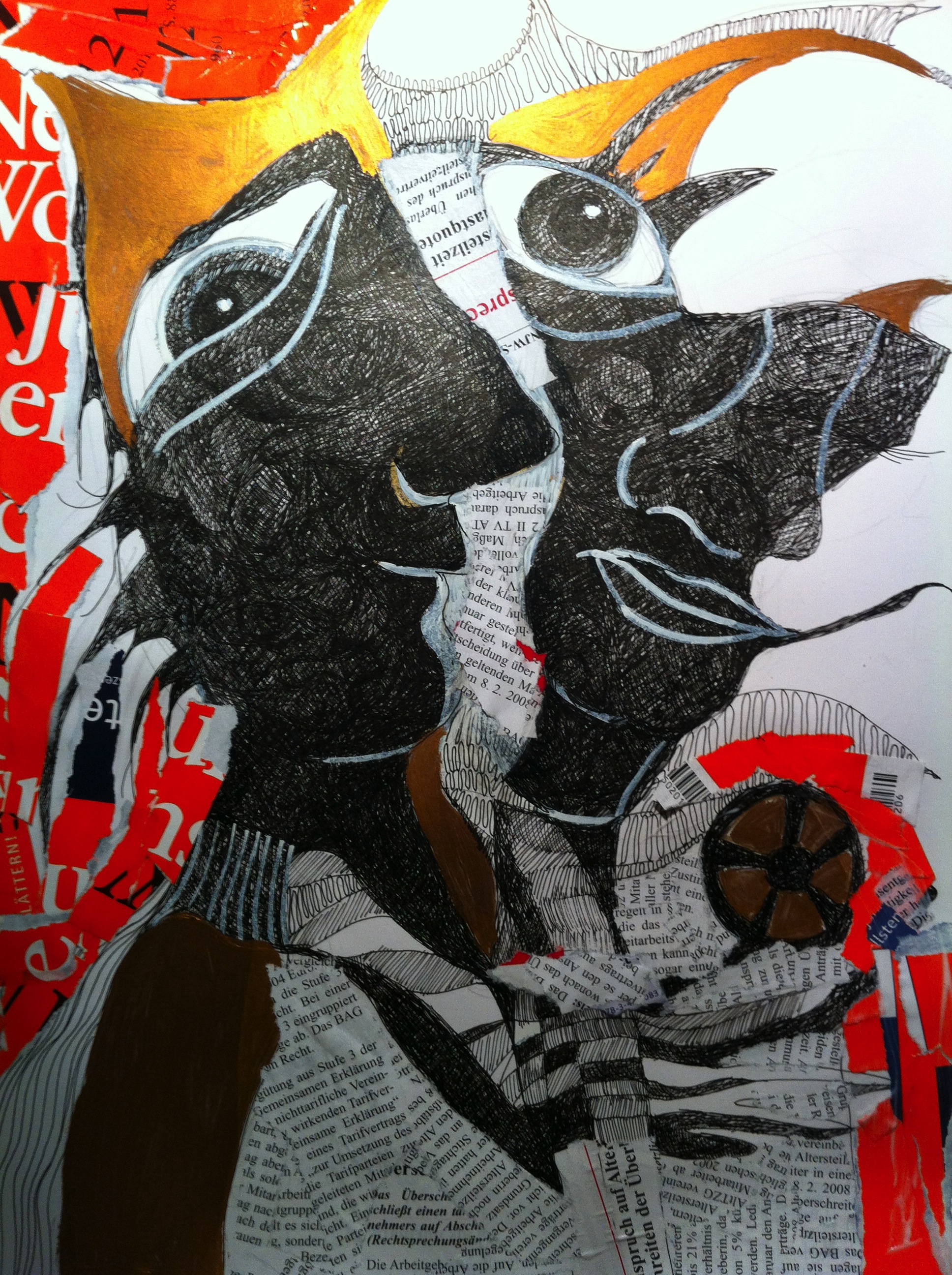
royal

Royalty: a fee that is paid to the owner or creator of intellectual property when it is used again. Black’s Law dictionary

Intellectual property is a legal concept  and like other legal concepts dependent on definition and open to political use and abuse.

The physical, geographical world has indeed been mapped extensively, some might say: exhaustingly, and to the extent that one may not walk this earth anymore without treading on another man’ or woman’s property.

As we are starting to protect that what we call intellectual property – with good reason, think compensation of artists, musicians, inventors who cannot work for free and live on nothing any more than any other trade could – we also have to think of what it means that we are willing to treat ideas very much the same way that we treat the surface of this planet.

As much as one – at the beginning of tis new century with its overwhelming environmental, cultural and economical problems – could question whether the concept of the exclusive private rights to use the land (property) and its resources has been beneficial one should now very carefully consider whether a similar approach of mapping the works of the mind through exclusive rights seems the path we should follow if we hope to address those problems that are not individual but communal problems, not problems of one country but of all people hoping to keep this earth a home for future generations.

“If nature has made any one thing less susceptible than all others of exclusive property, it is the action of the thinking power called an idea, which an individual may exclusively possess as long as he keeps it to himself; but the moment it is divulged, it forces itself into the possession of every one, and the receiver cannot dispossess himself of it. Its peculiar character, too, is that no one possesses the less, because every other possesses the whole of it. He who receives an idea from me, receives instruction himself without lessening mine; as he who lights his taper at mine, receives light without darkening me.” Thomas Jefferson, letter to Isaac McPherson, August 13th, 1813

the nice king breathes the world into existence

kingi don’t count the times
when people ask me
whether i could draw something
nice
for a change

people ask me that a lot

can’t you draw something nice
for a change

don’t think it offends me,

it doesn’t but instead

it confuses me
because, you see,

in my best artistic moments
i feel, don’t laugh,
a bit, just a tiny bit of
gonzo in me, you know,
ralp steadman,
think hunter s, thompson,
and you know where i’d be headed
if only i could

if not for the sobering fact
that i am too nice, too nice,
and so are my drawings,
and i suffer for their niceness,
believe me.

or think edward gorey,
there are moments
when i feel a bit edward gorey
in the tip of my pen,
and i cherish that moment

i even visited his house once
yarmouth port, cape cod,
going spirit hunting,
so to speak,

but my art, don’t think
i didn’t know it,
is too nice, too friendly,
too innocent,
even to be rewarded the
term “goreyan”

yes, i admire
maurice sendak,
the wild things, obviously,
dah,
the night kitchen,
we are all in the dumps with
Jack and Guy
and
Brundibar

i wouldn’t pretend
i ever felt Sendak in my pens,
but i should be so lucky,
and he is not nice,
he is really wild
and a synonym
for “loud greatness”

and i am just
nice

so you see
why i am confused
when you ask me
can’t you draw something nice for a change?

because all that i truly hope for
in my art
is that one day
i manage
not to

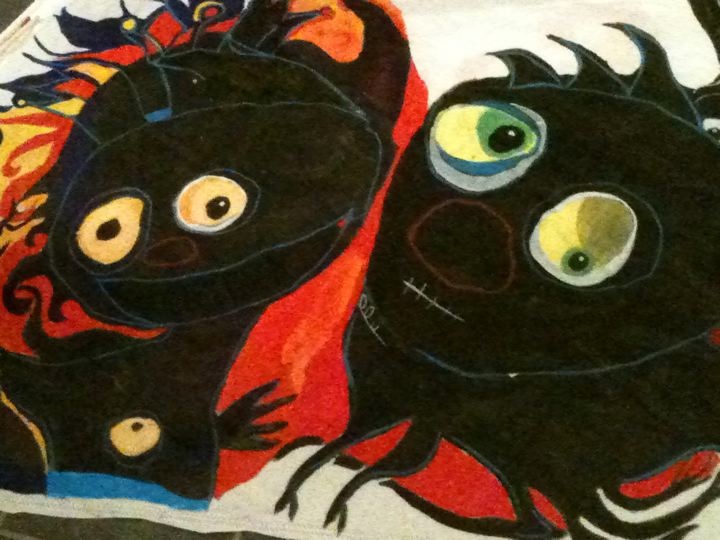
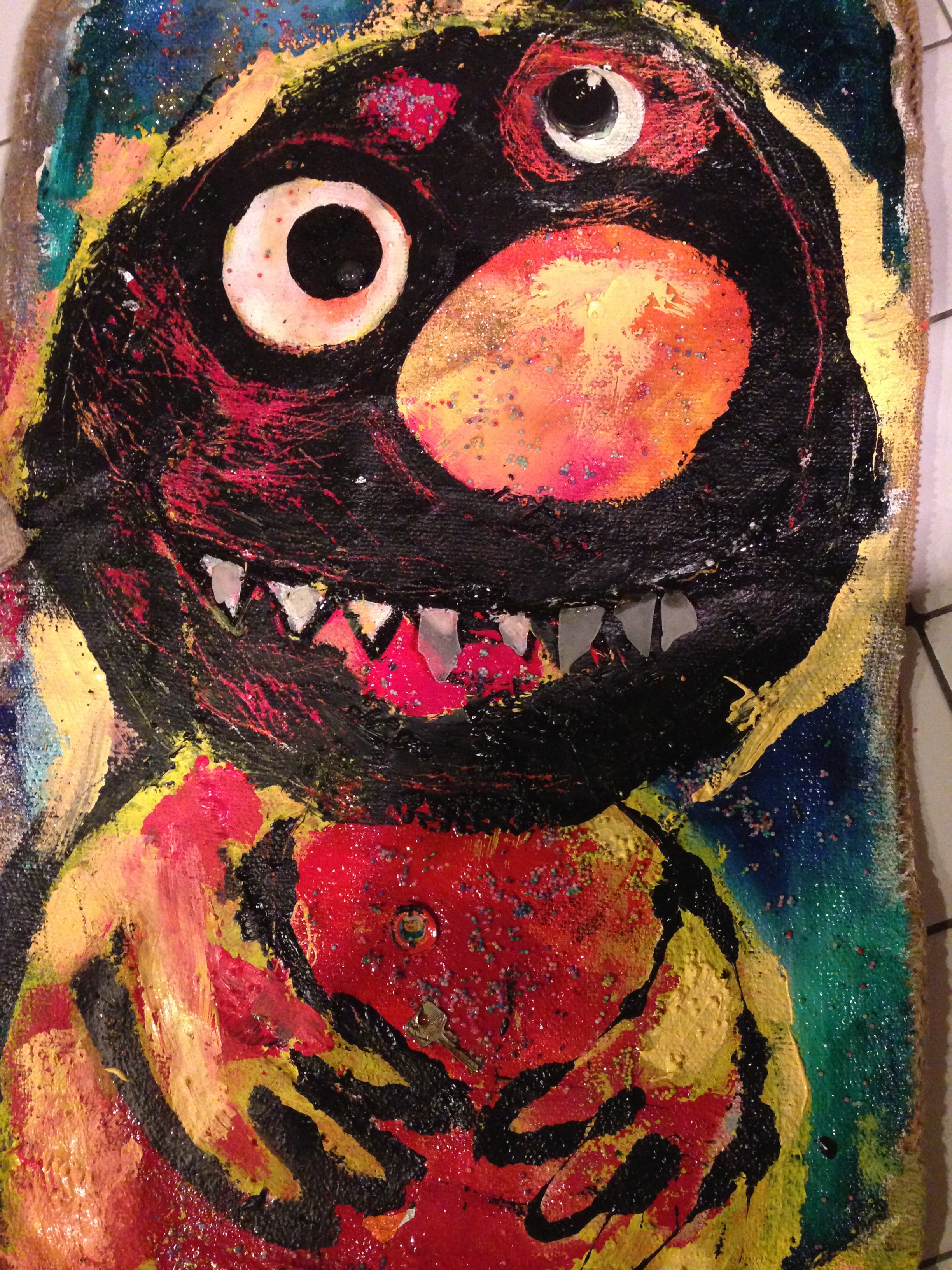
MONSTER Nr. 23

One wild thing: on closer inspection of these canvases you'd find bits and pieces of found objects enclosed such as children cherish. Pieces of beach glass substitute for teeth, small beads, glitter, all children I know love glitter!, keys and bottle caps and lost and found buttons. When did we forget to spin the dream, when did our world cease to hold small promises of meaning and adventure, a life time of stories still to be told? How did we grow up to forget the sensual richness of the world, the intense pleasure we can find only in  simple things and moments. When did we cease to live today in order to reach for a tomorrow that we never truly know will exist - and if it does it comes only to be given up and traded in for yet another tomorrow until there is none anymore? When did we start squandering our present moments for squalid projections? When did we tire of that what we have , right here and right now, the word, the discovery of nothing and everything, the breath of boredom and adventure alike? Ask an expert what life could be like, go hunt for chestnuts and bottle caps and pieces of this and that lost and found. Talk to a stranger and as for their story, smile every once in a while even if convention doesn't require you to, lift your eyes up and look at the disorderly lines of roofs and antennas and imagine Karlsson living up there somewhere or go to your knees and pick up something that glitters without whisking out a disinfectant afterwards. Be a MONSTER. Breathe. There is still some life to be had. Laugh without any particular reason. MONSTER Nr. 23

One wild thing: on closer inspection of these canvases you’d find bits and pieces of found objects enclosed such as children cherish. Pieces of beach glass substitute for teeth, small beads, glitter, all children I know love glitter!, keys and bottle caps and lost and found buttons.

When did we forget to spin the dream, when did our world cease to hold small promises of meaning and adventure, a life time of stories still to be told? How did we grow up to forget the sensual richness of the world, the intense pleasure we can find only in simple things and moments? When did we cease to live today in order to reach for a tomorrow that we never truly know will exist – and if it does, it comes only to be given up and traded in for yet another tomorrow until there is no tomorrow left? When did we start squandering our present moments for squalid projections of who we could be if only? When did we tire of that what we have , right here and right now, the word, the discovery of nothing and everything, the breath of boredom and adventure alike?

Ask an expert, a child no older than six, what life could be like if you’d find it again, go hunt for chestnuts and bottle caps and pieces of this and that, lost and found. Talk to a stranger and ask for their story, smile every once in a while even if convention doesn’t require it, lift your eyes up and look at the disorderly lines of roof shingles, chimneys and antennas and in your mind create a stage for a play that involves precarious acts of balance and skill. Think “Karlsson” by Astrid Lindgren.

Go down to your knees, seeking the perspective of a five year old,  and pick something from the ground that glitters just because it catches your eye – without whisking out a disinfectant afterwards. Be a MONSTER. Breathe. Laugh without any particular reason. Be the absolutely unremarkable, remarkable YOU you were born to be. Nothing more, nothing less. MONSTER Nr. 23

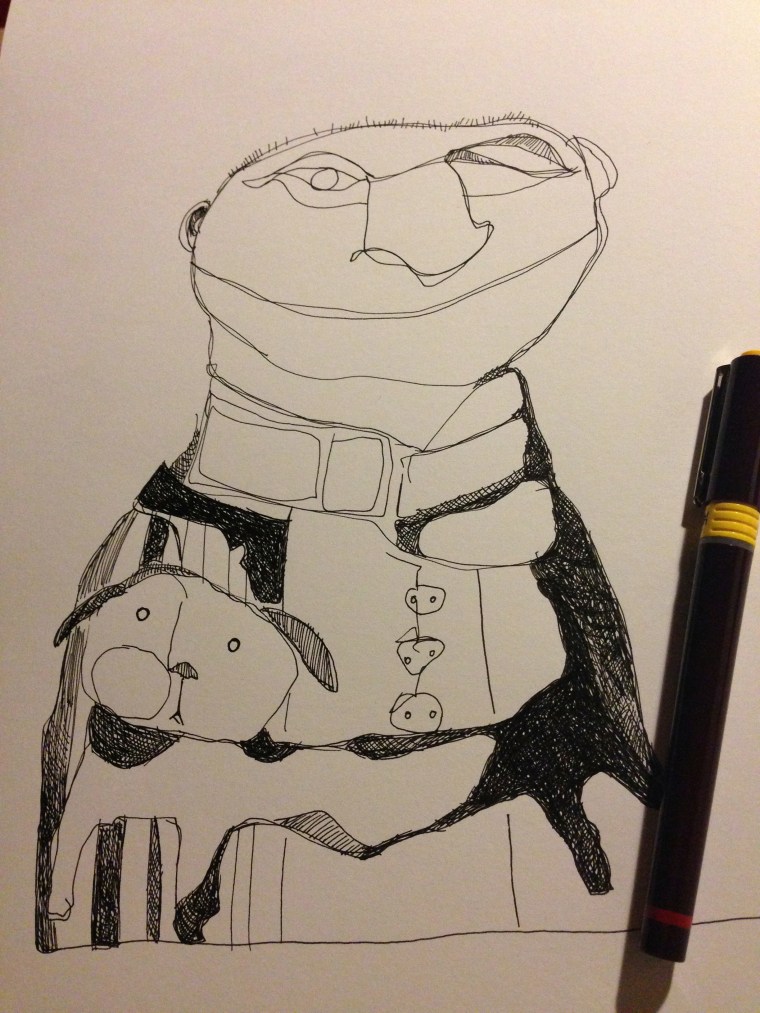
Monsieur Petit et son chien

Monsieur Petit et son chien

Did you know he existed?
I didn’t until yesterday
when he materialized underneath
the tip of my radiograph.

There he was
demanding my attention
yet remaining oddly silent,

Monsieur Petit et son chien.
Eh, bien.

I guess he is out there
somewhere,
in fact, I am almost certain he is.

Perhaps you know him?
Perhaps you have met him,

if you have,
please remember,
next time you see him,
to convey a small message
from me?
I’d be much obliged.

Just mention to him
that his image has separated
from him like his shadow could not
and has adopted a small dog.

And ask him to please
watch out for the real dog,
flea-riddled and shabby as he might be,
the dog,
and take care of him,
and be kind to him.

And tell him not to worry,
he will recognize him,
once he sees him.

Ask very gently,
be persuasive with a hint of
severe authority.
It’s important because,
you see,

his image would much like to keep the dog.

thou shall not confuse night with darkness

Image 1


After all those years of quiet desperation spent in the library it finally occurred to them that the meaning of the phrases they had taken to be metaphorical actually was to be understood literally. One of them said it, said it twice as if a discovery this horrendous and yet simple and elegant, had to be given a reflecting twin to cast light into the darkness of their ignorance. One of them instantly began to tear at the fine web of cross references and foot notes he had been weaving patiently for years and without ever questioning the worthiness of this pursuit, but they were like angel hair or glass wool and cut his hands with fine sharp lines out of which blood emerged like red pearls on a string. “I shall not be told convinced” he blurted out, not holding back now, “All those weeks, months, even years, sitting in the dark like a toad, with my skin starting to resemble the parchment  of the oldest books we had delivered from unknown depths of the library, all that knowledge I have assembled in my humble brain that has me compete with the most elaborate encyclopedias of this library, all this weaving and threading of letters, words, meaning, phrases is to be ridiculed by a simple, single and singular shining truth. What of the darkness that we have illuminated with stray thoughts of meaning, what of the wondrous glimmer of an insight long desired and yet so small that it is like a single candle flicker in a great hall. What of its beauty and possibilities? Look at your single truth that already shines into every corner now that you have unlocked its secret, that leaves no shadow, no desire, no discovery, no randomness and outshines all my small beautiful candles. How am I supposed to live with something so simple and shining when I have dedicated my whole life to the complex, hidden, wondrous discovery of paradox answers, when I love the darkness in which a single light shines, when i am a creature of the night and dedicated to a pursuit without hope? How am I to rise out of my darkness into this shining, merciless light?” And he began crying miserably, holding his bloodied hands out as if he was asking for a charitable donation, and the others looked on in silence.

what is it?

what is it?

what i want to see in these images (and you might see something else, they are as much yours as they are mine): freedom, mindfulness, compassion. a furious gentleness towards life. i see old stories in new clothes. there are stones, there are shadows. there is a smooth path under a tree. and i can relate all this and then return to what i know. because what i paint and write is what i confess not to know. and yet it is not ignorance i serve but the luminous mystery of a letter, a line, a word, a constellation, 20 degrees south-east of the belt of Orion, 23 times more luminous, twice the mass and the diameter of “our” sun. what i know is that if i could indeed throw an object hard enough, it would escape gravitational attraction, that there is a black hole in the galaxy M87, and that freedom is attainable through our words and acts.

Johari-Fenster, David Hockney, Carlos Castaneda – ein Zeitspiegel

IMGP1041Es mag sein, dass es wesentliche Diskrepanzen zwischen der Eigen- und Fremdwahrnehmung geben mag, aber das bedeutet nicht, dass die Fremdwahrnehmung notwendiger Weise eine von der Eigenwahrnehmung überhaupt unterscheidbare  Wahrnehmung einer Person ist. Joseph und Harry’s (Joseph Luft and Harrington Ingham’s) Theorie, dem sogenannten Johari-Fenster (Johari-window) mangelt es an Beweglichkeit. Das “Bild eines Menschen”, gleich ob Selbstbild oder Fremdbild, eine solche Vorstellung setzt bereits sprachlogisch einen Betrachter voraus. Ein Betrachter, der Natur der Betrachtung folgend, nimmt einen spezifischen Standort ein und sein oder ihr Urteil bezieht sich auf das von dieser Perspektive aus Ersichtliche, Sichtbare. Die Diskrepanz in der Betrachtung zwischen der betrachteten Person und dem Betrachter erklärt sich bereits aus dieser Unterschiedlichkeit des Standortes, ohne dass dies logischer Weise den Schluss zulässt, dass eines der Bilder zutreffender oder umfassender wäre. Es ist interessant: wenige Zeit später begreift der Künstler David Hockney, dass die statische Abbildung eines physischen Zustandes immer illusionär bleiben muss, Spiegelspiel – und deshalb bewegt er sich um den abzubildenden Gegenstand herum, während er ihn abbildet.Das Resultat ist eine Annäherung an den gesuchten Wert, ähnlich wie die Bestimmung der Fläche eines Kreises, und die unterschiedlichen Beobachtungen von unterschiedlichen Standorten gehen in eine organische Gesamtabbildung ein, deren wesentlicher Charakter eben das eine ist: Annäherung an einen gesuchten Wert. Zu etwa der gleichen Zeit steigt Carlos Castaneda aus seiner betrachtenden, von den Erfahrungen im englischen Common Wealth ebenso wie den Reisen des Alexander von Humboldt  immer noch geprägten objektiv-imperialistischen  Menschen- und Kulturbeschreibung seines Fachbereiches Anthropologie aus und versucht sich an einer ganz neuen, kreativen Art der Menschenerforschung ebenfalls von der Idee der Beweglichkeit und Veränderbarkeit des Standortes inspiriert. Ich wiederum meine, dass es keine Unterscheidbarkeit von Fremd- und Eigenbild gibt, sondern dass das Ich, ewig fragiler, elusiver Zustand, unterschiedliche Standpunkte einnimmt, und – soweit es um das Fremdbild, das von einem außerhalb seiner selbst liegenden Standort wahrgenommene, personenbezogene Bild geht –  tatsächlich eine Art holografischer Annäherungsprojektion ist.

What Travelling the World Taught Me About Patient Care

i read this blog regularly for its insightful and acute observations. the barefoot medical student almost runs a kind of small press here, putting much work and time into well researched blog articles. have a look at this article, for example, really regarding the way health care provider’s attitude towards their patients.

i couldn’t agree more with her. physicians need a patient’s cooperative consent in order for a successful treatment especially where chronic or vague complaints of ill-being are involved. I am convinced that most illnesses are not separable from complex environmental factors and the way a person is linked to it.

the regard other do or don’t have for a person’s value contributes greatly to their sense of well-being and will contribute to their quality of life and health. physicians without regard for the basic individual integrity reinforce feelings of helplessness. illness and the way we treat patients and people in general are often symptomatic of what is wrong with the environment in the first place and a hint at where to make some maybe small but none-the-less vital changes to treat a patient successfully and with a chance to make long term changes.

not touching a patient without their expressed consent in that sense might just be the first step to demonstrate that the patient is held in high regard by his or her physicians and the first step to her or his willingness to regain health.

barefootmegz's avatarMAC Awake

sas pt care

When I heard about Semester at Sea for the first time, I admit it was the idea of travelling the world that attracted me. I knew from a little bit of experience that travelling would enrich my perspectives and teach me more than any classroom, but really I was just thinking about all the places I had always dreamed of visiting, that could now become a reality.

Justifying such a long absence from campus meant that I had to identify teachable moments the program could provide. I came up with a whole report which I presented to my faculty (and which they miraculously accepted). I mentioned the virtues of travelling, and the work I would have to put in to carry a double course load, and then I mentioned the research I wanted to do: experiencing first-hand the public healthcare facilities in the various countries, as well as visiting…

View original post 931 more words

Infinite Jest …

IMG_5726It only occurred to me some years after first meeting him that his brain had been on fire probably day and night, during waking moments and during sleep. He was, I could see that right away, back then, high wired, hyper intelligent, super sensitive, coy, cornered, cynical. In was apparent in the first conversation one would have with him that he was constantly computing any kind of informational offering of his environment for bits and pieces of useful knowledge, useful in his own sense, not ruling out the value of overheard conversations of strangers, visual clues of bill board advertisement, the color scheme of the dioxin polluted NJ marsh lands, conspiracy theories and their opposites, math, astronomy, information technology, Shakespeare, even the CNN news ticker. He was reading, forever reading, and then reading some more, his brain was speed feeding itself knowledge, and he could recover this knowledge with the casual speed of a trained illusionist. When I knew him better he showed me the encyclopedic if highly individual work he was dedicated to, a work in many volumes bound in blue linen as soon as a new one was considered completed. A friend who worked at a university library did this for him volume by volume, one for the shelf in his den, and a twin one that he archived openly secretely in said library, for everyone to see and no one to find in maybe another century. It was a work so biased and yet so beautiful that it was unquestionable that I had been admitted to a unique work of art though he preferred to call it a scientific study of random code.

And still, it was only years later when in the course of an increase of my English language skills I could not only read but  also hear all the different voices merging in “Infinite Jest” by David Foster Wallace that I realized I had actually met a man who is – if that is at all possible considered who Wallace was – the dark twin of David Foster Wallace, sharing his semantics, his obsession, his socioeconomic circumstances, his despair, his addiction, his near autistic ingenuity to gain access to ever deeper layers of information and information encoded within this information,and that he was the man who had to be expected to exist in the margins of literary history, never to be found, as we know that there is never just one genius at any given time, but often just one to emerge to public consciousness , maybe to his own destruction. so that, with other words, i know there to be one other living madman, or genius, or whatever you’d like to call a man with a brain on fire, to weave the net still, to still find the words, to write the chronic of what is and was and will be in all its Borgean implications, thereby freely accepting the responsibility of calling the world into existence.