Page 23 of 41

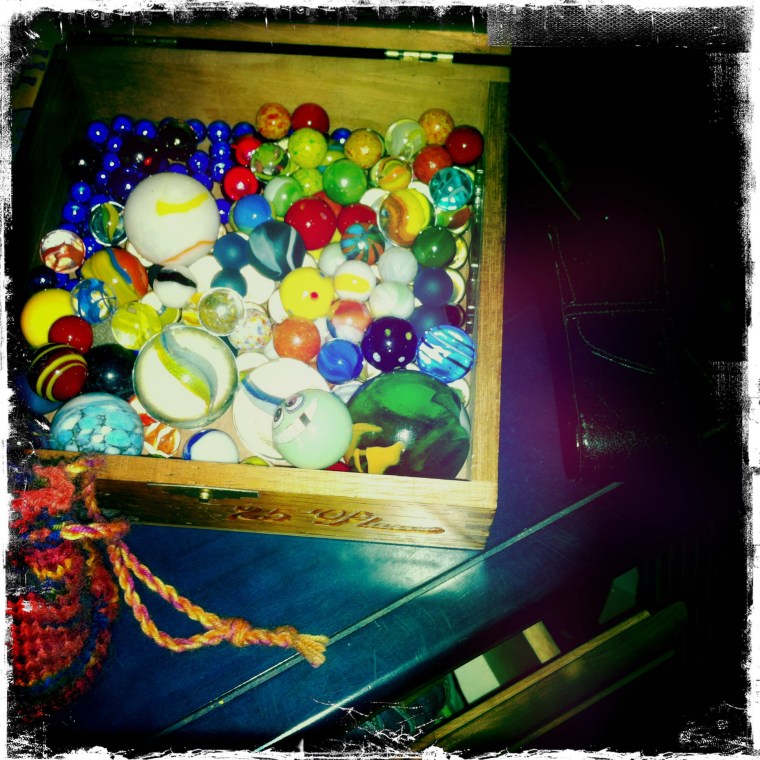
a galaxy of marbles

galaxy of marbles

Marbles are wonderful and mysterious. They are simple, fit in any pocket. You can take them with you wherever you go and start dreaming.

You see, in this marble I hand to you today, there is a whole world. If you can’t imagine that, if you object: ”But it’s much too small, how could there be a whole world in it?”, I would answer: “Just ask yourself how our planet Earth looks like for a voyager in space, like the astronauts of the Apollo Mission who eventually landed on the moon.”

Small. Perfectly round. Mysteriously blue. From the distance our planet is a beautiful marble in space. You wouldn’t know of the uncountable stories that take place there every day, so serene and peaceful does our planet look from not all that far away.

Yet you know better. Think of all the things that happen to you every day, add all those that you know happen to your friends and family, and their friends, and go on, and on, until you think of over 6 billion people, the whole population of this amazing, beautiful planet, until you get quite dizzy and confused with trying, and then you will have an idea how relative the words large and small are.

So, if you feel lonely, or bored, or if you have to write about something for school but don’t know where to start, or if you want to write or think about something no one else has thought about before you, or if you just desire to dream yourself far away from everything, take this marble, roll it in your hand, feel its pleasant weight, hold it against any source of light, a lamp, sunrays coming in through the window on a November morning, the full moon in a bright winter night, and you will find your story right there in your marble.

And it will be uniquely yours for that is the mystery of marbles: like humans from a distance they seem the same but upon closer inspection there are not two that are exactly alike.

And more, even if you cannot look at the little glass orb, after a while you will be able to imagine it, and the stories will come to you through the window of your open mind, from far away, from the gleaming galaxy of the marbles, way out there, right inside you.

art as a sanctuary

art as a sanctuary

Every person in this world has a place where they can go when they are tired of all the other places. For some people it is a favorite tree that they like to lean against and spend an hour gloomily looking at the world beyond the glimmering green shadows until they feel that something has been taken from their overflowing heart and they can leave feeling satisfied and able to go on with whatever it is that they have to do. For some people it is a song that they listen to, their eyes closed until they feel they can go on with life. Everyone has the right to retreat, to do nothing of consequence, to regain that mysterious balance that humans need to exist peacefully.

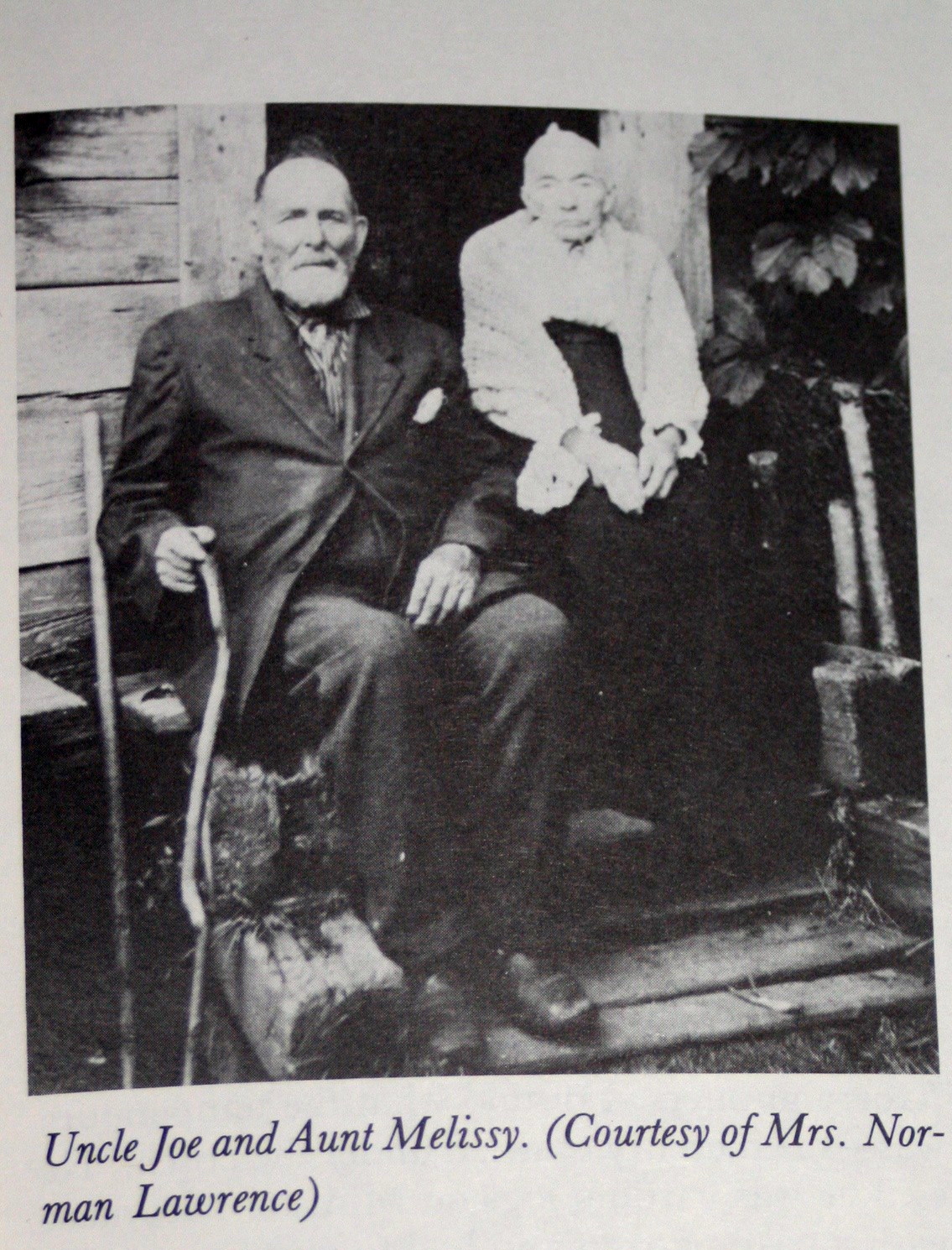
Aunt Melissy and Uncle Joe

Image - Version 2

Uncle Joe was as talkative as his wife was quiet – but she had a quick wit, accentuating his stories with dry remarks that he returned with good natured smiles. “The smartest girl in the Northern County she was”, he would sometimes say, “and imagine, she agreed to marry me! But only after I cut my beard and swore off tobacco. She would not have had me otherwise, and I have become a better man for it. “

As I started to get stronger and could sit up in bed, still wrapped up in the blankets, Uncle Joe would entertain me with outrageously funny stories of his youth. He was given to enraptured fits of laughter triggered by his own jokes. When he got too carried away with his stories, Aunt Melissy would look up from her work – for she was never idle – and comment sternly: “Never be rash with your mouth, nor let your heart be quick to utter a word before God, for God is in heaven, and you upon earth; therefore let your words be few.” Then Uncle Joe smiled good-naturedly and continued his story with just as much zest while Aunt Melissy continued with her chores as if the words had not been spoken. Only on Sundays she did not tolerate his spinning of tales but insisted on bible study and quiet prayer and he obeyed her without complaint.

I have never again met a husband and wife who seemed so comfortable in their home and so content with their life and each other. Despite his stockiness Uncle Joe was quick to jump up like a cat when Aunt Melissy entered the cottage and eager to please her with some little errand or kindness. She returned his pleasantries with home baked goods and fragrant meals. Her only love besides Uncle Joe were the snow white chicken in her yard for which she was known in the county. Aunt Melissy and her white hens. Children they had none.

kids and art – life is an adventure!

kids and art - life is an adventure!

Children are born with the natural ability to “make art”. Without ever having received formal instruction they will still alter their environment in a way that reveals the creative mind all humans possess. A stick is used to scribble in the sand, stones are arranged in pleasing patterns, flowers and leaves are strung on grass, a pencil is picked up and a wall decorated.

Children – like adults – use art to answer the challenges of their lives. Art is a medium to contemplate and resolve the essential questions of who we are, why we are alive and what is expected of us.

In a child’s life this can mean: What do I do when I am bored, feel tension, do not understand what is expected of me, but also: how do I communicate that I am happy, that I saw something amazing, remind my parents and caretakers that life is an adventure and that I ask you to be in the moment with me?

Teaching art in a classroom can strengthen the confidence a child needs to hold on to this amazing skill beyond childhood.

Keeping in mind that art is not an external experience, but is rooted deep inside each child, we understand why it can be confusing and discouraging to children if art is presented to them as belonging to an inaccessible adult sphere. Data of artist’s biographies are of little relevance to a second grader.

Instead we can talk to them about the origins of art and ask them about their own experiences as artists. A wealth of beautifully illustrated children’s’ books can help the teacher and the parent in the classroom (or at home) to do so in words that relate to the children’s’ need for a coherent, honest and joyful encounter with art. Artful children’s’ books acknowledge that art is relevant in the child’s own sphere. Asking children to talk about their own art always leads to fruitful discussions and true insight into the nature of artistic expression.

In order for children to develop the ability to love, they need to be loved first. In the same way it is true that children are enabled to acquire a true appreciation of the cultural products presented to them as “art” by a sincere recognition and appreciation of their own natural authority as artists. It is in this sense that the German artist Joseph Beuys stated that every person is – also – an artist and that Picasso reflected on his own artistic journey with the words: “It took me a lifetime to paint like a child”.

Little Red Riding Hood – a cautionary tale?

Little Red Riding Hood - a cautionary tale?

Dearest daughter,

in response to your letter in which you asked me very nicely to please allow you to walk into the wild woods by yourself:

remember Little Red Riding Hood? There was not a child more law abiding, sweet and obedient than her. A fact often overseen by those who refer to her story as a cautionary tale: the first third of it is entirely dedicated to how much everyone loved her due to her lovely and loyal disposition, truthfulness and dedication to her mother’s advice and guidance.

Do you think anyone hearing the story for the very first time – and being somewhat ignorant of the basic concept of morality in a fairy tale – do you think that such a person would expect her to forget about her mother’s advice the very first moment she encounters a challenge? Which is exactly what happens once she has wandered off happily with her basket filled with goods for her sick grandmother.

Well, we have to concede that she strays from the path of virtue for two reasons that somewhat make us stay sympathetic to her ordeal: first of all, she means well. A bunch of flowers from the wayside would surely be a welcome present for her grandmother? Never mind though that mother not only warned her against leaving the path but actually forbid her to do so! We see her put her own judgment without much quarrel with her conscience before her mother’s clear and concise directions. Let’s not forget we are talking about the most obedient girl in the village here!

The second aspect to exculpate her somewhat of course is that she is being seduced by a cunning conjurer of convincing tales. Can we really expect her to stick to those dry rules when confronted with the loveliness of the world beyond the right path as presented by a seasoned liar? The woods have never looked more inviting to her than after the wolf’s description of finely scented flowers growing in the shade of luscious trees! Shouldn’t we also blame her mother, by the way, who sends her into harm’s way? If there is a wolf lurking in those woods, as she well knows, why does she send her little girl on the errand? And you expect me to send you out into a world full of strange and unexpected temptations, equipped with just a few rules?

Here is the part of the story that has not been distributed widely but is worth considering. Prior to the whole walk in the woods scene Little Red’s mother had received a letter from her daughter. “Dearest Mother”, it read, “I am responsible and obedient. I would never do anything you told me not to! I have proven myself, now let me go!” Wouldn’t such a letter touch a mother’s heart just as yours’ touched mine? Wouldn’t it make her feel just a little guilty that she hasn’t entrusted Little Red Riding Hood with an important errand earlier already, Little Red Riding Hood, the best behaved, the loveliest, the most obedient girl in the village? You bet, it did. And we all know how the story ends!

Wait a minute, how does it end? If you think it has a bad ending, read again. Here we see her, sitting chipper at the table at her grandmother’s house, enjoying wine and cake in the company not only of her suddenly recovered grandmother but also in the company of a handsome huntsman?

Maybe this is not a moral warning tale about a girl who forgets the rules while she walks through the woods, ahem, to school on her own for the first time. Maybe it is a story about a girl who needs to make her own mistakes to find her own way, wolfs and all, and that despite all dangers there is a good chance for her to do just that. Maybe it is a story about a mother who needs to let her child go into the woods to find a way out again?

The more I think about it, the more I suspect that this is more a tale about the inevitable fact that mothers have to let their children go their own ways despite their fervent wishes to protect them against all evil and bad will, real and imaginary.

Go walk find your way through the wild woods as you must, my Little Red Riding Hood. But know that there is a wolf out there who will talk about moonflowers in the shades of the trees far off the beaten path …

With all my love,
Your Mother

artist statement – freedom is attainable

artist statement

compulsion to paint. is there a name for that? from that name was my compulsion born? and if my creative activity is to be described as compulsive behavior, do i wish to be free from it? as much as i desire freedom from life.

i am awake. through my waking mind images pass. i take a brush, a pen, and through brush and pen these images record themselves. i might be highly organized, efficient, sober, inquisitive etc. in my rational mind, but these images are what they choose to be.

there is no agenda, no program, don’t ask me for one. just a life between pillar and post.

what i want to see in these images (and you might see something else, they are as much yours as they are mine): freedom, mindfulness, compassion. a furious gentleness towards life. i see old stories in new clothes. there are stones, there are shadows. there is a smooth path under a tree. and i can relate all this and then return to what i know. because what i paint and write is what i confess not to know. and yet it is not ignorance i serve but the luminous mystery of a letter, a line, a word, a constellation, 20 degrees south-east of the belt of Orion, 23 times more luminous, twice the mass and the diameter of “our” sun. what i know is that if i could indeed throw an object hard enough, it would escape gravitational attraction, that there is a black hole in the galaxy M87, and that freedom is attainable through our words and acts.

sun witnessing a faint heart

sun witnessing a faint heart

the cold, distant star once called “our sun”
saw me walking to the very edge
of what some perceive as mere darkness,
others like to define as infinity,

saw me taking three steps out,
three reluctant, cowardly steps

into nothingness

and then, unbelievably,
turn back,
like someone who forgets to lock the front door
emerges sheepishly from the car in the driveway,

saw me turning back
to regain my balance at the very edge,
having gained nothing,
still in search of possessive pronouns

fever and another barefoot stranger

fever and another barefoot stranger

The last winter before the completion of the new church he had an encounter with a stranger who had called upon him repeatedly and who was staying at the town’s only inn. He was dressed in simple, yet elegant clothes, cut out of fine, dark cloth. In a small town a stranger like this would normally have generated a great deal of curiosity. But he was so quiet and unassuming in his manner as to almost appear invisible. He went for daily visits to the rectory where he was served tea and would have long conversations with the pastor. The elegance of his appearance was so convincing that it took a while for the pastor to notice that the stranger wore but a kind of biblical footwear, close to being shoeless.

It was late fall. The trees were brilliantly red as if with religious fervor. The pastor felt alert, alive almost as if a lifetime of doubt and study suddenly held some promise, as if the dark aspects of his life were less weighing on him. Then the stranger came down with a severe flu which delayed his departure. High fevers made him delirious, and the doctor and priest both were called to soothe the rage which seemed to devour the man who had been a quiet guest until he came down with this fever. After three days he lost his consciousness and did not regain it. He died in the fourth night without the pastor at his side. The pastor himself was delirious in fever at this time and died only two days after the stranger.

time oscillating

IMG_5724

In the meantime I discovered the places where the seams come undone Every classroom in my school had a clock on the wall right over the door, and all the clocks had identical clock faces, and every one of them showed a slightly different time. I don’t know whether clocks in classrooms today are all connected to one central, totalitarian time piece as I suspect might be the case, though I hope it is not so.

I always loved the way time oscillated between classes, obstinately refusing to be tamed. Officially, students had three minutes to walk to the next classroom after a period ended. But for the way from science to math, for example, you’d better made do with 1 minute and 29 seconds – the clock in Ms. Kirsch’s class was as fast as our teacher’s ability to conjure numbers out of the back entrance to Hilbert’s Hotel and as inexorable as her refusal to admit to time measured outside her class room.

On the other hand, you could afford to leisurely stroll to French after that, using not only the 1 minute and 31 leftover seconds from math but also the 40 seconds the French clock was late, giving you an ample 5 minutes and 11 seconds (not counted the additional minute or two Mme. Petite rustled with her papers, ignoring her students’ ongoing conversation).

The clock in language arts had the peculiar and infamous habit of stopping at exactly 12.00 pm every couple of weeks and could only be persuaded back into service by Superintendent Segrob who, for that very reason, was particularly fond of it, and year after year insisted on repairing rather than replacing it.

Every day for a few moments just before noon instruction in language arts paused and everyone’s eyes followed the unhurried second hand making its way from 11.59.59 am to 12.00 pm. It was almost like a pagan ritual, these four seconds of silence, as if we were paying our respects to the spirit of the clock, Time. Time, sputtering, fleeing, stopping, resuming its course, divided itself up over the 79 clocks in our school according to its own preference. With other words, it seemed to be on our side and refused to be institutionalized.

I know that the language art clock did not stop on that day. I don’t think it would have been possible for it to stop while I was willing it on. Apart from Time herself though nobody noticed that I counted every second of the school day, 24,000 seconds in all, stops, gains and losses, until, at last, the 2.47 pm bell wrapped it all up hurriedly and dropped the leftovers for the time dogs.

sad? or sappy.

sad? or sappy.

broken things
don’t make me sad.
remember the last
time you were really sad?
you don’t?
good for you.
believe me,
broken things
don’t make me
sad.

rain on windows
does not make me sad.
remember the last time
you were really sad?
you don’t.
good for you.
believe me,
rain running down windows
does not
make me
sad.

sappy songs
do not make me
sad
either.
remember,
and so on.
believe me,
they don’t make me sad
at all.

you do.
remember?
you don’t.
that does
make me

forget it.