Page 38 of 41

artist’s use of time (inspired by a discussion with fellow artist Anne Onsøien)

The industrial age has raised the bar of self-appreciation to the productivity of machines. The thought aside that machines in the so called industrial societies have also freed a large number of people from occupations too time consuming and tiring to leave space for education and/or leisure activities (making the pursuit of art an occupation for the privileged few and the occasional madman/madwoman), machines brought with them universal time and a machine productivity bound concept of human work ethics. The human mind will bend to see these demands fulfilled but it will not naturally behave that way. Especially creative work cannot be entirely synced with machine time cycles – and if it is we often perceive the results as disappointing and non-original. For artists who spend a good deal of their time alone chasing the next image or fictional character I think it is especially important to not bind self-confidence to the adaption to office/machine time.

Whether I am already procrastinating or still thinking and waiting: I have to find other parameters to establish that fine line for myself than to check off office-suite calendar time slots. The most important defense against external (and possibly: internalized) criticism referring to your use of time is your own confidence that you are indeed working when you are giving yourself space to let the idea, the character develop.

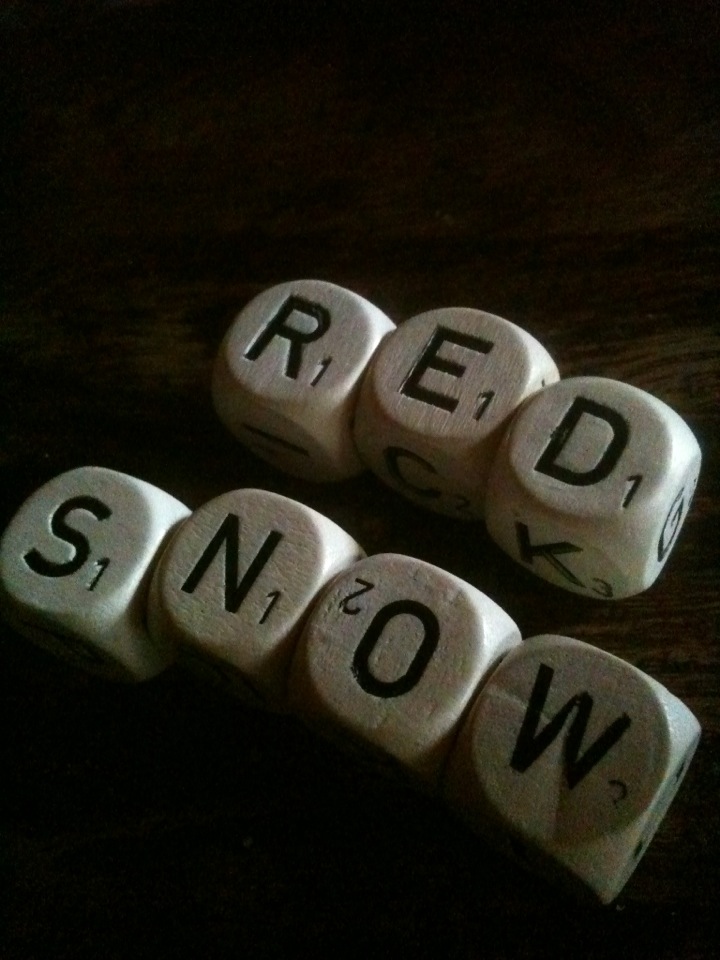
red snow


“Why is it out on permanent loan, Sir?” I asked instead. Now it was his turn to ignore me. “When they started the program, you see,” he answered in a low voice to a question I hadn’t asked yet, “it wasn’t particularly secret. No classified information, just a bunch of scientists with an idea.” I felt a chill. This was Somerville Public Library where kids get their sufficiently outdated material for school assignments and hang out between the dusty shelves in the little frequented art section. “It started with a culture collection of cryophilic algae and microbes, for example pyrolobus fumari.” Sensing my bewilderment, he added ”you need to take notes, you know, you can’t expect me to explain every detail.” As I grabbed one of the H2 library pencils and a stack of note-paper from the table in front of us, he relented somewhat and began to lecture. “Cryophilic algae, also known as red snow, have specialized on thriving under extreme conditions in the polar regions. They grow in the very cold, acidic, high in ultra-violet radiation, and nutrient-poor confines of melting snow. Fascinating, right? Pyrolobus fumari, collected from hydrothermal vents about 200 miles off of Washington State and nearly 1.5 miles deep in the Pacific Ocean on the other hand, survive at 235 degrees Fahrenheit. And we cultured yet another microbe from a yet unnamed strain that Penelope Hoffmann insisted even remains stable at 266 degrees Fahrenheit, when all other life ceases. But the most interesting aspect is that these microbes and algae go through long periods of dormant life cycles. We have isolated microbes from the Siberian permafrost, about three million years old. Bacteria germinated from spores preserved in Dominican amber, 30 million years old!” He leaned back. I looked at him expectantly, but he remained silent. One couldn’t get comfortable in the library arm-chairs with their beech-wood frames and their dust blue fabric over a dense kind of upholstery material and I had fidgeted around in my chair since we had taken our places, but despite the position his malformed spine imposed on him he looked completely relaxed. It actually looked as if he was relaxed within the frame of his bent body, as if that was his frame of reference, not the environment. My initial anxiety had settled too and I had begun to think. “

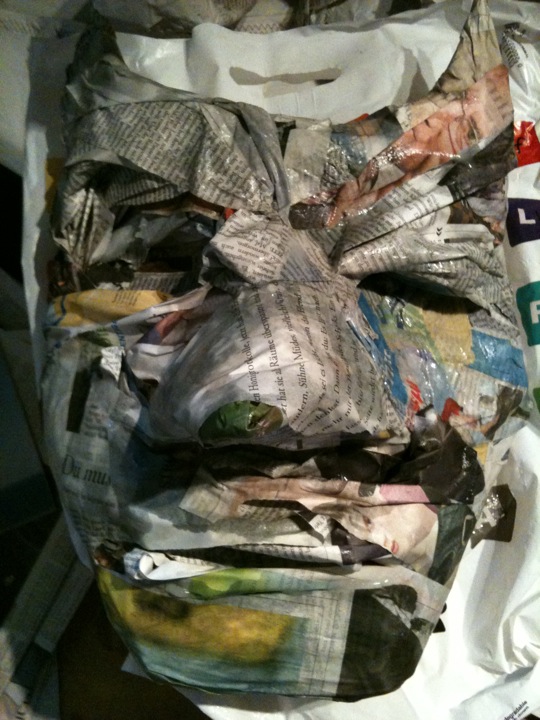
demons


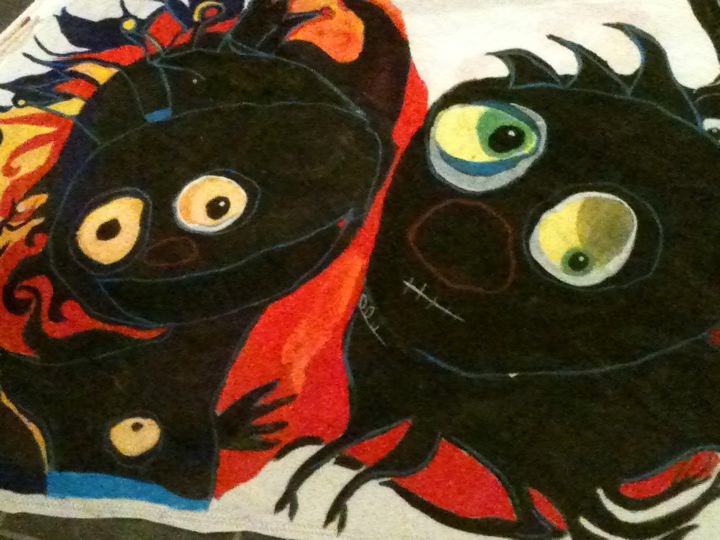
and at the seventh hour the demons arose, howling, and they were indeed fearsome to behold. but i laughed at their racket and answered: the likes of you I concoct with paper and paint from the home improvement store any day.

On the question of how I am qualified to teach art …


By trade I am a lawyer. Many lawyers do have a passion besides their original profession though, I happen to have three, if you count my love for children in general and my own children in particular as one. The other two are writing and art. I mention this because you will surely want to know how I am qualified to write on a subject that is a bit out of the way of my original expertise. My grandmother used to say I have been born with a brush in one and in pen in my other hand – and as far as I can remember I have been scribbling and drawing on every appropriate surface – and some less suited. That I came to study law is strange, all things considered, but I guess I wanted to try out if I could succeed at something else, something real. I graduated with two law degrees and, even though I actually (and I should add: eventually) became a practicing lawyer – even before starting to practice law I came straight back to art.
I do believe though that art is not an esoteric, isolated endeavor that people sometimes take it to be. Artists are well advised to take notice of their world and have an understanding of it that transcends the visual. Beuys said that every person is indeed an artist. He demanded that every sales person, dental hygienist, physician, scientist, philosopher, electrician … (fill in your profession) be first trained in art. The reverse holds true too. Every artist is part of a tangible social reality. The training to become a lawyer might in the end not be either so far from or so detrimental to artistic creation as it might seem at first.
I do love children – and I do remember quite vividly to have been one myself. Believe me as a first hand witness and as someone who still draws and paints, saws and glues every day: There is no time like childhood to experience the joy of art. I had the good luck to be partly raised by a grandmother who had the wisdom of an older generation to pretty much let me do whatever I thought entertaining if I obeyed some general ideas of etiquette that were easy enough to memorize. I was allowed to use any tool from the tool shed or the kitchen. Nothing was childproof or child-size, I had to use them as they were. I was also allowed to make generous use of old newspapers and magazines, of the newsprint paper that my grandfather, who was publisher of a local newspaper, brought home, and of every piece of metal, screw, paper, feather, stone or glass shard that I loved to pick up during our long walks. It never occurred to my grandparents that it was their responsibility to prevent me from injuring myself (and cutting , scraping and bruising myself while working with knives, scissors and hammers seemed part of my job description as “child”). I don’t know whether they ever articulated it that instead they trusted me to take care of myself that but it surely was the result of their laissez-faire regime.
I brought everything I found home and assembled it very much the way every child will when you do not interfere. I do not know where our desire to “make” things has its origin; I do know that we already possess it as children, together with an instinct of how things fit together. If children are not allowed to roam as freely as I was they will still build markers from pebbles and stones, they will still use sticks to draw in sand, build strange, improvised gardens in the mud, decorate prefabricated play structures with ritual signs when the occasion (boredom paired with freedom) presents itself.
To be creative is a basic desire of humans, all humans. It is a genuine expression of who we are even before we are defined by our social and economic circumstances. To teach a child to be creative therefore seems to me an elusive act. I look at children with a sense of awe, they are still there, right at the origin, and all I do as a teacher is to take them on the long walk I took as a child with my grandparents allowing my students their own discoveries and the freedom to collect at will what responds to their unique desire to create this world new according to their own vision as every artist will.
If we’d create more protective spaces for our children, spaces in which they could grow according to their own needs, we could cut back on many extracurricular activities. The challenge is right out there and the artist that lives in every one of us but is acutely alive in our children is ready to meet whatever form that challenge in their very own live might take.
To come back to the question of my own expertise: I do believe with visionary clarity that it is not my expertise and training/education that is relevant. It is my willingness to acknowledge, respect and celebrate children as the artists they are. I do believe that art is not a matter of paper and ink, of perspective and shading, I do believe though art techniques can be taught art cannot, no more than breathing, walking, seeing. It is something that happens when things go right or when you have to make them come out right. Art is the freedom to choose your own words. Art is the freedom to follow your own voices. Art is life.

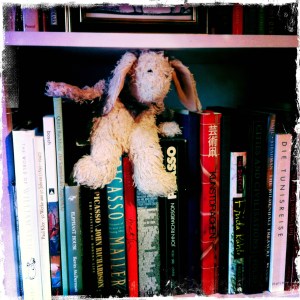
Small Rabbit Bookstore


After school I went to the town library. The sky was bright grey and diffusely glaring as if the sun was about to break through. The bare branches of the late November trees were once again settled with crows who moved lazily and could be mistaken for dark leaves. Shivering in the crisp air, I wrapped my double helix hand-knitted scarf twice around my neck (there was enough material to go around four times and still leave the ends falling over my shoulders), picked up speed and felt the pompom of my matching hat bouncing rhythmically with my steps. The feeling of the pompom reassured me as if childhood was still a possibility to be considered in this strange game I had taken to playing lately.

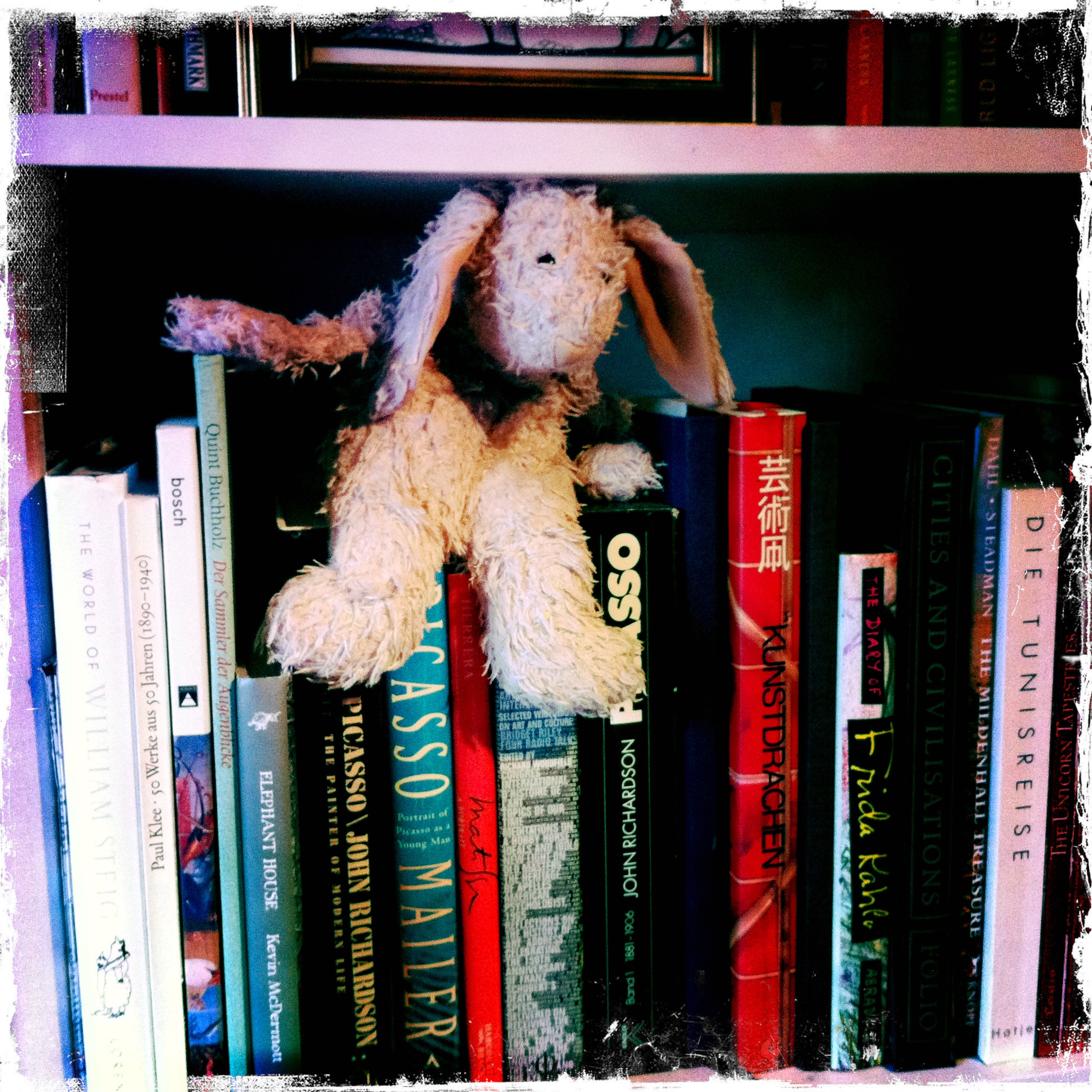
Until the event of the blockbuster bookstore I have always loved any kind of book store or library, and I had quickly found an appreciation for the smallish library in Summerville (not at least due to pretty and efficient Ms. Clarice) and loved the “Small Rabbit Bookstore” in town, too. The owner of the “Small Rabbit” was a nervous, wiry guy who looked very much like a hare. He rarely talked, never left his corner behind the register, and always wore a hat, even on hot summer days.

The store was nothing much compared the Strand Bookstore on Broadway we used visit too frequently when we still lived in the city, or the Crawford’s Childrens’ Book Store on Madison and 93rd Street, and neither did the Summerville Memorial Library compare to the New York Public library city branch we used to go to every Monday after school. My mother had refined the skill of dragging us, my sister still riding on her hip, through the whole library following without doubt a well planned route, while filling a tote with amazing speed: art books, do-it-yourself-guides for plumbing, mathematical treatises, and any selection of dusty volumes on obscure topics. Feeling out the frail limits our patience predictably imposed on her, she would finally settle down in the kids’ section and spent the next two hours finding treasures for us, reading with us and following my sister’s lead crawling through the labyrinth of shelves.

Sometimes I longed to be back in New York, in our cramped walk-up apartment, sharing a bed-room with my little sister. I also longed to be a mere child a little longer, relying on my mother’s ingenuity to entertain and educate me – often by the same idea. I still loved sitting in her kitchen in the afternoon or at night, talking with her or listening to her monologues on H+, the idea of transhumanism, or her doubt concerning the accepted theory of Vincent van Gogh’s suicide.

I also still enjoyed occasionally joining her on weekends for trips or excursions to the city – but things were different than they used to be. Not as simple. It was understood now that I could say no, that I was allowed to choose my own entertainment. My mother still took my sister Phoebe along on every one of her quests whether Phoebe wanted to or not – but I often decided to stay at home even though it made me feel uncannily excluded.<a
Tessalation

In the meantime I stood by and just waited, too impatient to take care of my weekly list of reading and also afraid to let the old man out of sight. My head still throbbed lightly and the smell of the new scrubby grey floor tiles did not help to improve it. I concentrated on the unusual pattern of the otherwise ordinary floor covering. The tiles were light and dark grey and laid out in an unexpectedly complex pattern. Areas can be filled completely and symmetrically with tiles of 3, 4 and 6 sides, but it was long believed that it was impossible to fill an area with 5-fold symmetry though Kepler played with the idea. I knew this because my mother loved the work of M.C. Escher who was intrigued my mathematic patterns and used them in his illustrations. It did perplex me that the library floor tiles were cut out of so called kite and dart shapes which actually do allow a surface to be completely tiled in an asymmetrical, non-repeating manner in five-fold symmetry with just two shapes based on phi. As a result the tessellation of the dense felt tiles in the lobby made it impossible to arrange my thoughts according to the floor pattern – a technique I had used since childhood to soothe anxiety.

Einstein’s delusion

“A human being is a part of a whole, called by us ‘universe’, a part limited in time and space.

He experiences himself, his thoughts and feelings as something separated from the rest… a kind of optical delusion of his consciousness.

This delusion is a kind of prison for us, restricting us to our personal desires and to affection for a few persons nearest to us.

Our task must be to free ourselves from this prison by widening our circle of compassion to embrace all living creatures and the whole of nature in its beauty.” Einstein

of course that task one day is easily accomplished by submitting to whichever death comes our way. in the meantime moments of compassionate awareness on a human, earth bound scale will suffice and procure a less chilling enjoyment. all living creatures. yes. but there is compassion also through our specified affections. the singular touch. the loving appreciation to the detail of a restricted vision creates the sought after connection,proves to be a gate, alas, mostly without awareness.

Circus Utopia Art Press reads: Thomas Moore

Circus Utopia reads Thomas Moore
It seems to me that where private properties exist, where all men measure all things in relation to money, it is hardly possible to establish, in public affairs, a regime at once just and prosperous, unless you esteem it just that the best things belong to the worst persons, or unless you judge it well that all goods be shared among the fewest people who even then are not entirely satisfied, whilst all others are in the direst poverty. This is why I reflect upon the Constitution of the Utopians, so wise, so morally irreproachable, among whom with the fewest possible laws all is regulated for the good of all, in such a way that merit is rewarded; and that, in a sharing from which no one is excluded, everyone has nonetheless a large part.

Thomas Moore
Circus Utopia Art Moments