Page 12 of 25

Monsters everwhere

Monsters everwhere

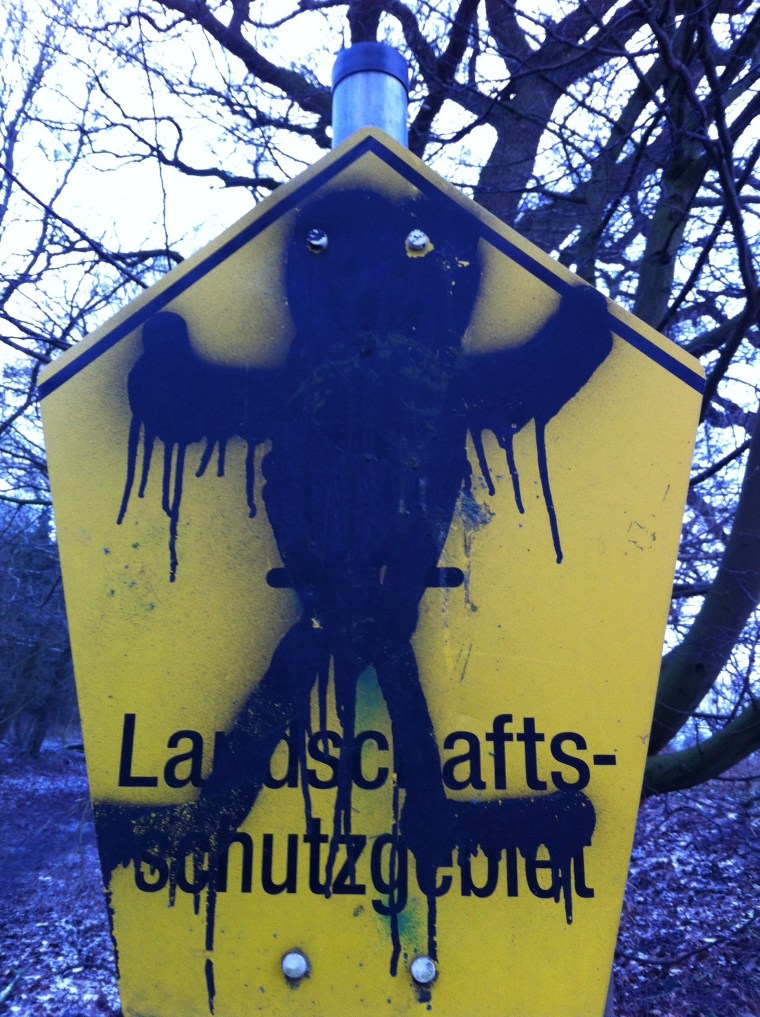
While taking walks I usually pay attention to the marginal ways people express themselves in public. “Marginal” in the sense that one cannot identify a specific purpose to an expression nor the reason somebody had to feel compelled to make such a public, albeit anonymous statement. This picture was taken in a wooded area near to Hamburg. The original sign reads “nature preserve” (Landschafts-Schutzgebiet) and the symbol chosen to communicate the idea is a stylized black owl. I have noticed that these signs seem to be attracting alterations wherever they are displayed. It’s funny, considered that they are only found pretty much out of the sight of urban traffic.

It’s a bit mysterious to me. What is it that the sign communicates (despite the sober, original administrative message)? What triggers the desire to change it? Is it the way the owl stares at the viewer with yellow (paper-cut like) eyes?

The changes mostly interpret or exaggerate the original monster like quality of the cut out owl. Here someone actually spray painted a monster on top of the owl, completely obscuring the original symbol. It seems not too far fetched to state that the simple anthropomorphic quality of the monster points back to the very origin of art, the moment when humans started to express themselves with symbols.

As Mircea Eliade has observed in his work “The Sacred and the Profane”, even in the modern world we pay witness to a deeply ingrained “mythical” comprehension of the world by reacting to triggers. The world through human eyes is “fraught” with religious value, or at least with “meaning” in the sense of an offer of communication not necessarily only between people but also between people and nature, people and the inanimate world, people and the perceived reality of an order of their world that they must adhere to to give their own lives value and meaning.

Could it be that the character of this sign inadvertently triggers such a response? And that the response is rendered in just the same language? Artist’s musings, for sure …

I have often been asked why monsters are a recurring theme in my work. Obviously there is not one answer to that question. Sometimes it’s their naivety and friendly, childlike celebration of the world that attracts me. But I have done other more serious monsters. And I feel that one underlying theme might be a response not unlike these anonymous signs. Though I do not paint on traffic signs …

Just to round this up: I have also seen the signs and the little owl creature changed through weather and sunlight, resulting in faded or partially peeling paint. And in the midst of these beautiful alterations the little owl changes character, always peeking out at the world and talking about time and change … Seems that nature itself takes pleasure in participating in this game …
past and future

past and future

but to this day humans are unique in their ability to remember both, the past and the future, only sometimes they are not aware of this enviable gift because, you see, past and future are often confusingly alike and quite difficult to distinguish.

multiplying y – creating depth

multiplying y - creating depth

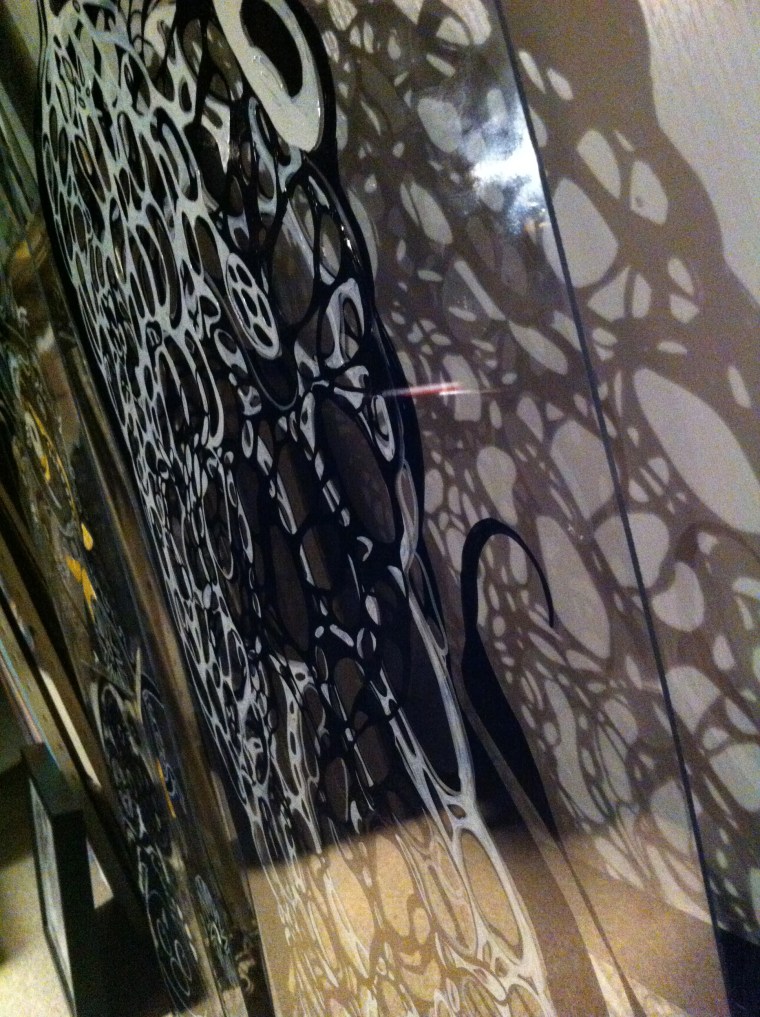
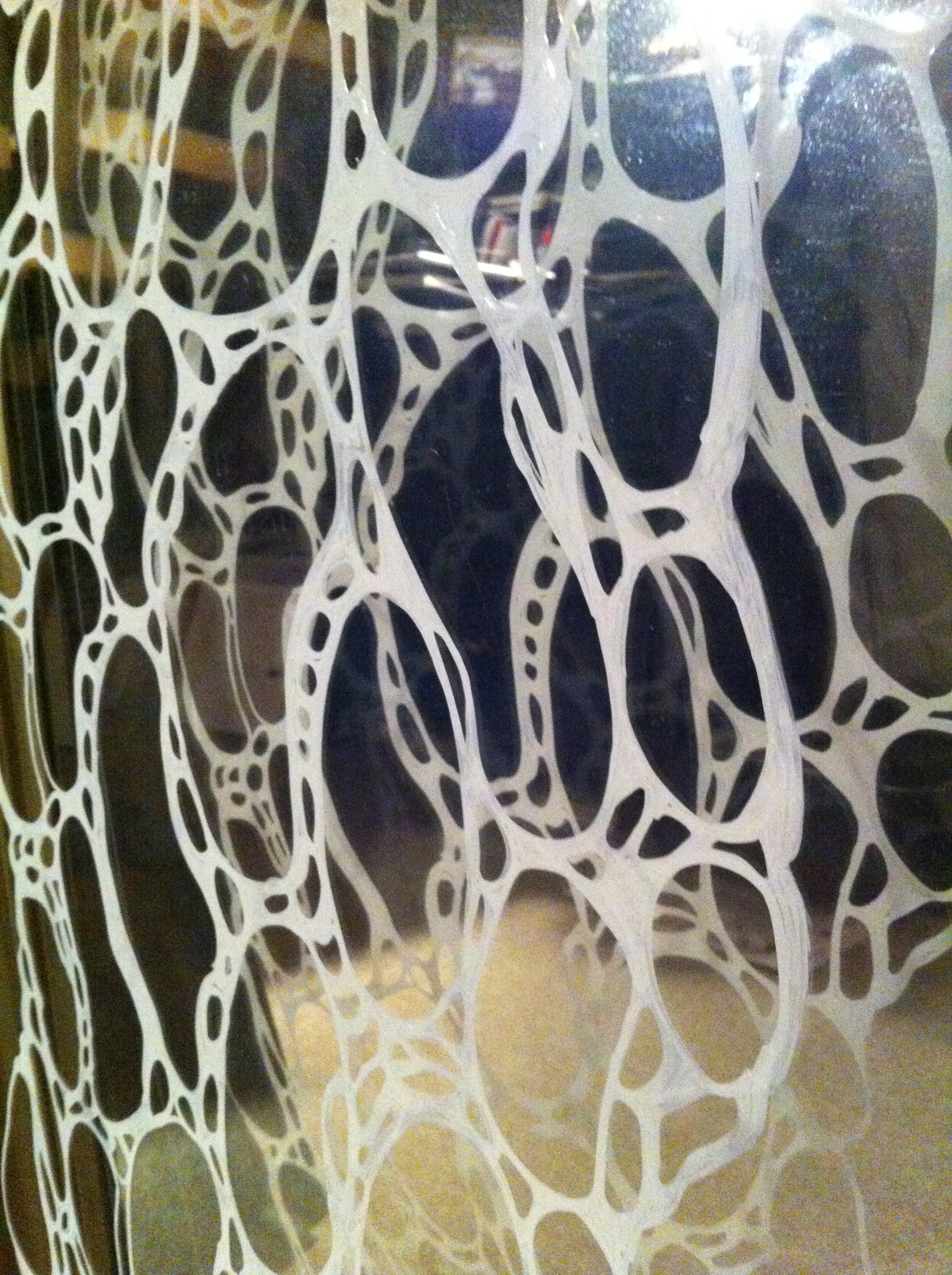
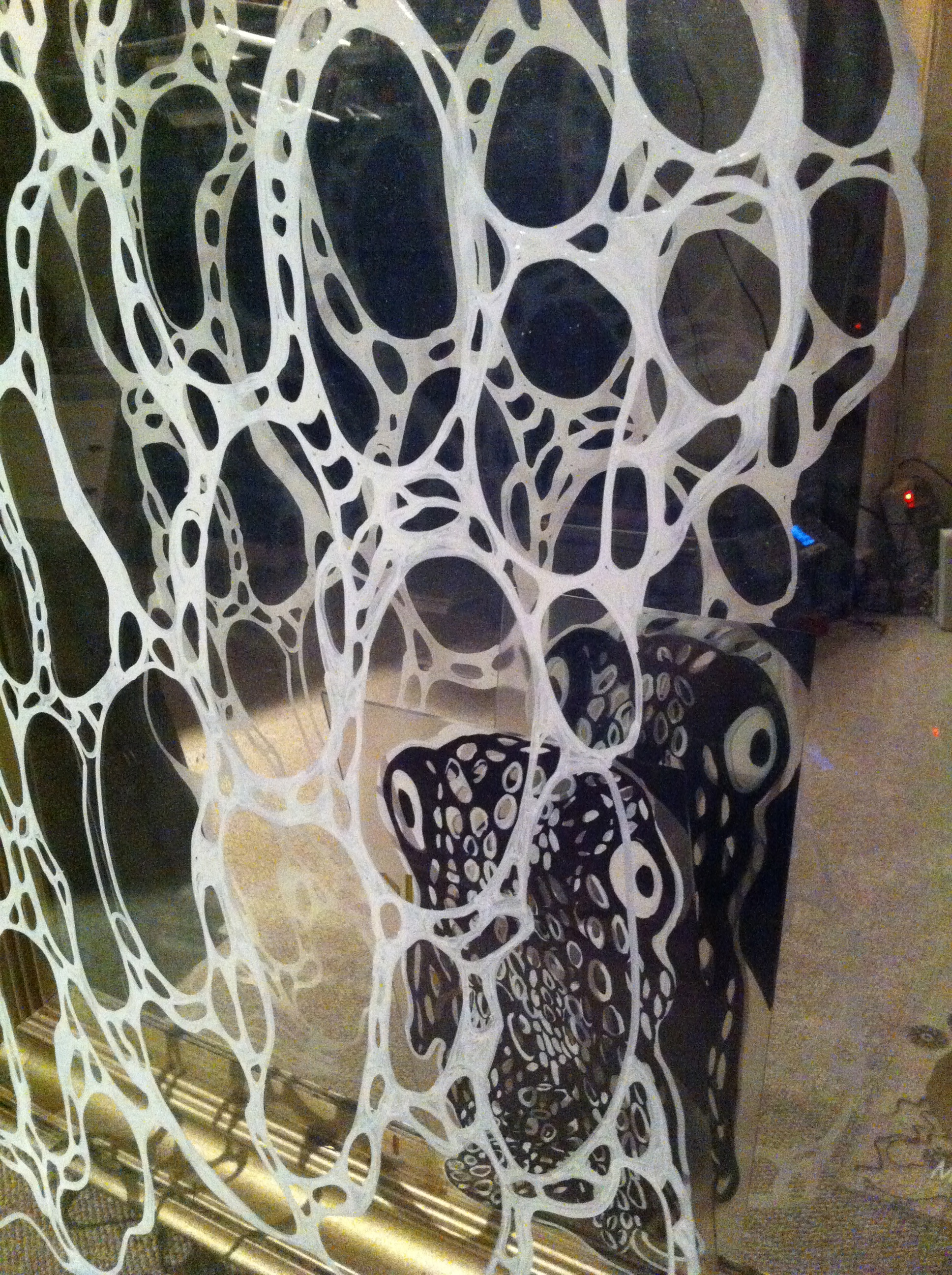
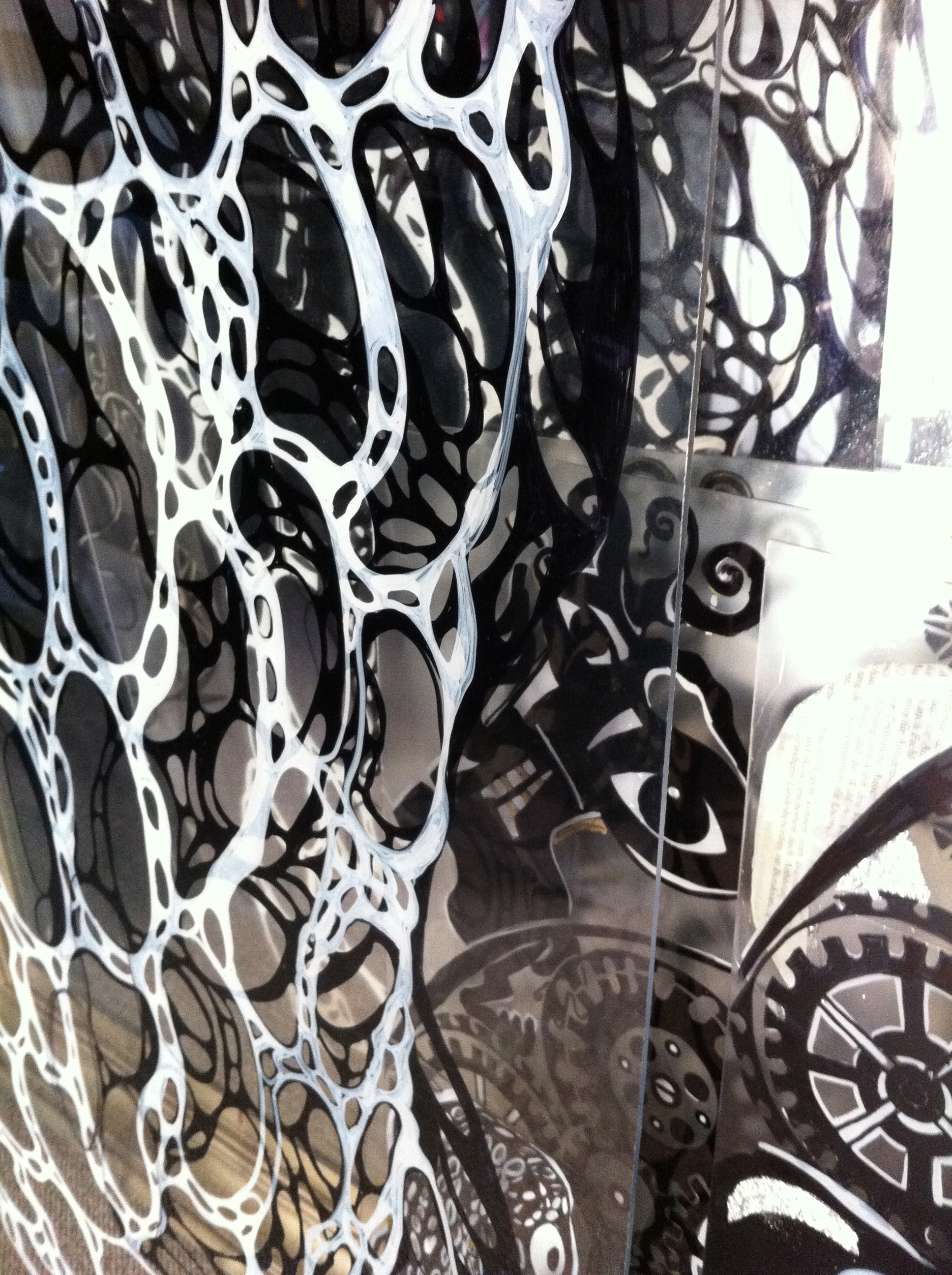
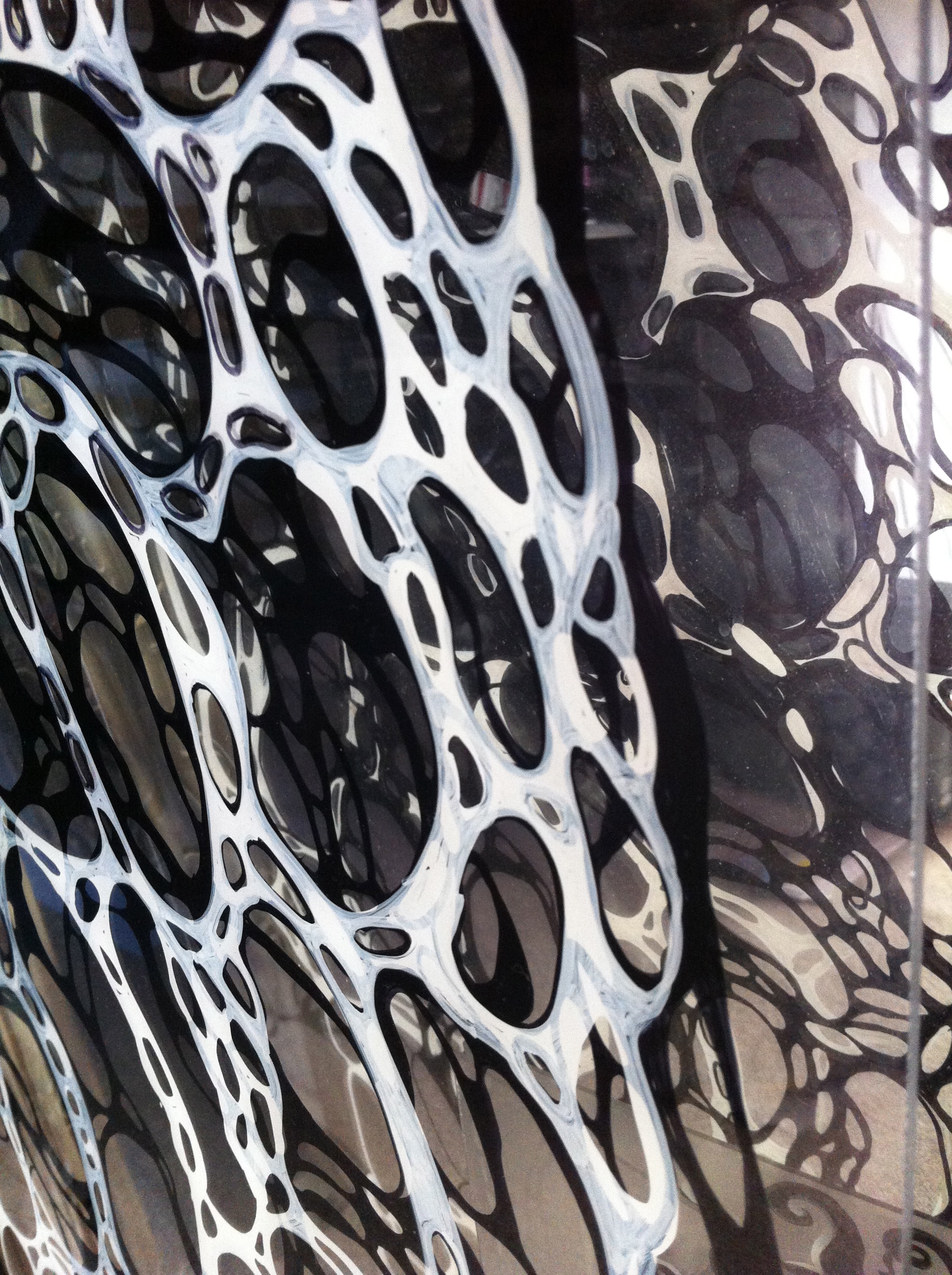
I thought it would take at least two more nights to finish this acrylic sheet but as I couldn’t stop drawing I finished it last night. I drew five layers altogether until I felt more lattice pattern would obscure the interlacing layers (which I drew on both sides).

It’s intriguing that working on a transparent sheet creates a drawing that feels at the same time tangible and elusive.

I think it would be great to multiply “y” further but this time not by adding more layers but by creating additional pieces in the same format. Five to ten sounds good for starters. I have always had a taste for the non-identical multiples in art. By the way, each sheet is about 1,30 m high. But I could also start by using up all the small panes I still have (about eight), drawing layered monsters, then proceed to the larger sheets.

Back to home depot it is …

multiplying y – the next night

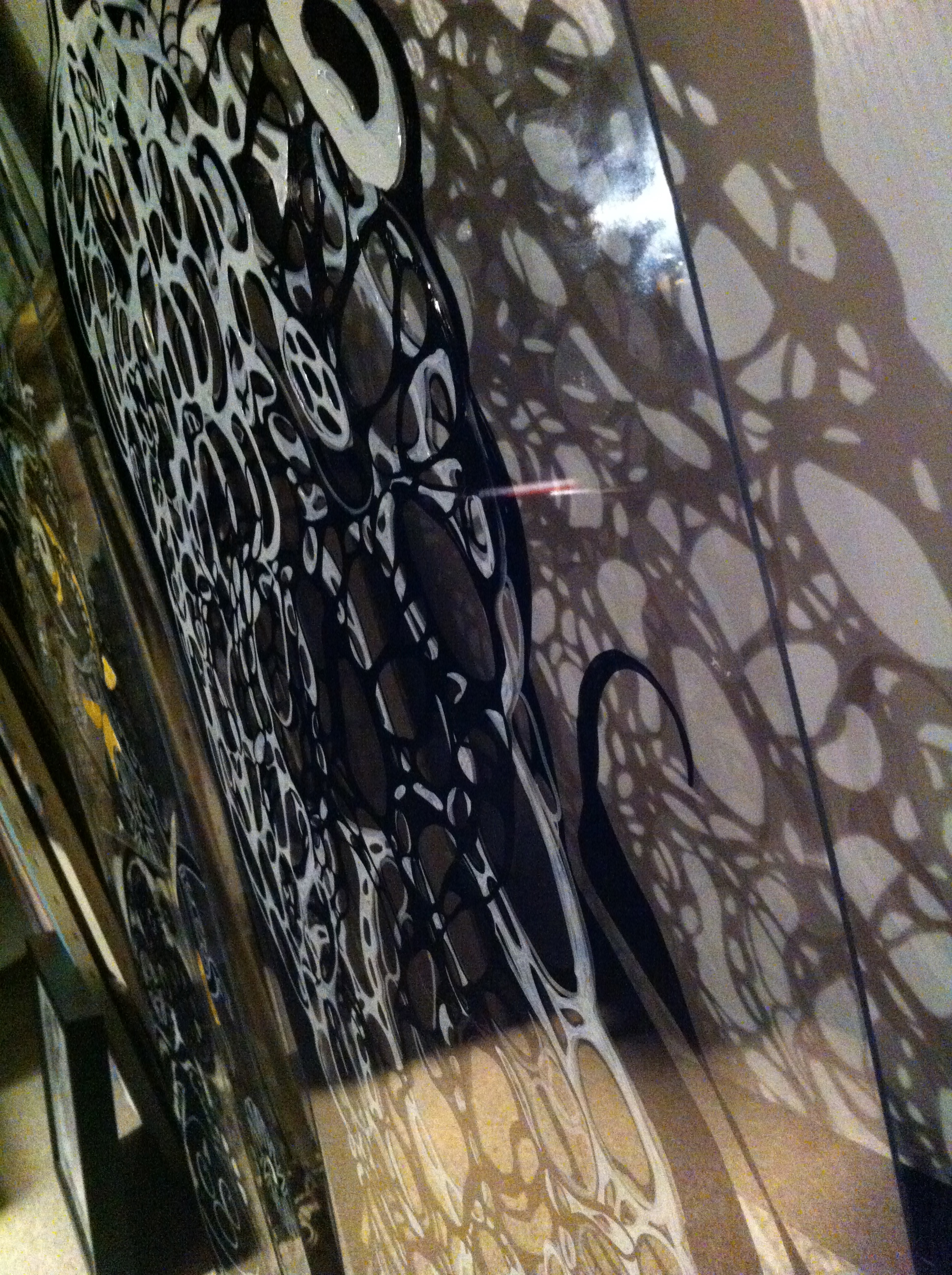
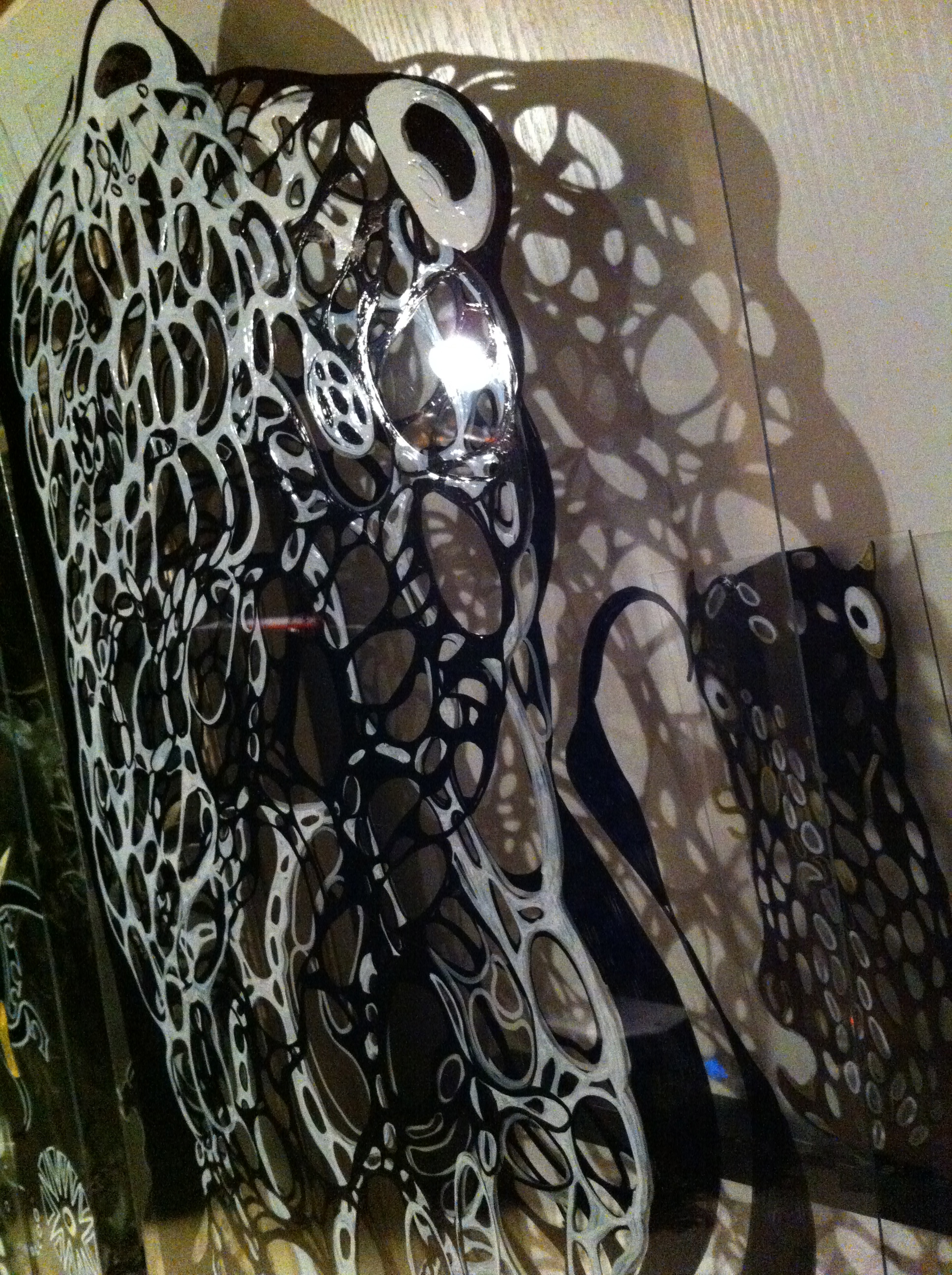
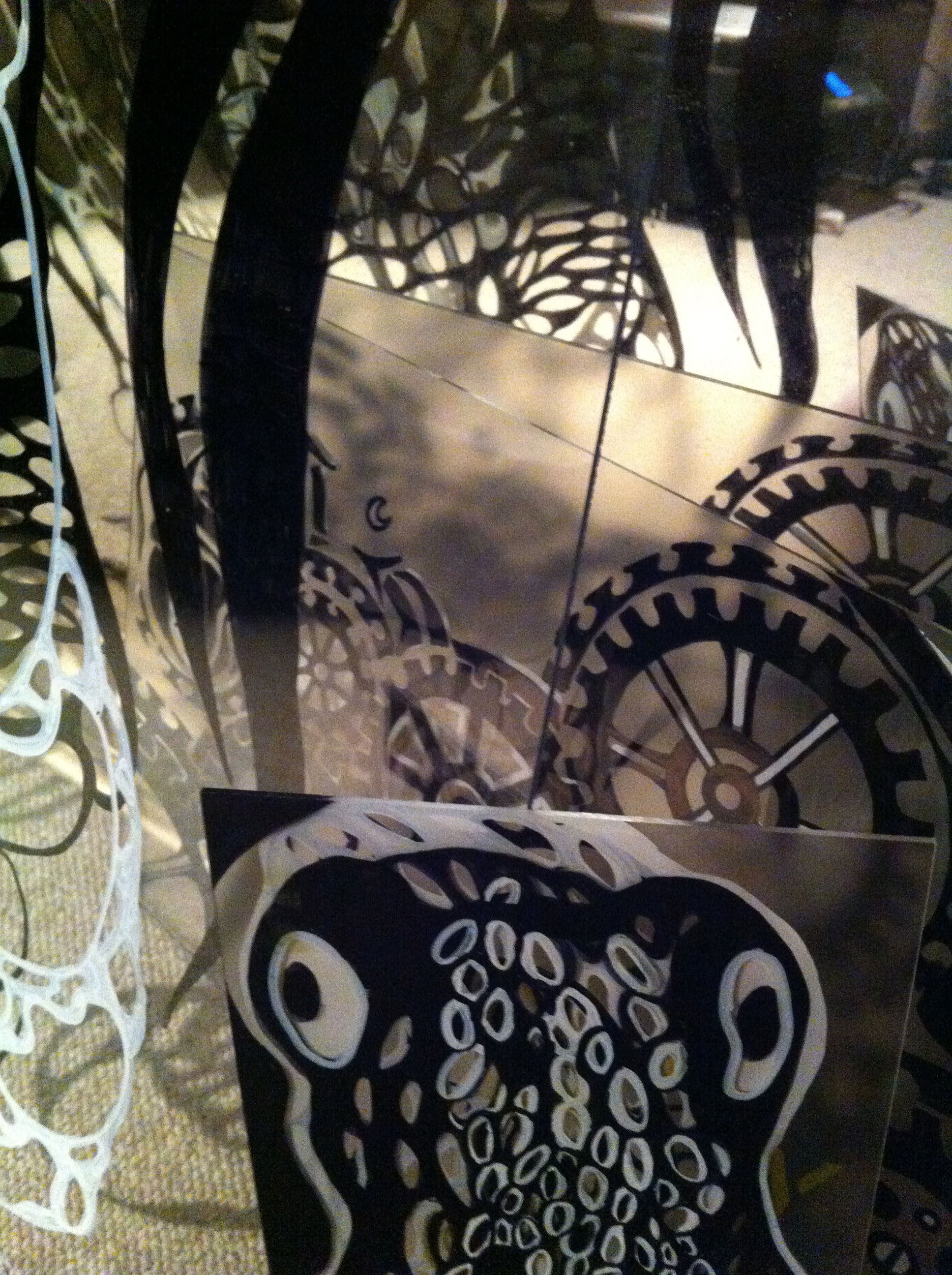
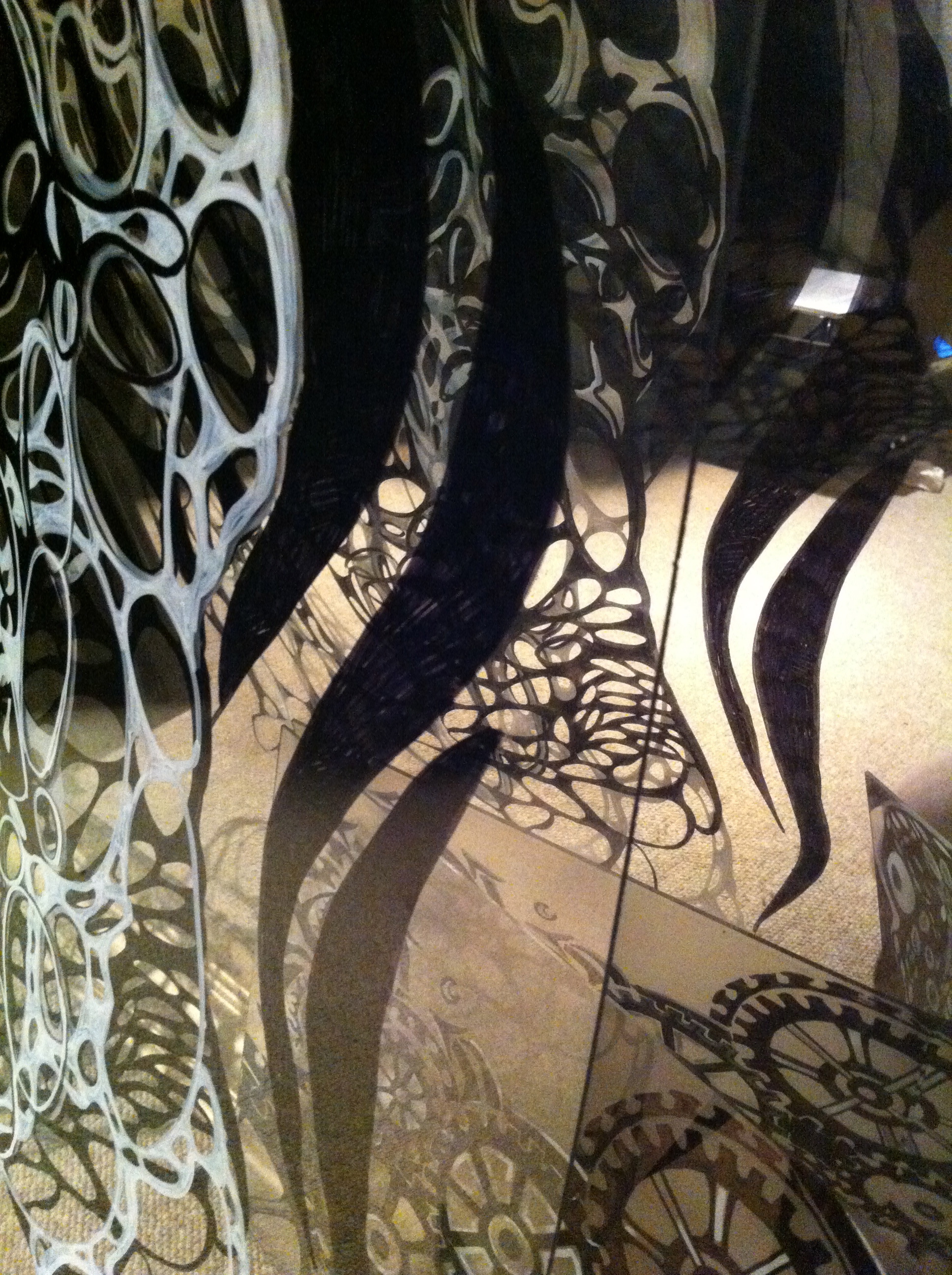
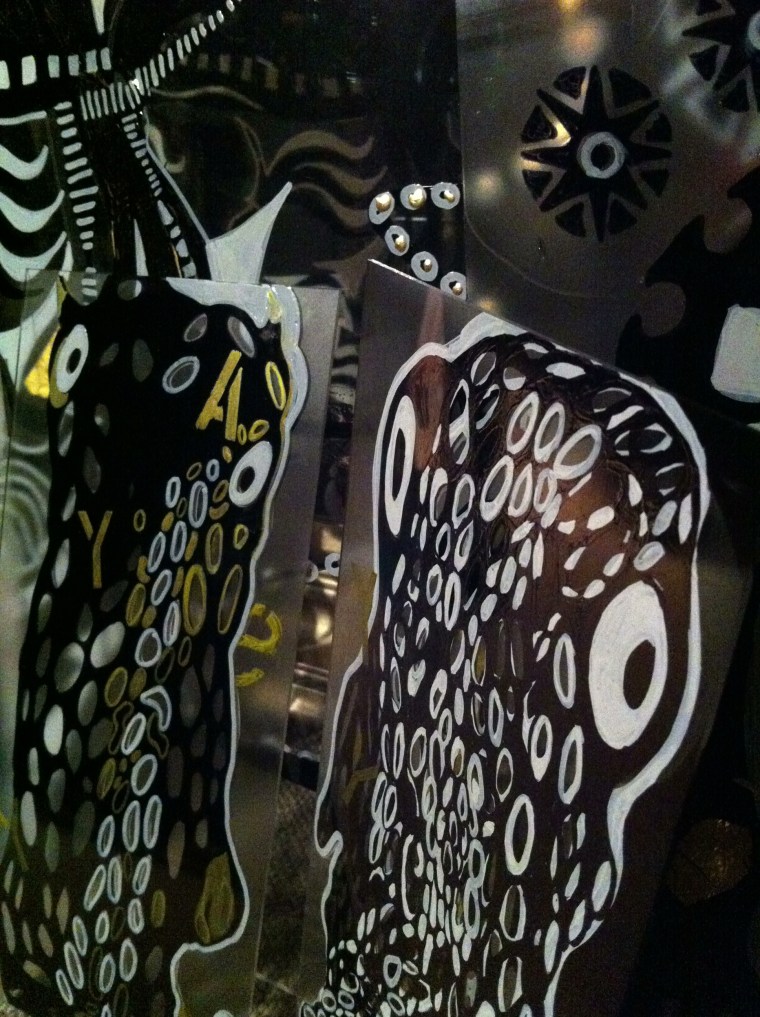
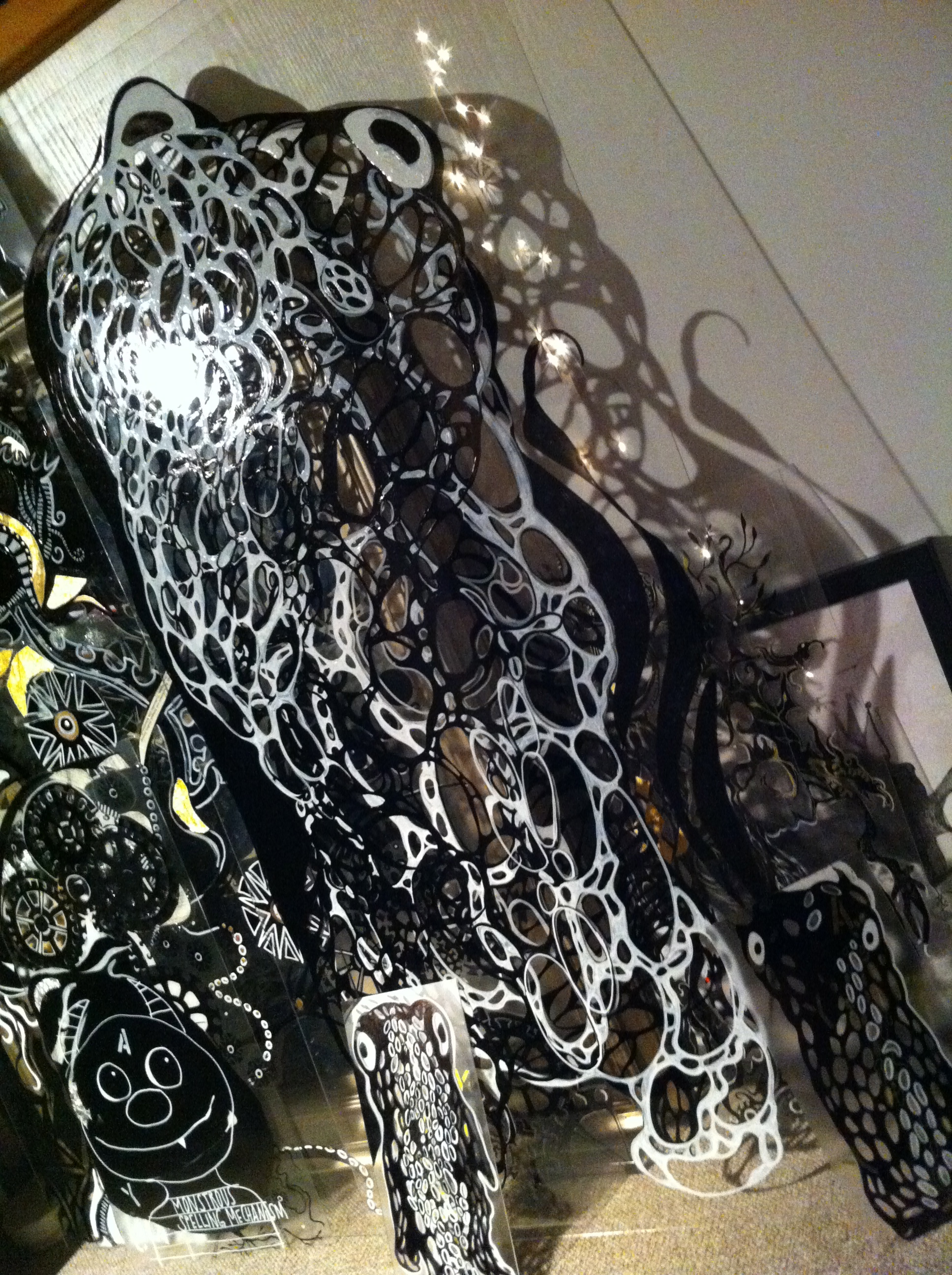
IMG_5722 IMG_5723 IMG_5724 IMG_5725 IMG_5726 IMG_5727So I started multiplying y. Drawing the net pattern on the larger glass panes allows the rhythm of the pattern to emerge. I started with white on one side of the acrylic sheet and drew a loose knit-like pattern. Then I layered black organic lace-work on top. I drew about five hours, then I called it a night. But not before playing a bit with my new building block system of drawings, creating deep, three-dimensional images by arranging and rearranging different elements in front of a big mirror. You can see that the combination of smaller drawings getting “caught” in the net-pattern of the larger pane really works well. I have to finish the larger drawing, I think it will be another two to three nights. After that I want to try a wilder, more impulsive web of lines on a large sheet. What if …

the process of multiplying y – or: the power of “what if …”

Art is a question. Or, more precisely an active research framework where one question leads to another through tangible action. In my case, at the moment, that tangible action is drawing. Every night. On acrylic glass panes.

As an artist you know the question every finished work asks of you. What if? Every night since December 26th I have finished one drawing and every morning I have looked at it and asked myself a simple “What if …?”.

What if, for example, instead of one layer of that net-like surface the creature I called into visual reality I tried two layers, or three? So, that is what I will do the following night. And once finished, I will study it and realize that something happened when I multiplied the net-like layers (actually by five). The feeling that one net-like layer caused me to encounter has deepened. As this is art and not science, this was not necessarily predictable.

But the drawing is still small, more like a study of the possibilities of layering net-like patterns. So, today’s question will be “What if … I took a much larger glass pane?” I still happen to have one of those, by the way.

At some point I might ask myself: Why? Y? Why layer net-like patterns night after night? Why nets of all things? Small. Larger. One layer, Five layers. But asking for the meaning of the pattern or symbols does not follow inevitably as part of the inquiry. I might just as well choose not to ask that question and stay with the mere technical observation.

The one question I never ask myself is: “Does it make sense?” I have been asked that by others, of course. Repeatedly. The implication being: Isn’t it a waste of time?

The answer, to that question is so obvious, that I don’t have to ask myself. (More obvious at least than the right of someone else to ask me why I actively waste my life-time). Does it make sense?

The answer is that if it would make sense in the spirit of that question I would not do it. I would not do it even if I felt like it. Even if I had an urge to do it. I just wouldn’t, if it made sense.

I am like a cartographer, stringing together points on a map. Does is make sense to look at the stars and wonder how far one could go? Does it make sense to accelerate a particle? Does it make sense to be breathe? Rather than to contemplate such a question I ask: “What if.” Many times over. Night after night. Dream after dream.

Art is a question.

“Thing” from “Our World”, a sixth grade art adventure

I have been so very fortunate as to have been invited as a visiting artist as well as a “lecturing lawyer” into classrooms in the US and in Germany. Sometimes I think that I missed my calling (being a teacher) – but I am ever so grateful for the freedom of being able to work with students without having to write report cards.

A recent project involved a sixth grade class that took a tour of the NordArt 2012 (where I occasionally work as an independent art docent) as an inspiration for an amazing project. The idea was not to copy something they had seen that day, visiting the second largest annual exhibition of contemporary art in Northern Europe after the dOKUMENTA ( catching my breath here …) – but to do art. Full-Stop.

So for once (and with the approval of an amazing art teacher who decided not to grade the work) the rule was: there are no rules other than the ones the provided material imposes. And gravity. And so on. Of course, the rule that there are no rules, as a sixth grader pointed out, is a rule. There was a lot of philosophy going on anyhow.

Is there such a thing as an original idea? What if you took the whole class to a planet where nothing they had ever known existed, where there was no up nor down, nor warm nor cold, no soft, no hard, no form they had ever seen before and no function to any form they could think of? Was such a world conceivable? And what happens if you start finding form where there had been none? Would you be able to find an idea without having been exposed to any form before? How can something come out of nothing? What was first, the hen or the egg? We had a ball.

Of course, there was the material. Wire. Paper, Glue. And paint. Lots of paint. No rules here either. How to apply paint? Sure you can use a brush. Or your hands. Do you have to apply it at all? How abut freeing the paint from the idea of application? We did that too. And were having a ball. Again.

The kids came up with incredible colors, beautiful forms and great stories. Some of their work took form, much of it was fleeting. We saw the most amazing colors running down plastic sheets, swirling colors on paint palettes, painted hands and faces. It was beautiful. It was certainly lots of fun. I am convinced it was art.

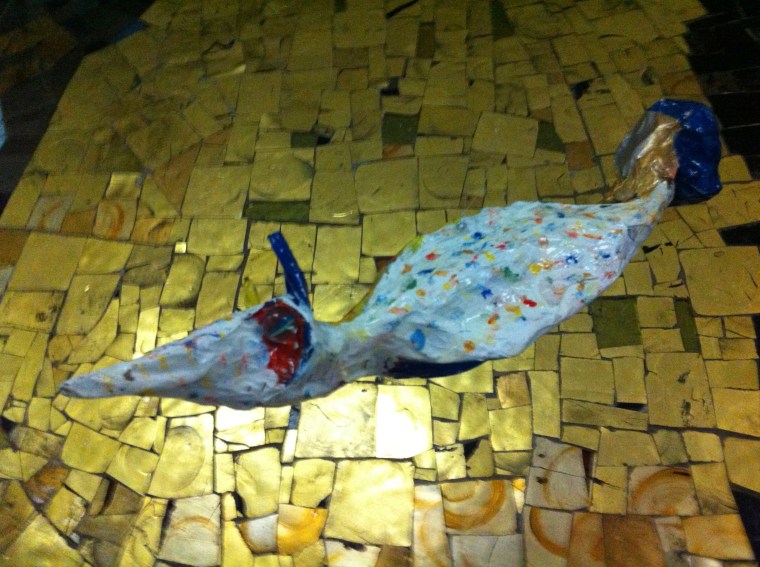
The creature posted here was just one of the many creatures and forms populating “Our world”, as the students called it. We have yet to collect their stories and assemble them in a book. I will post more. For now: the “Thing”. I love it.

ART and kids, that is an awesome mix. I do so hope they will keep some of their wild and creative impulses and treasure them as they are getting older. There is nothing as joyful as turning your back to all the “ifs” and “buts” and just be. In the process. Your process. Your life.

Monstrous Spelling Mechanism / Zen practice of giving thanks to a teacher

Monstrous Spelling Mechanism / Zen practice of giving thanks to a teacher

Art is time travel, no question. I didn’t know I still carried this monster around – but here it is. I learned how to read pretty early, before school, scanning my grandfather’s newspaper and imitating the strange throat clearing sounds he produced every now and then while reading. It was quite literally his newspaper, he was a co-publisher of some small town daily newspaper, back in the days when they were still independent.

Anyhow, reading and drawing quickly grew into something alike to breathing and running around for me. Imagine my bewilderment when in first grade I discovered that someone had torn all the words apart and stuck them into a strange primer expecting me to study each one of them separately. I decided not wanting to have anything to do with it and skipped to the end of the book where most letters founds themselves tidily arranged back to sensible words and stories.

I was quickly found out though by our teacher who then consulted with my mother, complaining about my absolute messy reading habits (being able to read but not to practice sound exercises with random letter-combinations). The following week she caught me with a book under the table again – and I still refused to fill out the worksheet according to the primer. We were at war. She took away my book and I kept busy studying the colophon in the reading primer.

Before you give me credit for my precocious rebellious behavior I have to admit that I plain did not understand what was expected of me, and for some reason the teacher had such a vague personality that I found it incredibly hard to focus my attention on that pale, almost transparent if upset presence who did not stop elaborating on how I was not supposed to read what I hadn’t been taught to read. It seemed to me that I could see the squiggles on the chalkboard behind her – through her. I could literally look right through her. It was a mess.

At home my mother followed up on my homework assignments and had me fill the lines of my notebook with squiggles and squabs. It was monstrous, it really was. I had absolutely no clue what I was doing and why. My mother meticulously instructed me how to fill a page with doodles, then she left me to it. When she left the room I took out a book and read instead. There were tears that night.

I don’t know what would have happened had we not moved to a new suburb. I got a new teacher who very nice about my keeping a book under the table and even encouraged me to put it on the table instead. While in the first school my teacher had insisted on my using the phonetic approach which was still brand new back then to acquire a skill I already possessed, in my new school I was allowed to spell with the whole word sight system which happened to be the way my reading comprehension just happened to work anyways.

Later I did learn to take the words apart, by the way. Today I am the master of the monstrous spelling mechanism. I wonder if the second elementary school teacher ever knew that she was a life saver. Thank you, Frau Bock.

Celebration

Celebration

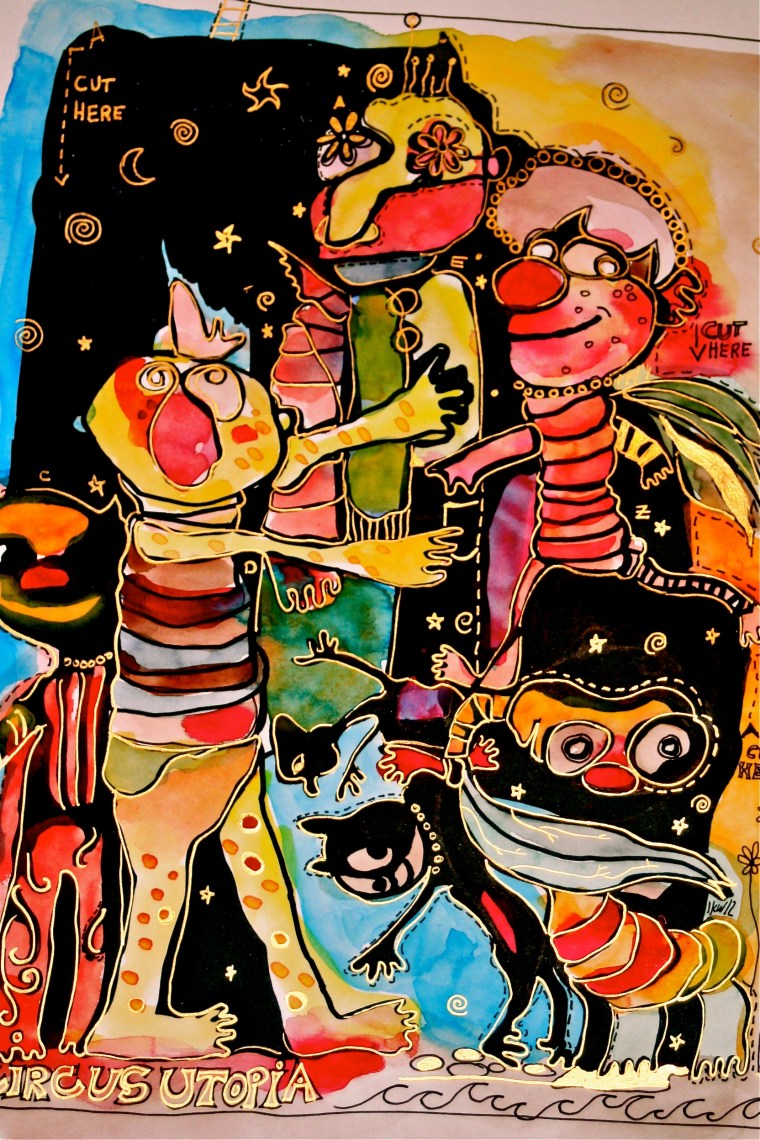
I like this illustration for it’s neither jolie, pretty, nor ugly, it’s a celebration, a meeting of some of the characters that constantly remind me that I want to draw instead of doing whatever else it is I have to do. It’s probably actually a fairly accurate illustration of my (non-verbal) thoughts when I am not focused on law or writing and it explains why it sometimes costs me quite some effort to focus on the mundane aspects of life when all these people are spoking around in my brain.