Page 5 of 6

Art and me, or: The crowd at my breakfast table
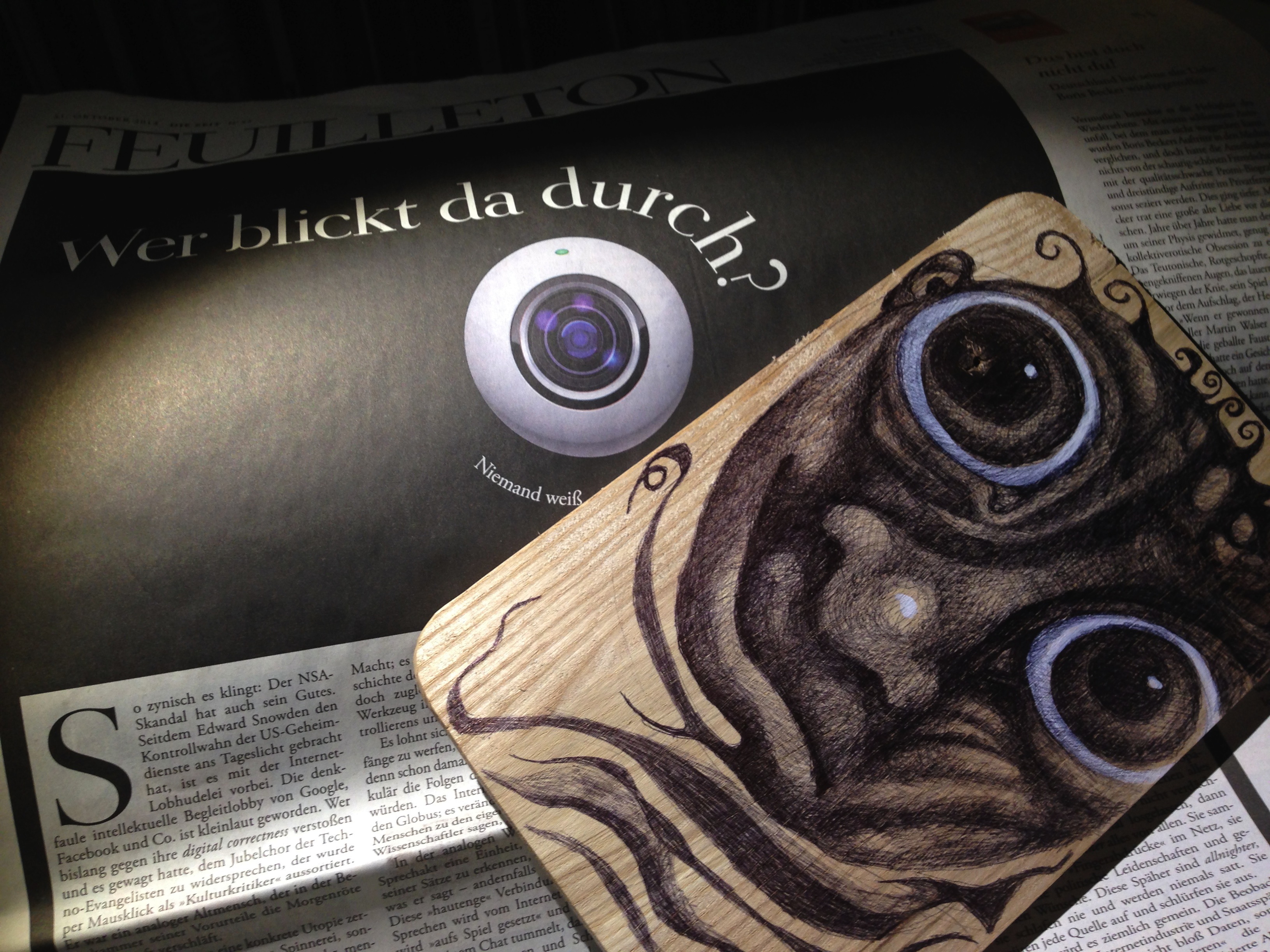
Wer guckt da durch?

Art and me, we have a strange and very complicated relationship. I have been chasing it with determination and desperation, and it has cold-heartedly denied me. The pain of rejected love is cruel, but I submitted to it only so long. I retreated, admitting defeat was the most dignified thing to do in this situation, I thought, and I became a lawyer. But then, surprise, instead of going its own way, art took up a habit of following me instead, never quite disappearing out of sight, yes, I would say, teasing me, challenging me.

Eventually, we made up, kind of, since then I have been treating it with respectful nonchalance,and it has been faithfully and annoyingly waiting for me ever since at the breakfast table, casually asking me: “So, what are you up to today?”, not being offended by my silence while I am hiding behind my crucially important notes for the day, while I am all business, anticipating legal arguments and dictating the first legal brief in my mind, instead asking again, equally casually: “Mind, if I tag along?”, and I – with an air of studied indifference respond: “Sure, why not?”, and out the door we rush.

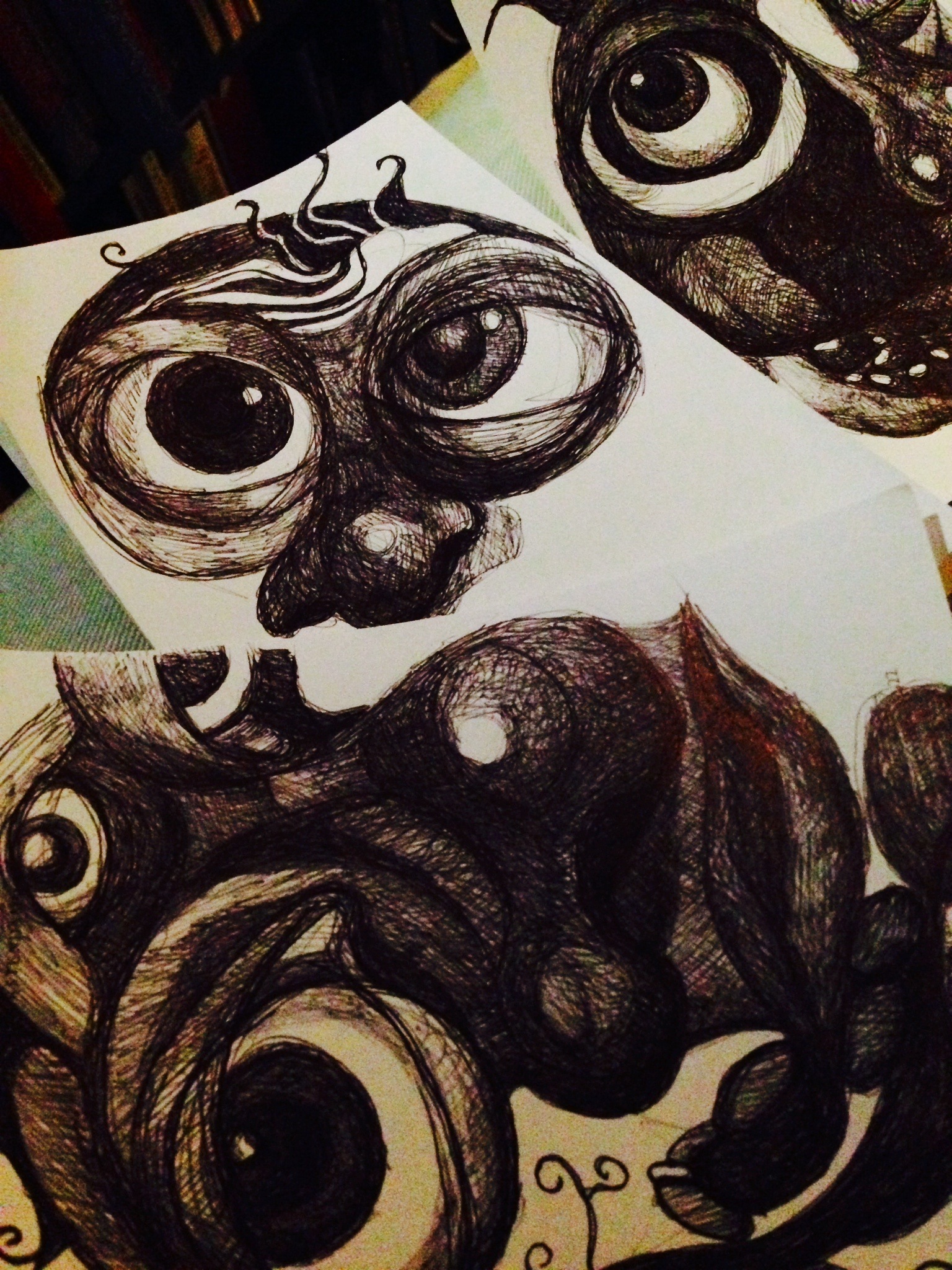
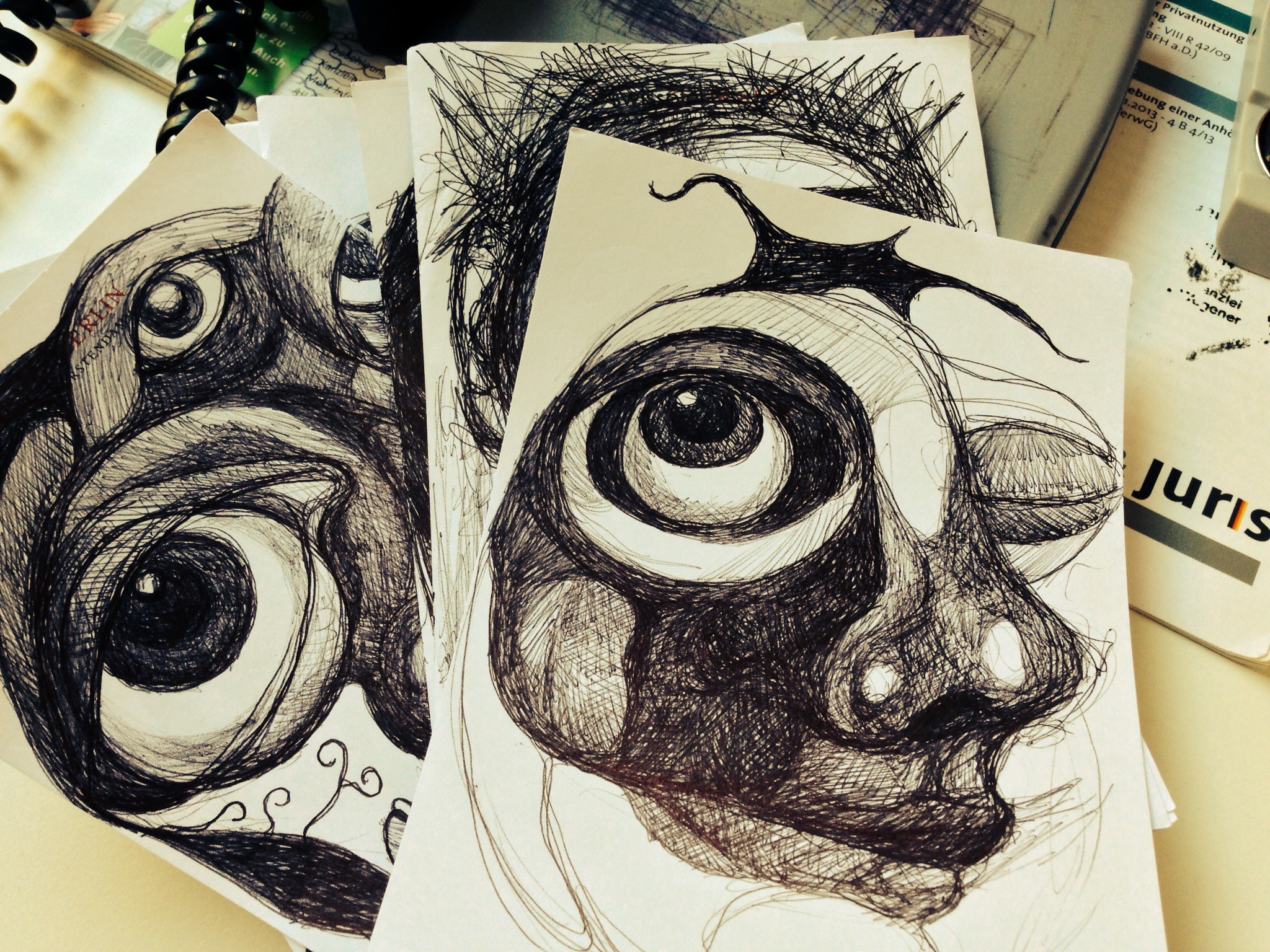
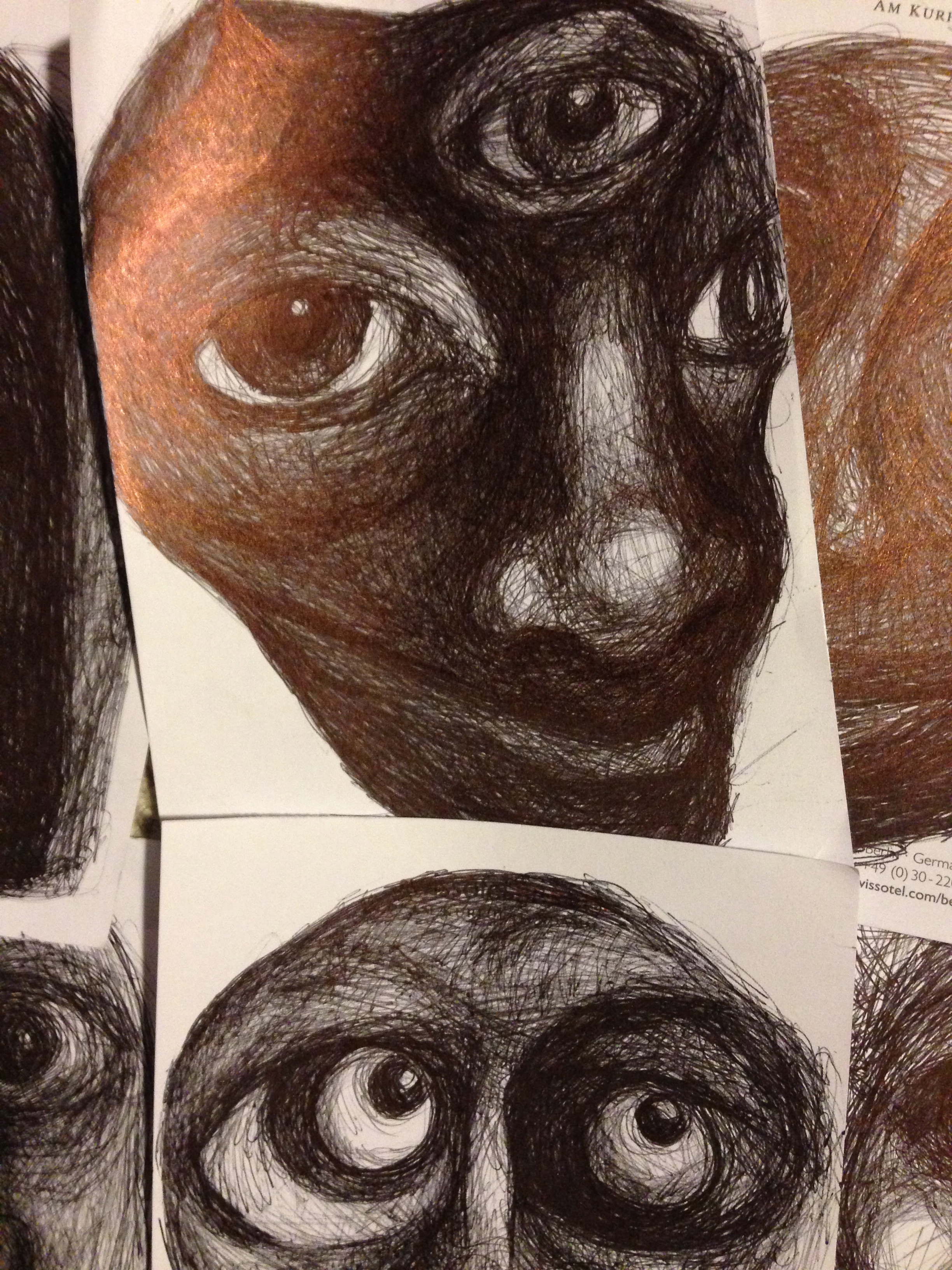
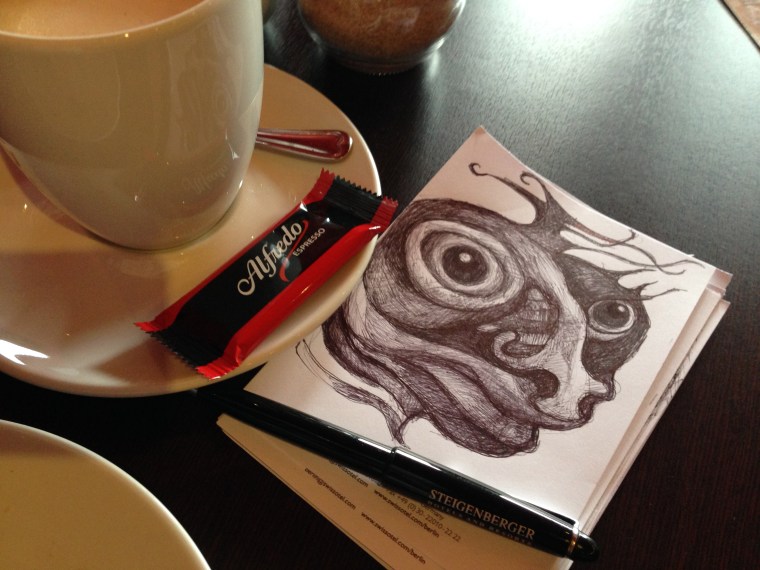
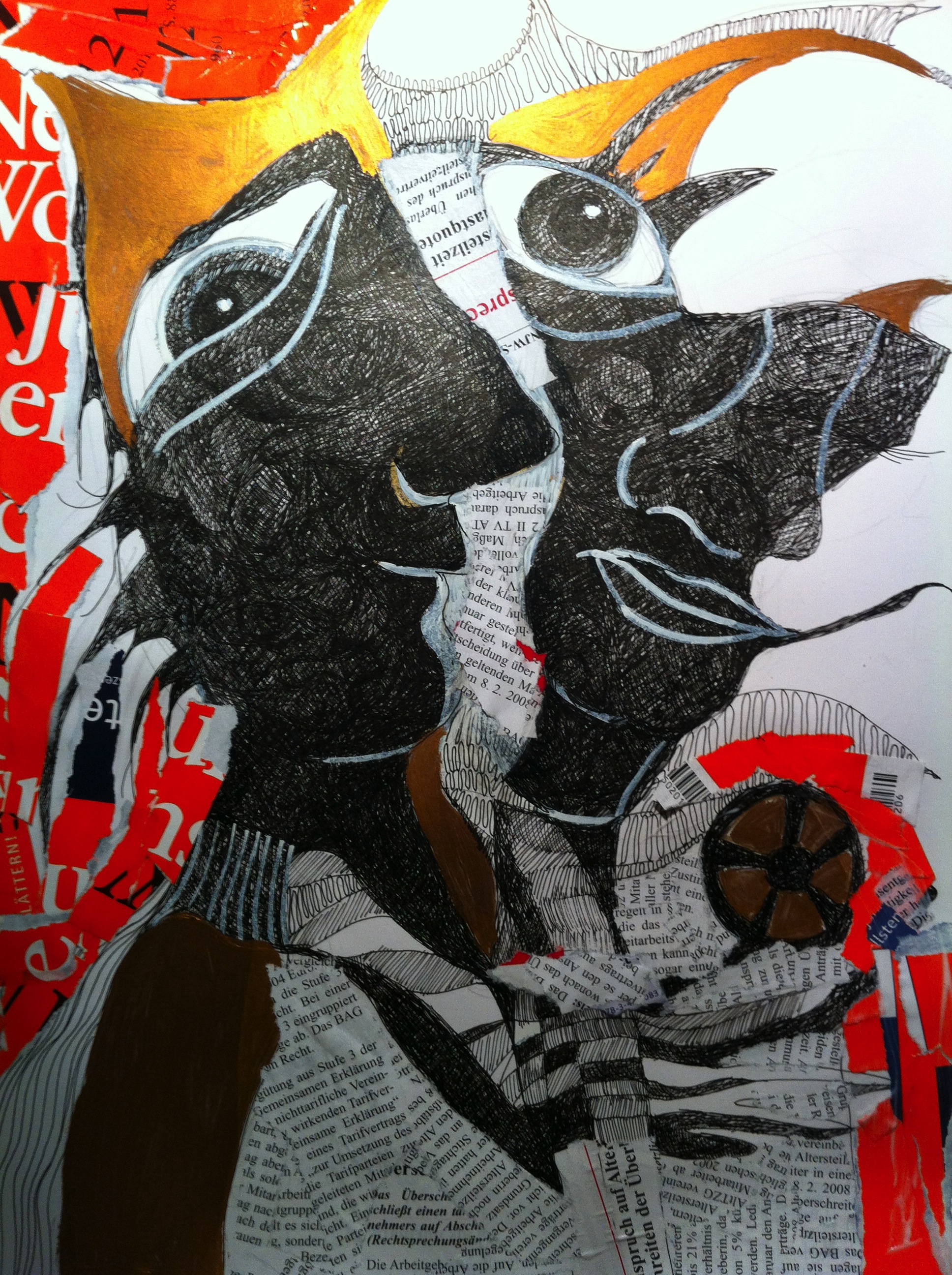
And when I come home in the evening and I open my very important briefcase out tumble bits of this and that, drawings on note paper, done while I was on the phone, creatures with big eyes while I was thinking about security of data transmission, one of my new wooden drawings “Watch out while you are being watched” over a quick coffee break. At home I don’t know how to archive the mass of these  bits and pieces anymore, nor where to store the heap of casual paintings done at night, JUST because, and during every free moment and I feel like I imagine the husband must be feeling who doesn’t quite know whether he is cheating on his wife when he spends time with a female friend his wife is well aware of or whether he is cheating on said female friend when spending quality time with his wife.

Garbriel Lorca, the beautiful Spanish poet who was murdered by the Nationalist Forces shortly after the beginning of the Spanish Civil War in 1936 – who really was a much better poet than an artist expressed it very much the same way, because he loved drawing, tenderly calling it his “mistress” while he stayed married, of course he did, to his writing. I remember reading in a small, illustrated Lorca volume I had bought at the Heinrich Heine Buchhandlung at the main train station of the Berlin Zoo station – a book store that was as great and complicated and deep and full of books and ideas about books as it could possibly get, probably a dependance of Borges library. I was twenty and attending classes by Prof. Robert Kudielka at the HdK, the University of Fine Arts in then still Westberlin – while actually meaning to study law at the Free University. You see, from the beginning this was a complicated thing and the small Lorca volume seem to me like an announcement of something I was not ready to grasp yet. I still own it.

I got constantly side-tracked during those years because of places like the Heinrich-Heine book store where they absolutely supported the idea of spending your entire cash worth a month of earnings at  some student’s job on a heap of books you could just so carry to the register – after first staying for what seemed like days in the sacred railway catacombs, resembling a labyrinth of overpacked shelves. You’d come out with marvelous finds, books that had been hiding for decades, books unknown even to the book seller, and you and the book seller would jointly rejoice in the find, and the book seller would come up with a fantasy price for the book because the one displayed on the inside of the cover seemed – unreal. 51 cents, Pfennige, or something like this. So, you’d pay 2,50 DM, and it wasn’t a used book, it was a book that had been waiting for you to be the first owner patiently since about 1953, well over a decade before you had been born and even more time before you became literate and then some more.

I got constantly side-tracked because there were the collections of old masters in Dahlem, one S-Bahn station before Thielplatz, my law school station, and you’d only guess that I must be a somewhat decent lawyer for passing my exams besides the fact that getting off the train in Dahlem to for a small detour through the beautiful tree-lines streets of Dahlem as often as not ended up with an entire day in the collections, studying Rembrandt and Baehr and flemish artists instead or, if I made it to class in the morning, not returning from the university’s cafeteria at lunch time because it was located pretty much right next to the collections.

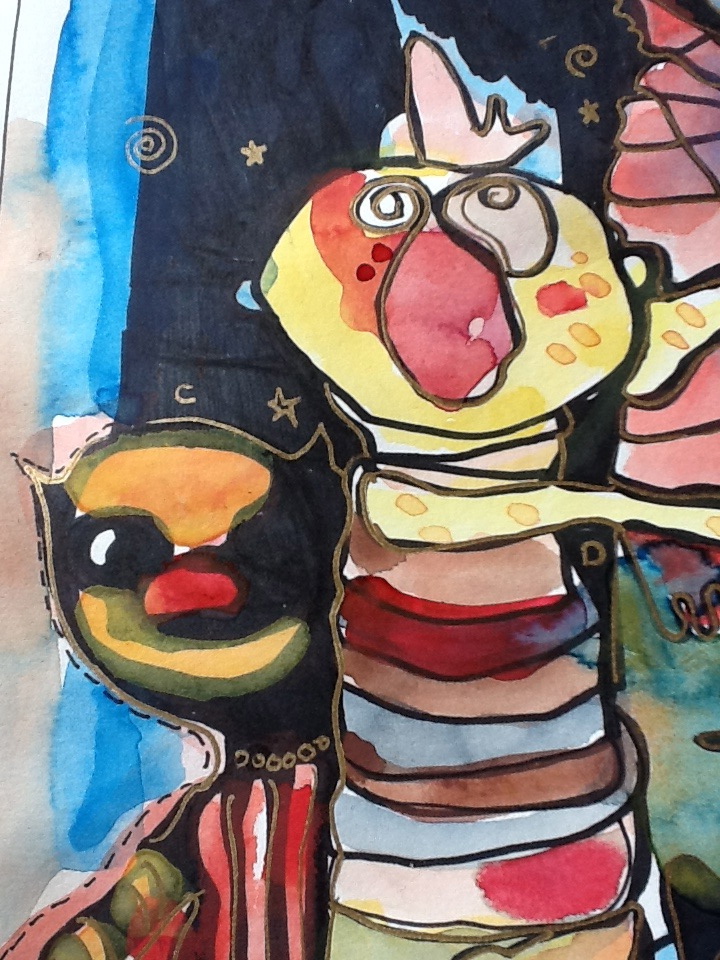
I am actually now practicing law, specializing, surprise, on art and law, and art still has a very sly way of side-tracking me. Maybe it has something to do with the fourteen years I spent in New York, idling away time at the MoMA and the Met, and at Crawford Doyle booksellers. Art has always influenced the Why and Where, has seduced me to accept situations I would not have dreamed of for the sake of studying a Vermeer at the Metropolitan Museum of Art, Calder’s Circus at the Whitney, or rough Miro drawings at MoMA or Gerhard Richter‘s black and white paintings at MoMA, Odilon Redon, Armando Reverón, Richard Serra, Lucian Freud, Swoon, Kiki Smith, Marina Abramović, Nancy Spero, my appetite may have been more voracious than discerning, but it found nourishment as I found distraction from more pressing questions and challenges and time passed swiftly as I was holding still, holding still and just looking and looking.At times that seems my main occupation. Looking. Thinking. Understanding. Reversing. Looking again.

Sometimes now I suspect that I do what I do – including law – because of art not despite, but I am loath to follow up on that suspicion. For now, I like the casual question in the morning, the uncertainty, the “Wow, this is still going on” and with as much determination and desperation as ever before. One could not ask for better. Want me to tag along. Sure.

By the way, above drawing is one done on the side, complementing a serious legal interest of mine. Even as I write this blog. Who is watching you? I am still married to the law. But if you made you way through to here, you realize that I as I have spoken about “art” as a single occupation I have really referred to two loves: Writing and painting. Now, that is – almost – too much for one life. definitely for one blog article that is already stretching the limits of a reasonable article’s length.  It’s a bit crowded at the breakfast table at times.
someone’s watching you – privacy of data, an appeal / round two

Image 5

“Writers must oppose systems. It’s important to write against power, corporations, the state, and the whole system of consumption and of debilitating entertainments. I think writers, by nature, must oppose things, oppose whatever power tries to impose on us.  … You know, in America and in western Europe we live in very wealthy democracies, we can do virtually anything we want, I’m able to write whatever I want to write. But I can’t be part of this culture of simulation, in the sense of the culture’s absorbing of everything. In doing that it neutralises anything dangerous, anything that might threaten the consumer society. In Cosmopolis Kinski says, “What a culture does is absorb and neutralise its adversaries”. If you’re a writer who, one way or another, comes to be seen as dangerous, you’ll wake up one morning and discover your face on a coffee mug or a t-shirt and you’ll have been neutralised.” Don DeLillo (Panic #1, Nov. 2005, pp. 90-95.)

And is it not at the same time a cynical paradox and the hybris of writers, artists and maybe even lawyers, yes, now that I mentioned it, certainly lawyers as well, that in striving to be effective, successful, sharp, persuasive, unveiling, exposing, revealing, uncovering the workings of the machine we also strive for the kind of recognition that neutralizes our very effort. This is still the romantic idea of the individual rebel, the genius writer, the brilliant artist, a sly title afforded with societal approval by the very system that is being accosted, criticized and opposed just because this honor neutralizes, even castrates the very effort it lauds. Don DeLillo writes accordingly in Underworld that true proof of existence lies with the recorder not the recorded, the one who does not have a name but the authority to write the code which makes time tick. My words, his idea, by the way.

If you did indeed value the corrosive of your intellectual ability  you would choose to remain unknown behind a work that was known for its efficiency. you would not buy the idea of the genius writer who ends up on a t-shirt or, for that matter, on Facebook where you can democratically and to no specific end be approved of by the click of a button, but you would anonymously and in a group of like-minded minds labor towards the specific end of a realization of your ideas.

this is, coming round from yesterday’s etude on the privacy of data, another appeal to keep private if you can and claim the right and authority to do so.

do you feel like you are being watched?

fearful knowledgeit’s because you are. the recent discussions about the privacy of data – or the absence of such privacy when it comes to any form of telecommunication or electronic communication – has revealed that for now that even the basic implications that could lead to a meaningful discussion of the issues at stake are at best only vaguely understood.

the increasingly public lives we seem to live obscure the nature of information even further. the general public as judged by news coverage and political discussion seems somewhat nonchalant about their own data privacy, maintaining that private data could not be of any use to those who fish for it (what do you care about what I had for breakfast?), and that those who had anything to hide should better be found out early, with other words that to the law-aiding citizen the privacy of data is not of great urgency. The sheer mass of private, non-relevant information creates the further illusion that what one reveals in electronic form was as elusive as a thought shared with a friend in a crowd of people.

to reintroduce the idea  that information may not be – as more commonly understood – an abstract observation extracted from a state of reality to communicate the specific nature of that given state, but instead the first cause to make reality, with other words, that information is to the “thing” it describes what the letter is to the word and the line that draws the letter is to the letter, to reintroduce this thought at the moment when countless legal aspects of data privacy are already causing the discussion to meander without true force, may be pushing the discussion to the brink of madness, but it could also turn out to be immensely useful.

“In the beginning was the word”, this grand opening refers to the provenance of the idea – translating thus the term “logos”, which refers to the inherent logic and order of things. The order of things as encoded in a word very much like a program that at the same time provides a building plan for a specific “thing”, is the cause for its realization and provides the necessary algorithms to build it. Furthermore, if the chosen word, data, information, has “wisdom” (Hebrew for “word”), which means: knowledge of the world as a whole, to speak the right word is to give the initial and irrevocable impulse for the creative act out of which reality follows.

Maintaining authority over that kind of knowledge as far as it refers to your individual data, even if it included plainly what you had for breakfast, whom you’ll meet for lunch and what your favorite color is, might be a cautious and recommended approach until you could positively rule out that this kind of data is indeed what makes you. That could be the making or the unmaking of you.


the art of evolution

IMG_0875the line that weaves a monster creates a world of possibilities. hopeful monsters, evolution by systemic mutations, as developed by goldschmidt in his theory on “hopeful monsters”, provides, as a metaphorical recourse, the right to hope against all odds that what is uneven – think Kant and the crooked timber of humanity – might be not only necessary but at times preferable to what is normatively expected. (citation after: dartouth.edu/~dietrich/NRG2003.pdf
“a single mutational step affecting the right process at the right moment can accomplish everything, providing that it is able to set in motion the ever-present potentialities of embryonic regulation” Goldschmidt, R. The Material Basis of Evolution (Yale Univ. Press, New Haven, Connecticut, 1940).

everywhere and nowhere – a trip to berlin and back


IMG_0872IMG_0882


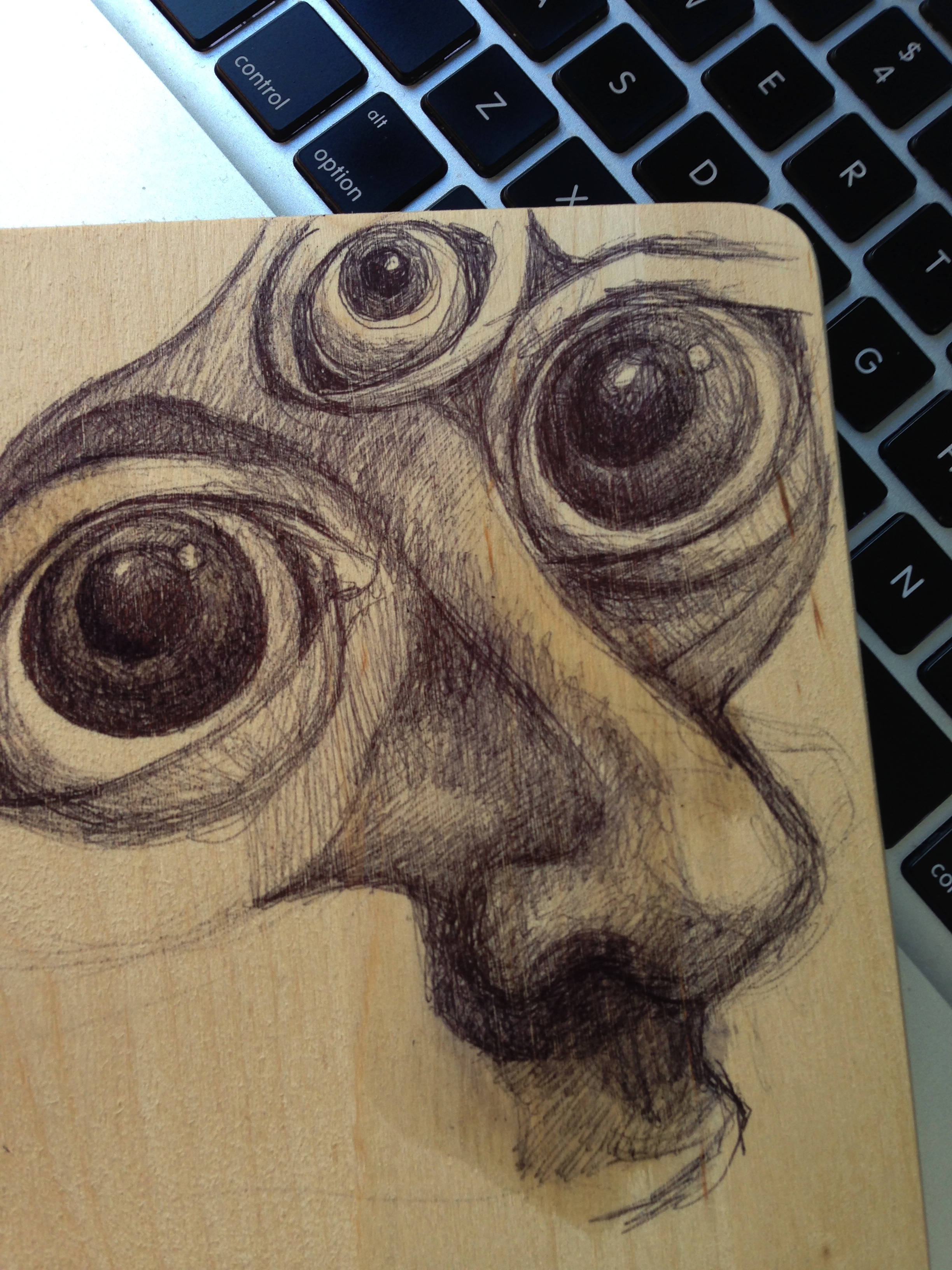
black ball pen, anywhere paper. while working as a lawyer specialized on the representation of visual artists, sometimes the time in between, travel time, waiting times, coffee breaks during a conference turns out to be a creative space in which not just some kind of creative maintenance seems to happen but actually – while I am using readily available art supplies like note paper and ball pens provided at said conference – something interesting, some original kind of work or an idea that will be worth developing. like this weekend. i added to my to do list for the day: buy plenty refills for black ball pens. something’s coming.

legal terms: royalty

royal

Royalty: a fee that is paid to the owner or creator of intellectual property when it is used again. Black’s Law dictionary

Intellectual property is a legal concept  and like other legal concepts dependent on definition and open to political use and abuse.

The physical, geographical world has indeed been mapped extensively, some might say: exhaustingly, and to the extent that one may not walk this earth anymore without treading on another man’ or woman’s property.

As we are starting to protect that what we call intellectual property – with good reason, think compensation of artists, musicians, inventors who cannot work for free and live on nothing any more than any other trade could – we also have to think of what it means that we are willing to treat ideas very much the same way that we treat the surface of this planet.

As much as one – at the beginning of tis new century with its overwhelming environmental, cultural and economical problems – could question whether the concept of the exclusive private rights to use the land (property) and its resources has been beneficial one should now very carefully consider whether a similar approach of mapping the works of the mind through exclusive rights seems the path we should follow if we hope to address those problems that are not individual but communal problems, not problems of one country but of all people hoping to keep this earth a home for future generations.

“If nature has made any one thing less susceptible than all others of exclusive property, it is the action of the thinking power called an idea, which an individual may exclusively possess as long as he keeps it to himself; but the moment it is divulged, it forces itself into the possession of every one, and the receiver cannot dispossess himself of it. Its peculiar character, too, is that no one possesses the less, because every other possesses the whole of it. He who receives an idea from me, receives instruction himself without lessening mine; as he who lights his taper at mine, receives light without darkening me.” Thomas Jefferson, letter to Isaac McPherson, August 13th, 1813

artist statement (mine)

this knowing “you are on to something good” is exactly where the artist meets the scientist. only that in general the scientist will be patient and disciplined enough to acquire the skills necessary to actually explore and eventually understand that unfounded suspicion and the artist will just take a cursory inventory of the idea’s implications and then take to the type writer (or the canvas) like the monkey, ready to blindly shell out the sequence of letters to actually and surprisingly eloquently prove that “it” was always known.Bild

huis clos

Jean-Paul Sartre (um 1950)
Jean-Paul Sartre (um 1950) (Photo credit: Wikipedia)

walking up some flights of stairs in the morning, taking one step at a time, my thoughts start drifting, and i continue walking, and i keep thinking, and my feet continue climbing up the first flight of stairs, one step at a time, one step at a time, and i continue dreaming pleasantly, and my feet continue walking until i grow aware that it is taking a rather long time to climb that one flight of stairs, 13 stairs at most, and while my feet are still climbing i see that i have reached the second to last step and still i climb and my feet continue to move obediently, my thoughts retracing my steps, until finally, and i can measure that time span of the last step, i have reached the first landing.

time perception of course, by its nature is subjective, but how long a dream can one dream climbing up one flight of stairs, i wonder. on the landing the grey light filtering through the milky hall way window does not admit to time passing and i almost dread climbing the next flight of stairs.

but, of course, i do, what else is there to do, but to continue. so i focus on the steps this time, 13 at most, and i am resolved not to allow my thoughts to drift.

i focus while i am walking, and i focus on my focus, and i see myself walking up that flight of stairs, 13 steps at most, while i am concentrating so hard on not dreaming, not drifting, on almost not thinking that my brain starts feeling cold.

and my feet keep moving, climbing up the steps, and i am carefully keeping my focus, and yet when i have mastered not even half the flight of stairs, i realize that once again the time it takes to climb these steps does not correspond to the number of steps i have been climbing and i freeze in the midst of climbing, one foot on the seventh step, one still on the sixth, and i have a hard look at that staircase but there is nothing out of the ordinary to be observed.

and yet i am sure of it, it takes too long to climb these stairs, and ideas start forming, offering themselves with deceptive playfulness, but i reject them because now all i want is to  be done with climbing that staircase and so i continue.

trying to regain that coveted state of unconsciousness with with which one climbs a step of stairs, not observing the act of climbing, not synchronizing mind time with physical time, i pitifully fail.

again i step up and step up and step up as if climbing that staircase was a specific task to fulfill, as if i was not mastering some flights of stairs but was struggling up a mountain to reach a monastery carved out of the mountain side, as if i was following a pilgrim’s path to enlightening. i couldn’t be more aware of every single neuron firing to accomplish this complex daily task though all i crave is unawareness towards it. and i continue climbing.

on the next landing i hardly pause to contemplate what i must do as there is no alternative to walking, and i simply walk up the next flight of stairs, i walk and  i walk, and by now i am not struggling against the perception of the walk that does not correspond to the space though i am not accepting it either.

on to the next. i know by now that this is and is not an ordinary staircase, that i will resume life once i reach the top but as of now my life is suspended and all that is asked of me is to walk up those steps, so i keep walking.

my unimaginative mind gets bored of this existential task, even slightly amused, rather than to be terrified, never mind that for all i know this stairway might be sartre’s huis clos and gabriel, ines and estelle might be right behind me, or i might be ines or estelle, but still my mind gets bored of this task of climbing some flights of stairs as if that was all there was to do for eternity.

when i am bored of being slightly amused by my own superior outlook on the terror of eternity i start swearing silently under my breath, but still  i am climbing, and at some point i am done swearing, too, or rather i run out of entertaining curses.

so when i am done swearing , i start wondering who is going to study my briefs today, or tomorrow for that matter, who is going to review my documents, conduct my research, draft my pleadings. and after climbing another flight of stairs, i start feeling pity for myself and i  sadly ask myself who is going to comfort my children and read my books and paint my paintings while i am climbing this endless staircase. and still i am climbing.

and this i do every morning. i tell you this just because you asked me whether i believe in eternity (or anything, really). sure i do.

every morning, rejecting the elevator, i do repent of my choices by climbing that eternal staircase and, for all i know, i never leave it, for all i know, i am forever walking up one flight of stairs after the other, because i do not remember ever reaching the top of it, i do not remember opening the door to exit the hallway and entering my office even though i won’t deny either that i am indeed sitting here, at my desk, drafting my briefs, conducting my research, writing my pleadings and trying to convince you if not myself that i am more than a speck of transient dust.