Page 6 of 6

Sir Thomas More

Portrait of Sir Thomas More (Holbein)
Portrait of Sir Thomas More (Holbein) (Photo credit: Wikipedia)

It seems to me that where private properties exist, where all men measure all things in relation to money, it is hardly possible to establish, in public affairs, a regime at once just and prosperous, unless you esteem it just that the best things belong to the worst persons, or unless you judge it well that all goods be shared among the fewest people who even then are not entirely satisfied, whilst all others are in the direst poverty. This is why I reflect upon the Constitution of the Utopians, so wise, so morally irreproachable, among whom with the fewest possible laws all is regulated for the good of all, in such a way that merit is rewarded; and that, in a sharing from which no one is excluded, everyone has nonetheless a large part.

Sir Thomas More

Little Red Riding Hood – a cautionary tale?

Little Red Riding Hood - a cautionary tale?

Dearest daughter,

in response to your letter in which you asked me very nicely to please allow you to walk into the wild woods by yourself:

remember Little Red Riding Hood? There was not a child more law abiding, sweet and obedient than her. A fact often overseen by those who refer to her story as a cautionary tale: the first third of it is entirely dedicated to how much everyone loved her due to her lovely and loyal disposition, truthfulness and dedication to her mother’s advice and guidance.

Do you think anyone hearing the story for the very first time – and being somewhat ignorant of the basic concept of morality in a fairy tale – do you think that such a person would expect her to forget about her mother’s advice the very first moment she encounters a challenge? Which is exactly what happens once she has wandered off happily with her basket filled with goods for her sick grandmother.

Well, we have to concede that she strays from the path of virtue for two reasons that somewhat make us stay sympathetic to her ordeal: first of all, she means well. A bunch of flowers from the wayside would surely be a welcome present for her grandmother? Never mind though that mother not only warned her against leaving the path but actually forbid her to do so! We see her put her own judgment without much quarrel with her conscience before her mother’s clear and concise directions. Let’s not forget we are talking about the most obedient girl in the village here!

The second aspect to exculpate her somewhat of course is that she is being seduced by a cunning conjurer of convincing tales. Can we really expect her to stick to those dry rules when confronted with the loveliness of the world beyond the right path as presented by a seasoned liar? The woods have never looked more inviting to her than after the wolf’s description of finely scented flowers growing in the shade of luscious trees! Shouldn’t we also blame her mother, by the way, who sends her into harm’s way? If there is a wolf lurking in those woods, as she well knows, why does she send her little girl on the errand? And you expect me to send you out into a world full of strange and unexpected temptations, equipped with just a few rules?

Here is the part of the story that has not been distributed widely but is worth considering. Prior to the whole walk in the woods scene Little Red’s mother had received a letter from her daughter. “Dearest Mother”, it read, “I am responsible and obedient. I would never do anything you told me not to! I have proven myself, now let me go!” Wouldn’t such a letter touch a mother’s heart just as yours’ touched mine? Wouldn’t it make her feel just a little guilty that she hasn’t entrusted Little Red Riding Hood with an important errand earlier already, Little Red Riding Hood, the best behaved, the loveliest, the most obedient girl in the village? You bet, it did. And we all know how the story ends!

Wait a minute, how does it end? If you think it has a bad ending, read again. Here we see her, sitting chipper at the table at her grandmother’s house, enjoying wine and cake in the company not only of her suddenly recovered grandmother but also in the company of a handsome huntsman?

Maybe this is not a moral warning tale about a girl who forgets the rules while she walks through the woods, ahem, to school on her own for the first time. Maybe it is a story about a girl who needs to make her own mistakes to find her own way, wolfs and all, and that despite all dangers there is a good chance for her to do just that. Maybe it is a story about a mother who needs to let her child go into the woods to find a way out again?

The more I think about it, the more I suspect that this is more a tale about the inevitable fact that mothers have to let their children go their own ways despite their fervent wishes to protect them against all evil and bad will, real and imaginary.

Go walk find your way through the wild woods as you must, my Little Red Riding Hood. But know that there is a wolf out there who will talk about moonflowers in the shades of the trees far off the beaten path …

With all my love,
Your Mother

fever and another barefoot stranger

fever and another barefoot stranger

The last winter before the completion of the new church he had an encounter with a stranger who had called upon him repeatedly and who was staying at the town’s only inn. He was dressed in simple, yet elegant clothes, cut out of fine, dark cloth. In a small town a stranger like this would normally have generated a great deal of curiosity. But he was so quiet and unassuming in his manner as to almost appear invisible. He went for daily visits to the rectory where he was served tea and would have long conversations with the pastor. The elegance of his appearance was so convincing that it took a while for the pastor to notice that the stranger wore but a kind of biblical footwear, close to being shoeless.

It was late fall. The trees were brilliantly red as if with religious fervor. The pastor felt alert, alive almost as if a lifetime of doubt and study suddenly held some promise, as if the dark aspects of his life were less weighing on him. Then the stranger came down with a severe flu which delayed his departure. High fevers made him delirious, and the doctor and priest both were called to soothe the rage which seemed to devour the man who had been a quiet guest until he came down with this fever. After three days he lost his consciousness and did not regain it. He died in the fourth night without the pastor at his side. The pastor himself was delirious in fever at this time and died only two days after the stranger.

map of a brain on fire

map of a brain on fire

i will write up the contract
entitling you to
a map of my brain, that world on fire,
almost like the contract
we roughly sketched with a yellow pencil stub
(for authenticity)
on the ripped-out fly-leaf
of the iliad in my grandfather’s study.
(sacrilege!)

we were children then
but that is not an excuse

i will write up the contract,
not for nothing
did i go to law school to learn how to
negotiate that what cannot be agreed upon,
how to arrange the terms of a transaction
that is to lead to mutual discontent,
for content is not to be gained through negotiation
and mutual discontent will have to do

we were children no more then
but that is not an excuse

your signature stands in for
your body so it better be water proof ink.
maybe we were smarter still
when we used that yellow pencil stub
to draw a contract
that neither of us meant to honor.
we were pirates after all.

children do grow up
but that is not an excuse

so let us sign it in waterproof ink then,
against our better judgment.
here is your letter of entitlement,
all i ask in return is
the right to keep that old flyleaf,
signed in pencil.

good luck to you now.
i forgot to inform you
that this kind of contract cannot be
specifically enforced,
but then again,
you didn’t care for the flyleaf,
did you.

we are but children.
and that shall be our only excuse.

Art & Law / another sketch

Art & Law / another sketch

a random list of lawyer-artists: Piero della Francesca, Heinrich Heine, E.T.A. Hoffmann, Robert Schuhmann, Goethe, Adalbert Stifter, Igor Stravinski, Gottfried Keller, Franz Kafka,Kurt Tucholski, Wassily Kandinsky, Cézanne, Henri Matisse, Antonie Tapies, Winfried Bullinger, Bernard Schlink Julie Zeh

Not surprisingly lawyers who are also writers are not at all uncommon. The art of writing truly is heart and brain of the legal profession, a necessary skill but also a reason to enjoy this profession even in its mundane days. You know that you are a lawyer when you do enjoy writing about a defect vehicle with a bivalent engine and when you put effort into writing it well.

Most of the visual artists I know about on the other hand actually fully changed careers (the contemporary artist and law professor Winfried Bullinger, Berlin, being a notable exception). Most of the musicians did (with the exception of E.T.A. Hoffmann who managed to be a lawyer, writer, musician). Some of the writers did, too, like Julie Zeh, and yet their legal training shows in their writing in many ways, starting with insights into the legal profession they have been privy to.

These observations (writers might stay lawyers, visual artists and musicians change careers, starting out as lawyers) seem to make perfect sense. After all the law does not use the language of visual forms (though you can’t practice law without abstraction, a link between the visual arts and the legal profession that Kandinsky pointed out), and lawyers do not sing, except for the occasional lullaby to their children.

But art and law, may it be writing, music or visual arts, are very similar in their understanding of their work as a process not only in the sense that every trade necessarily needs to follow certain steps to come up with a product or a desired result but in the sense that the result is the process itself.

This is nicely illustrated in music. You can only experience music during the unfolding of the process, even though the process might have a name (Symphony No. 4 in B Flat Major, Op. 60; II. Adagio), unless you are willing to entertain the thought that time is illusionary you can never meet up with the work in its completed, “static” form. The same is true for writing. Creation (on the writer’s side of the process) and recreation (of the reader) of any kind of text relies on a complex process-orientated if time disconnected cooperation between the writer and the reader. The product of writing might be a book, a stack of paper etc. but only in the decoding process can this product be assimilated into the readers realm.

In the visual arts this connection sometimes might seem less obvious, the results (depending on the art form) being seemingly static. A painting is a painting is a painting. But even the tableau painting is the product of a singular unfolding process – and probably can only be truly enjoyed if that process is comprehensible to the viewer through the painting/ the art object. (I have seen dead paintings before, a sad sight, but a good painting is process).

As much as humans might desire stasis, translating to: security, at heart they know that stasis cannot be achieved, at best an illusion of final laws, regulations etc.:

In the more than thirty thousand years of art history (watch the wonderful Werner Herzog documentary, “The Cave of Dreams”) and legal activity (responding to the need of their communities to reflect changing circumstances in their way of cooperation) the arts as well as the law have left testimony to the human desire to understand the harmony of process and metamorphosis, of inevitable change. I believe that people in their heart of hearts wish to learn the art to dance to the music of time (Anthony Powell) rather than to be dragged by the music of inevitability.

für viele:
Hermann Weber, Juristen hinter Literatur und Kunst, Tagung im Nordkolleg Rendsburg vom 16. – 18. September 2011, Reihe: Rechtsgeschichte und Rechtsgeschehen, Band 18, 2013, 2. Auflage, Gebundene Ausgabe, 208 Seiten
ISBN: 978-3-643-11768-7

Klaus Kastner: Literatur und Recht – eine unendliche Geschichte, Neue Juristische Wochenschrift (NJW) 2003 S. 609-615


Mahabaratha, final version

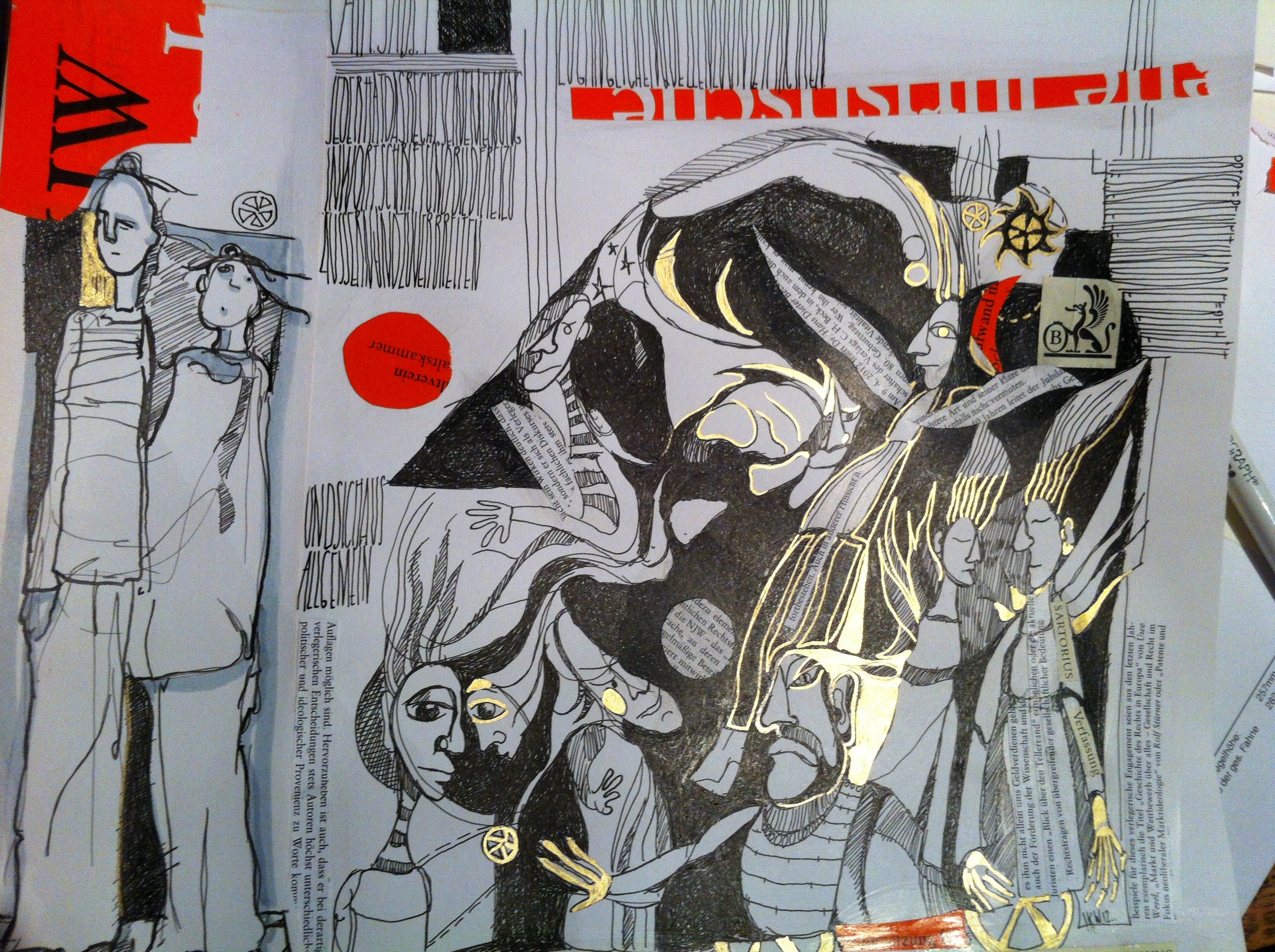
See the people on the left, right out of “Waiting for Godot”,real and possibly identifiable by their puzzled expressions and shabby clothing, confronted with the ideas and forces of the Mahabaratha, the great wagon of creation, that rule their existence whether they are aware of them or not, whether they approve of these ideas or reject them or are capable to form an opinion on the ethic implications of them in the first place.

The Mahabaratha, one of two major Sanscrit epics, is one of the first known written attempts to address the question of whether there can be a just war. On the wagon you will be able to identify the military commander as well as the celestial (winged) beings who discuss the fate of humans calmly and without apparent distress or compassion. Stylistic resemblances to Guernica through the more compassionate woeful expression of the face to the left of the commander, moving towards the human sphere as if in a warning but alas without reaching them or even being conceived as possible, points towards the reality of human existence: even though war has but destructive consequences it is an ever reoccurring reality throughout history, sweeping away everything in its path.