Sirens

The lake had glazed over and the ice had hardened and grown thick that year without any snow at all, making the safest ice you could hope for. Lake Willoughby is by many considered the most beautiful winter lake in the area. This is because due to its depth it is the last lake in Vermont to freeze solid, mostly not before late January or early February and thus remains snow free even as most of the other lakes are covered under a harsh monotonous blanket of snow. The color of the ice of their lake changed with the moods of the clouds racing over the sky on a sunny day and could change from green to blue to black within the course of a few hours.
If you have ever walked on ice without snow cover you know it is like magic, like walking over a window into a strange world from which you are separated by just a few centimeters.
With patience, just before nightfall, and if like Vermont kids you are able to hold very still despite the cold, if you manage to be one with the frozen world without moving, the fish will come close to the surface of the ice and you can watch the burbot from above as about a dozen males and females form a writhing ball several feet in diameter and dance what looks like an agonizing devilish dance under water, rolling over the bottom of the shallows and muddying the waters under the black ice.
„Don´t forget,” said the father to Joe underneath his breath, before he started to pull up the hooks, “these burbot devils are creatures of the deep and yet the good Lord sends them up for us to be sustained through winter.”
They certainly looked devilish, thought Joe, their heads were flat, their large mouths with pursed lips contain several rows of small sharp teeth, but Joe who loved any living creature still felt sorry for them when they lay on the ice after their father had hauled them up skillfully. When their eyes broke and glazed over, separated from their world but by a few inches of frozen ice, even the grim appearance created by the barbel that hung from the lower jaw made them look pitiful to the boy.
But his father never failed to remind him that they were mighty strong predators, skimming the shallows for smaller and larger creatures to feast on, crayfish, perch, minnows and even landlocked salmon almost their own size. Fearless they are, he said, don´t pity them. And they will fight back when they have fallen prey to your bait and hooks.“
Father had woken Joe and Will in the afternoon when it was still light outside but the shade was starting to flow into the valley between the mountains and spilled over the dark ice like the schoolmaster´s dark blue ink.
This hour remained Uncle Joe´s most favorite time of a winter day until he got very old. If it coincided with a fading winter sun over Mount Hor to the West, Uncle Joe would absent himself from any kind of work he happened to be pursuing at the very moment and despite his beloved and feared wife Aunt Melissy´s stern glance he would walk down to the shore to gaze out into the illuminated blue valley that had replaced the silver rippled summer lake.
He would always come back home with far away eyes as if he had looked beyond the borders of what lay in the past and his usually twinkling eyes were calm and serene for the remainder of the day. Did he still then hear his father´s words, the words the old man had addressed to the brothers that winter night before they went ice fishing almost holding them back by the collar so eager had they been to get out there the first time that very winter?
 The father had warned them to spread their gear out evenly and orderly over a well organized area, under no circumstances were they to drop it all in one place in order to distribute the weight more evenly over the ice.
He had spoken with a stern voice, looking them into their eyes to ascertain they were listening, even though they had heard his speech many winters, time and again.
Joe remembered the grin Will gave him, as father was issuing his final warning before they were allowed to step out on to the ice: „Boys, listen up. If you fall through the ice, try not to panic. It´s just very cold water, nothing you are not used to. Turn toward the direction from which you came and carefully place your hands and arms on the unbroken surface, working your body forward onto the ice by kicking your feet. Once out, remain lying on the ice and do not stand up or you might fall through again, and then roll away from the hole. Roll or crawl back to your tracks until you return to solid ice.“
And thus they had ventured out, all three of them, Joe with his father, carrying his share of gear and keeping his eyes on the dark transparent surface of the ice while following in his father´s light steps. They quickly reached their respective camp places which were to be set up around  precut ice holes his father had maintained over the last few days.
Every once in a while Joe looked up to see Will´s small figure in the distance setting up camp at the second hole about a hundred feet away. Both Will and his father first took out a skimmer and carefully but forcefully broke the sheet of ice that had glazed over the newly cut hole during the last 6 hours since father had last been out and then fished out the ice fragments and the slush underneath that would continue forming over the course of the night. Joe´s father then handed over the skimmer to the boy who fastened it to his belt with a thin cord. It would be his chore to skim the ice slush out of his father´s fishing hole over the night while Will had to do his own. He had to do this gently so the burbot wouldn´t be scared off. It was an important chore.
The ground was clear ice under their feet and night was already settling in. This was the most beautiful hour when the ice was shimmering blue as if illuminated from within and the evening air was crisp and really cold but not deadly cold yet. Later the night it was one of the most important things to keep warm during the wait for the fish to take the bait as tiredness would overcome them but for now he was alert and excited. Every once in a while he cast a glance over to Will who went through the same motions as his father in setting up camp. Maybe next year Joe would have his own fishing hole a hundred feet off his father´s side too.
He looked up the cliff of Mount Pisgah along the east shore of the Lake. The cliff lay frostlocked and forbidden. In summer Will and he would scramble up through the woods and rocks again, and explore how the cliff´s surface, so familiar to them, had changed over the course of the winter by small landslides and rockfalls that blocked pathways from the previous summers or had created new ones, had felled small trees rolling by and littered fresh rock shards sharp as a knife´s blade over a glade. There was this one thing his father said repeatedly as the boys ventured out as he knew they must to become part of the land and endure its challenges despite their mother´s worries. He said that even a mountain was but a changeable thing in the sight of god, and Joe knew that to be true by all these changes that were mostly invisible to the untrained eye but that Will and he could spot from the road and that made them eager for spring time to find out more.
But despite all these changes, now, in the evening light, Mount Pisgah looked eternal as did Mount Hor on the other side, and Joe shivered and hurried to help his father with the last preparations. At home the boys had helped father to prepare the line with the set-line hooks and strips of dried fish. They had no live bait which would have worked even better but even burbot was hungry this time of year and the dried fish would do.
His father unrolled the set line gently into the ice fishing hole. The sinker helped to pull the line to the bottom quickly. Father secured the line around a strong spruce pole and made sure that enough weight was on the line. After that the long wait could start, and darkness would finally claim the ice valley save the two small lamps that were hung up at stakes next to the camp sides and would be the only way to signal to Will who would be all but invisible by his own fishing hole.
Joe could hear the ice working with clear cold sounds but his father was relaxed now and unhurried and so Joe knew they were safe and the ice was strong enough to bear their weight this night. He knew that even the moose would sometimes venture out on the ice once the lake was frozen though it happened from time to time that an animal would fall through the ice. Two winters ago father had found a frozen in moose calf in the lake not far from the shore and had worked very hard to free the frozen carcass to provide the family with meat for a long time. Every time that the family had had moose stew that winter, Joe who had been only ten years old then, had felt sad thinking of the poor calf who had fallen through and not managed to get out of the water in time, but father had said that the meat was a gift and that it had been a miracle too that the calf had not gone under before freezing into the ice. Joe hoped that the animals were smarter this year. He scanned the darkening shore line for the swiftly moving shapes of the creatures, glad to know that at least the bears were deep in their winter´s sleep until March and were not likely to bother them at their camp site.This year food was not so plentiful as it had been that winter two years ago when they had found the calf,. This year the family depended on the catch to survive winter without going hungry.
Underneath his feet the boy could now see slight movements and he knew this meant that the burbots had started their dances. For a moment he had a slight feeling of vertigo as he remembered an old fireside tale.
The old woman by the creek told the young ones who stopped by every once in a while to hear a good tale that it was absolutely necessary to look away immediately and call for the good god´s support if you ever spotted larger figures under the ice. Legend knew there were heartbreakingly beautiful heathen maids living in the lake who looked like humans save for a long silver fishtail instead of legs. They were said to smile up from their icy world especially at young men from underneath the glassy ice and try to lure them to the open hole to reach out and pull them into their dark cold world.
Joe´s mother had said that these stories were but old women´s fireside tales unfitting for young men like Joe and Will when he had asked her about it, but he had seen a shadow of fear in her eyes nonetheless. He thought that Will, being 15 now, certainly would not look away if a beautiful girl was ever to smile at him, and neither would he.

 

Ice fishing on Lake Willoughby, Sunday’s draft  

IMG_2386

So grandfather went out again in the morning and – coming back in from the cold -declared grimly that they should try and get some sleep

as the ice was sound enough now, and they would go ice-fishing at nightfall and stay out in the bitter cold until almost midnight. Burbot mainly feed at night and that is when they had to set their lines.
Grandfather in the meantime put on single hooks with a gap between point and shank larger than ¾ of an inch. He stored them carefully in two 5 gallon buckets, each large enough to carry many sets of lines made from dowels. For each line they had about 8-ounce sinkers. Because together these were too heavy for the buckets, they were packed separately in rough hemp sacks. He packed two sleds with supplies, one for himself and Joe and one for Will who was old enough now to do his own fishing at a hole about 70 ft, away from theirs. He packed rope, ice picks and augers, a spud bar, two horse blankets for each of them and extra mittens.

As fishing burbot is done with hooks flat on the ground so they did not walk too far from the shore because the reef at the shore of the lake, as you know, falls off steeply into the main lake basin, deeper than any line is long that has ever been cast down the lake. 300 ft. maybe more. Nobody knows what creatures might be living down there, in the abyss of darkness but I guess they would not be a welcome sight in our world.

Burbot spawn on the rocks and boulders in 2 to 20 feet of water, and that is fairly close to shore, on the reef and the first drop-off at the base of the reef. But staying close to the shore was dangerous, as the edges of the ice can be much thinner and shallow water in general changes temperature more readily and the ice is unstable. And even when the ice had formed to grandfather’s satisfaction, we were aware that sometimes, not too often, the ice somewhere out on the lake from the depth of the basin, could shatter with the sound of a whip or a scream and rip through the ice all the way to shore with deadly speed. If you heard the whip you were to make for shore, leave everything behind, not care for catch nor supplies, just run. That’s why you would never put a good knife down on the ice, while fishing, and why you kept the ice pick in your belt as well. These things were hard to come by – alas not as hard as two healthy sons. So even if, by any chance, you had left your tools where you were not to leave them, you were still expected to run.

It was dangerous to go out there, and both, grandfather and grandmother, were weary to let Joe and Will join in, but they needed the extra hands to make enough catch or else they would starve to death.

Will and Joe did not mind the danger, far from it, they could not wait to get out onto the ice. They were boys, locked in a cabin for many weeks, safe some small outings, and they were missing summer and their freedom. They even enjoyed the idea of danger as much as any boy would, and they trusted above all that grandfather, who could walk on ice as fine as a sheet of parchment, knew when the right time had come for them to go out.

And the adults in their own way also were impatient and found it hard to wait for the ice to get sound enough, for the best time to catch burbot is their spawning season, a time when there was not only burbot but also plenty of whitefish and pike to be caught, while after the season passed the lake could look like a desert and you wouldn’t spot another burbot until next winter for they lived in the depth.

The lake had glazed over and the ice had hardened and grown without any snow, making the safest ice you could hope for.

And the most beautiful, too, though it does get very dark at night at your fishing hole, the ice becomes like a window into the lake. And if you are patient , just before nightfall, and despite the cold hold your position on the ice without moving, you can watch the burbot trough the ice as about a dozen males and females form a writhing ball several feet in diameter and dance what looks like an agonizing devil’s dance under water, rolling over the bottom of the shallows and muddying the waters under the black ice.

Don’t forget, they are creatures of the deep. They have sharp teeth and they are mighty strong predators, skimming the shallows for crayfish, perch, minnows and even creatures almost their own size when it’s time to feed. Fearless they are. And they will fight back when they have fallen prey to your bait and hooks.

Ice fishing in Lake Willoughby, about 1790, new chapter, excerpt

Image
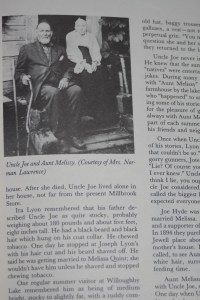
Aunt Melissy and Uncle Joe Hyde, Westmore, Lake Willoughby

“As you know the town was chartered by the authority of the State, Aug. 17th in the year of the Lord over 150 years ago.” I said, imitating Uncle Joe’s voice. Fiona smiled a bit. Encouraged, I continued:” It was then granted to Capt. Uriah Seymour, Abraham Sedgwick and their associates, being 65 persons in all, with the usual reservations and appropriations in the Charters or the grants by the Legislature. None of the original grantees or proprietors ever settled on their lands.”
All of Unce Joe’s stories started like a history lesson. Maybe to put Aunt Melissy’s suspicion over too wild a tale to rest only to sneak it in later. If Fiona was bored by the beginning, she did not let on. The patches on her dress now were of a saturated blue and orange, shining.
“There is no record of the exact time, nor by whom the first settlement was made.. But we do know that some six or seven families finally came to this town from Windsor and Orange Counties and made a settlement, among whom were Jabesh Hunter, Allen Wait, James Lyon, Jeremeel Cummings, Lot F. Woodruff, Dave Porter, Abel Bugbee and my grandfather, Joseph W. Hyde. The town had not been allotted at this time and they settled on such lands as best suited them, and others came too and made a beginning.”

Fiona listened contentedly. Stories were rare in our every day lives and even though I could by far not do it as well as Uncle Joe Hyde, who would pause artfully now and then, and whose blue eyes delighted in the fact that he had someone listening to his old stories gave it a special mellow flavor.

“But soon the cold season came and the Great War broke out between the Colonies and England. The settlers were surrounded by a howling wilderness a long distance from any other settlement, their numbers were few and not all were of kind disposition for you had to be rough at heart to survive on the land even though the soil is rich and productive and well suited to farming. The settlers were a hardy and industrious band of pioneers; like my grandfather they had come a long way into the wilderness, some single men on their own, some had made the way with young families. Each of them knew loss, especially loss of wee ones who passed on into the peace of the Lord before their first birthdays and left young wives sad and dreary.
Their labors on the land were not ordered and peaceful like today, but it was onerous work, with no time for rest, not even on the day of the Lord, their privations were many, but the hope of better times coming and faith in their Lord cheered them on and enabled them to endure the hardships until the War came. Some had even build commodious barns and comfortable dwellings but though all of their hearts were fierce and brave, most were still forced to abandon their homes not yet into the second generation and retreat. Their numbers were scattering, the frost destroyed their crops and the fear of the British and of hostile Indian tribes filled their hearts with fear. So they held a council to see what it was best to do in their perilous situation, and most families decided to surrender at discretion and most left very soon for some of the lower and more thickly settled towns in the State.”

Fiona embraced her legs and listened to me intently. I had given up imitating Uncle Joe but was still using his words. My history teacher in Summerville would have been fascinated as I spoke like a gazette from the early 19th century.
“It took over 30 years until the town was settled again. But my grandfather was among the few and scattered who stayed on, all these years. So did my grandmother who was a small, fearless woman and could hold her own among the men, and she worked like one, too. So my father was born, and was the only surviving child among 12 children who all perished before their 15th birthday. The family lived in a wee wooden cottage for all of the married life of the parents, sometimes with up to four or five children, from cradle to grave, right here on the old clearing where my father later built the stone house. Maybe it was because the cabin was so tiny and surrounded by dense woods, maybe it was because they respected the land they lived, didon very little farming, really just working a small garden patch, and made their living mostly on hunting and fishing, that the enemy overlooked them, and also the tribes who roamed the hills let them be, maybe they were just too insignificant to be noticed, and so they did survive the wild days and years when they had no company but each other.

My grandfather taught my father all there was to know about the lake and he knew as much about fishing and hunting as any Indian. They lived well enough on trout, rainbow smelt, burbot, yellow perch, longnose sucker, lake chub, common shiner and whitefish.

My grandfather took my father and his older brother Will out ice-fishing in winter. They mainly fished for burbot, a fish rich in cod-liver oil which my grandmother extracted and made the children swallow measured out by the spoonfull each morning. It left an ill, fishy taste crawling up from the stomach all day long, but she would not let them leave the house without it. You know, the liver of the burbot is huge. I was told my grandfather would cut it out of the fresh kill and eat it raw, but my father and his brother refused.

When Will died, last of all the brothers and sisters, just shy of his fifteenth birthday, my father became fearless. He said, Will had been his only friend, all others had died too young or had been too sick or had been girls and not fit for the rough hunting and fishing trips my grandfather took my father and Will along on. There had been babies who died before they ever learned to walk and talk, a sister – Abbe – who was funny and quick-witted and who had lived almost nine years and was still missed, but it had always been Joe and Will and they had taken each other’s company for granted even when all the others left them, some not leaving behind more than a shadow. Even when Abbe had taken sick with a high fever and passed on after having been delirious for two days and nights and then unconscious for another day before she faded at nightfall of the third night it had still been the two of them who brought Abbe flowers in summer and put them on her grave as they remembered that she had loved them, still the two of them who did not contract the fever and had lived once again.

Will had been his best and only friend, they had been thick as thieves and one knew what the other was thinking without ever saying it out loud. They shared a bed all their lives and woke up the same minute every morning, Over time they had grown sure that it was this bond that protected both of them from harm – and they had been their parents’ pride because bringing up two healthy, strong boys out 12 children was still an accomplishment in the wilderness by the lake.

Both loved fishing with their father, but ice-fishing they loved best of all. It took a while until the lake froze over in winter because it is so deep, and my grandfather went out every day to test if it was safe to walk on the ice after the frost had come to stay and the ice slowly glazed over. They knew that fresh burbot with its brown and green mottled skin was waiting for them under the ice, deep down, and as they were subsiding on dried fish and meats they could not wait for the fresh catch even if it meant fresh cod liver oil. They say, said Uncle Joe Hyde, that burbot tastes a lot like lobster and they call it the “poor man’s lobster” and, by the good Lord, (here Aunt Melissy would cast him a stern glance) I have never tasted lobster in my live but there is no fish as delicious as freshly fried burbot.

Note: This chapter is based on a historical article in the Vermont Historical Gazetteer, edited by Abby Maria Hennenway. Orleans County – Westmore Chapter: By Calvin Gibson and Alpha Allyn. Published by Claremont Manufacturing Co., 1877, pgs. 365 -373.