Page 3 of 6

The Twelve nights of Christmas – Night Six: Don Quichotte and Sancho Panza

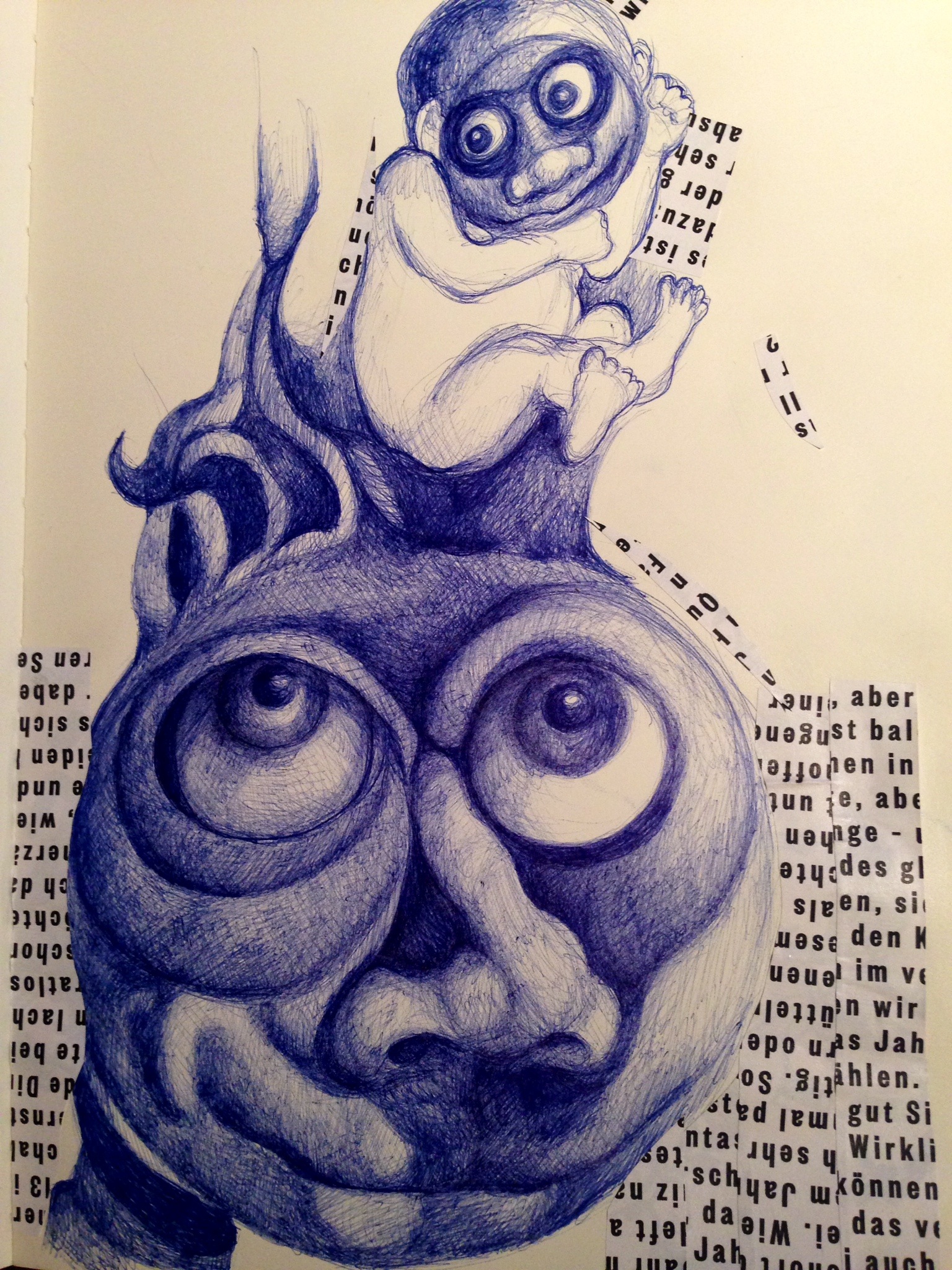
FotoIt did not quite surprise me when these two made their appearance today, half way through the twelve nights, when mind and hand start to relax and thereby the line dances over the paper playfully and feels free to follow the imaginative mind: Don Quichotte and Sancho Panza. If you’d asked me which fictional character I would most identify with the answer would have to be Don Quichotte.
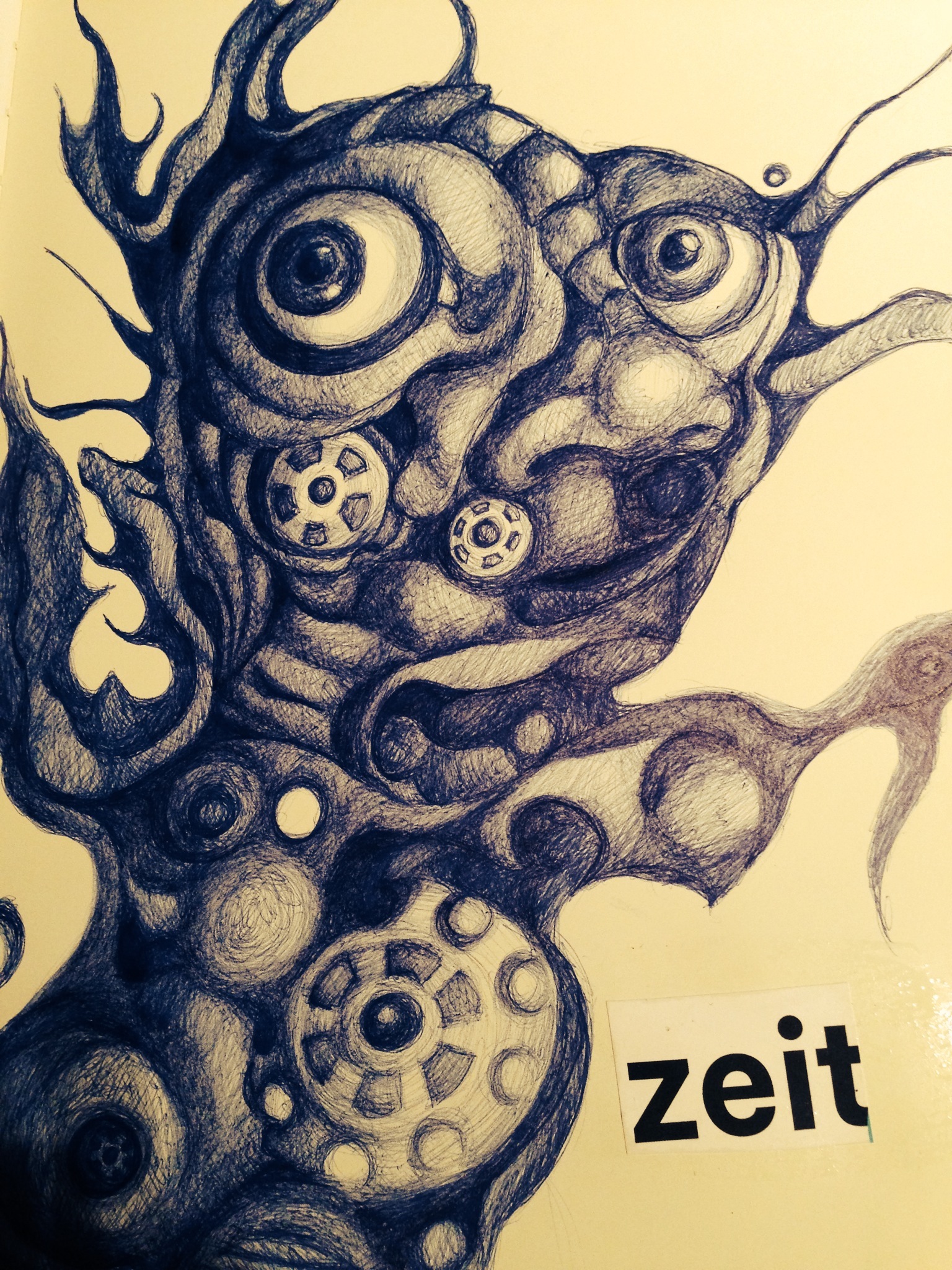
Though tonight’s version of the noble looser rather resembles a chimera, offspring by Typhon and Echidna, the mother of all monsters, a creature living and fire breathing, composed of multiple animals. Typhon, last son to Gaia, mother of all creation and creative forces. From Greek mythology to Cervantes 17th century parody to, I am sure, David Foster Wallace, the questions remain essentially the same: how to put together the fragments observed by a mind estranged from its own experience by the very act of narration, reassembling life very much like a chimera through a thousand eyes of literary characters and thereby celebrating the wondrous ability of humans to invent their own reality and then – quite bravely or quite cowardly but in all consequence – live in it.


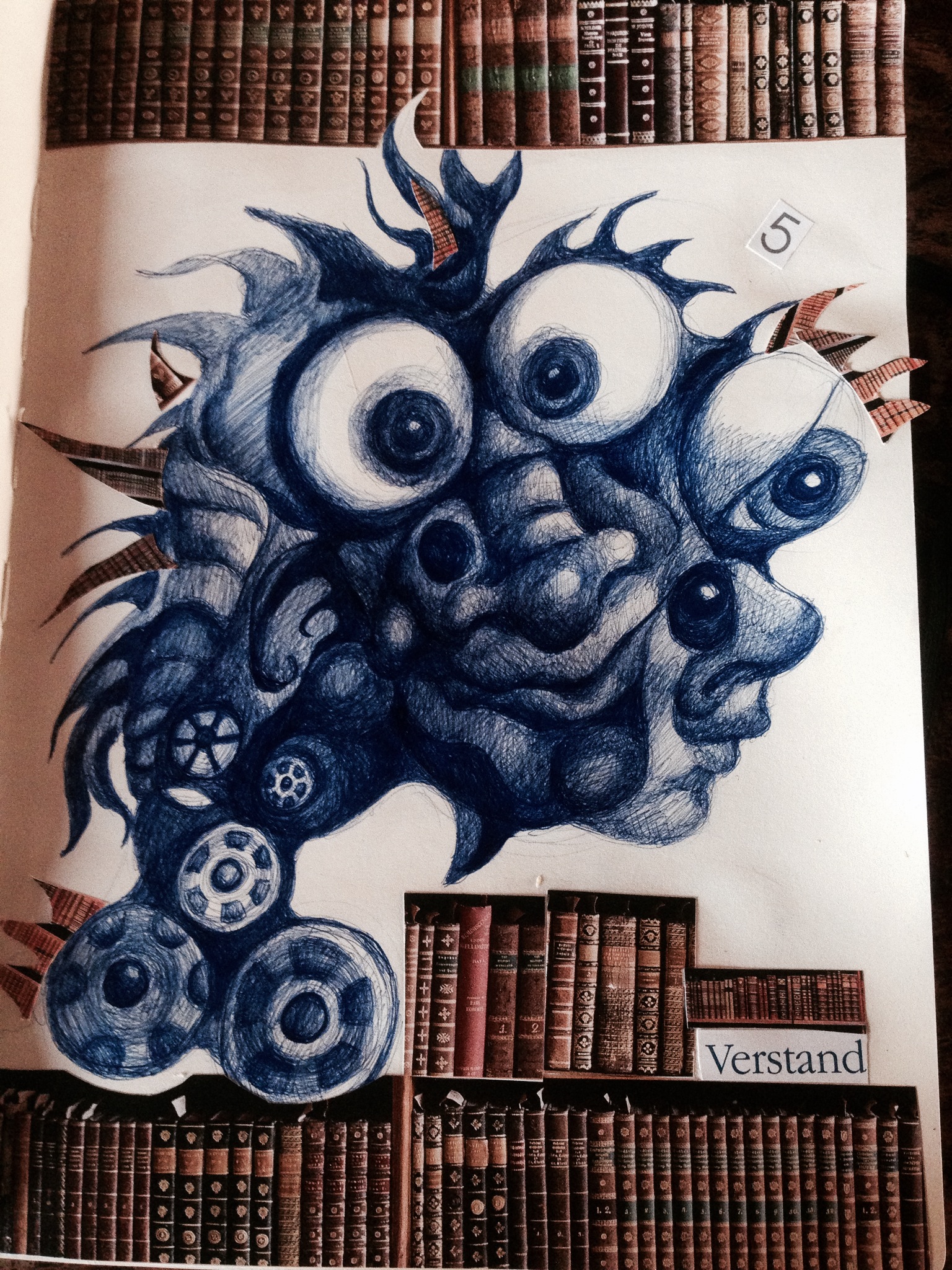
The fifth Night of Christmas – Dragons in their lair

 
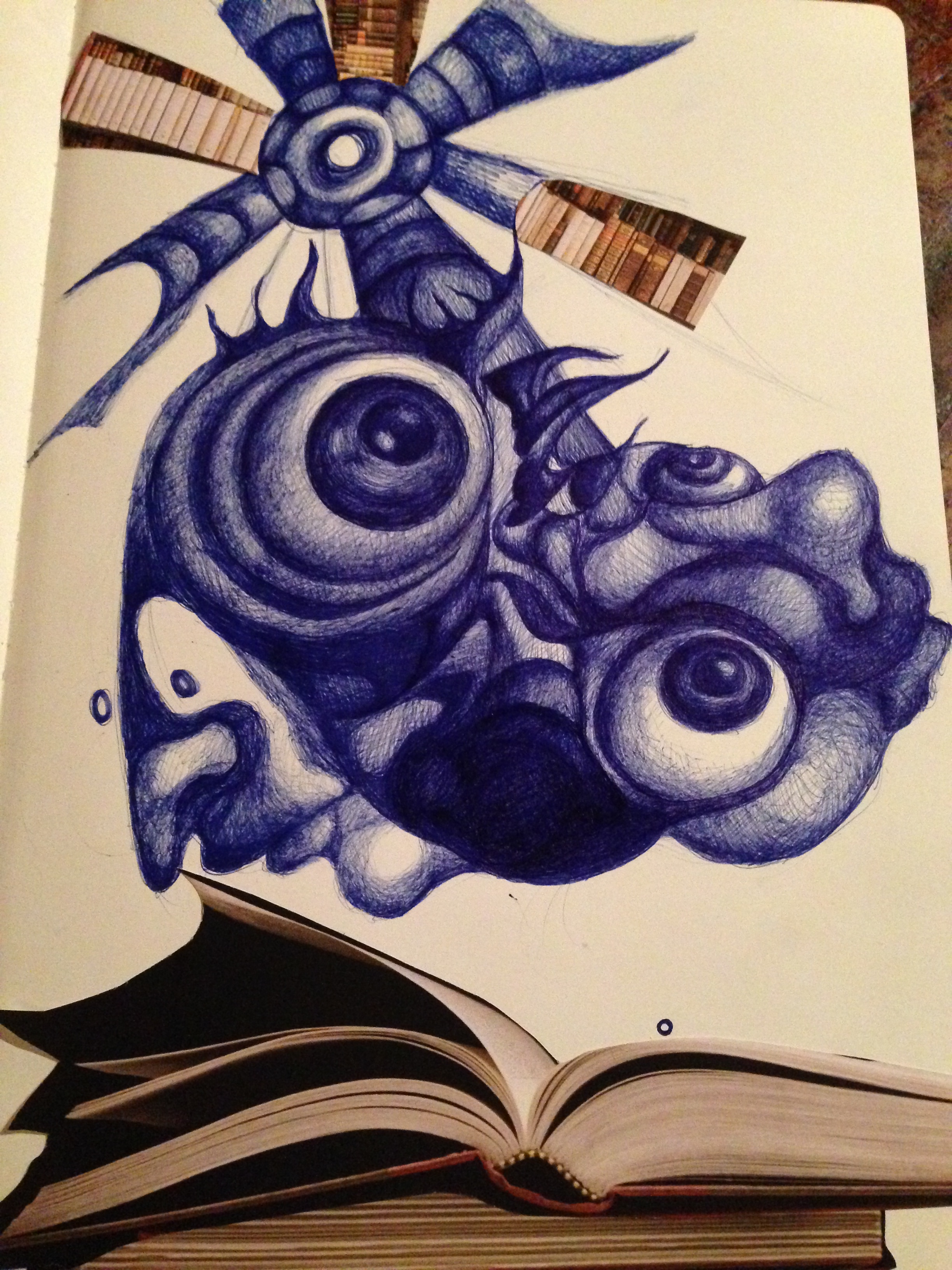
During the night, while I draw, I do not necessarily know what it is that I am drawing. I wait until the morning before I add the collage elements and complete the drawing. By that time I see what I have done the night before with different eyes. Every drawing seems like a message send to my future self. As often as not, I am actually surprised what it is that I have been focussing on. Like many artist I confess not to know what occupies my mind while I am drawing, I am just drawing.

The twelve nights allow me to focus on drawing despite the continuing demands of my other work. I made it hard for myself this year by choosing a technique that requires a couple of hours for each drawing – but it quite satisfying as well.

Writing and drawing have been part of my life for as long as I can remember – I’d like to think that the dragons in their library lair are an inside view of that dominant part of my brain that won’t let go of ART despite incentives offered to lead another life altogether.Foto

The Twelve Nights of Christmas – die zwölf rauen Nächte

Image 2The raw nights are the twelve nights of an older Christmas than the one people might remember today, pointing back to traditions and rituals even older. The modern annual ritual of shopping seems somewhat pale in comparison.

These December nights are the darkest nights in the year here up north. Just after winter solstice when the North pole is tilted 23,5 degrees away from the sun and all places with a latitude above 66,5 degrees North (Arctic Polar Circle) are in complete darkness, even in locations down at, let’s say, 54 degrees North, day light is scarce and valued. It was common knowledge to the old ones that they were at their weakest in this part of the reoccurring cycle of the year, prone to sudden grave illness and mental darkness. A dangerous time for the oldest and youngest of the communities, a common cold potentially turning to raging fevers and death within hours. Short the days and short a life!

Dating bad 4000 years, celebrations held during this time of year, lasting days, twelve days, ranged from drunkenness, carnival, debauchery to watchfulness, soberness and contemplation. How to address your own mortality or that of those dear to you, how to defend your mind against the equally luring and threatening  darkness, how to celebrate the return of the sun, how to trust the old covenant that there will indeed be another year? From Saturnalia to Christmas to northern pagan winter solstice traditions – the quest between forgetfulness to prayer to sober acceptance – cultures and people have proven to handle the same basic human fear very differently. But in the darkness up North, the projection of fearful images of the mind into the impenetrable darkness of the night has led to its own tradition of keeping the demons at bay. Making visible the creatures of darkness through watchful contemplation while guarding the night is a time tested way to navigate through the twelve days of the ascending sun light hours, defending what you love and believe in against the already receding tide of darkness.

This is what I have chosen to do for years now with the raw nights: defending what I believe in against the already receding tide of darkness by illustrating, making visible the creatures the darkness projects into the mind. The modern mind, as the Romanian philosopher and historian Mircea Eliade pointed out in his book “The Sacred and the Profane”, may be but a thin veil to the archaic mind that is still bound in fear and intuitive defenses against the danger lurking in the dark even if the dark may be no more than the fear of monsters hiding under the bed in a well tempered room today. But I feel that reenacting  the custom of the night watches by picking up pen and paper for 12 nights is more a sober and mindful transformation of old human knowledge into my own experience of time than a regression into the archaic mind.

Coloring a map of the United States with Sennelier pastels

IMG_3159My mother was busy preparing dinner and answering questions my sister had while sitting at the big wooden table and doing her homework. This evening she was coloring and cutting out the states and gluing them in the right place on a map of the US. Both my sister and I hated coloring in worksheets and my mother had brought out her expensive Sennelier pastels to persuade my sister to employ some effort on the task. The map as far as it was completed looked like a beautiful velvet patchwork quilt. You can’t achieve that with your Crayolas. I wondered whether her teacher would be able to appreciate the difference.

Montana was already pasted in its proper place. It was colored in layers of gorgeous deep Indigo and now, with a vengeance, Phoebe was wasting pale Vermillion Orange on Idaho. I sat down at the table and watched her. There is something nice about a little kid coloring in even if she detests it. My mother walked past me and ruffled my hair in a distracted way. It was just as much part of her dinner routine as cleaning dishes right after using them. For a moment I was back in a comprehensible, friendly world. No opportunistic cannibalism, no aliens. Phoebe pasted Idaho on to her map and contemplated color choices for Washington State. “Why do they have to be different colors?” she complained but her heart wasn’t in it, you could see that she did enjoy choosing a new pastel stick. According to my mother you can never work with materials that are too good and you should always strive for beauty but I still felt a bit doubtful whether you actually needed art pastels to complete this kind of homework.

Phoebe still had the whole west coast and Alaska to color and paste and she grunted disapprovingly as she studied the worksheet after cutting out Washington State. Washington was going to be Cinnabar Green. I liked the way she held her tongue between her lips when she had to cut something out or color something in. She looked a lot like Plinius, our cat, after his dinner when he sits down on the table and probably contemplates dessert choices waiting outside in the dark beyond the kitchen door. Phoebe looked like that whenever she was focusing on something. Right now she smeared Cinnabar Green all over Washington. The pastel stick made a fat, smacking sound on the paper. At the kitchen bar behind us my mother cracked an egg. The splintering sound  was very clear and pleasing to me. I thought that recently I had been much more perceptive to small sounds. Only this morning on my way to school I had stopped to listen to the sparrows hopping over the path to the front door of our school, their tiny claws scratching the bricks. How much does a sparrow weigh? 35 g?

the nonsense dictionary of lifeforms on Helium-3 and other insignificant by-products of music-poisoning

English: Spectrum of helium
English: Spectrum of helium (Photo credit: Wikipedia)

or: when will we start to harvest the moon …

surprising studies show that if the anti-venom of bureaucratic correctness  is not injected in time and the victim instead continues to breathe slowly through the nose, the seemingly alarming condition develops from a hallucinatory episode to a temporal ability to find one of the hidden doors into the helium-3 universe. the first sign of this conversion from the three-dimensional limitation into a full comprehension of the “it” including helium-3 is a steady stream of blue light from the nostrils. this oscillating string of conscious matter should not alarm the victim nor bystanders as it is not a loss of matter but a reconfiguration of the same. slightly nasal intonation after readjustment not uncommon but overall harmless. for reassurance the progress of the victim’s condition can be  measured at a frequency of 8.665 GHz (3.46 cm), which is emitted naturally by ionized helium-3. the comprehension of the fact that most of the matter in the universe is non-baryonic, that is to say not made of any subatomic particle that include neutrons and protons, and that this matter is thought to be the primary source of gravity recording the constellation of the universe like the grooves on a record record a song, allows the observer to deduct from the state of rapture that the poisoned mind is – for a moment – privy to nothing less than a fusion of dark matter with consciousness, the first music of time.

an intervention at this point seems not indicated.

from: the dictionary of lifeforms on Helium-3 and other insignificant by-products of music-poisoning

ART – creativity from down the rabbit hole …

the white rabbit's cardTo be creative is a basic desire of humans, all humans. It is a genuine expression of who we are even before we are defined by our social and economic circumstances. To teach a child to be creative therefore seems to me an elusive act. I look at children with a sense of awe, they are still there, right at the origin, and all I do as an art teacher is to take them on the same kind of  long walk that I had been privileged to undertake with my grandparents and I simply allow them to discover their world and to collect at will what responds to their own desire of creating this world new. If we’d allow our children more freedom and time to explore their own world and provide them with materials that are not dedicated to specific purposes, we could cut back on many extracurricular activities. Let them venture out there and the artist that lives in every one of us but is acutely alive in our children is ready to meet all the great challenges of art right in our neighborhood.

Children’s books and art

photo-2

In my work I feel inspired by artists like Jim Henson, Maurice Sendak, Edvard Gorey, Tatjana Hauptmann, William Steig and Uri Shulevitz who are often underrated in their artistic merit due to the fact that they have published work for children. The archetypical quality of a simple story or image can be very powerful. More recently I have come to greatly admiring the work of German artists Albert Schindehütte (Hamburg) and Einar Turkowski (Kiel). Both of these artists also chose to illustrate what one could see as children’s books but I suspect their work is being  cherished by children as well as by artists and people who love art. Their illustrations hold an inexhaustible, dependable pleasure for me.

Art and me, or: The crowd at my breakfast table

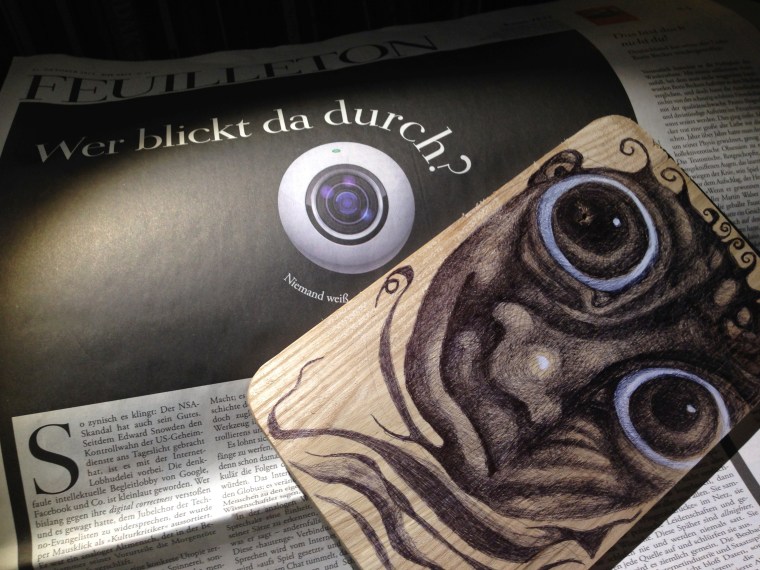
Wer guckt da durch?

Art and me, we have a strange and very complicated relationship. I have been chasing it with determination and desperation, and it has cold-heartedly denied me. The pain of rejected love is cruel, but I submitted to it only so long. I retreated, admitting defeat was the most dignified thing to do in this situation, I thought, and I became a lawyer. But then, surprise, instead of going its own way, art took up a habit of following me instead, never quite disappearing out of sight, yes, I would say, teasing me, challenging me.

Eventually, we made up, kind of, since then I have been treating it with respectful nonchalance,and it has been faithfully and annoyingly waiting for me ever since at the breakfast table, casually asking me: “So, what are you up to today?”, not being offended by my silence while I am hiding behind my crucially important notes for the day, while I am all business, anticipating legal arguments and dictating the first legal brief in my mind, instead asking again, equally casually: “Mind, if I tag along?”, and I – with an air of studied indifference respond: “Sure, why not?”, and out the door we rush.

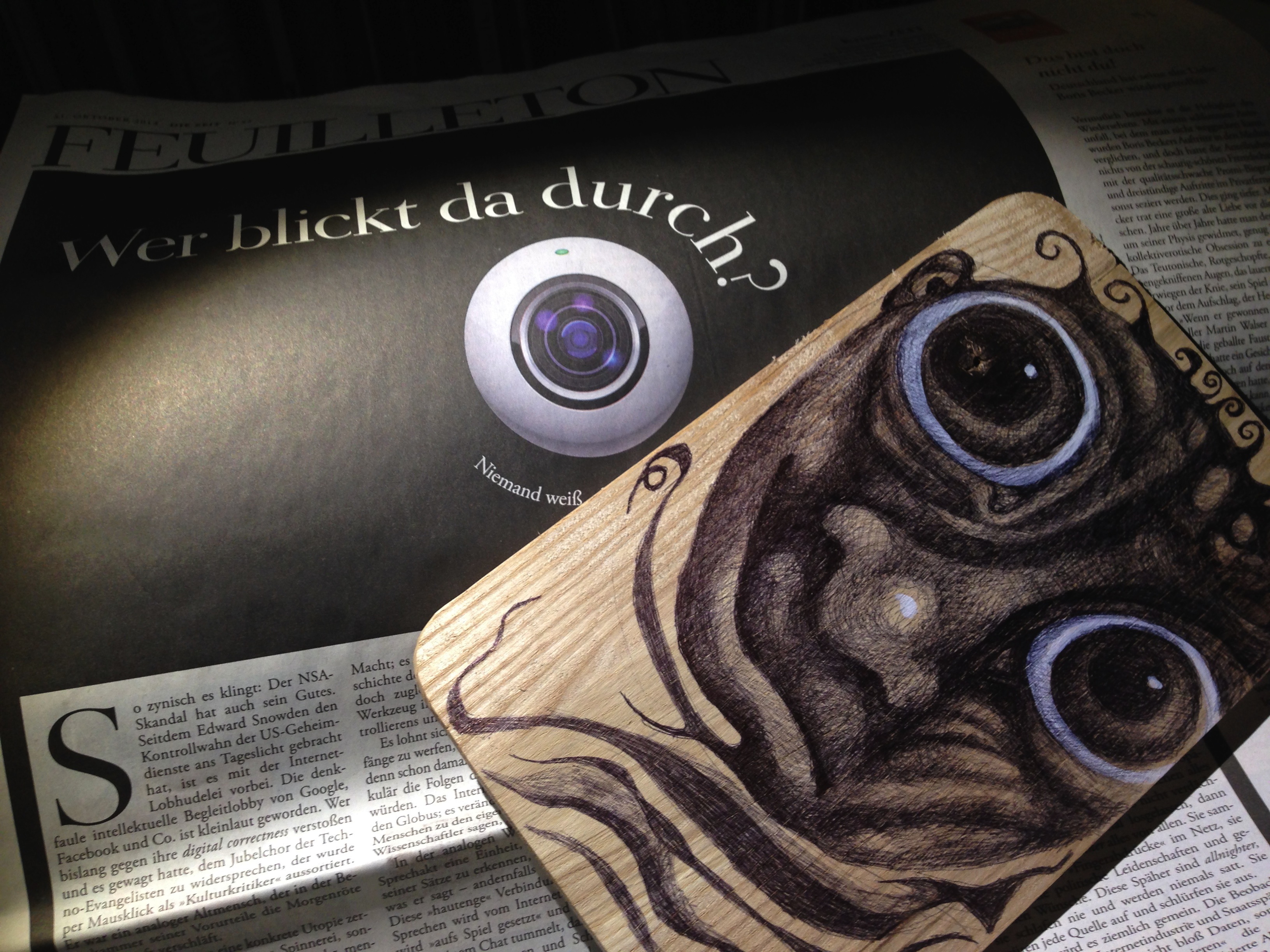
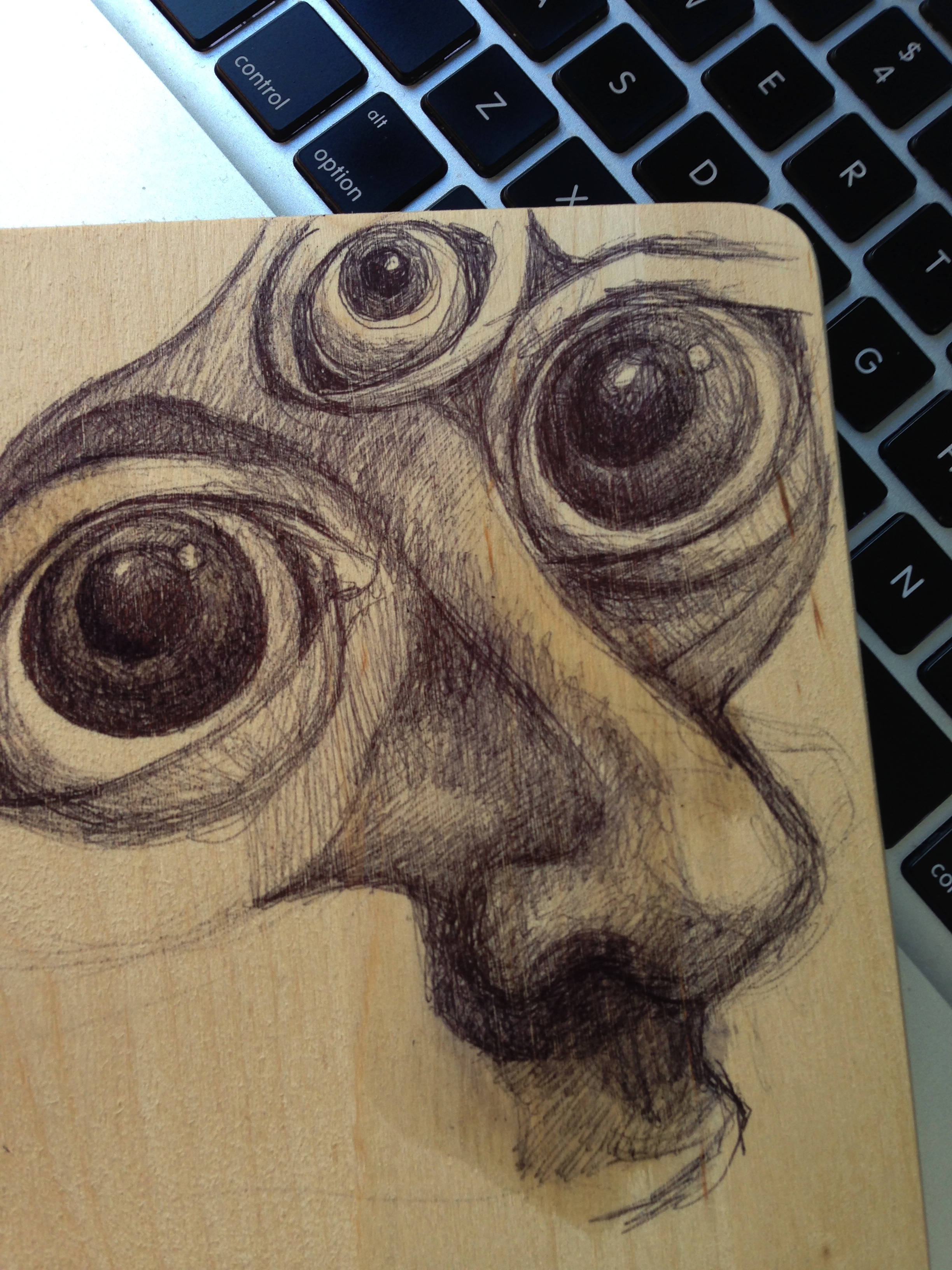
And when I come home in the evening and I open my very important briefcase out tumble bits of this and that, drawings on note paper, done while I was on the phone, creatures with big eyes while I was thinking about security of data transmission, one of my new wooden drawings “Watch out while you are being watched” over a quick coffee break. At home I don’t know how to archive the mass of these  bits and pieces anymore, nor where to store the heap of casual paintings done at night, JUST because, and during every free moment and I feel like I imagine the husband must be feeling who doesn’t quite know whether he is cheating on his wife when he spends time with a female friend his wife is well aware of or whether he is cheating on said female friend when spending quality time with his wife.

Garbriel Lorca, the beautiful Spanish poet who was murdered by the Nationalist Forces shortly after the beginning of the Spanish Civil War in 1936 – who really was a much better poet than an artist expressed it very much the same way, because he loved drawing, tenderly calling it his “mistress” while he stayed married, of course he did, to his writing. I remember reading in a small, illustrated Lorca volume I had bought at the Heinrich Heine Buchhandlung at the main train station of the Berlin Zoo station – a book store that was as great and complicated and deep and full of books and ideas about books as it could possibly get, probably a dependance of Borges library. I was twenty and attending classes by Prof. Robert Kudielka at the HdK, the University of Fine Arts in then still Westberlin – while actually meaning to study law at the Free University. You see, from the beginning this was a complicated thing and the small Lorca volume seem to me like an announcement of something I was not ready to grasp yet. I still own it.

I got constantly side-tracked during those years because of places like the Heinrich-Heine book store where they absolutely supported the idea of spending your entire cash worth a month of earnings at  some student’s job on a heap of books you could just so carry to the register – after first staying for what seemed like days in the sacred railway catacombs, resembling a labyrinth of overpacked shelves. You’d come out with marvelous finds, books that had been hiding for decades, books unknown even to the book seller, and you and the book seller would jointly rejoice in the find, and the book seller would come up with a fantasy price for the book because the one displayed on the inside of the cover seemed – unreal. 51 cents, Pfennige, or something like this. So, you’d pay 2,50 DM, and it wasn’t a used book, it was a book that had been waiting for you to be the first owner patiently since about 1953, well over a decade before you had been born and even more time before you became literate and then some more.

I got constantly side-tracked because there were the collections of old masters in Dahlem, one S-Bahn station before Thielplatz, my law school station, and you’d only guess that I must be a somewhat decent lawyer for passing my exams besides the fact that getting off the train in Dahlem to for a small detour through the beautiful tree-lines streets of Dahlem as often as not ended up with an entire day in the collections, studying Rembrandt and Baehr and flemish artists instead or, if I made it to class in the morning, not returning from the university’s cafeteria at lunch time because it was located pretty much right next to the collections.

I am actually now practicing law, specializing, surprise, on art and law, and art still has a very sly way of side-tracking me. Maybe it has something to do with the fourteen years I spent in New York, idling away time at the MoMA and the Met, and at Crawford Doyle booksellers. Art has always influenced the Why and Where, has seduced me to accept situations I would not have dreamed of for the sake of studying a Vermeer at the Metropolitan Museum of Art, Calder’s Circus at the Whitney, or rough Miro drawings at MoMA or Gerhard Richter‘s black and white paintings at MoMA, Odilon Redon, Armando Reverón, Richard Serra, Lucian Freud, Swoon, Kiki Smith, Marina Abramović, Nancy Spero, my appetite may have been more voracious than discerning, but it found nourishment as I found distraction from more pressing questions and challenges and time passed swiftly as I was holding still, holding still and just looking and looking.At times that seems my main occupation. Looking. Thinking. Understanding. Reversing. Looking again.

Sometimes now I suspect that I do what I do – including law – because of art not despite, but I am loath to follow up on that suspicion. For now, I like the casual question in the morning, the uncertainty, the “Wow, this is still going on” and with as much determination and desperation as ever before. One could not ask for better. Want me to tag along. Sure.

By the way, above drawing is one done on the side, complementing a serious legal interest of mine. Even as I write this blog. Who is watching you? I am still married to the law. But if you made you way through to here, you realize that I as I have spoken about “art” as a single occupation I have really referred to two loves: Writing and painting. Now, that is – almost – too much for one life. definitely for one blog article that is already stretching the limits of a reasonable article’s length.  It’s a bit crowded at the breakfast table at times.