Page 4 of 6

someone’s watching you – privacy of data, an appeal / round two
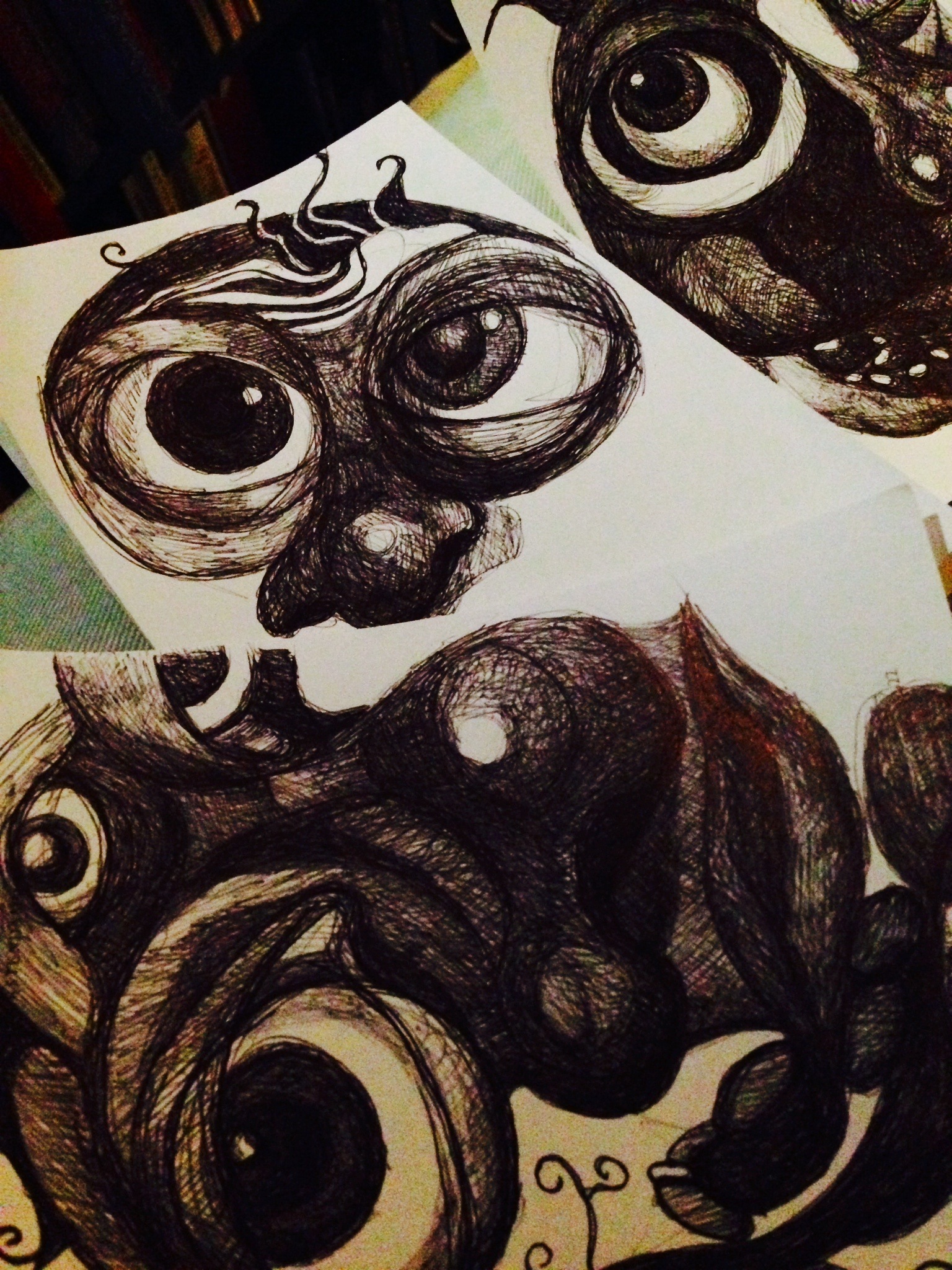
Image 5

“Writers must oppose systems. It’s important to write against power, corporations, the state, and the whole system of consumption and of debilitating entertainments. I think writers, by nature, must oppose things, oppose whatever power tries to impose on us.  … You know, in America and in western Europe we live in very wealthy democracies, we can do virtually anything we want, I’m able to write whatever I want to write. But I can’t be part of this culture of simulation, in the sense of the culture’s absorbing of everything. In doing that it neutralises anything dangerous, anything that might threaten the consumer society. In Cosmopolis Kinski says, “What a culture does is absorb and neutralise its adversaries”. If you’re a writer who, one way or another, comes to be seen as dangerous, you’ll wake up one morning and discover your face on a coffee mug or a t-shirt and you’ll have been neutralised.” Don DeLillo (Panic #1, Nov. 2005, pp. 90-95.)

And is it not at the same time a cynical paradox and the hybris of writers, artists and maybe even lawyers, yes, now that I mentioned it, certainly lawyers as well, that in striving to be effective, successful, sharp, persuasive, unveiling, exposing, revealing, uncovering the workings of the machine we also strive for the kind of recognition that neutralizes our very effort. This is still the romantic idea of the individual rebel, the genius writer, the brilliant artist, a sly title afforded with societal approval by the very system that is being accosted, criticized and opposed just because this honor neutralizes, even castrates the very effort it lauds. Don DeLillo writes accordingly in Underworld that true proof of existence lies with the recorder not the recorded, the one who does not have a name but the authority to write the code which makes time tick. My words, his idea, by the way.

If you did indeed value the corrosive of your intellectual ability  you would choose to remain unknown behind a work that was known for its efficiency. you would not buy the idea of the genius writer who ends up on a t-shirt or, for that matter, on Facebook where you can democratically and to no specific end be approved of by the click of a button, but you would anonymously and in a group of like-minded minds labor towards the specific end of a realization of your ideas.

this is, coming round from yesterday’s etude on the privacy of data, another appeal to keep private if you can and claim the right and authority to do so.
do you feel like you are being watched?

fearful knowledgeit’s because you are. the recent discussions about the privacy of data – or the absence of such privacy when it comes to any form of telecommunication or electronic communication – has revealed that for now that even the basic implications that could lead to a meaningful discussion of the issues at stake are at best only vaguely understood.

the increasingly public lives we seem to live obscure the nature of information even further. the general public as judged by news coverage and political discussion seems somewhat nonchalant about their own data privacy, maintaining that private data could not be of any use to those who fish for it (what do you care about what I had for breakfast?), and that those who had anything to hide should better be found out early, with other words that to the law-aiding citizen the privacy of data is not of great urgency. The sheer mass of private, non-relevant information creates the further illusion that what one reveals in electronic form was as elusive as a thought shared with a friend in a crowd of people.

to reintroduce the idea  that information may not be – as more commonly understood – an abstract observation extracted from a state of reality to communicate the specific nature of that given state, but instead the first cause to make reality, with other words, that information is to the “thing” it describes what the letter is to the word and the line that draws the letter is to the letter, to reintroduce this thought at the moment when countless legal aspects of data privacy are already causing the discussion to meander without true force, may be pushing the discussion to the brink of madness, but it could also turn out to be immensely useful.

“In the beginning was the word”, this grand opening refers to the provenance of the idea – translating thus the term “logos”, which refers to the inherent logic and order of things. The order of things as encoded in a word very much like a program that at the same time provides a building plan for a specific “thing”, is the cause for its realization and provides the necessary algorithms to build it. Furthermore, if the chosen word, data, information, has “wisdom” (Hebrew for “word”), which means: knowledge of the world as a whole, to speak the right word is to give the initial and irrevocable impulse for the creative act out of which reality follows.

Maintaining authority over that kind of knowledge as far as it refers to your individual data, even if it included plainly what you had for breakfast, whom you’ll meet for lunch and what your favorite color is, might be a cautious and recommended approach until you could positively rule out that this kind of data is indeed what makes you. That could be the making or the unmaking of you.


the art of evolution

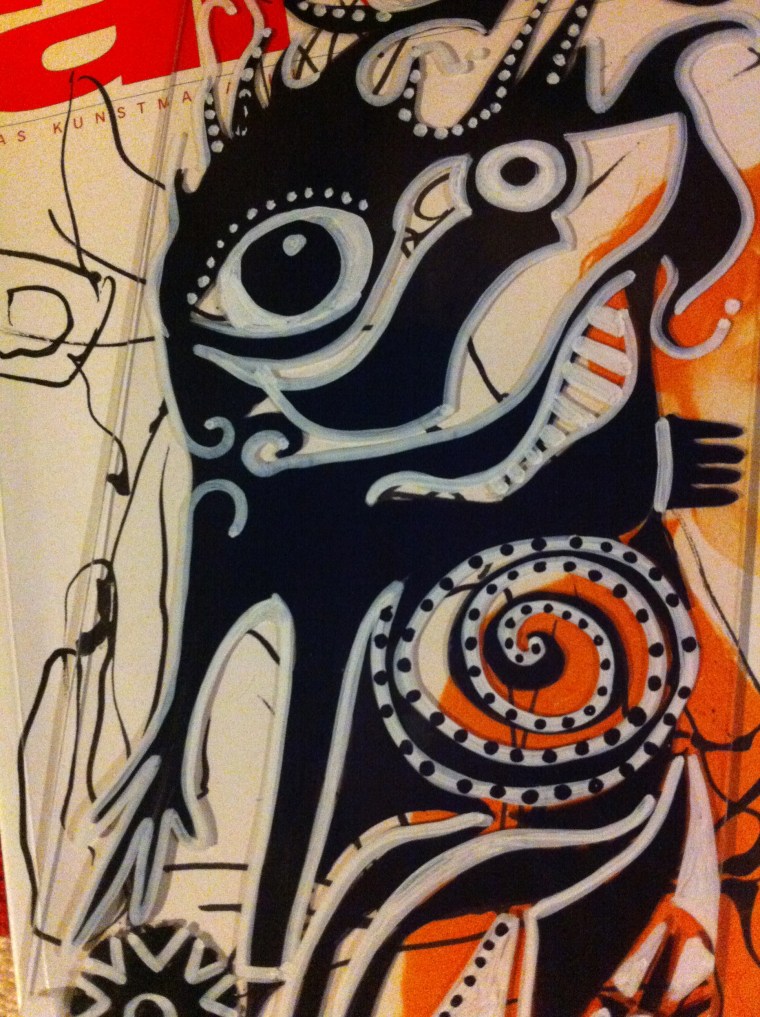
IMG_0875the line that weaves a monster creates a world of possibilities. hopeful monsters, evolution by systemic mutations, as developed by goldschmidt in his theory on “hopeful monsters”, provides, as a metaphorical recourse, the right to hope against all odds that what is uneven – think Kant and the crooked timber of humanity – might be not only necessary but at times preferable to what is normatively expected. (citation after: dartouth.edu/~dietrich/NRG2003.pdf
“a single mutational step affecting the right process at the right moment can accomplish everything, providing that it is able to set in motion the ever-present potentialities of embryonic regulation” Goldschmidt, R. The Material Basis of Evolution (Yale Univ. Press, New Haven, Connecticut, 1940).

everywhere and nowhere – a trip to berlin and back


IMG_0872IMG_0882


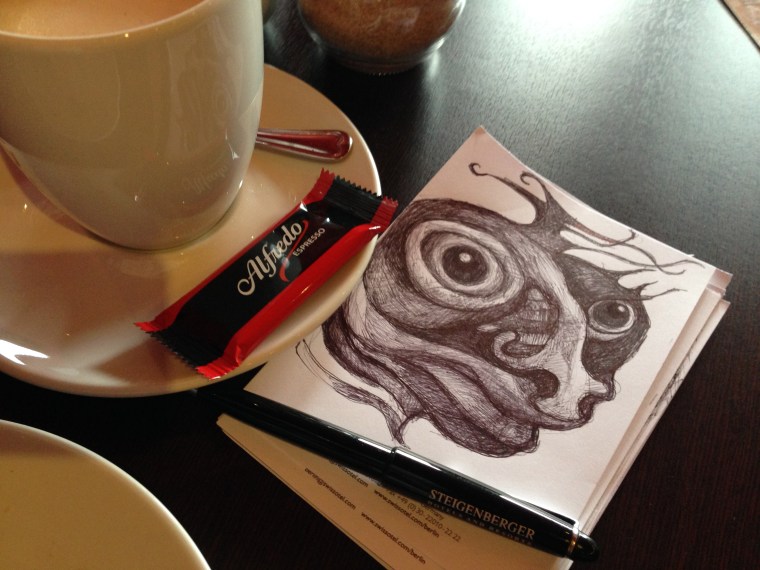
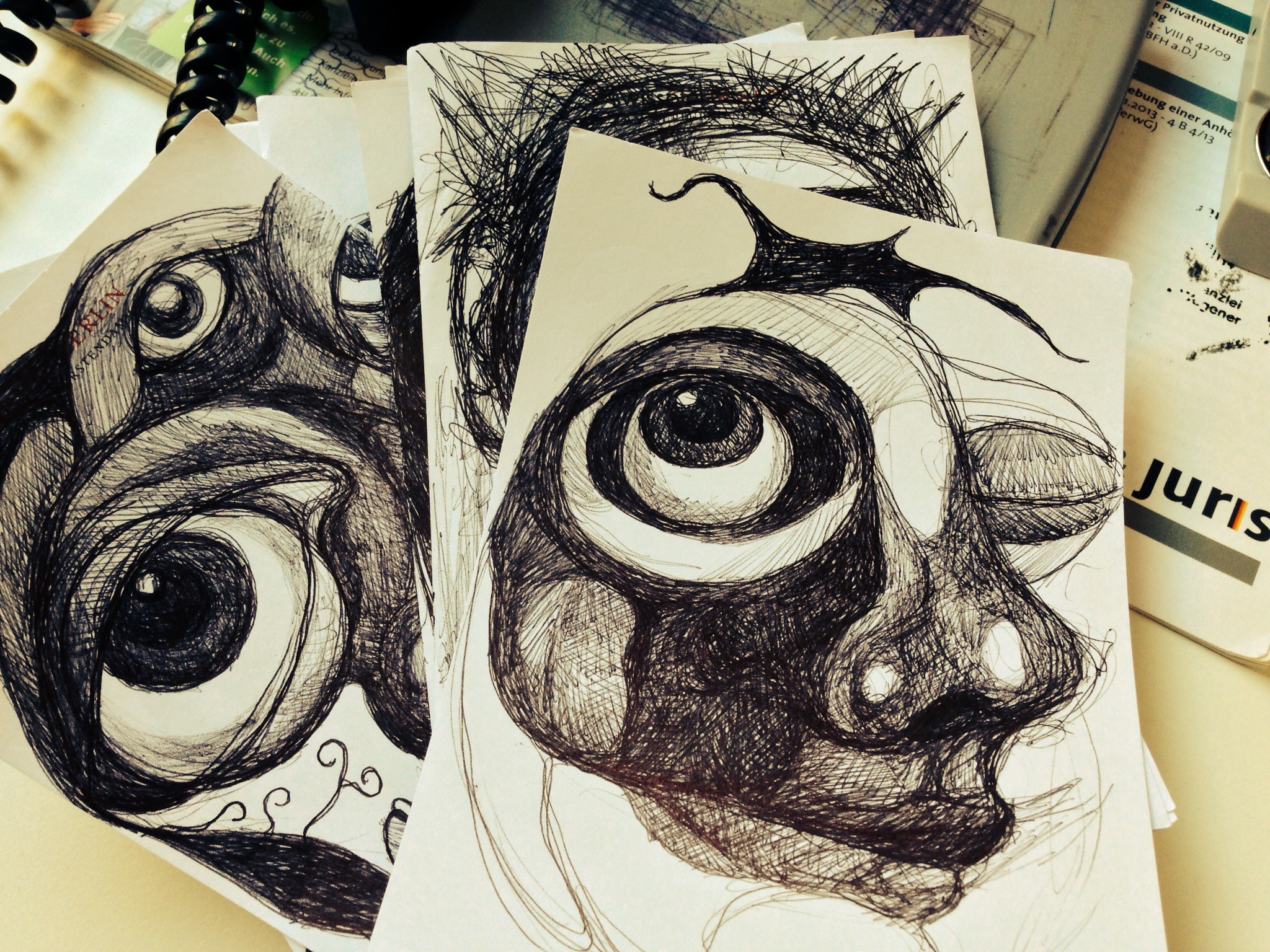
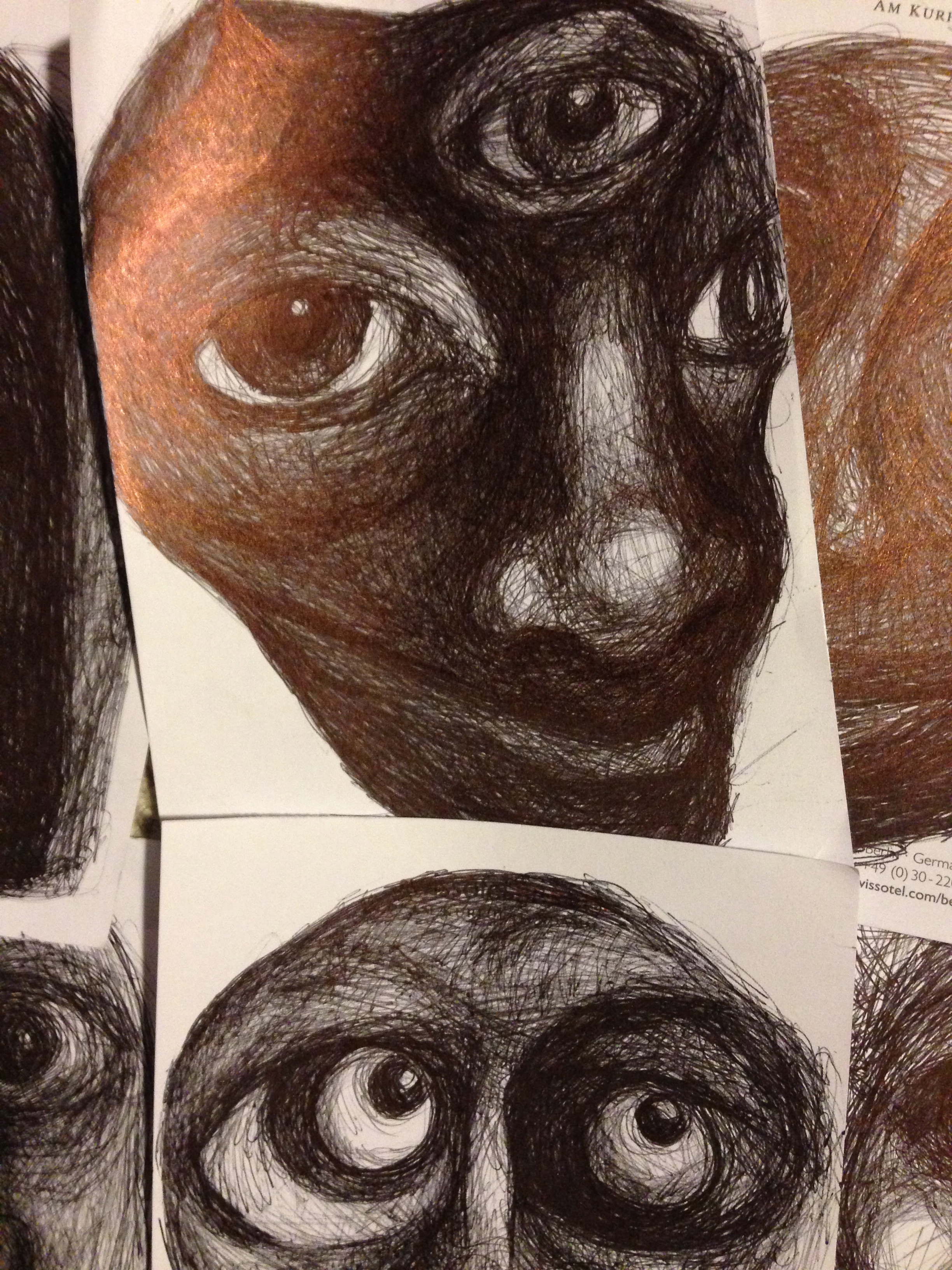
black ball pen, anywhere paper. while working as a lawyer specialized on the representation of visual artists, sometimes the time in between, travel time, waiting times, coffee breaks during a conference turns out to be a creative space in which not just some kind of creative maintenance seems to happen but actually – while I am using readily available art supplies like note paper and ball pens provided at said conference – something interesting, some original kind of work or an idea that will be worth developing. like this weekend. i added to my to do list for the day: buy plenty refills for black ball pens. something’s coming.

the nice king breathes the world into existence

kingi don’t count the times
when people ask me
whether i could draw something
nice
for a change

people ask me that a lot

can’t you draw something nice
for a change

don’t think it offends me,

it doesn’t but instead

it confuses me
because, you see,

in my best artistic moments
i feel, don’t laugh,
a bit, just a tiny bit of
gonzo in me, you know,
ralp steadman,
think hunter s, thompson,
and you know where i’d be headed
if only i could

if not for the sobering fact
that i am too nice, too nice,
and so are my drawings,
and i suffer for their niceness,
believe me.

or think edward gorey,
there are moments
when i feel a bit edward gorey
in the tip of my pen,
and i cherish that moment

i even visited his house once
yarmouth port, cape cod,
going spirit hunting,
so to speak,

but my art, don’t think
i didn’t know it,
is too nice, too friendly,
too innocent,
even to be rewarded the
term “goreyan”

yes, i admire
maurice sendak,
the wild things, obviously,
dah,
the night kitchen,
we are all in the dumps with
Jack and Guy
and
Brundibar

i wouldn’t pretend
i ever felt Sendak in my pens,
but i should be so lucky,
and he is not nice,
he is really wild
and a synonym
for “loud greatness”

and i am just
nice

so you see
why i am confused
when you ask me
can’t you draw something nice for a change?

because all that i truly hope for
in my art
is that one day
i manage
not to

moonflower

Canis Major as depicted in Urania's Mirror, a ...
Canis Major as depicted in Urania’s Mirror, a set of constellation cards published in London c.1825. Next to it are Lepus and Columba (partly cut off). (Photo credit: Wikipedia)

“Your fist like this”, she said, “covers about 10 degrees of the night sky.”  She moved my hand slowly over the dark water and spoke in her methodical way, no use to interrupt her. “20 degrees south-east of the belt of Orion, you see, there is the brightest star in the night sky, right in the constellation of Canis Major.” She waited for a moment for me to catch up with her. Our entwined hands travelled over the night sky and stopped. And there it was, deep underneath us, the brightest star of the night sky, as far as I could see. “Do you see this star?” she asked. “It is called Sirius. It is 23 times more luminous than our sun, twice the mass and the diameter of the sun. It is only 8.5 light years away.” The way she said “only 8.5 light years”, it sounded as if she was talking about a Sunday picnic destination. It sounded like: We could take the bike. It’s only 8.5 light years away. Before I had a chance to point that out to her, however, she had started talking again, and almost without warning, though in answer of my question, switched from her facts, from degrees between two points of light in the celestial sphere, luminosity and brightness, and mass of celestial objects, to a startling revelation.


fever and another barefoot stranger

fever and another barefoot stranger

The last winter before the completion of the new church he had an encounter with a stranger who had called upon him repeatedly and who was staying at the town’s only inn. He was dressed in simple, yet elegant clothes, cut out of fine, dark cloth. In a small town a stranger like this would normally have generated a great deal of curiosity. But he was so quiet and unassuming in his manner as to almost appear invisible. He went for daily visits to the rectory where he was served tea and would have long conversations with the pastor. The elegance of his appearance was so convincing that it took a while for the pastor to notice that the stranger wore but a kind of biblical footwear, close to being shoeless.

It was late fall. The trees were brilliantly red as if with religious fervor. The pastor felt alert, alive almost as if a lifetime of doubt and study suddenly held some promise, as if the dark aspects of his life were less weighing on him. Then the stranger came down with a severe flu which delayed his departure. High fevers made him delirious, and the doctor and priest both were called to soothe the rage which seemed to devour the man who had been a quiet guest until he came down with this fever. After three days he lost his consciousness and did not regain it. He died in the fourth night without the pastor at his side. The pastor himself was delirious in fever at this time and died only two days after the stranger.

time oscillating

IMG_5724

In the meantime I discovered the places where the seams come undone Every classroom in my school had a clock on the wall right over the door, and all the clocks had identical clock faces, and every one of them showed a slightly different time. I don’t know whether clocks in classrooms today are all connected to one central, totalitarian time piece as I suspect might be the case, though I hope it is not so.

I always loved the way time oscillated between classes, obstinately refusing to be tamed. Officially, students had three minutes to walk to the next classroom after a period ended. But for the way from science to math, for example, you’d better made do with 1 minute and 29 seconds – the clock in Ms. Kirsch’s class was as fast as our teacher’s ability to conjure numbers out of the back entrance to Hilbert’s Hotel and as inexorable as her refusal to admit to time measured outside her class room.

On the other hand, you could afford to leisurely stroll to French after that, using not only the 1 minute and 31 leftover seconds from math but also the 40 seconds the French clock was late, giving you an ample 5 minutes and 11 seconds (not counted the additional minute or two Mme. Petite rustled with her papers, ignoring her students’ ongoing conversation).

The clock in language arts had the peculiar and infamous habit of stopping at exactly 12.00 pm every couple of weeks and could only be persuaded back into service by Superintendent Segrob who, for that very reason, was particularly fond of it, and year after year insisted on repairing rather than replacing it.

Every day for a few moments just before noon instruction in language arts paused and everyone’s eyes followed the unhurried second hand making its way from 11.59.59 am to 12.00 pm. It was almost like a pagan ritual, these four seconds of silence, as if we were paying our respects to the spirit of the clock, Time. Time, sputtering, fleeing, stopping, resuming its course, divided itself up over the 79 clocks in our school according to its own preference. With other words, it seemed to be on our side and refused to be institutionalized.

I know that the language art clock did not stop on that day. I don’t think it would have been possible for it to stop while I was willing it on. Apart from Time herself though nobody noticed that I counted every second of the school day, 24,000 seconds in all, stops, gains and losses, until, at last, the 2.47 pm bell wrapped it all up hurriedly and dropped the leftovers for the time dogs.

a walk without you

a walk without you

unless looking into a mirror
one only sees the world ahead
void of the self
that otherwise
seems inescapable.

in a world before
silver mirrors
and gleaming, reflecting
surfaces
one would only catch
one’s own image ever
as a fluid ghost
on the surface
of a still water.

maybe the self
was more fluid then, too,
less defined by the
expectations that came
with the knowledge of one’s
appearance.

once you asked me
what i thought the world
would be like
after you were gone
and i told you
to just look ahead.

today i took the same walk
and i can confirm
what i said back then.
the world is still
the same
void of you
as it was with you.

only someone walking
behind us would have had
a different view
of our world,
a view that would have
included us.

but through my eyes
the world ahead
the curve in the road
the tree that bends over the path
the fence with peeling
– or fresh –
paint depending on the
time of year
still does not include us,
never has
and never will.

i am glad
that the small path
we used to walk
does not depend
on our presence
to be lovely.

only the fluid images
of you and me passing by
the quiet pond
used to acknowledge human ghosts.

but those did not take up much space
and one barely notices your absence
as only one of us
passes by.