Mr. O´Leary encounters an act of kindness


Mr. O´Leary was highly suspicious of acts of kindness. He had been working in a field – contract law – where nothing ever was what it first seemed to be. As a lawyer he had had to train himself to question not just every contract presented to him, but to question even the expressed will of every client who came to him to have a contract drafted.

This was kind of the connecting negative puzzle piece to the legal plain-meaning rule, a principle used by courts in interpreting contracts that provide that the objective definitions of contractual terms are controlling, irrespective of whether the language comports with the actual intention of either party.

Mr. O´Leary was a specialist in creating contracts that satisfied plain-meaning-interpretation, eliminating inconsistencies and double-meaning phrases, extracting the literal content of the contract from the hidden intention of his clients without making it plain that other than purely legal and contractual reasons were actually motivating his clients to sign a contract that was written thus.

His guiding principle in understanding the lawyer-client relationship was that clients expected him to know about them and their intentions without telling him, in fact, for him to know what they could have known about themselves but preferred not to know and thus would not relate to him in plain terms. He considered it his job to shield them from this kind of painful, self-reflecting knowledge and he was supremely certain that his clients expected him to not ever let them know what they preferred not to know about themselves but to keep it disguised from them while at the same time adjusting the contracts to their hidden goals thus allowing them to continue to feel – reasonably – good about themselves and at the same time satisfy – and justify – their true goals.

When he was a young lawyer still – and green with it – he executed – to the letter and in an irreproachable manner – what clients told him to do and wondered when they paid their bills without complaint and still carried their business elsewhere afterwards. But he was quick on the uptake and soon adjusted his business conduct. There were certainly things they did not teach you at law school. Ever since he´d adjusted his guiding principles , clients, high paying clients, knew how to find him even though he was literally hiding amidst his file boxes like the Minotaur at the heart of the labyrinth Daedalus designed.

A graduate and scholarship student of the University of Chicago Law school Mr. O´Leary in his day had had his choice of law firms who´d have been glad to consider his application. He was extremely smart and had an impeccable work ethic. He´d also been subject to the same prep-talk (he called it propaganda) of „success“ as his class mates. Judged by how their alma mater described her alumni they all were but a group of friends who would pick up the phone anytime one of them called with a question and sat down with him to walk through issues. According to their law school they all were extremely fun, thoughtful, smart, and FUN students, and would continue to bring the same energy to their work as lawyers.

It was not that he did not appreciate the excellent education and rigorous academic training he had received.He also knew that the average salary for newly minted law graduates was nearly about $180,000 per year by now and that the graduates were worth it. It meant that as a lawyer with no experience he could have immediately be in the top 5% of U.S. earners. But for some unfathomable reason he also knew that students graduating from a top tier law school were the same as people on average with the only – significant – difference that they were subject to more diversion and temptation.

He did not graduate top of his class to be diverted from life. He could have taken three or four top performing associates from any top law firm and founded his own big law firm as a naming partner. It was all within his reach. But it was not what he had wanted.

If it seemed strange to others that he had accepted Mr. Letterman´s offer to become a partner on 35th street rather than to join one of the top ten law firms in New York and get worn down as an associate there before being hired by an excellent law firm and becoming partner eventually it was because they did not know some of the things about him, he thought he had realized early on.

It was not a sign of humility that he had chosen Mr. Letterman sen. instead. It was not exceptional that he did not get drunk on the prep talk of success. He had not been a recluse in law school. He had actually differed from the other highly motivated graduates and future pilars of society in a degree up, not down, by a notch. He had wanted more. It had been an extreme act of arrogance and late-puberty idealism (the same) and the result of careful research. He had been very clear to himself about what he thought he wanted and what he thought he did not want.

He was convinced back then – and was convinced still – that life mostly just happened to people, even or especially people who graduated from top tier law schools. Even early on in law school, he was convinced that people wasted about 15 – 20 years of their lives and took another ten to rectify their initial mistakes, if they were so lucky to live as long as that. He was not going to be cheated by life in this manner.

Mr. Letterman had an excellent reputation. You did have to know  how to find him. The office address was not sufficient to get in touch with him. But Mr. O`Leary was a good observer. Mr. O´Leary had also been told that Mr. Letterman sen. was legend and did not accept any applications. He had been told that even if Mr. Letterman would accept an application, he´d be likely not to pay the kind of salary that a University of Chicago Law school graduate legitimately could expect as a starting salary. This was concluded by the state of Mr. Letterman´s cramped office and filing system.

But what mattered to Mr. O´Leary was something fairly abstract and elusive: he was convinced that Mr. Letterman was one of the few lawyers he´d ever encountered who was in charge of his own life. His research showed that nobody took Mr. Letterman sen. along for a ride. As Mr. O´Leary saw it, Mr. Letterman owed nobody a kindness. He certainly did not owe him, a recent graduate, an opportunity to reach out for the kind of life he thought Mr. Letterman had found. He knew though he was depending on an act of kindness for Mr. Letterman to accept his application.

Not that he believed in it. In kindness. He had been practicing law for many years now and he had lived in NYC for as many years and he was sure, absolutely sure, that he had never encountered a genuine act of kindness apart from Mr. Letterman´s willingness – as many years ago – to accept his application.
Alternative pathways to the primary visual cortex

impeached kingHe turned around and looked in my direction, his dark glasses reflecting the library lights like distant stars. Then he smiled. Automatically I smiled back at him, but then I remembered that he was blind, and my smile froze. I was frantically searching to find an appropriate opening sentence in my vacant mind. He held his smile still as he was addressing me. “I think we have a mutual friend, Ms. Clarice,” he said kindly, not commenting on my rude behavior. I was now searching for his eyes behind the dark shades and instead encountered my own mirror image, small like a doll. “I am sorry,” I finally stammered, addressing the little doll more than the man, “I am really sorry, but how do you know who I am?” I was still being rude, I realized. The small person reflected in the distant mirror of his glasses I had taken for my own reflection made an unexpected move that startled me even more if that was possible. She took a mocking bow towards me and disappeared into one of the bright reflections of the lights above. “Things are not what they seem, Ms.” responded the old man, why don’t we sit down somewhere so you can ask your questions. My name is Dr. Aaron Hausner. And who might you be?”

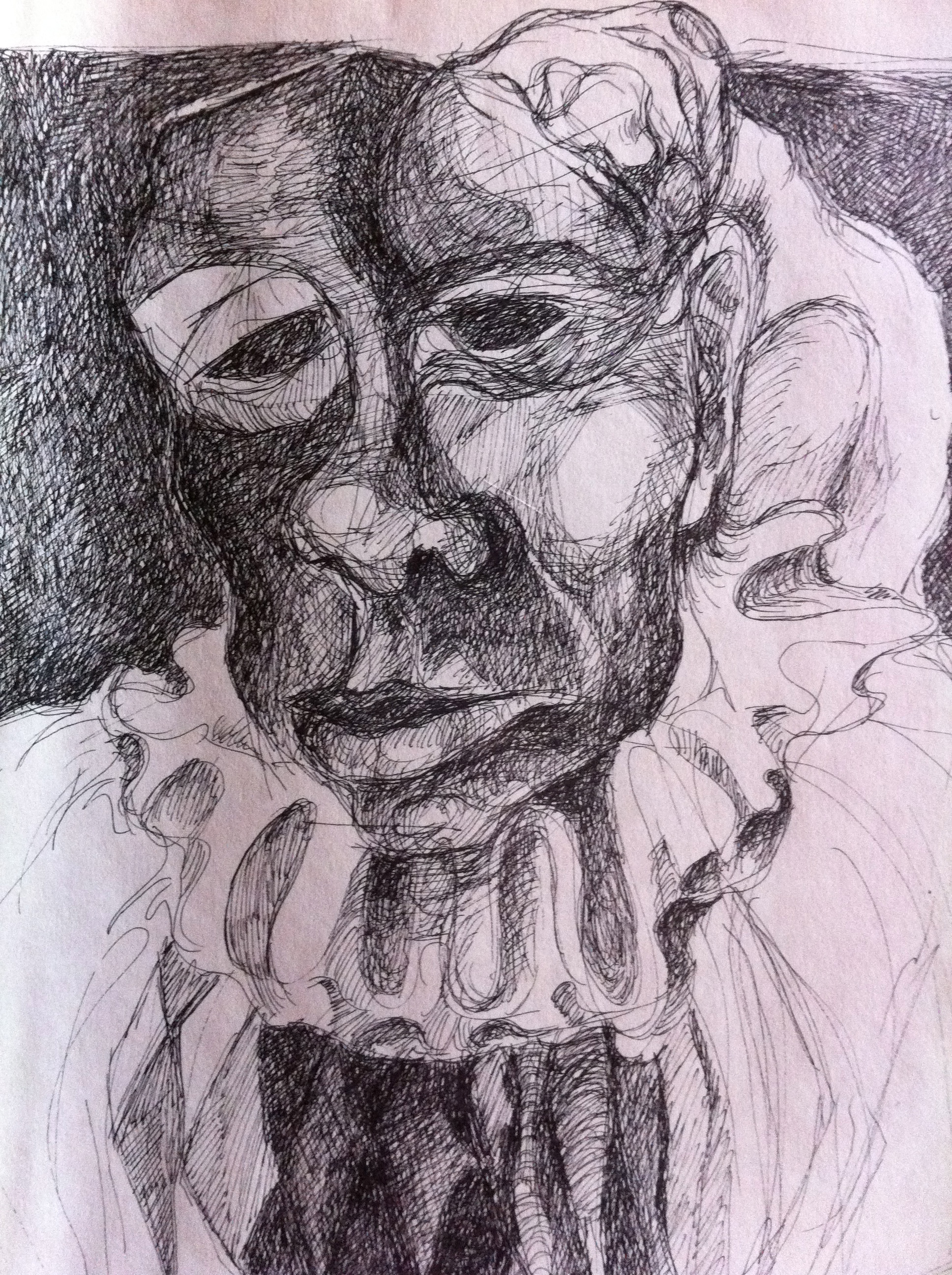
Dr. Hausner dedicated a long time to me. He was soft-spoken and had an uncanny ability to predict my next question – yet, at the same time he did not once directly answer any one of my articulated questions. After we had occupied a spot in a somewhat secluded corner of the library – he had been leading the way without ever hesitating – he had again turned directly towards me and had started speaking with a soft voice. “The route from eye through the primary visual cortex the is not the only visual pathway into the cortex. Other pathways exist that bypass the primary visual cortex. A blind man like me can learn to trust those pathways though they do not stimulate a sense of optical vision. I do know whether there is an object in my way, approximately which size it occupies and whether it is mobile or fixed in place, of organic or inorganic nature. I also know whether a person directly faces me or wether I face a person and whether this person smiles at me. Scientifically this phenomenon is called blindsight.“ I felt like a fool. He answered. “Don’t feel bad, most people feel inhibited when they first address an apparently blind person. And to be honest, not all blind people know about this phenomenon either, though most blind people I have talked to could relate experiences that strongly point towards their ability to process some visual information even though not in the way they expect.” I was stunned. We were silent for a moment. Finally I found my voice: “My mother is an artist. She draws objects as an intricate net of lines, and though the object is not directly represented through these lines, with a bit of patience one can usually tell what the drawing is about. I mean, you can see the object though you clearly can’t.” I drew a deep breath. Dr. Hausner seemed to listen but he didn’t come up with a typical grown-up response like: How interesting of you to point out the similarities between an artist’s perception and a blind person’s perception.

retail culture

IMG_3250A parking lot and two blocks worth of retail place ankered around a Barnes and Nobles book store had replaced the industrial clutter of deserted flat brick buildings and weeds she had known like an internal landscape of suburban dread for all of high school. The place now had the mark of a new era of tidy franchised architecture, the clocks had been reset to zero and were running fast. Fifteen years count-down to decay, or to the day the last book would be printed, whichever came first. There was no emotional reaction to the replacement of her childhood environment with these exchangeable elements of retail culture. The fact that it was nearly impossible to tell whether she was in New Jersey or California actually felt kind of welcome, delaying the realization that she had indeed come back. She pulled into the parking lot next to a brand new looking silver Ford SUV with enough space to accommodate a mini baseball league team but most likely outfitted with only two child safety seats and DVD headrest monitors. It was still raining.


One second of eternity at Lake Willoughby

IMGP1041Lake Willoughby, grated into plutonic rock by a deep glacier, is a 300 feet deep, water filled scar between two mountains with biblical names, Mount Hor to the West and the Eastern Mount Pisgah. If you stand on the North Shore of the lake, it actually has the appearance of a deep fjord, though there is no outlet to the sea. Instead there is said to be an underground aquifer connecting the basin of Lake Willoughby to that of another eerie body of water beyond Mount Hor, Crystal Lake. In my mind that acquifer had the form of a water filled cathedral, in my mind I saw swimmers gliding swiftly through a space abandoned by a people even older than they were. There was an incredible, inexplicable light the way I imaged this. You have to keep in mind that I imagined this within a dream without actually seeing it, two steps down and under. Even though my sober mind took offense with the inexplicability of the light.

While I was thinking and conjuring up images within the dream I stood at the waters edge of the lake as I had done many summers and the water exactly like the water of lake Willoughby as I remembered it acted like a mirror. The surface seemed to be like a sheet of glass of finest quality, separating the clearly visible underneath from the still world above, and the mirror image of this world like an incomprehensible fourth dimension in between both worlds. Again I saw the forms in the distance, gathering around precariously piled up, submerged boulders. Each winter these boulders avalanche down Mount Pisgah and roll into the lake to form the outline of an inaccessible stone city, creating an intricate mountainous terrain. I wondered how long it would take to fill the deep ravine of the lake with boulders and fleetingly thought of the old story about the small bird wearing away a mountain with his beak to mark the passing of the first second of eternity. In my dream I had this thought.

Po Tolo

IMG_2146

“My grandfather, your great-grandfather, believed that there is life in the Sirius system. The Dogon, an African tribe with very acute astrological knowledge, have believed for centuries that there is life out there as have the ancient Egypts and the Sumerians. According to the Dogon Sirius is accompanied by two other stars, a very small and incredibly dense star they call Po Tolo, which means “very little star”, and which modern astrology has confirmed to exist only recently and calls Sirius B. Indeed it has turned out to be a small star with an incredible density, heavier than the iron we know on earth. The Dogon also claim that the other star in the Sirius-System is lighter and larger than Sirius. They call it Emme Ya. And around Emme Ya they say there orbits the home planet of the Nommos, the children of Sirius and Emme Ya.“

My mother inhaled deeply. I knew she was thinking of her grandfather. She still missed him. He died some years before I was born but she had told us many stories about him.  I had always imagined him a very stern man, rarely smiling, expecting a great deal of my mother. I couldn’t picture him indulging in fantasies about alien life.


deep blue pride / from my new novel (nasciturus pro iam nato habetur, quotiens de commodius eius agitur)

IMG_2442One day Aunt Melissy, Uncle Joe and a I had been invited to an assembly on a Sunday after church to the church elder and his wife. The men and boys were gathering in the meeting hall of the church while the womenfolk were expected to assemble at the church elder’s house. His wife was entertaining us with cake and good strong smelling coffee in her dining room that was big enough to fit at least twenty people at the table and then some around the benches placed at the wall. Even at such a gathering  there was no idle chatter but the women discussed who in the community was in need of support or charity and how the community should cooperate to provide it. The girls were clearly as bored as any girl at any time would have been even though I was sure they were working as hard and obediently as I was. We were all seated alongside the wall on the benches, holding on to our mugs and a piece of cake. I exchanged glances with a girl about my age who was seated across the table at the other wall. The girl seemed strangely familiar but I could not place her face. She was dressed just a bit prettier than the other girls and in fact she was a bit prettier than everybody else.  After we had finished our coffee she got up, left the room and returned with a tray to collect our mugs and the dishes we had been balancing on our knees. When she took mine she made a funny face at me, and the girl next to me giggled. I couldn’t tell whether she had been laughing at me or about me but the pretty girl had already filled her tray and carried it out of the room. When she came back into the room she did not reclaim her seat on the bench but stood next to the state elder’s wife, her hands neatly folded in front of her apron and  waiting to be allowed to address the woman sitting at the table. Finally, her mother decided to look up and notice her. As soon as her eyes found her daughter’s smile you could see the smallest glimpse of pleasure and pride you will ever catch in another person’s face. I looked at Aunt Melissy. Nothing much escaped her sharp birdlike eyes and, sure enough, she was squinting her eyes in the familiar way she displayed only when she was alarmed by some misbehavior while observing elder’s wife intently. The lady was well trained though and the moment of satisfaction with her daughter’s beauty and well-displayed training had passed quickly and had been replaced with the usual sober inquiry she met everyone in her church with, never letting on that she was the first lady of the community. I think that in this moment though I knew that behind all of this admirable display of virtue people were as they are through all times – well meaning at their best, proud and ambitious underneath, full of insecurity and doubt. Maybe even Aunt Melissy knew some of these feelings. I looked at her. Nah, not Aunt Melissy, I corrected myself. Maybe every hundred years or so somebody came along who was actually virtuous and good to a fault. In this room I knew this one person not to be the church elders’ wife  but Aunt Melissy.

Infinite Jest …

IMG_5726It only occurred to me some years after first meeting him that his brain had been on fire probably day and night, during waking moments and during sleep. He was, I could see that right away, back then, high wired, hyper intelligent, super sensitive, coy, cornered, cynical. In was apparent in the first conversation one would have with him that he was constantly computing any kind of informational offering of his environment for bits and pieces of useful knowledge, useful in his own sense, not ruling out the value of overheard conversations of strangers, visual clues of bill board advertisement, the color scheme of the dioxin polluted NJ marsh lands, conspiracy theories and their opposites, math, astronomy, information technology, Shakespeare, even the CNN news ticker. He was reading, forever reading, and then reading some more, his brain was speed feeding itself knowledge, and he could recover this knowledge with the casual speed of a trained illusionist. When I knew him better he showed me the encyclopedic if highly individual work he was dedicated to, a work in many volumes bound in blue linen as soon as a new one was considered completed. A friend who worked at a university library did this for him volume by volume, one for the shelf in his den, and a twin one that he archived openly secretely in said library, for everyone to see and no one to find in maybe another century. It was a work so biased and yet so beautiful that it was unquestionable that I had been admitted to a unique work of art though he preferred to call it a scientific study of random code.

And still, it was only years later when in the course of an increase of my English language skills I could not only read but  also hear all the different voices merging in “Infinite Jest” by David Foster Wallace that I realized I had actually met a man who is – if that is at all possible considered who Wallace was – the dark twin of David Foster Wallace, sharing his semantics, his obsession, his socioeconomic circumstances, his despair, his addiction, his near autistic ingenuity to gain access to ever deeper layers of information and information encoded within this information,and that he was the man who had to be expected to exist in the margins of literary history, never to be found, as we know that there is never just one genius at any given time, but often just one to emerge to public consciousness , maybe to his own destruction. so that, with other words, i know there to be one other living madman, or genius, or whatever you’d like to call a man with a brain on fire, to weave the net still, to still find the words, to write the chronic of what is and was and will be in all its Borgean implications, thereby freely accepting the responsibility of calling the world into existence.

moonflower

Canis Major as depicted in Urania's Mirror, a ...
Canis Major as depicted in Urania’s Mirror, a set of constellation cards published in London c.1825. Next to it are Lepus and Columba (partly cut off). (Photo credit: Wikipedia)

“Your fist like this”, she said, “covers about 10 degrees of the night sky.”  She moved my hand slowly over the dark water and spoke in her methodical way, no use to interrupt her. “20 degrees south-east of the belt of Orion, you see, there is the brightest star in the night sky, right in the constellation of Canis Major.” She waited for a moment for me to catch up with her. Our entwined hands travelled over the night sky and stopped. And there it was, deep underneath us, the brightest star of the night sky, as far as I could see. “Do you see this star?” she asked. “It is called Sirius. It is 23 times more luminous than our sun, twice the mass and the diameter of the sun. It is only 8.5 light years away.” The way she said “only 8.5 light years”, it sounded as if she was talking about a Sunday picnic destination. It sounded like: We could take the bike. It’s only 8.5 light years away. Before I had a chance to point that out to her, however, she had started talking again, and almost without warning, though in answer of my question, switched from her facts, from degrees between two points of light in the celestial sphere, luminosity and brightness, and mass of celestial objects, to a startling revelation.


tesselation with 5-fold symmetry

My head still throbbed lightly and the smell of the new scrubby grey floor tiles did not help to improve it. I concentrated on the unusual pattern of the otherwise ordinary floor covering. The tiles were light and dark grey and laid out in an unexpectedly complex arrangement. Areas can be filled completely and symmetrically with tiles of 3, 4 and 6 sides, but it was long believed that it was impossible to fill an area with 5-fold symmetry though Kepler played with the idea. I knew this because my mother loved the work of M.C. Escher who was intrigued by mathematic patterns and used them in his illustrations. It did perplex me that the library floor tiles were cut out of so called kite and dart shapes which actually allow a surface to be completely tiled in an asymmetrical, non-repeating manner in five-fold symmetry with just two shapes based on phi. As a result the tessellation of the dense felt tiles in the lobby made it impossible to arrange my thoughts according to the floor pattern – a technique I had used since childhood to soothe anxiety. Instead I began to draw shifting lines through the pentagrid in my mind, preferably coming up with glowing triangle shapes. The forms danced in front of my eyes. I felt faint.

library of babel

BildMy books were still my books, but in the otherlight they belonged to a library long since destroyed, the great library of Babel, lost in time. In the grey otherlight yesterday was today and tomorrow. My books bore the name of great authors who during their lifetime had not been granted a chance to write. Who had existed like I did now, but had suffered from persecution, hunger, war, or had just had the misfortune to be born as women who had not been granted to even learn to read and write. I saw their names on the spines of the books in this library. And I was filled with a sense of gratitude to the stars of my own life, a feeling that was way too large to be contained in one person and so it just swiftly washed through me in the otherlight.