Page 2 of 3

the what is the who

IMG_4323Once, when I was about seven years old, I had asked my mother whether she thought that the idea of me had existed before me, and who could had stored this kind of information and where and how (just to be complete), and she had looked at me with that dreamy look she always gets when she comes up with an idea for a new story. She hadn’t answered me but had rushed over to her desk and started scribbling. You probably know the wacky kids’ book “The What is the Who”. It ‘s still in print. She never answered my question, by the way. Maybe you have to find out some things by yourself.

time, oscillating

Station Clock
Station Clock (Photo credit: Wikipedia)

In the meantime I discovered the places “where the seams come undone”, as my mother called it. Every classroom in my school had a clock on the wall right over the door, and all the clocks had identical clock faces, and every one of them showed a slightly different time.

I don’t know whether clocks in classrooms today are all connected to one central, totalitarian time piece as I suspect might be the case, though I hope it is not so. I always loved the way time oscillated between classes, obstinately refusing to be tamed. Officially, students had three minutes to walk to the next classroom after a period ended. But for the way from science to math, for example, you’d better made do with 1 minute and 29 seconds – the clock in Ms. Kirsch’s class was as fast as our teacher’s ability to conjure numbers out of the back entrance to Hilbert’s Hotel and as inexorable as her refusal to admit to time measured outside her class room.

On the other hand, you could afford to leisurely stroll to French after that, using not only the 1 minute and 31 leftover seconds from math but also the 40 seconds the French clock was late, giving you an ample 5 minutes and 11 seconds (not counted the additional minute or two Mme. Petite rustled with her papers, ignoring her students’ ongoing conversation). The clock in language arts had the peculiar and infamous habit of stopping at exactly 12.01 pm every couple of weeks and could only be persuaded back into service by Superintendent Segrob who, for that very reason, was particularly fond of it, and year after year insisted on repairing rather than replacing it.

Every day for a few moments just before noon instruction in language arts paused and everyone’s eyes followed the unhurried second hand making its way from 11.59.59 am to just after 12.01.02 pm. It was almost like a pagan ritual, these approximately sixty-three seconds of silence, as if we were paying our respects to the spirit of the clock, Time. Time, sputtering, fleeing, stopping, resuming its course, divided itself up over the 79 clocks in our school according to its own preference. With other words, it seemed to be on our side and refused to be institutionalized.

I know that the language art clock did not stop on that day. I don’t think it would have been possible for it to stop while I was willing it on. Apart from Time herself though nobody noticed that I counted every second of the school day, 24,000 seconds in all, stops, gains and losses, until, at last, the 2.47 pm bell wrapped it all up hurriedly and dropped the leftovers for the time dogs.

Plinius, the cat


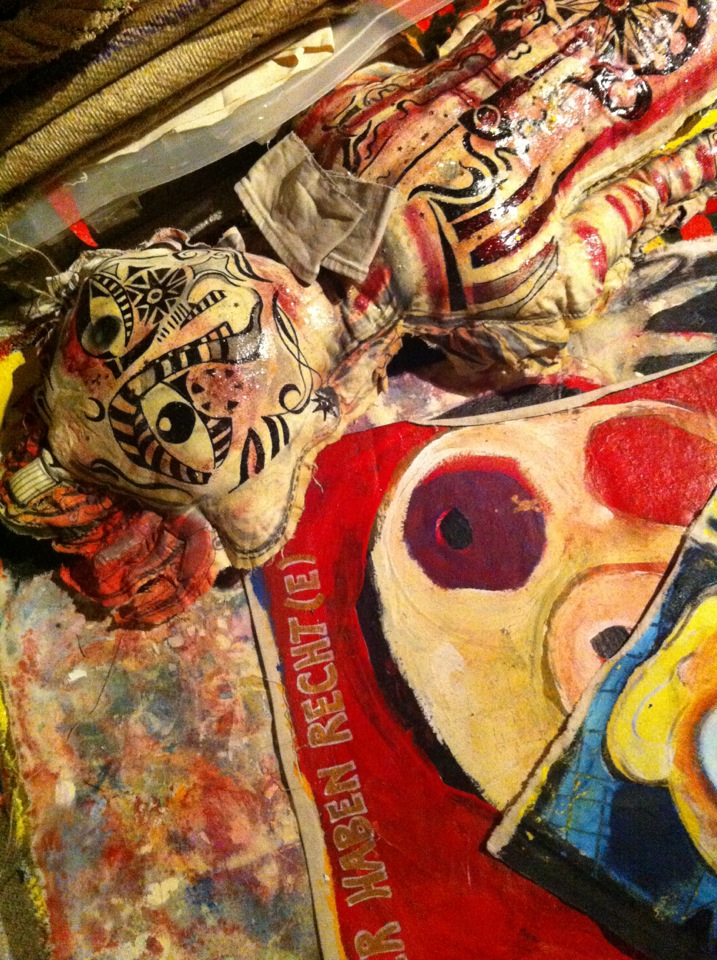
IMG_5564She had been busy herself lately, working on an oversized, unstretched canvas that was spread over the floor in the room that in other houses would have been the living room but in our house was an art space and a library. Right now you couldn’t even enter it without risking to step into wet paint. Plinius had learned to avoid the canvas, just like everybody else he balanced around it on the outer edges.

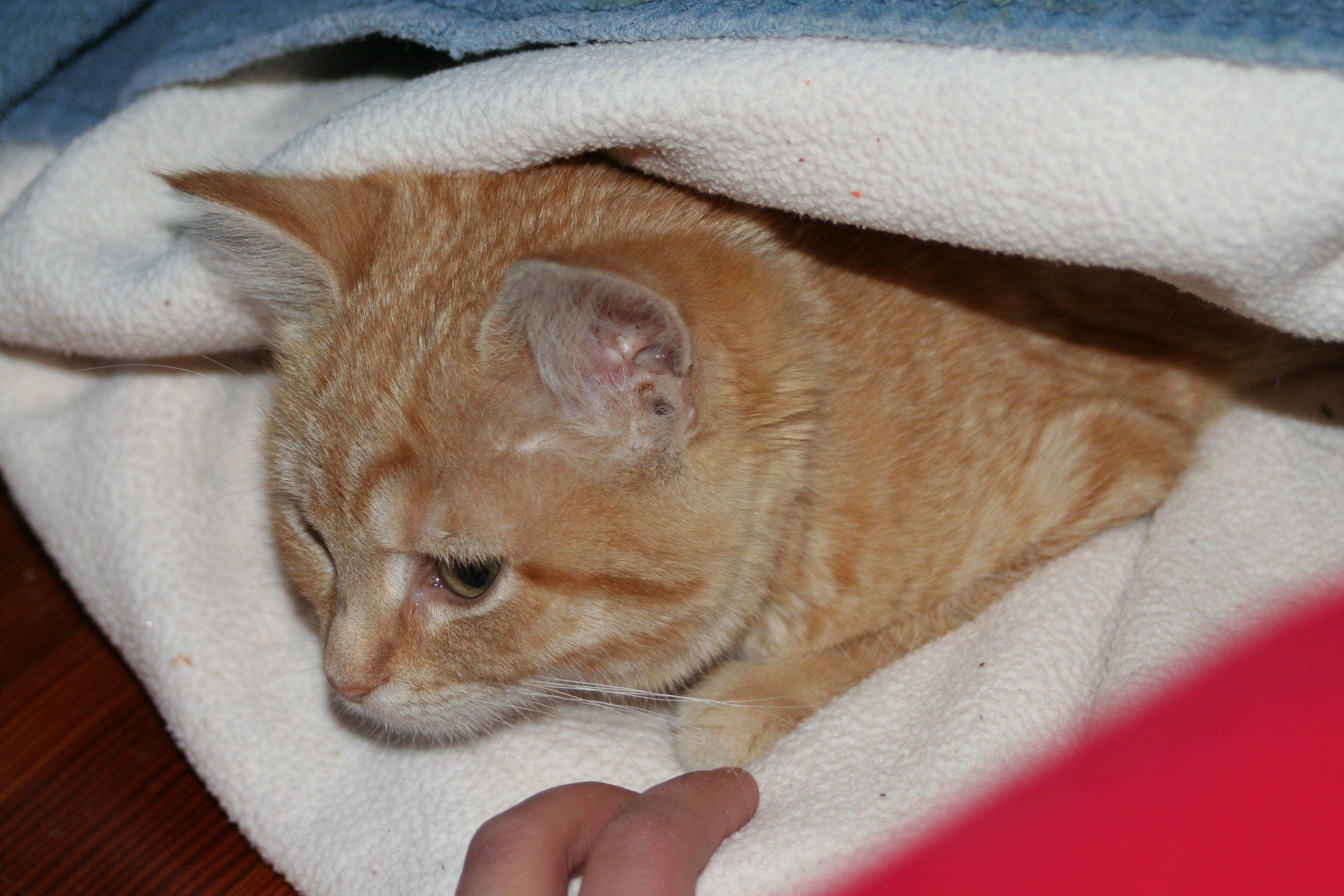
IMG_0341When he was a kitten still he had managed to get his fur and his paws coated with oil paint a couple of times, some of the paintings dating back to his childhood show his then tiny paw prints (the adult Plinius left raccoon-foot sized prints in the garden). He had been thoroughly disgusted by the experience, furiously licking the Tyrian Purple and Cadmium Red spots on his ginger tabby fur. Strangely enough, as a grown cat he enjoyed finding a place as close to the wet paint as possible.

English: pigment red 108 cadmium
English: pigment red 108 cadmium (Photo credit: Wikipedia)

There he sat down, often on the stretch of canvas that wasn’t actually part of the painting, but that my mother uses to clean brushes and that she calls the “annotative margin”. He purred his fat Plinius purr while he was watching the loaded brushes rush over the canvas. Cats like to live their lives in the margins and on the edges, I guess.


8.5 light years

8.5 light years

She moved my hand slowly over the dark water and spoke in her methodical way, no use to interrupt her. “20 degrees south-east of the belt of Orion, you see, there is the brightest star in the night sky, right in the constellation of Canis Major.” She waited for a moment for me to catch up with her. Our entwined hands travelled over the night sky and stopped. And there it was, deep underneath us, the brightest star of the night sky, as far as I could see. “Do you see this star?” she asked. “It is called Sirius. It is 23 times more luminous than our sun, twice the mass and the diameter of the sun. It is only 8.5 light years away.” The way she said “only 8.5 light years”, it sounded as if she was talking about a Sunday picnic destination.

looking down at the stars

looking down at the stars

When I was five, my mother, an artist, told me that over time the use of the words “up” and “down” had been reversed through what she called “accumulated acts of lazy thinking”. Consequently, she told me, people had gotten used to seeing the world in a crooked way. With other words: where other people look up into the tangled branches of a tree, to the clouds, an airplane, the sky, my mother had trained herself to look down into the depths of the endless oceans of the universe.

The amazing thing is that the moment you try this, it feels just like the right way to look at things and you will feel like you have never truly seen the sky before. Stretching myself I reach deep down into the world whereas before, when I understood up and down in the usual way, the sky seemed more or less like a painted stage decoration.

Often, on late summer nights my mother, my sister and I would lay down flat on the lawn of our front yard and look down into the stars. The grass of our lawn was long and wavy, different from the short cut golf course front lawns of our neighbors, and woven through with moonflowers that smelled lovely in the warm, damp night air and in their whiteness actually glowed like little stars themselves.

I remember one night when I felt particularly light and small, and grateful to gravity for holding me securely to the surface of my own planet. The stars glittered in the distant depth. My mother giggled when she noticed that my little sister had fallen asleep right there on the lawn, her head nestled onto my mother’s shoulder.

Suddenly it seemed so unlikely to me that in all of the universe expanding before my eyes our planet should be the only one with life on it. I asked my mother, who had been silently holding my hand whether she thought that there was life out there. My voice sounded like a whisper. It was the kind of question to which you don’t really expect an answer.

time oscillating

IMG_5724

In the meantime I discovered the places where the seams come undone Every classroom in my school had a clock on the wall right over the door, and all the clocks had identical clock faces, and every one of them showed a slightly different time. I don’t know whether clocks in classrooms today are all connected to one central, totalitarian time piece as I suspect might be the case, though I hope it is not so.

I always loved the way time oscillated between classes, obstinately refusing to be tamed. Officially, students had three minutes to walk to the next classroom after a period ended. But for the way from science to math, for example, you’d better made do with 1 minute and 29 seconds – the clock in Ms. Kirsch’s class was as fast as our teacher’s ability to conjure numbers out of the back entrance to Hilbert’s Hotel and as inexorable as her refusal to admit to time measured outside her class room.

On the other hand, you could afford to leisurely stroll to French after that, using not only the 1 minute and 31 leftover seconds from math but also the 40 seconds the French clock was late, giving you an ample 5 minutes and 11 seconds (not counted the additional minute or two Mme. Petite rustled with her papers, ignoring her students’ ongoing conversation).

The clock in language arts had the peculiar and infamous habit of stopping at exactly 12.00 pm every couple of weeks and could only be persuaded back into service by Superintendent Segrob who, for that very reason, was particularly fond of it, and year after year insisted on repairing rather than replacing it.

Every day for a few moments just before noon instruction in language arts paused and everyone’s eyes followed the unhurried second hand making its way from 11.59.59 am to 12.00 pm. It was almost like a pagan ritual, these four seconds of silence, as if we were paying our respects to the spirit of the clock, Time. Time, sputtering, fleeing, stopping, resuming its course, divided itself up over the 79 clocks in our school according to its own preference. With other words, it seemed to be on our side and refused to be institutionalized.

I know that the language art clock did not stop on that day. I don’t think it would have been possible for it to stop while I was willing it on. Apart from Time herself though nobody noticed that I counted every second of the school day, 24,000 seconds in all, stops, gains and losses, until, at last, the 2.47 pm bell wrapped it all up hurriedly and dropped the leftovers for the time dogs.

a questionable moral choice

a questionable moral coice

My pale, transparent reflection
in the window pane confirmed another aspect
that I had omitted
when thinking about the ever morphing,
transitional aspect of every physical space.

I was a transitional being as well.
Everything had to change.
Only yesterday I had been a child,
and it had seemed
that I would be a child forever.

Growing up had always seemed to me
to be some kind of failing,
a questionable moral choice.

now it was apparent that I, too,
would eventually have to grow up.

My mirror image clearly
was not that of a child
anymore.
My other self was hovering
between the trees
lining the residential street
and the book shelves reflected
in the window.

It seemed like I was sitting
in a fabulous natural library,
looking from there
into the confined space of the reality
of my room
like at a framed painting
that didn’t concern me much.

It looked like a peaceful place,
that library,
like a place right out of someone’s mind.

Like a place where one would forget
time and space
and never feel hungry or tired or aggravated.

My stomach grumbled as I thought about that place.
Being of real flesh and blood I was hungry.

genius

Bild

tarnished brass bracelets jingle on your wrists,

over your shoulder you carry

the same scratched leather satchel

full of papers and books.

worn sandals on naked feet.

even now,

i recognize you in an instant.


it’s winter.

you keep well in the background.

between shelves M-Z in biographies

you are not at risk.


you have had your share of abuse

and are weary of it,

though not afraid.


the red letters of a franchise bar

reflect in the deep black tar

of a recently paved parking lot.

another new strip mall.

the evening is patiently enduring

the loneliness of a friday night.


people climb out of sport utility vehicles

half the size of their houses, i assume,

and file into the barnes & noble

for a grande non fat latte

and some magazines or bestseller titles

to while away the hours.


and you, in the background,

leafing through

a mussorgski biography.

how in the world this got there

you can’t imagine,

then Frank Zappa,

but that’s not why you came.


finally, your head clears.

you carefully deposit yourself

in an armchair.

still, no one pays attention.

the anxiety subsides.

the numbers start dancing.

Plinius, the cat logarithm

Finding Plinius could be impossible at times. For days on end the only sign of his existence could be that his cat bowl was empty in the morning. At some point, mostly drawn by Phoebe’s calls in the evening, he would walk out of the shadows in the garden and return home to sleep in the margins for a couple of days or on his favorite chair in the kitchen. I was never certain of his return. In that way he was like my father, too. It was very likely he would come to pick us up for a weekend but never entirely. When I shared this observation with my mother once, she quoted from “The Hobbit”: It’s a dangerous step, the first step out of your own front door.” Implying, I guess, that no one really knows whether they are going to return at night. But the remark wasn’t all that helpful. Some people do make more of an effort than others to come back. My father had a challenging work schedule in a big law office in the city. I guess, I was somewhat harsh towards him. Still.

Walking into the kitchen that night I found Plinius right away. He was sitting in his favorite chair, looking up and squinting his eyes as if he had actually been waiting for me. A small reading light had been kept burning as every night in case we girls were to walk into the kitchen in search of something to drink. I walked over to Plinius and kneeled down in front of his chair. He yawned and turned his head to the side. “Plinius,” I whispered, putting my fingers in his fur. He felt real, shaggy softness, powdery cat fur smell with a hint of cat litter. I put my nose into his fur and inhaled. A real cat. When I looked up, Plinius had closed his eyes again. He wasn’t purring, mind you. But he let me be. Unusual. As I looked at him, my face close to his face, noticing a bit of mucus leaking from his dirty pink cat nose, the long whiskers, the white grandpa beard on his chin, there seemed to be, in his very presence, a message. It was like working on a math problem, knowing you just had to think right about and even more importantly look right, look in the right way, whatever that meant, at the equation and you would understand it. That was how math usually was for me, the answer to a problem was right there, in front of my eyes, on the paper, I just had to bring it into focus.

And that was what Plinius seemed to be to me that night in the kitchen, a living and breathing logarithm to express a specific, meaningful relationship between an unknown value and me, cat2me is the output from the function cat2 when the input is me. I looked at him really hard. Did Phoebe speak cat as well? Did she know what kind of a cat logarithm Plinius was? Plinius himself couldn’t be bothered to help me. cat2phoebe is the output from the function cat2 when the input is phoebe. Plinius sighed as if bored by my slow mind, moved a bit under my hands, and farted.

Sirius

Often, on late summer nights my mother, my sister and I laid down flat on the lawn of our front yard and looked down into the stars. The grass of our lawn was long and wavy, different from the short cut golf course front lawns of our neighbors, and woven through with moonflowers that smelled lovely in the warm, damp night air and in their whiteness actually glowed like little stars themselves. I remember one night when I felt particularly light and small, and grateful to gravity for holding me securely to the surface of my own planet. The stars glittered in the distant depth. My mother giggled when she noticed that my little sister had fallen asleep right there on the lawn, her head nestled onto my mother’s shoulder. Suddenly it seemed so unlikely to me that in all of the universe expanding before my eyes our planet should be the only one with life on it. I asked my mother, who had been silently holding my hand whether she thought that there was life out there. My voice sounded like a whisper. It was the kind of question to which you don’t really expect an answer.
My Mother took my hand and pointed down at the three stars of the belt of Orion. “Your fist like this”, she said, “covers about 10 degrees of the night sky.” She moved my hand slowly over the dark water and spoke in her methodical way, no use to interrupt her. “20 degrees south-east of the belt of Orion, you see, there is the brightest star in the night sky, right in the constellation of Canis Major.” She waited for a moment for me to catch up with her. Our entwined hands travelled over the night sky and stopped. And there it was, deep underneath us, the brightest star of the night sky, as far as I could see. “Do you see this star?” she asked. “It is called Sirius. It is 23 times more luminous than our sun, twice the mass and the diameter of the sun. It is only 8.5 light years away.” The way she said “only 8.5 light years”, it sounded as if she was talking about a Sunday picnic destination. It sounded like: We could take the bike. It’s only 8.5 light years away. Before I had a chance to point that out to her, however, she had started talking again, and almost without warning, though in answer of my question, switched from her facts, from degrees between two points of light in the celestial sphere, luminosity and brightness, and mass of celestial objects, to a startling revelation: “My grandfather, your great-grandfather, believed that there is life in the Sirius system. The Dogon, an African tribe with very acute astrological knowledge, have believed for centuries that there is life out there as have the ancient Egypts and the Sumerians. According to the Dogon Sirius is accompanied by two other stars, a very small and incredibly dense star they call Po Tolo, which means “very little star”, and which modern astrology has confirmed to exist only recently and calls Sirius B. Indeed it has turned out to be a small star with an incredible density, heavier than the iron we know on earth. The Dogon also claim that the other star in the Sirius-System is lighter and larger than Sirius. They call it Emme Ya. And around Emme Ya they say there orbits the home planet of the Nommos, the children of Sirius and Emme Ya.“