Page 2 of 3

The woods are lovely …

Robert Frost, 1913.
Robert Frost, 1913. (Photo credit: Wikipedia)

It might just be true that there are some words that own us before we even truly know them.

A long time ago, I was a kid still, I watched a spy movie. I don’t even know the title of that movie now nor do I remember the plot.  I seem to remember the face of the main actress but do not know her name. I just recall that the story unfolded around a group of so called “sleepers”, people who were leading normal average US citizen lives until they were called – by phone – by a contact person who then “woke” them to perform a certain task by reciting a single line from a poem to them. And this single line from a very famous poem  stayed with me for years. Alas, neither did I know it was famous, nor did I initially know that it would haunt me for many years.

To make things more difficult, the movie was American synchronized to German. The time must have been late Seventies, I guess. None of these fragments of information enabled me to identify the movie.

The line as that came to haunt me was: “Des Waldes Dunkel zieht mich an, doch muss zu meinem Wort ich stehn und Meilen gehn’ bevor ich schlafen kann, und Meilen gehn, bevor ich schlafen kann.” I was immediately electrified. It was as if I had been woken up. The line stuck. After a few days I knew that I longed to  learn the whole poem.Eventually, and maybe only a lover of poetry gets this, I longed for the poem the line was taken from like I would learn to long for a certain person much later on – but just not quite then.

Alas, there was no mentioning of the title of the poem. Nor of the author. I didn’t know what it was that electrified me. It was well before one could start an internet search. So I had to nurse that longing. And marvelously I did. For years actually. I never forgot those lines. Even though they might be among the most famous last lines of any poem ever written, I didn’t find them for a long time. It might have been easier had they been first lines though.

The translation of these lines, of course, is: The wood are lovely, dark and deep, but I have promises to keep, and miles to go before I sleep. And miles to go before I sleep.

We finally found each other, that poem and I, some twenty years later. And I was as happy as if someone had revealed my fate to me. And the revelation of that fate would have been to know the poem. The woods are lovely. It took about three minutes to learn the rest of the poem when I found it. I knew I had known it before I had known it. I knew it when I found it.

And I have no answer as to how it can be that a poem, a poem not even in my then native language came to claim my allegiance. Came to claim me.

The poem was written by Robert Frost. I am a sober person but this poem was written into my genetic make-up. It seems that I had always known it, that it had been waiting for me, patiently, all these years, even testing me.

This is a kind of respectless approach to the great poet, forgive me, Mr. Robert Frost, respect less in the sense that, of course, this poem is not individual, and that is where its true beauty lies.

Robert Frost, a poet who died before I was even born. But not long after, in a small book store in the Upper, upper east side, around 95th street and Lex, I  had discovered a kid’s illustrated version of “Stopping by the woods”, stumbling upon it, virtually, I met an old photographer, a neighbor of mine on 95th Street and Columbus, Jacob Lofman. In his apartment there was a beautiful picture of Robert Frost that Jacob Lofman had taken years before. I know now that the picture was well known by the time I spotted it on the walls of the humble apartment in the Upper West Side when Jacob had invited me for tea.

Well known that foto might have been and still is, but it wasn’t to me back then. It was still not part of my culture. Robert Frost in New England. And so it came that I had the great pleasure to discover this image, the image of Robert Frost, in the apartment of a photographer who knew how to look at a man who by the time he met him was already legend and still to show something deeply personal about him.

I kept looking at the picture for a long time. Jacob made tea and I looked at the picture. I still can hear the water boiling, the tea cups cluttering. It made me happy to just look at the picture hanging on a wall in an apartment in the Upper West Side. In my ignorance I didn’t know that the man in the picture was famous. I knew by then, just for a few days, that he had written the poem I had searched for ever so many years. I don’t know why it was that poem by Robert Frost any more than you could answer why you love a certain person and not another.

I still don’t know why words have that kind of power. I just know by fortunate experience now that they do. I have rarely been as happy in my life as when I discovered those fragile bonds to a poem that had claimed me so many years ago. I know now, of course, that EVERBODY and their neighbors love “Stopping by the woods”. I guess that’s how it ended up in a spy movie. But without any cultural context, even without the context of the poem, just by a few lines in translation, spoken a few times, these lines had been truly powerful.

Life is strange, complex, opaque, but  still we can establish part of its truth. We just know it when we see it. Truth claims us. Words have that kind of sober, relentless, inconsequential power. They are an end in themselves, no further salvation promised or needed.

Die Banalität der Zeit als Gegenwart (aus dem Roman: Nachtwachen)

Die Banalität der Zeit als Gegenwart

Stamp Hannah Arendt
Stamp Hannah Arendt (Photo credit: Wikipedia)

Den Großvater zu verstehen heißt nicht zwangsläufig, eine ganze Generation zu verstehen, heißt nicht, Deutschland während der Zeit des Nationalsozialismus zu verstehen. Aber dennoch scheint es K unausweichlich, auch nach ihrem eigenen Großvater zu fragen. Seit der Lektüre von Hannah Ahrendts Buch “Die Banalität des Bösen”, das sie während ihrer Seminararbeit zum Fall Eichmann  studiert hatte, hatte sie die Idee verfolgt, gerade dem Banalen, der Alltäglichkeit  in der Biographie ihres Großvaters nachgehen zu wollen. Wobei sie nicht notwendigerweise nach der Alltäglichkeit des Bösen in der Biographie des Großvaters suchte, sondern eher nach der scheinbaren Bedeutungslosigkeit alltäglicher Entscheidungen oder dem kumulativen Effekt vieler scheinbar banaler Entscheidungen zu einem unveränderlichen, verheerenden Ganzen, eben nach der Banalität der Zeit, wenn sie als Gegenwart daher kommt, und vielleicht auch nach ihrer Gewichtigkeit, wenn sie vergangen ist. Nach der banalen Abfolge von als Anekdoten und Geschichten wiedererzählten Ereignissen, die angeblich die Entscheidung für die NSDAP vor 1933 als ein nahezu natürliches Ereignis erscheinen ließ. Weltwirtschaftskrise. Hunger. Hoffnung. Aufrüstung. Krieg. Erzählt in Ereignissen der einzelnen Tage, während derer sie sich zutrugen.

Sie suchte auch nach einer Erklärung danach, warum unter denselben Umständen einer zum Dieb wird und der andere ein ehrlicher Mensch bleibt. Warum Gottfried Benn und ihr Großvater den Nationalsozialisten vorauseilenden Gehorsam geleistet hatten und Klaus Mann die mörderischen Absichten der Partei hingegen von Beginn an verstanden und verabscheut hatte. Die Frage, die sich ihr letztlich stellte, war, ob ihr Großvater nicht doch in die NSDAP eingetreten war, eben weil er das Parteiprogramm und die Absichten der Nationalsozialisten sehr wohl verstanden hatte und sie mit zu tragen bereit gewesen war. Sie wollte verstehen, was den Großvater dazu bewogen hatte, bereits 1931 in die NSDAP einzutreten. Das 25 Punkte Programm der 1922 von Preußen und anderen deutschen Ländern auf Grundlage des Republikschutzgesetzes verbotenen NSDAP hatte als Programmpunkt die Entrechtung der Juden durch den Entzug der deutschen Staatsbürgerschaft  schon enthalten.

K entsinnt sich des späten Bekenntnisses des Großvaters , “man habe den Juden Unrecht getan, auch wenn sie keine Deutschen waren. “Dem Wertheim, zum Beispiel,” hatte er anerkennend gesagt,  “das war ein ganz ausgezeichneter Geschäftsmann.”  Noch über vierzig Jahre später hatte er nicht sehen können oder wollen, dass die in Deutschland verfolgten Juden Deutsche gewesen waren. “Die Nationalsozialisten haben den Juden in Deutschland doch die deutsche Staatsbürgerschaft überhaupt erst entzogen.” hatte sie eingeworfen. “Das musst Du als Juristin doch einsehen, Katja,” hatte der Großvater erwidert, “Es war ja ein wirksames Gesetz, auch wenn es manchen nicht gefiel, aber Gesetz war es doch.”

K konnte dem Großvater höchstens zu Gute halten, dass er sich  nie mit der Floskel verteidigt hatte, “man habe von all dem doch gar nichts gewusst.” Vielmehr hatte er, allerdings auch unter Verwendung des neutralen Infinitivpronomens, gesagt: ” Man habe sich geirrt.” Als habe es sich um einen Rechtschreibfehler gehandelt. Ein Aktenversehen. Und eben: “Das kann Deine Generation gar nicht mehr verstehen, Katja.” Und dann hatte er das Thema gewechselt und wieder aus seiner Kindheit als Lehrersohn erzählt.

Erst jetzt, mit dem Abstand von zehn Jahren seit dem letzten Gespräch, mit dem Abstand des Todes, der zwischen ihnen liegt und der sich weitet wie ein Fluss, der über die Ufer tritt, und dessen anderes Ufer schwerer und schwerer erkennbar wird, erst jetzt, mit dem Abstand von einem Kontinent und einem Meer, kommt es ihr in den Sinn, dass in diesen Geschichten aus dem Dorf, den Geschichten von dem Jungen Nick Rieper vielleicht etwas von dem Alltäglichen der Zeit zu finden ist, das sie damals vergeblich aufzuspüren versucht hat.

Die Sprache der Welt

The location of Samoa
The location of Samoa (Photo credit: Wikipedia)

Rafiq unterhält sich mit dem UPS Boten, der in seiner braunen Uniform breitbeinig wippend vor dem Tresen steht und auf seinen Bagel wartet. Auch er hält einen Pappbecher mit Kaffee in der Hand. Trotz der Kälte trägt er ein kurzärmeliges Hemd und Shorts. Wie immer fühlt K sich beim Anblick der UPS Uniform an die Uniformen der Hitler Jugend erinnert, selbst hier, in einem palästinensischen Coffee Shop in der Upper West Side New Yorks. Unwillig über sich selbst wendet sie ihren Kopf ab und studiert statt dessen den Umschlag, der neben ihrem Teller liegt. Auf dem Papier haben sich Fettflecken gebildet. Die Konstellation und Form der Flecken weisen eine verblüffende Ähnlichkeit mit einer geographischen Karte von Samoa mit den Inseln Upolu, Savai!i, Apolima und Manono auf. Eine neues Cluster von Assoziationen folgt dem visuellen Impuls, der für sich bereits eine Assoziation ist. Es endet auf dem Misston “Deutsch-Samoa”. Sie schließt die Augen.

Das klingende Scheppern von Münzen auf dem Counter, das Öffnen und Schließen der Registrierkasse, das Ticken und Dampfen der Kaffeemaschine, Rafiqs Stimme, ein Messer, das zu Boden fällt, das Knistern des beschichteten Papiers, in das Samir, Rafiqs Bruder, ein Sandwich wickelt. Wie wäre es, wenn alles, was sie erlebte, eine Abfolge von Worten in einem Buch wäre? Und wenn diese Worte gleichzeitig in zwei Sprachen gelesen und verstanden werden könnten, aber in jeder dieser Sprachen vollkommen verschiedene Geschichten erzählten? Und eine Sprache wäre die Sprache der Welt, von der ihr Großvater ihr als Kind berichtet hatte.

K öffnet die Augen wieder und schlägt ein frisches Blatt in ihrem Skizzenbuch auf. Für einen Augenblick noch hört sie auf all jene Geräusche, die zusammen das Lied eines Morgens in einem Coffee Shop orchestrieren.

Dann beginnt sie zu schreiben. Sie sucht nach Worten, nach Wortklängen. Sie schreibt eine Liste von Worten, die in verschiedenen Sprachen vollkommen unterschiedliche Bedeutung  annehmen. Die Sprache der Welt.

IL. EEL. 1. Franz. m. Personalpronomen 2. Engl. Substantiv Fischart SPRING. SPRING! 1. Deutsch, Verb, Imperativ, zum Sprung auffordern 2. Engl. Substantiv, Jahreszeit

DIE. DIE! 1. Deutsch best. fem. Artikel 2. Engl. Verb, Imperativ, Aufforderung zum Sterben
HELL. HELL. 1. Deutsch Adjektiv, Anwesenheit von Licht 2. Englisch, Substantiv, Inferno

ESSE. ESSE. 1. Latein Verb, Infinitiv, sein, sich befinden 2. Deutsch, Verb, Imperativ, zur Nahrungsaufnahme auffordern
PETIT.PETIT 1. Latein, Verb, erstreb

Where were you when Thompson hit that home run?

Brooklyn Dodgers
Brooklyn Dodgers (Photo credit: Wikipedia)

You see, writing that sentence to me is kind of scary, in fact, it requires quite a bit of courage. In a few words it describes all I know – and I do not know – about a culture I lived in and that I breathed in for thirteen years. And then some. If you think “13” you’ll understand how well suited I was to be in that place, because it seems to me that it is more important to have an association to the fact that Ralph Branca wore the 13 that day, way back then, in 1951, than to even have been born at the time when Thompson hit that home run and the Giants won the game 5-4.

A long time ago a friend taught me my first real American phrase. This was after years of English classes at school had rendered me a perfect fluent, neutral speaker of a language that is so rich in tones and associations that my lack of sensibility for the colors of a certain word might have invoked an association equivalent to a machine’s translation of, say, John Updike.

My first real American words were: “How about them Yankees?” And we practiced them for a few weeks. We lived in the same apartment  building on 95th Street at that time, and we would practice in the elevator upon chance meetings. Me: “Hi Joe! How – about – them – Yankees?” He: “Howabout’em?”. Eventually, I sounded somewhat more like I was asking what I was asking. Only, of course, I didn’t. Because I wasn’t. Asking. I had not the first clue about baseball. But I kind of started getting the gist of things.

Maybe you have guessed from the first paragraph what I am reading at present. I am still the academic speaker I was when I first lived in New York, fluent to a fault and with blank undertones to my speech. But then again, I have those in my original, my native language too, the blank undertones, speech that leaves no associations for the listener even if it seems rich with referrals and meaning to me.

But be that as it might, not for nothing have the years passed and have I entertained something that should be called, for lack of other words, an illegitimate affair with a language not my own but with a passion so strong that at least I feel like I have staked a small claim on a land that rightfully belongs to others.

And that claim should not be judged by my own ability to play the instrument,to speak the lingo, to actually ask about that homer, scary thought! – but by the fact that my ear is now catching all that it might have missed when I first listened to that tireless speech of the city, 95th Street, Columbus, Broadway. I read about the outfielder Bobby Thompson on that day in baseball history, Oct. 3rd 1951, in that landmark novel and I do not only think “Ralph Waldo Emerson” and “Shot heard ’round the world” from his Concord Hymn, something I might have done before (and something, fittingly, DeLillo never mentions, the “Shot heard ’round the world”).

I mean, I know this, but I can also actually picture the guys, J. Edgar Hoover with the torn newspaper and all, and I hear them as clear as I hear music from Mozart though I am separated from that in time and space and culture, too, and I get it. Or, let’s be honest and a bit humble, I think, I get it.  I think I know who they are, these guys and their wives, like  Nick and Marian, and where they come from and why it is inevitable that one of of them should head straight into cardiac arrest after the game, and I know that they are real and I might meet them out there one day and recognize them and smile at them. And they, in return, would not give a f- and would have no clue who that meager shadow was, passing by. Which would be just fine with me.

I get so much reading these pages and listening to them, so much detail that I didn’t get before that it delights and amazes me despite the fact that it is of no use to anyone including myself other than for its sheer entertainment value. Which is a result of half a lifetime of practice. There is something in there that tells you about how language connects us to a specific place and time and how obstinate and inefficient love insists on being.

I doubt I could pull it off, that question, asked leisurely in a conversation. As if it was something, one asked, conjuring up a feeling of common history, no matter where you stood.  And, sorry Joe, I still have to ask someone in the streets about them Yankees, but I know what it means when I hear someone doing it, and I hear the city and its history and its people and their loans and their marriages and their kids at college. So, let me get back to reading then. Underworld.

Infinite Jest …

IMG_5726It only occurred to me some years after first meeting him that his brain had been on fire probably day and night, during waking moments and during sleep. He was, I could see that right away, back then, high wired, hyper intelligent, super sensitive, coy, cornered, cynical. In was apparent in the first conversation one would have with him that he was constantly computing any kind of informational offering of his environment for bits and pieces of useful knowledge, useful in his own sense, not ruling out the value of overheard conversations of strangers, visual clues of bill board advertisement, the color scheme of the dioxin polluted NJ marsh lands, conspiracy theories and their opposites, math, astronomy, information technology, Shakespeare, even the CNN news ticker. He was reading, forever reading, and then reading some more, his brain was speed feeding itself knowledge, and he could recover this knowledge with the casual speed of a trained illusionist. When I knew him better he showed me the encyclopedic if highly individual work he was dedicated to, a work in many volumes bound in blue linen as soon as a new one was considered completed. A friend who worked at a university library did this for him volume by volume, one for the shelf in his den, and a twin one that he archived openly secretely in said library, for everyone to see and no one to find in maybe another century. It was a work so biased and yet so beautiful that it was unquestionable that I had been admitted to a unique work of art though he preferred to call it a scientific study of random code.

And still, it was only years later when in the course of an increase of my English language skills I could not only read but  also hear all the different voices merging in “Infinite Jest” by David Foster Wallace that I realized I had actually met a man who is – if that is at all possible considered who Wallace was – the dark twin of David Foster Wallace, sharing his semantics, his obsession, his socioeconomic circumstances, his despair, his addiction, his near autistic ingenuity to gain access to ever deeper layers of information and information encoded within this information,and that he was the man who had to be expected to exist in the margins of literary history, never to be found, as we know that there is never just one genius at any given time, but often just one to emerge to public consciousness , maybe to his own destruction. so that, with other words, i know there to be one other living madman, or genius, or whatever you’d like to call a man with a brain on fire, to weave the net still, to still find the words, to write the chronic of what is and was and will be in all its Borgean implications, thereby freely accepting the responsibility of calling the world into existence.

moonflower

Canis Major as depicted in Urania's Mirror, a ...
Canis Major as depicted in Urania’s Mirror, a set of constellation cards published in London c.1825. Next to it are Lepus and Columba (partly cut off). (Photo credit: Wikipedia)

“Your fist like this”, she said, “covers about 10 degrees of the night sky.”  She moved my hand slowly over the dark water and spoke in her methodical way, no use to interrupt her. “20 degrees south-east of the belt of Orion, you see, there is the brightest star in the night sky, right in the constellation of Canis Major.” She waited for a moment for me to catch up with her. Our entwined hands travelled over the night sky and stopped. And there it was, deep underneath us, the brightest star of the night sky, as far as I could see. “Do you see this star?” she asked. “It is called Sirius. It is 23 times more luminous than our sun, twice the mass and the diameter of the sun. It is only 8.5 light years away.” The way she said “only 8.5 light years”, it sounded as if she was talking about a Sunday picnic destination. It sounded like: We could take the bike. It’s only 8.5 light years away. Before I had a chance to point that out to her, however, she had started talking again, and almost without warning, though in answer of my question, switched from her facts, from degrees between two points of light in the celestial sphere, luminosity and brightness, and mass of celestial objects, to a startling revelation.


digital sadness

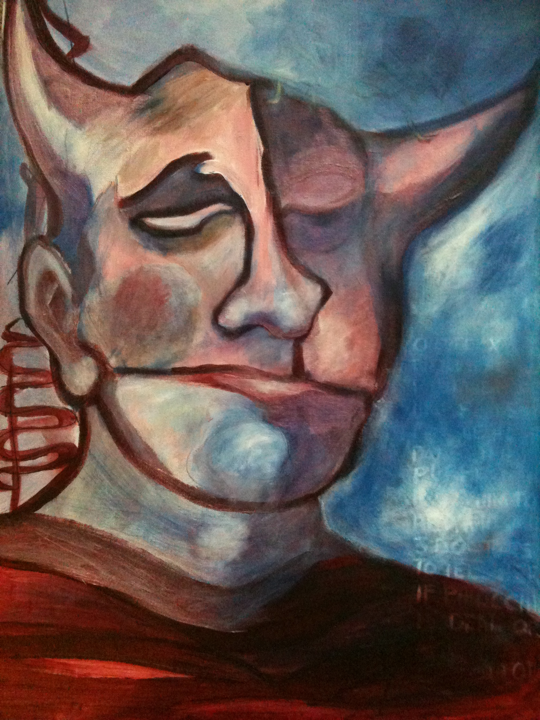
Bildthere were lights and colors washing down the cab window, there was the rain, transparent movement, the cab driving through the night, time suspended. i had memorized the painting that had been burned and now i let go of the image of the devilish creature and just looked out of the cab window, letting the city images pass by. All was said and done. My hands still carried an ashen smell.

I let go of my specific self, and I knew with quiet certainty that everything out there was coded in a simple, elegant way. The needlepoint lights of the far away office buildings were 1, and the red lights over there, the cab coming to a stop, those lights were 0, the raindrops running down the window pane like external tears were 011001, and the guy running down the street holding a soppy edition of the times over his head was, let me see, 1, for what he had just done, and 0 for his existence and another 1 for someone waiting for him with an unwelcome surprise, 101.

There was no sadness just then, no joy either, just a stillness in everything, an acceptance of now, the cab driver talking about night time driving, 100101001, and the drunken guy who had no money left to pay for the fare, 001, and the traffic and people coming from out of town, and my life was not measured by birthdays, one year like the other, my life was suspended too – and I was weightless against the dark