Page 34 of 41

Thibeas’ final days

wearily, the king inspected his ragged group of counselors, the budget long since exhausted, the tin soldiers melted, the castle but a shack with weeds growing through the cracks, human miscellaneous mistakes, crooked timber all of his entourage, and yet there was a light in their eyes that the glorious days had not known, and he was glad he had taken their erroneous advice.he pointed out the fine detail of the scratched figures in the rock, the fish, the symbol of the ancient ones, which so far seemed to have gone unnoticed by his advisers whereas thibeas concluded that their travels had lead them along the old path which they had wandered unwittingly, their tired feet drudging over the worn out stones like so many tired feet before them. wonderingly now they looked back and saw indeed that the smooth surface over which they had come bore the polished colors of legend: crimson red, trout blue, slate and deep emerald.the king looked at thibeas and considered his state of mind. for days had the old man not spoken and on two occasions had he stumbled as if he was about to give up but then had gripped his staff and – without complaint – had started walking again. the king nodded and finally gave the signal which set the whole rag tag army in motion almost at once as if their feet had been craving movement, anything but to stay in this place, but alas, they walked with more care now as their feet, wrapped in woolen and leather rags, touched the mellow colored rock, polished it of the chalky dust and left deep glowing imprints on the old path. crows perching in the bare november trees cawed condescendingly as the people passed underneath. from time to time the northeastern wind soared through the high branches like an echo of the past. the recently devastated fields ahead of them smelled not like death but like freshly tilled, fecund soil only, like a promise.

blog dialog about literary characters with whispers of a barefoot med student

just ordered the “garden of evening mist” by tan twang eng to meet the japanese gardener arimoto. my heart desires it. who says that book characters are any less real than people in flesh and blood? they are the voices that live in our minds, they have a life of their own, manifest in a form no less tangible than the body that is but a physical expression of a compromise for all those voices we have to integrate to become one acceptable social being. if allowed to express themselves as single beings, if being placed in their proper, ideal environment (like arimoto might, as i suspect, in the garden yugiri) they develop back into the full character they crave to be, rid of their siamese bonds to multiple twins inside one mind, and can induce you to be wiser, fiercer, more compassionate than you would be had you not known them. you grieve for them if misfortune befalls them. they can play to your most intellectual and your most archaic impulses. they answer your desires but only if they feel inclined. they disregard you if you fail to live up to their standards and refuse to be conquered by an average mind.

dilettante ideas on healing by a seasoned atheist (the mahabaratha series, cont.)

No human wound on this earth has ever been healed other than through gentle touch. No human spirit has ever been mended other than through love and compassion.

Be weary of the bitter potion of self-chastising you justify taking every day by calling it medicine, it might just be what it calls itself: poison.

Yoga teaches to adjust your practice to the point of no pain, to accept the slowness of your progress with a humble spirit,not to break yourself to succeed, you are but human. I shudder of the practice that mortifies your flesh for some idealized purpose.
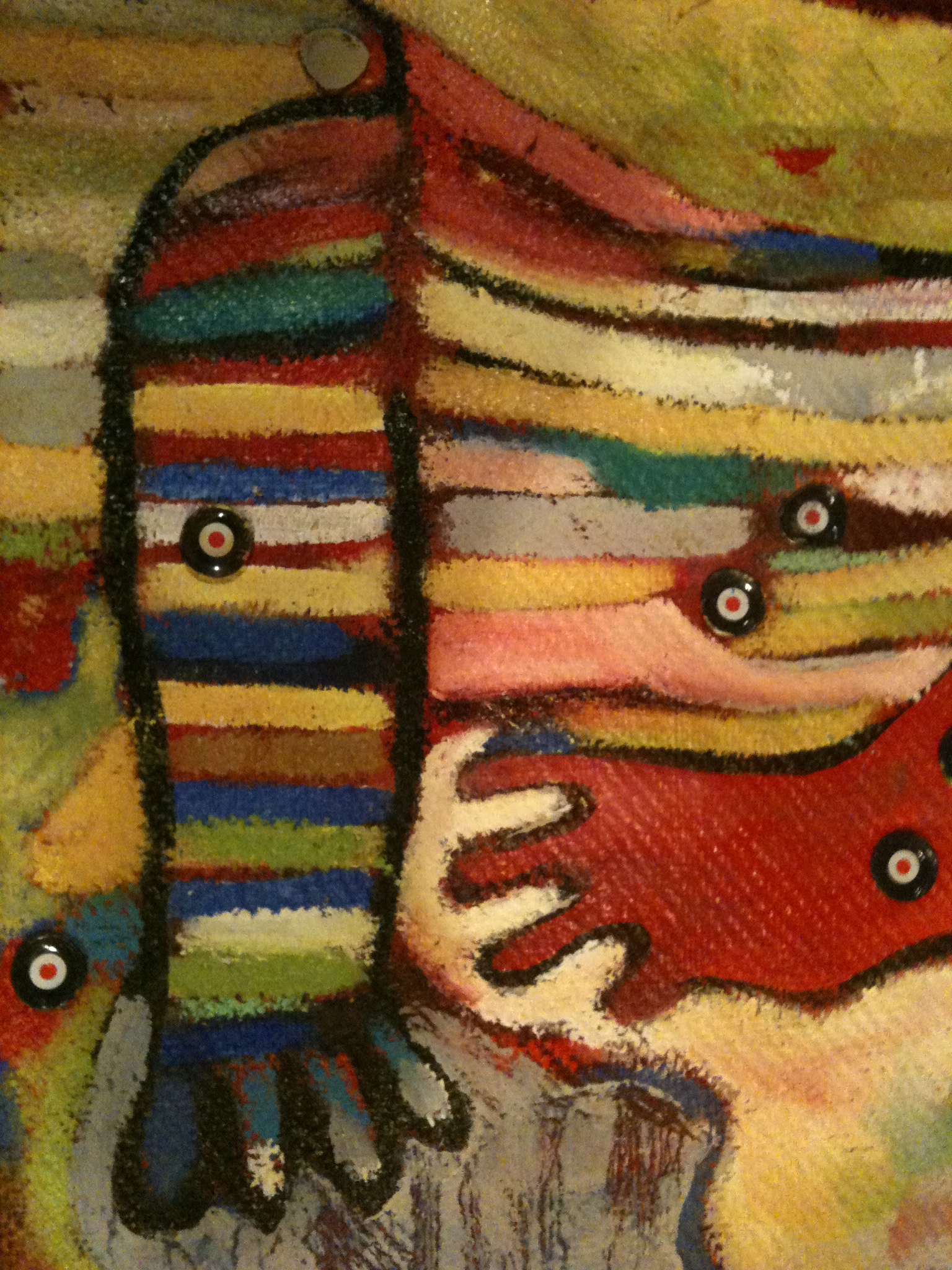
To be asked how to heal pain I would answer with love, not with more pain. The part of us we might call the soul is like a newborn, requiring care and gentleness. You would not cause a newborn pain, and you would justly call anybody a madman who thought that causing a child pain could be justified by any benefit.

True, pain is an unavoidable part of human existence. The Buddha teaches to answer it with compassion. Christ asks to love yourself as you would others. Allah is fond of mildness and does not give to the harsh. Would you cause your own children pain to better them? Would you feel justify hurting someone else for their own
longterm benefit? I know you would not. Could you possibly embrace the idea of treating yourself with the same gentleness?

Will you accept yourself as you are? Will you allow compassion with yourself, forgiveness with your own weakness, smiles for your own pathetic inadequacy?

Put down that cup of poison and drink from the clear water of life untainted by interpretation.Trust your senses. The hands of your children or your friend, the beauty of being warm or cold, of being alive still to sight and sound. Life is a celebration. Celebrate.

And when you get upset with me for writing like as if I knew how to accomplish such a complex thing as healing (which I readily admit not to know)I just ask you to believe me that I am not writing it from a privileged, theoretical point of view, that I have known pain as much as you might have, that I know the terror of waking at three twenty-one at night – and yet I ask you to open your eyes to see that life is beautiful despite its apparent shortcomings and that you are good as you are.
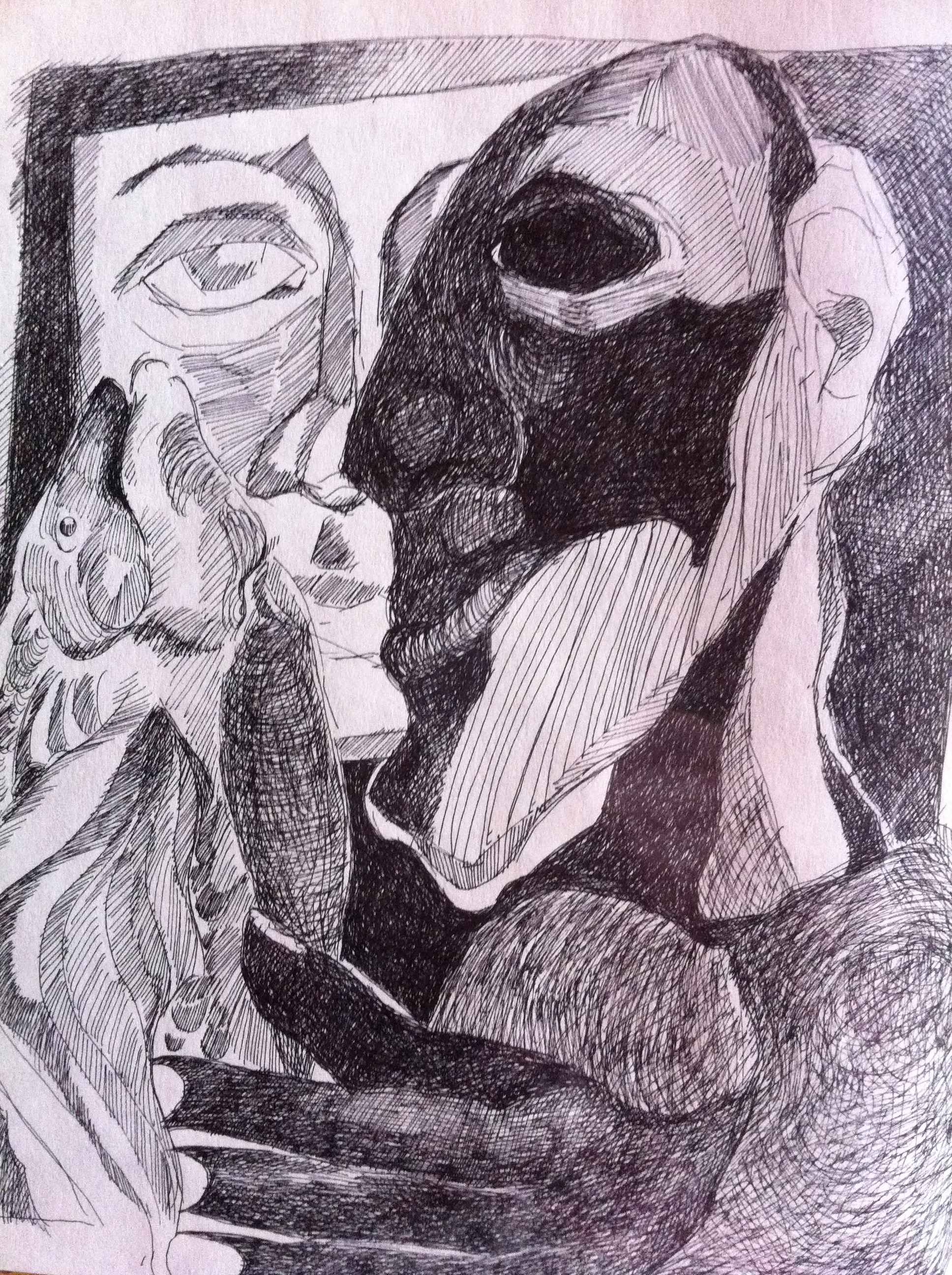
Mahabaratha, final version

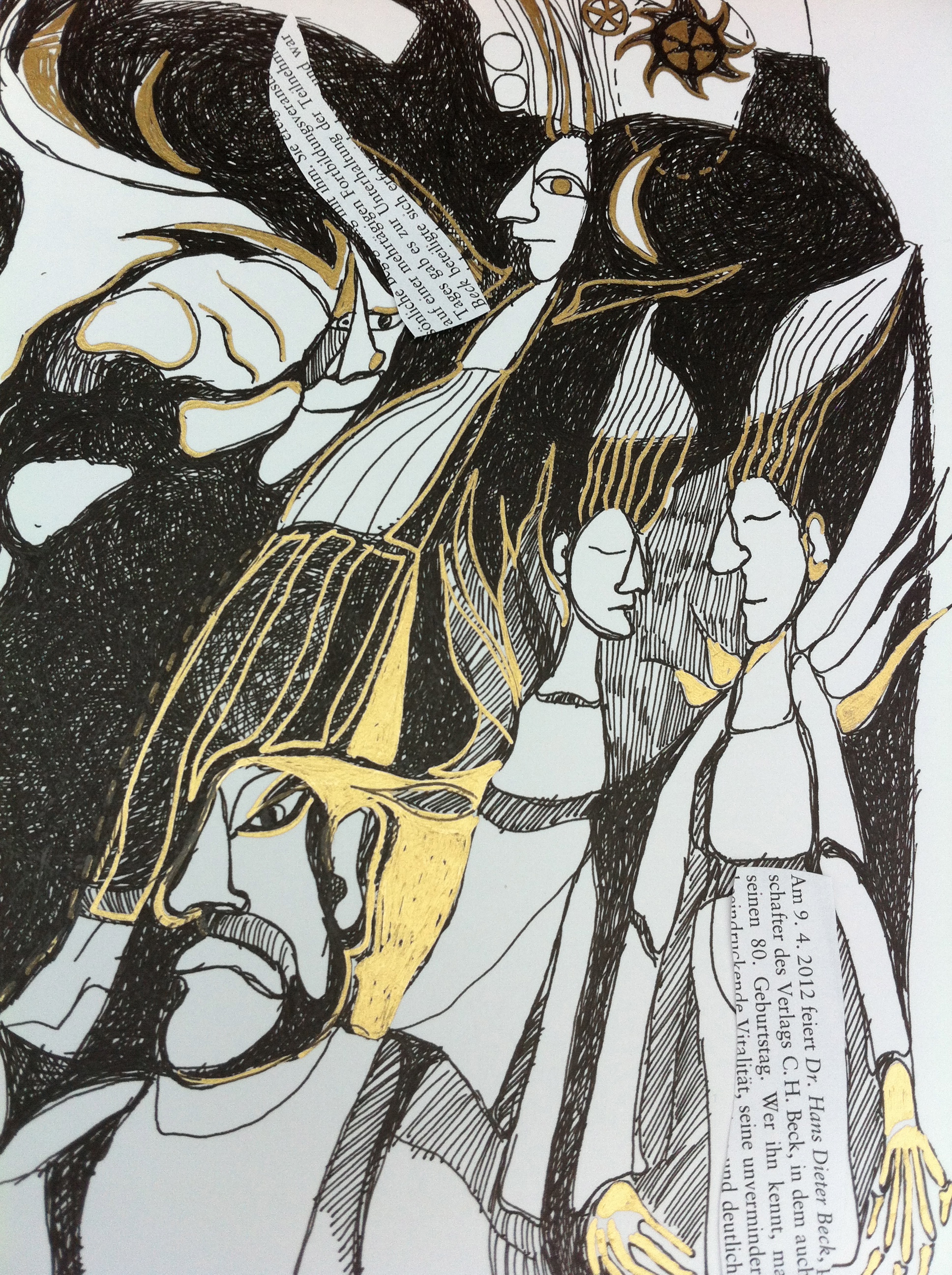
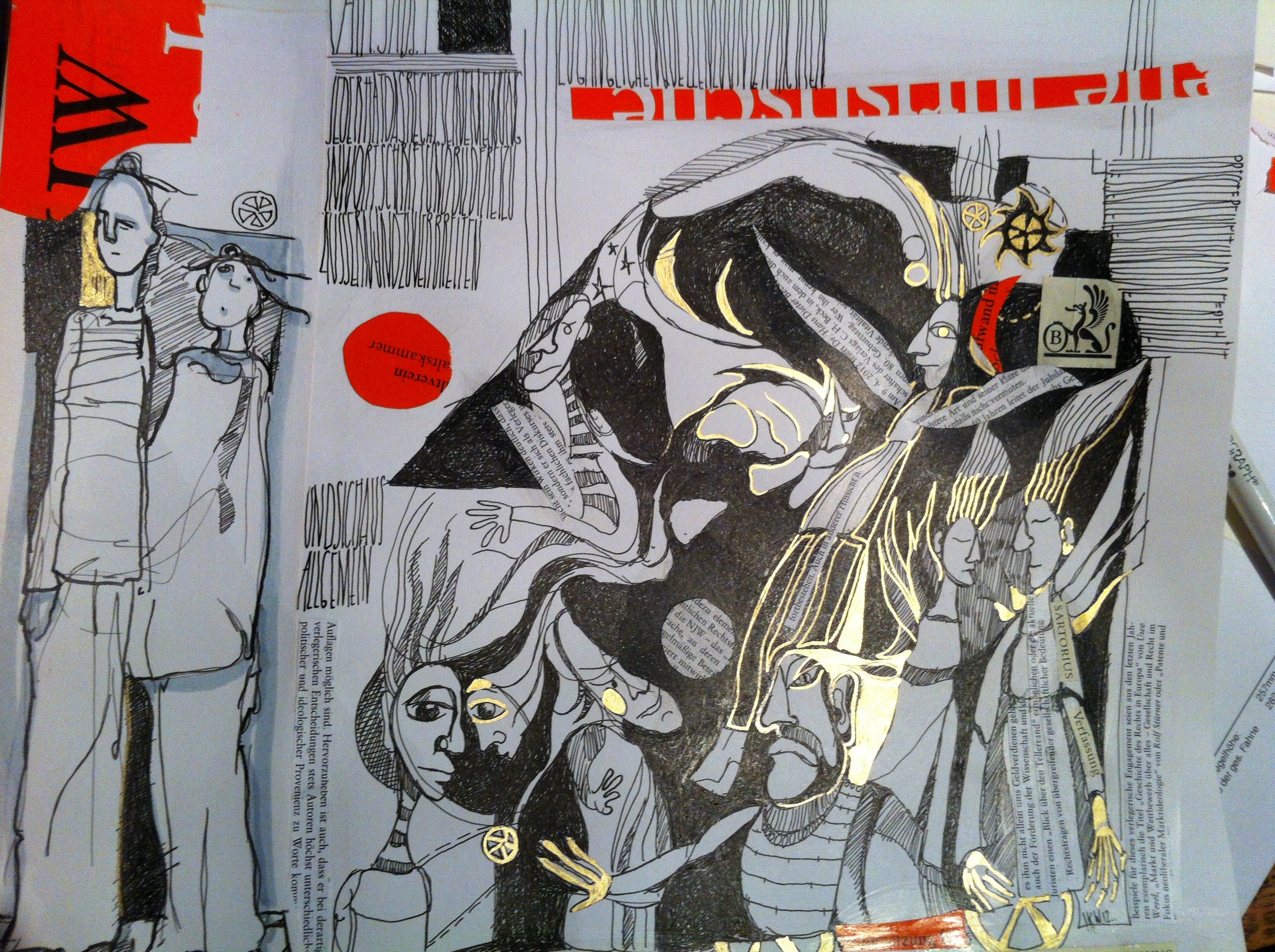
See the people on the left, right out of “Waiting for Godot”,real and possibly identifiable by their puzzled expressions and shabby clothing, confronted with the ideas and forces of the Mahabaratha, the great wagon of creation, that rule their existence whether they are aware of them or not, whether they approve of these ideas or reject them or are capable to form an opinion on the ethic implications of them in the first place.

The Mahabaratha, one of two major Sanscrit epics, is one of the first known written attempts to address the question of whether there can be a just war. On the wagon you will be able to identify the military commander as well as the celestial (winged) beings who discuss the fate of humans calmly and without apparent distress or compassion. Stylistic resemblances to Guernica through the more compassionate woeful expression of the face to the left of the commander, moving towards the human sphere as if in a warning but alas without reaching them or even being conceived as possible, points towards the reality of human existence: even though war has but destructive consequences it is an ever reoccurring reality throughout history, sweeping away everything in its path.

An open question, rephrased … (Thank you, OléVolta)

Do you feel that what you see in official exhibitions and what you conceive as important contributions to art through your own experience as an artist are related? Or do you feel that there is a disconnect between the relevance of “official” art and the art that is relevant in your own political and cultural environment?

The Glass Library continued, another “shi..y” first draft

I packed my papers and stacked the books on the table in front of me. The girl in the window library did the same. I watched some other library users amble around, pick up books and the people in the glass library did the same. Watching the world in the mirror had a numbing effect on my mind. I leaned back in my chair once more. That’s when I saw her. In the “Nature Sciences” section. The girl I had seen reflected in Dr. Hausner’s dark glasses the day he had talked to me about the experiments at the New York Ocean Institute. She was immersed in the study of a big red volume that she was balancing on her arms. She was wearing her school uniform again. She was not wearing shoes. I turned around to scan the library for her.
It is surprisingly difficult to translate a mirror image back as anyone will know who has ever tried to cut their hair in front of a mirror. I found the “Nature Sciences” section after some trial and error but the girl was not to be seen. I jumped up from my chair and walked quickly towards the shelves, expecting to find her replacing the volume but the aisle between the shelves was already vacated when I arrived. The girl was about my age and I very much wanted to make her acquaintance. Someone my own age, someone real to talk about the complicated grown-up world I had gotten myself entangled in.
I suspected that she knew Dr. Hausner. She must have been following our conversation or else I would not have seen her reflection in his glasses. Why did I not turn around? I had preferred to call her “the girl who lived in Dr. Hausner’s glasses” because I loved stories, any kind of story – but right now I needed someone real. I walked towards the end of the aisle and looked left and right but there was only an old lady perched on a foldable stool, the kind you use for field sketching. She was holding a legal pad and a pencil which made small scratching sounds on the paper as she was writing. She looked up as I checked the aisles and smiled. She was wearing thick owl glasses and looked fragile. I smiled back. She waved her hand, indicating that I should come over but I hesitated and wondered whether I should just respond with a wave as if I had misunderstood her intentions but then I reconsidered and walked over.
“Did you want to talk to me?”, I asked with my hushed library voice but she just continued to smile and pointed towards her ears first, then her mouth. She ripped the top page of her legal pad, folded it over twice and handed it to me, still smiling like a wise owl. I smiled back to acknowledge her gesture instead of saying thank you – but then I remembered Dr. Hausner’s explanation about blind sight and added “Thank you, Ma’m.” in my normal voice. I was glad I did because it immediately resolved a strange numbness in my mind and the old lady smiled at me as if she had guessed my train of thought. Then she started writing again.
For a moment I thought she would write another message for me but she just filled the page with fine lettering, turned it over to continue on the next page and seemed to have forgotten all about me. I said “Good bye, then”, and after waiting idly for another moment slowly took a right turn back into Natural Sciences and to my desk. If you think the normal thing to do would have been to immediately read the page she ripped off her legal pad, you might have a point. I am normally as curious as the next person but that day I just slid the folded yellow paper into my map, picked up my books and papers and left. I had had enough of enigmatic messages and hints and I wanted food more than anything even if it meant that I had to go home.
I kept looking for the barefoot girl as I crossed the library and down the wide spiral staircase but I didn’t see her and didn’t really expect to either. I would have to return some of the books the following day as they were for overnight loan only and I would look for her again then. The young guy who had been called “Honey” by the messy lady checked out my books and gave me a normal, actually quite nice smile. Satisfied with someone keeping within convention for once I returned the smile gracefully, left the library and walked home.

blog dialog: art and the internet – an open question

There are so many works of art I only got to know because of the internet and especially through blogs. Amazing artists who would have been never known to me and whose work I enjoy immensely and allow to take an influence on my own standard of creating. I come to other artists’ blogs for encouragement when I feel that I have spent too much time with myself and my own work; I admire and am in awe of the amazing work from the most unlikely corners of the world – of the skill, the amount of expertise and professionalism and fortitude both in writing and painting/illustrating – I actually feel that the internet has allowed me to find my own “people”.
I am currently writing my (legal) doctoral thesis about museum and other cultural spaces and the selection process of paintings and artists to be included in exhibitions in those desired spaces.With the internet, artists – for the first time in history – have been empowered to present their work to a wider audience regardless of whether the art, cultural and political establishment will accept it. I would be truly interested in feed-back about representation of artists to the public. In your experience: does the work you are finding included in traditional exhibition spaces represent the spirit, quality and intellectual content of work artists you know are currently working on?