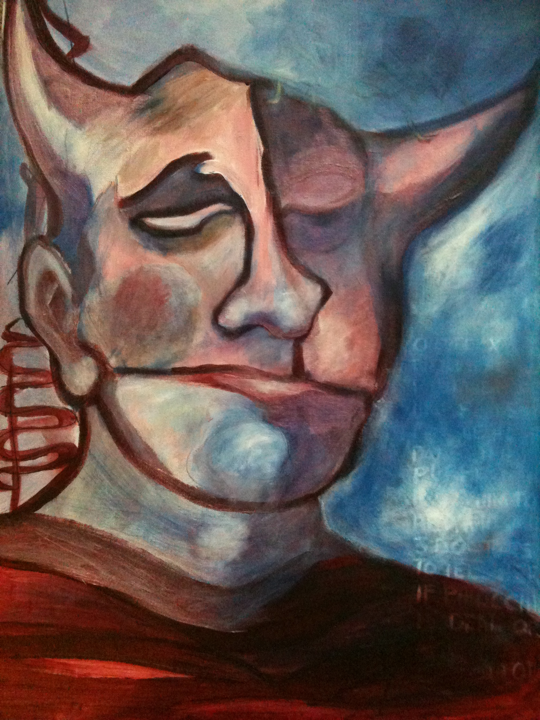
Mud people (excerpt from Gargoyle)
fullsizeoutput_b93 The shallow hole the boy had dug became deeper with time as he scooped out the red colored clay the ground was made of. He filtered it through his hands, taking out stones, sticks, decomposed leaves and roots. Punching and smoothing it he compacted the clay to one block, thus slowly building up a monolith from clay. He devoted great care to this process, making sure that he would have a structurally sound mass with which to work. Over the course of building hundreds of small people from mud he had gotten quite skilled at this craft. Only when he was content with the sound that a slap against the block produced, a deep, saturated thud, would he proceed to sculpt. With deliberate slowness he worked from the general form to the details. Many times a form had collapsed when he had tried to overemphasize a movement or had placed the limbs too far outside the center of gravity. In the beginning he had tried to use sticks to support an arm reaching out or a leg stepping forward and though technically that solution had worked he didn’t like that the figure now seemed to defy the laws of gravity that nature put on the material and form. It was thus almost impossible by the mere use of sticks and clay alone to sculpt an outreached limb that looked natural. So he had returned to work from the inner core of the material and to rather hint at a movement that – though invisible – the eye would project into the empty space. He was always intrigued by what he could see without seeing it. He liked the way his sculptures randomly related to one another, all he had to do was to quietly look at both sculptures and discover this relationship of forms. Something deep inside him stirred when he looked at his creations and their silent endurance. He could see the form of the space in between two physical forms, it was nothing and yet visible if one cared to look, it changed constantly, stretched and diminished, even disappeared. It was actually easier for him to comprehend the properties of this in between space than the form itself. You could get out of the trajectory of any moving object if you controlled that space. If you made that space in between adhere to your inner voice you did not need sticks to build a figure. Why, you barely needed your hands, all you had to do was to look long and hard, look at the clay monolith and make some slight adjustments. Soon his people were crouching, stretching, running, turning. He took great pleasure from this.

His father began to take notice too. One night when he had returned home from the workshop the little garden patch had first caught his attention. In the twilight the clay sculptures his son had build in the afternoon had a strange quality of perfection. There were seven fresh sculptures, six of them crouching on the ground, the seventh a small figure in flight, emerging out of a block of brick-colored earth, running.
From a distance it had seemed that all sculptures possessed distinct personalities and bore individual facial features. Something about these features seemed oddly familiar to the stonemason. Upon closer inspection he realized though that the impression of an actually sculpted face dissipated from a nearer perspective – but reinstated itself the moment he stepped back like a magical trick. The inability to confirm his initial finding, to come closer to the truth, was intriguing to him. He asked himself how a not yet six year old child could have created such a sophisticated illusion. He didn’t ever doubt that the impression was created deliberately. He studied the people his son had made for a long time. Inside the house the light from the boy’s bedroom shone dimly through the drawn curtains.
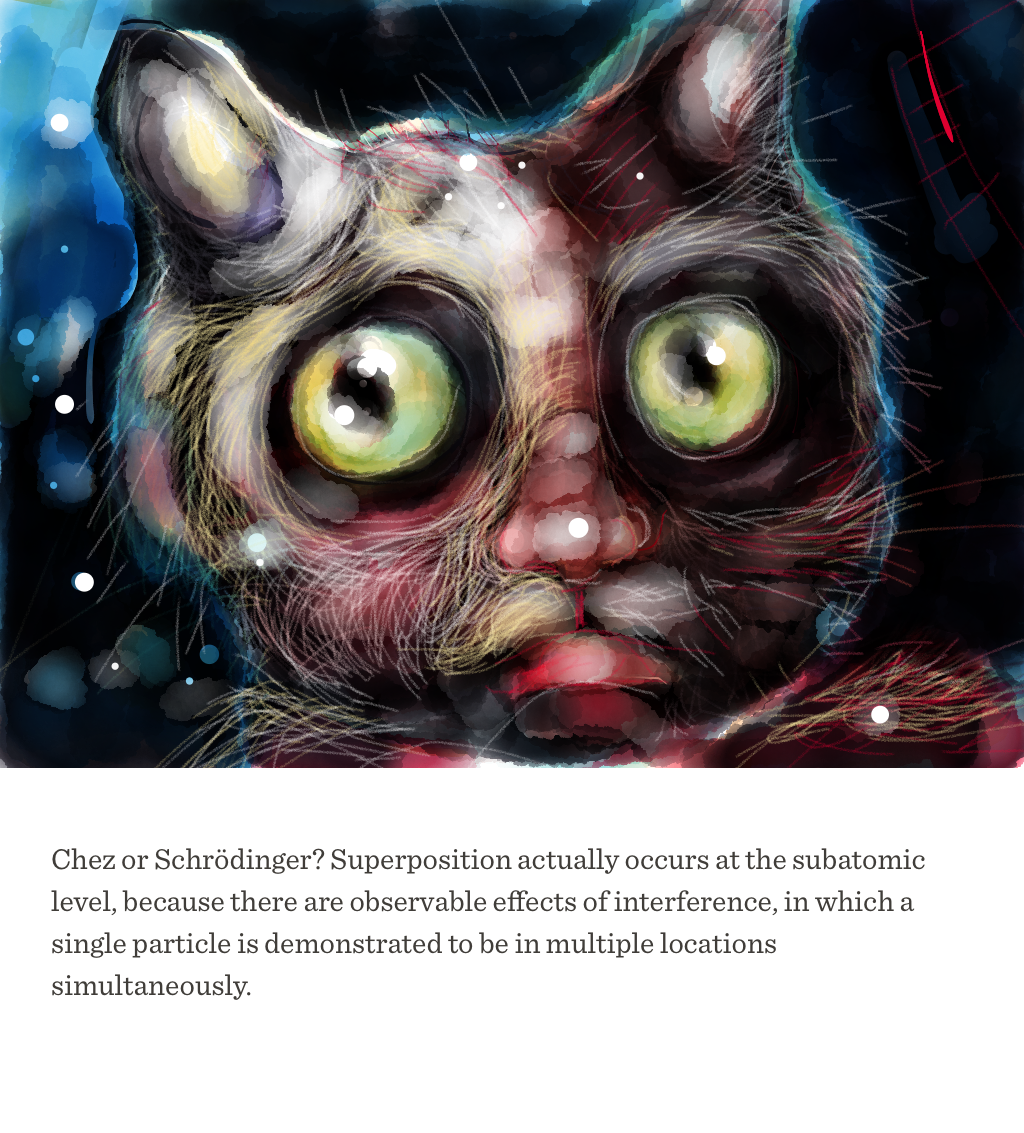
Schrödinger’s cat – or: On the art of being in multiple locations simultaneously

 
After a couple of years working  part time as a lawyer I just started working in a full time position. The first week brought me to about 50 hours and an additional 13 hours commuting time. My brain – while obviously mostly occupied with cases and briefs – feverishly tries to establish a parallel sphere in which running, art and writing might still have a serious existence. While it is hard to get out paints at night digital sketches have been a kind of substitute for my art deprived brain. As for non- legal language impact I have been listening to David Foster Wallace while driving and Proust. In search of lost time. One does not need a psychologist to figure out why these are the choices that offered themselves. As for Schrödinger’s Cat: Only while rereading the small blurb on superposition under my sketch did I realize why the idea has found its way into my nightly art fix: the effect in which a single particle is demonstrated to be in multiple locations simultaneously. 

autocorrect

IMGP1041When she was ready to write, the first word that presented itself was: nocolor. Autocorrect corrected it three times over. Autocorrect wrote: “No color”. The word as it needed to be was: nocolor. She knew what it meant. It was a good word to start with. She could see that autocorrect was struggling with the concept. She took a piece of transparent drawing paper o and instead of typing she drew the word with a radiograph pen, 0,35 mm: nocolor. The paper endured the non mistake.

Autocorrect was a mediocre little man in a grey woolen suit. She knew him. Raymond Chandler had known him, too. Common sense, autocorrect, is the little grey man who never makes a mistake in addition. But it is always someone else’s money he is adding up. Oh, I have met the little man in the grey suit many times over. Here he lingers. I am sure autocorrect wears a grey suit, but I know better than to pay attention to him. nocolor is a good word to start writing about the exits that are not accounted for. the little grey man wouldn’t know them if he stood facing one. He would insist there was no door. And he’d be right there is no door. Only there is.

Alternative pathways to the primary visual cortex

impeached kingHe turned around and looked in my direction, his dark glasses reflecting the library lights like distant stars. Then he smiled. Automatically I smiled back at him, but then I remembered that he was blind, and my smile froze. I was frantically searching to find an appropriate opening sentence in my vacant mind. He held his smile still as he was addressing me. “I think we have a mutual friend, Ms. Clarice,” he said kindly, not commenting on my rude behavior. I was now searching for his eyes behind the dark shades and instead encountered my own mirror image, small like a doll. “I am sorry,” I finally stammered, addressing the little doll more than the man, “I am really sorry, but how do you know who I am?” I was still being rude, I realized. The small person reflected in the distant mirror of his glasses I had taken for my own reflection made an unexpected move that startled me even more if that was possible. She took a mocking bow towards me and disappeared into one of the bright reflections of the lights above. “Things are not what they seem, Ms.” responded the old man, why don’t we sit down somewhere so you can ask your questions. My name is Dr. Aaron Hausner. And who might you be?”

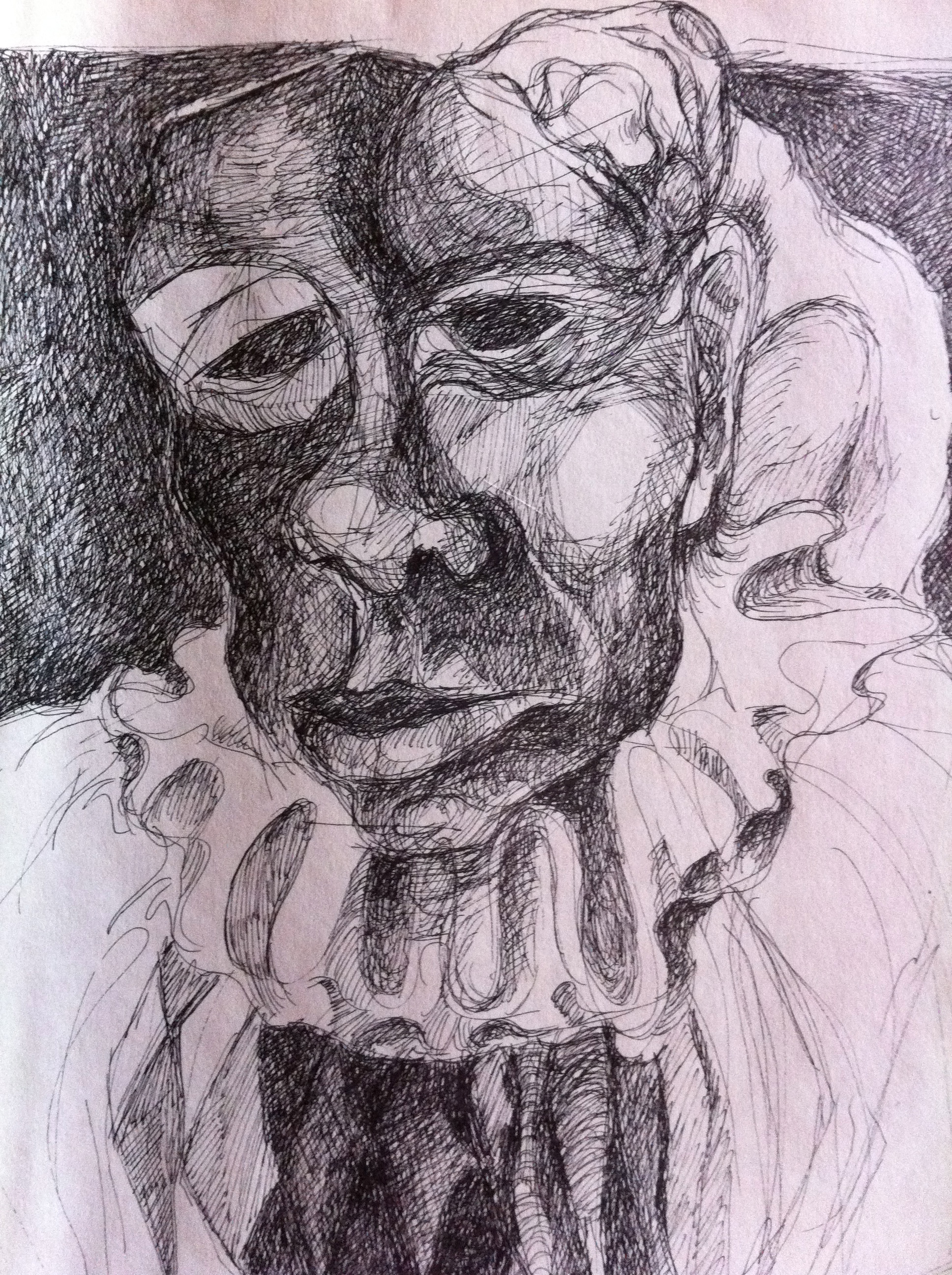
Dr. Hausner dedicated a long time to me. He was soft-spoken and had an uncanny ability to predict my next question – yet, at the same time he did not once directly answer any one of my articulated questions. After we had occupied a spot in a somewhat secluded corner of the library – he had been leading the way without ever hesitating – he had again turned directly towards me and had started speaking with a soft voice. “The route from eye through the primary visual cortex the is not the only visual pathway into the cortex. Other pathways exist that bypass the primary visual cortex. A blind man like me can learn to trust those pathways though they do not stimulate a sense of optical vision. I do know whether there is an object in my way, approximately which size it occupies and whether it is mobile or fixed in place, of organic or inorganic nature. I also know whether a person directly faces me or wether I face a person and whether this person smiles at me. Scientifically this phenomenon is called blindsight.“ I felt like a fool. He answered. “Don’t feel bad, most people feel inhibited when they first address an apparently blind person. And to be honest, not all blind people know about this phenomenon either, though most blind people I have talked to could relate experiences that strongly point towards their ability to process some visual information even though not in the way they expect.” I was stunned. We were silent for a moment. Finally I found my voice: “My mother is an artist. She draws objects as an intricate net of lines, and though the object is not directly represented through these lines, with a bit of patience one can usually tell what the drawing is about. I mean, you can see the object though you clearly can’t.” I drew a deep breath. Dr. Hausner seemed to listen but he didn’t come up with a typical grown-up response like: How interesting of you to point out the similarities between an artist’s perception and a blind person’s perception.

Artist’s logic: to a friend who just celebrated an important birthday, (isn’t any birthday?)

While I travel between two very different worlds, one might just as well say, universes, between the paper world of the lawyer backed up by the many stories and needs of my clients, as different from one another as one can imagine, and the turpentine world of art, the stark smells, the mess, the need to tangle that which has just before been neatly ordered, backed up only by my own perception of the beauty of randomness, my need to stretch beyond the confines of an individual biography and yet of course always landing face first back in, well  if not in the mud then at least in a bucket of paint like any other clown in business,

while I travel between these worlds I feel entirely grateful that for some random reason I have been given the gift of intense pleasure in all these fragments that might never amount to much, not make a front page but at any time give me a sense of wonder and awe of the wild twists and turns. How I wish you would, too, I mean, take intense pleasure in what is, not fear how much or how little there is to come. Take the deep breath and dare to live this imperfect, strange, angst-ridden, beautiful, funny, short, long, light, dark thing called a life. How I wish you’d get to be just you, not judge yourself nor let yourself be judged by others while you lay down, if only for a moment, the burden of your insight.

Here’s to the wild twists and turns, my friend, to moments of desperation followed by sudden outburst of unfounded optimism, to the great calm between the days of discontent and the fractured mirror of contentedness reflecting the light of other possible worlds.

IMG_3159


The elusive act of teaching children how to be creative …

Legal Chimaere

To be creative is a basic desire of humans, all humans. It is a genuine expression of who we are even before we are defined by our social and economic circumstances. To teach a child to be creative therefore seems to me an elusive act. I look at children with a sense of awe, they are still there, right at the origin, and all I do as the teacher I am honored to be at times is to take them on the same kind of  long walk that I had been privileged to undertake with my own grandparents and I simply allow them to discover their world and to collect at will what responds to their own desire of creating this world new. If we’d allow our children more freedom and time to explore their own world and provide them with materials that are not dedicated to specific purposes, we could cut back on many extracurricular activities. Let them venture out there and the artist that lives in every one of us but is acutely alive in our children is ready to meet all the great challenges of art right in our neighborhood.


Time itself took notice of the unlikely creature

IMG_2513

“I  will be back.” Was it even meant to be a promise or rather the a mere, impulsive expression of an intent? The gargoyle pondered this question over many days, even weeks after the mason had left. He remembered the exact  sound of the words, their intonation, the expression of the mason’s face, the thoughtful gathering up of the tools, the turn of the head to once again rest his eyes upon the face of the stone creature, the final words – the gargoyle relived all of these moments and weighed them, day after day.

Every day up to midday he collected small reasons why chances were good that the man should appear this day, after midday he thought of excuses why he could not possibly have made it possible to come this day but would surely be able to fit it in tomorrow or at least before the week, the month , the season was over.

Perhaps the last gargoyle had been lonelier than he had cared to admit previously or maybe this obsession with the return of the mason was just yet another way to pass time.

Waiting for something to happen, somebody to appear, seemed to be far superior to just being, even if it infused his previously peaceful existence with a permanent sense of pain, a feeling that was so close to boredom that at times he would have been unable to distinguish it.

Boredom or pain both compromise our sense of regular time passing and whereas a day had just been a day, an hour just an hour before the advent of meaning and desire (now time had a direction, time existed so the mason could bridge it, so the gargoyle could subtract minutes from the greatest distance that separated him from the return, the moment when the mason had finally turned his back on him and left the roof), now a day could be excruciatingly long, especially if the gargoyle thought to have detected sounds coming from behind the closed roof door.

Expectation, gladness, desire, wishfulness, frustration, even despair were all variations on the same theme, waiting. Waiting in turn meant the refusal to accept time for what it was; it was like a progressing illness. It never occurred to the gargoyle to abandon his unreasonable expectation and to return to stone nature in order to gain the peace he longed for. Peace seemed attainable only if his curiosity about the reason for the return of the mason could be satisfied. Time passed and the mason did not return. Eventually the initially glad expectation turned into a numb pain, over time seemingly removed from any cause. A general disappointment  overcame the gargoyle, the most human of feelings, as if something that had been promised to him was now purposefully being withheld. It was as if his existence was gradually being tainted by something he could neither name nor really be completely sure of.

Time itself took notice of the unlikely creature and inexorably started gnawing at him with tiny teeth. The  gargoyle still formulated his thoughts in human phrases. But instead of patiently following a thought until it moved just out of grasp and then starting all over again like a child, he had taken to a summarizing his thoughts in a more generalist way, often colored by self-pity. A second rate stone poet he was now, defeated and ridiculous, utterly grown-up and utterly human. He felt contempt for himself, for his dependence, his passive waiting, his pathetic obsessiveness but he couldn’t help himself. There was no way to stop. No way to stop waiting. Tiny cracks were forming in the rough granite surface. Defeat was looming.

Transformative forces


IMG_0537

He  was but a gargoyle, a stone image.  How the gift of sentient observation had come to him he did not know any more than man knew where the soul originated. From his place on the roof he observed people, adults and children alike and marveled about the passage of time. After years and years of observation, of overheard fragments of conversation that the wind had carried up in the same unreliable and moody way he carried a fragrance like a caress or deposited leaves and debris in the gutter, from years of watching children grow up and age, he had concluded that humans were born with many gifts only to shed them with the years until nothing of value was left. Adults to him, the steadfast observer, were a manifestation of a process of  deterioration of their former promise.

There seemed something broken about adults to him, men and women alike, as if the original balance of their design had been spoiled. He liked children perhaps because they seemed unaware of the passage of time. He observed with pleasure as a seven year old girl straining under the weight of a watering can that she had been sent to fill up at the pump stopped in her tracks and put down the watering can only to pick up a small, white pebble to examine with great  interest and sincerity as if she had struck treasure. Another day he had observed  a young boy crouching on the path in an  immobile position for close to an hour, a long time in human count, to closely look at the street of ants entering the church underneath the granite slab step of the back door. It was the same ant street, as  wide as the arm of the local butcher,  that the custodian had failed to banish form the grounds even after many years of relentless and poisonous battle.

Every now and then, from his precarious precipice the gargoyle observed a kid  blinking up into the grey light of an early Northern spring day, scanning the gargoyle’s own dark silhouette against the diffusely bright clouds.  He had never seen any adult lift their head to actually study the structure and ornamentation of the church. It was children only, children  possessing the gift of timelessness by focussing on something small just outside their reach and holding on nonetheless, thereby transcending the moment that was forced upon them by wisdom or mere whim of the ruling adults in their lives. And all that time he was waiting just as they were waiting, existing in limbo, in a state of not knowing, waiting to be unbound, for his fate to be revealed to him, and yet dreading it, dreading it was but a process of diminishing, of deterioration just as the passage of time exemplified by human behavior seemed to indicate.  And yet, there were moments he still believed in the transformative forces of time and light.

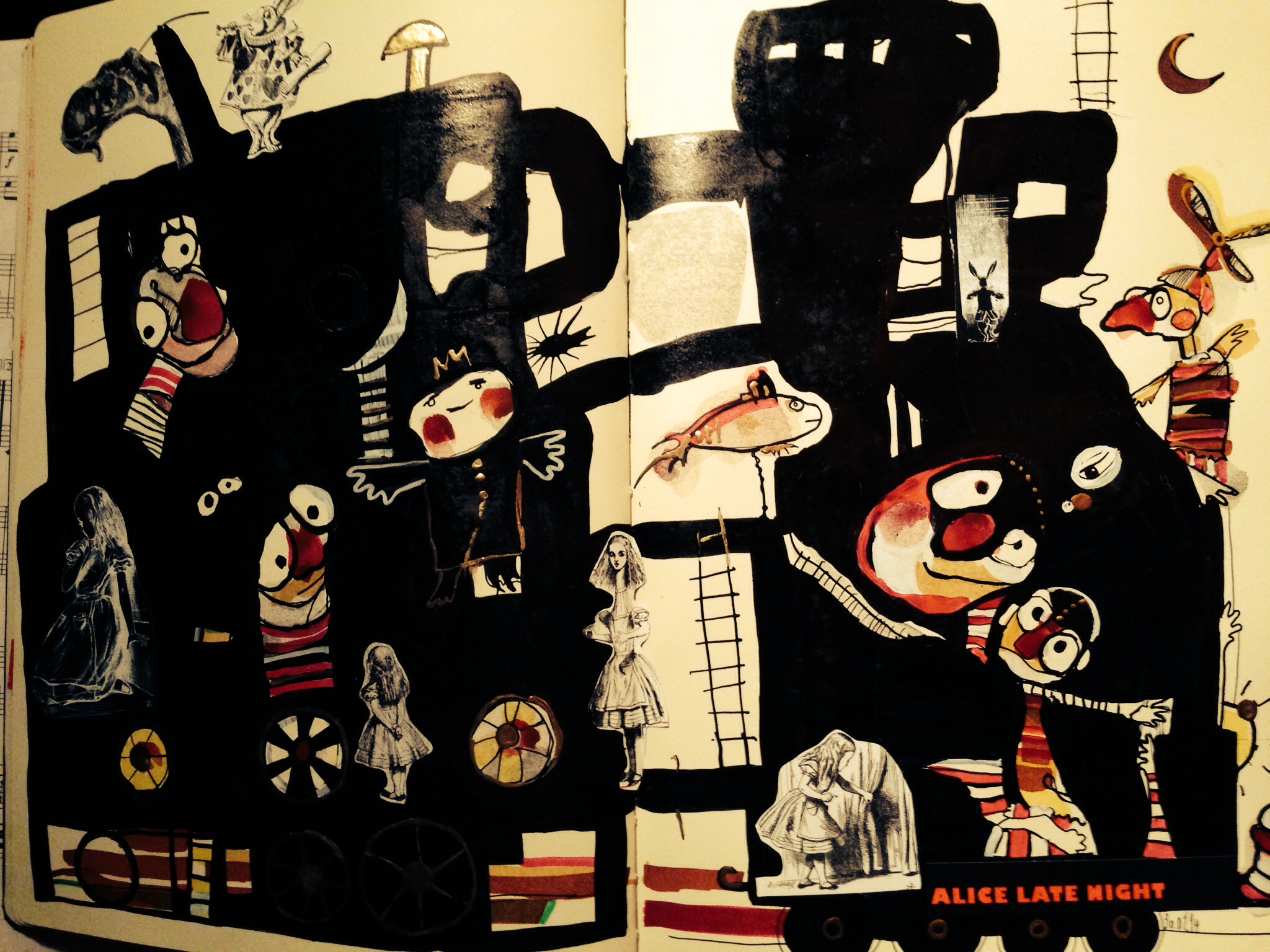
Alice at Night or the long way since Chauvet

Alice at night

The longer I “make art”, the more I am intrigued by the uniquely human need to conjure up coherent images that are  no direct translations of the visual environment as our eyes and brain perceive it.  We know that this strange obsession of humans to conjure up images exists for over 30.000 years. The oldest surviving images known to us painted on walls of a deep bear cave in Chauvet, France, are breathtakingly beautiful. It is remarkable that 30.000 years later we are still able to relate to these early images, maybe even understand their narrative, remarkable considered that these are images of a culture lost in time, as distant from our own world as some imagined extraterrestrial culture. We see  and feel rhythm, movement, beauty – but we do not know why these drawing were created. All we seem to know is that this is our heritage. Maybe this is the cradle of human consciousness – the need to create images and see images in the curving path of a charcoal line.

If we proceed beyond our modern time’s desire to sell most anything in the world , and to employ the power of images to achieve this, we are still creating without truly knowing why we are doing this. Images as marketing tools are so powerful not only because they are almost disturbingly universal due to their pictorial content, but because can be read by anyone who can see, that will reliably be read even when the person “reading” is not aware of the deciphering act. There is no analphabet to images even though they are in their own way as illusionary and abstract as words are to the thing they are representing.

Images are incredibly powerful in influencing our behavior because we are born to react to the furthest abstraction to the original that is still distinguishable from “everything else” (as the most complete description of what the thing is not.) We are wired, so to speak, to read out these abstractions, the blur perceived from the corner of the eye, because every second counts. But that might be true for any moving organism. However, we also obsessively and compulsively creating images, inventing new coherent thought and context.

I think that the human mind though sharing most of its features with other living creatures  – for the last, let’s just say for arguments sake: three percent is completely different. We are doing something that no other living creature will engage in: we are writing new programs. We are creating new worlds. In the beginning was the word. And the word was an image.

Each drawing in itself contains a coherent thought if not a universe. Asked to explain how an image I am either observing or creating is coherent I’d be at a loss. But I know – while I am working on it –  that there is some kind of balance and I continue working towards that balance until I feel I have achieved it or know for sure that there is no way to get there any more. And when I have achieved that balance I know something follows, that there is a consequence to a coherently spelled program, even though I do not know what kind of consequence.

And what fascinates me is not the fact that I have some half cooked up theories about drawing, its origin, its relation to human nature but to observe that this impulse, and may it be explained completely differently, has driven me to drawing for all of my life, or more precisely since I received my first set of rectangular Stockmar beeswax crayons at the age of three and was instantly smitten with the living force of the colorful horses drawn on the metal box. I do remember with vivid clarity that this image on the crayon box instantly conjured up another image, one that I knew I had to draw, one that I have drawn many times since – and I am still looking to find the balance for that one particular image.

assault on reason

there was a time the child knew with unfailing certitude that what was presented to her as the inevitable if not inexorable logic of reason was but a clever disguise for the a massive assault on reason .IMG_0538