Page 2 of 8

Po Tolo

IMG_2146

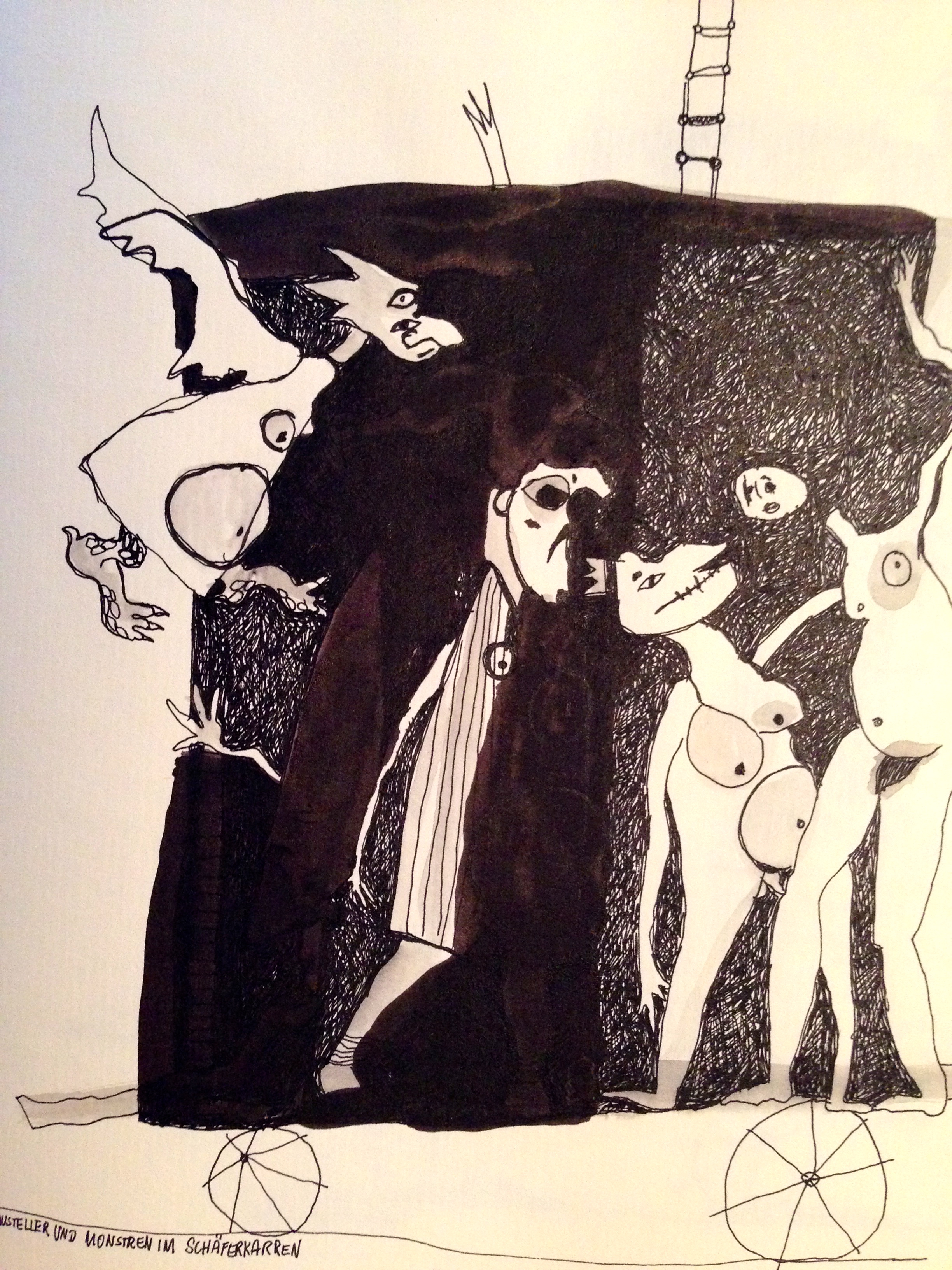
“My grandfather, your great-grandfather, believed that there is life in the Sirius system. The Dogon, an African tribe with very acute astrological knowledge, have believed for centuries that there is life out there as have the ancient Egypts and the Sumerians. According to the Dogon Sirius is accompanied by two other stars, a very small and incredibly dense star they call Po Tolo, which means “very little star”, and which modern astrology has confirmed to exist only recently and calls Sirius B. Indeed it has turned out to be a small star with an incredible density, heavier than the iron we know on earth. The Dogon also claim that the other star in the Sirius-System is lighter and larger than Sirius. They call it Emme Ya. And around Emme Ya they say there orbits the home planet of the Nommos, the children of Sirius and Emme Ya.“

My mother inhaled deeply. I knew she was thinking of her grandfather. She still missed him. He died some years before I was born but she had told us many stories about him.  I had always imagined him a very stern man, rarely smiling, expecting a great deal of my mother. I couldn’t picture him indulging in fantasies about alien life.
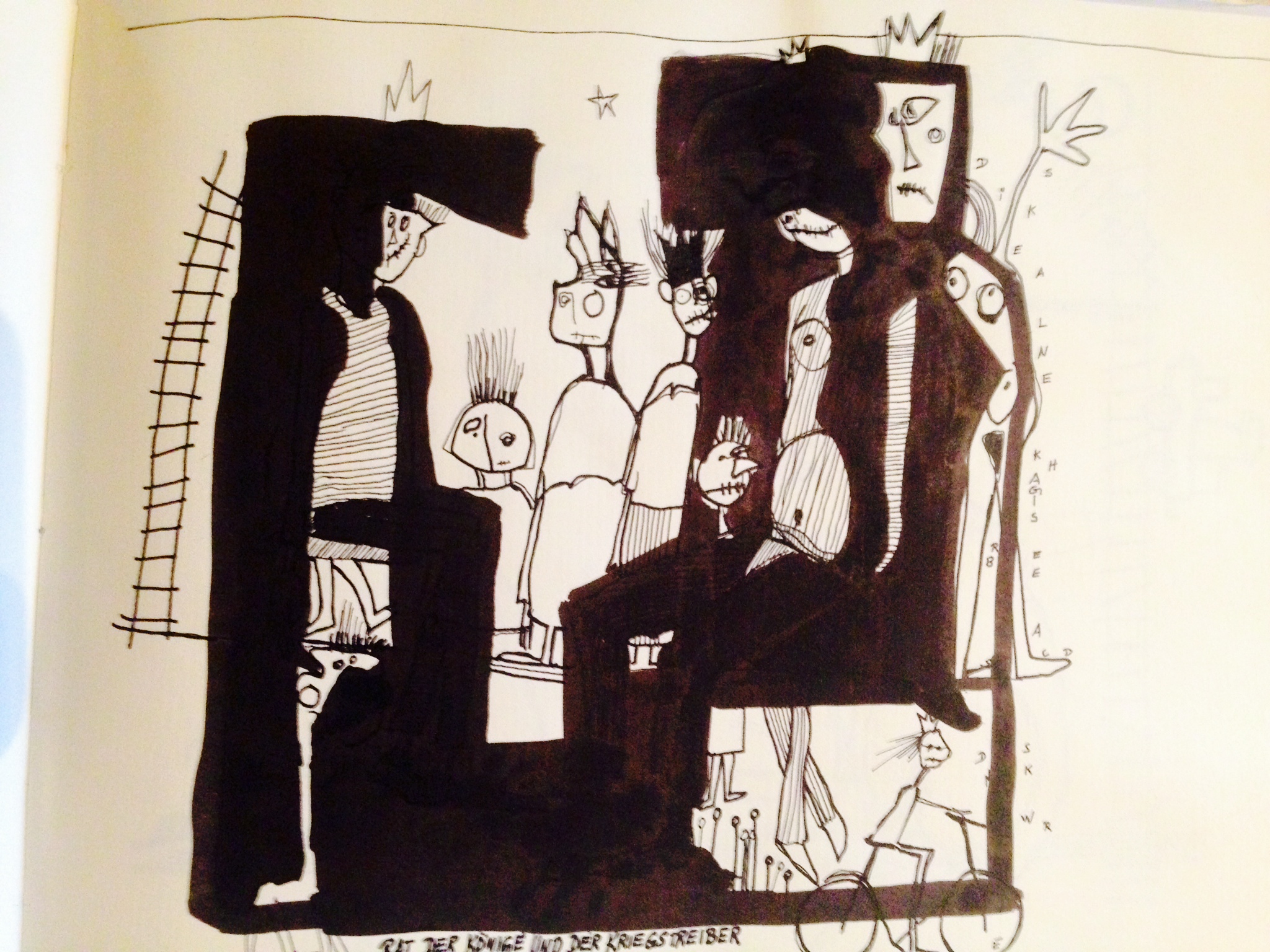
 

Zur Natur des Rats der Könige und Kriegstreiber – on the nature of the council of kings and warmongers


Once they realized that there was not one king or one queen, but a succession of kings and queens each of whom was “the” king or “the” queen regardless of their individual identity, so that in fact, the king or the queen was not only unconquerable but  actually immortal, that times might change and ideas might change but “the” king or “the” queen” would not, so that one revolutionary, one upraising idea might threaten an individual queen or king and even overthrow them, garrote them, end them, but would have to accomplish this task within one lifetime, while “the” king or “the” queen had all the ages of the world  to wait, witness and rise again, once they realized that “the” king or “the” queen might use this or that war monger to clear the way once time was good and ripe and yet would discard of the warmonger as easily as of the revolutionary as soon the need was satisfied, once they realized that this was so, they also realized that it was not their task to interrupt the fleeting council of kings and queen and warmongers but use their one lifetime to conjure up from the source, the holy grail, a people that were as unconquerable as the grail, giving a random gathering of people a binding, unifying reason to be, to defend their freedom against the usurper through all the ages and to recognize their freedom as not a consequence of liberation but as an unalienable right and quality.
Rat der Kuonige und Kriegstr

British Storybook illustration – the golden time of the childrens’ book …

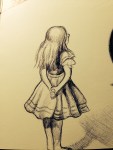
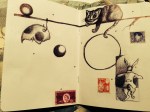
After drawing for many nights I didn’t feel I wanted to let go just yet. True, my paintings are calling urgently, but what are a few hours? So I kept on drawing and I used John Tenniel’s Alice in Wonderland illustrations as an inspiration. Alice again, why do I keep coming back to Alice? Well, if I do at least I am in good company. To this day Lewis Carroll and John Tenniel keep inspiring artists worldwide.

These ball pen drawings are based on the original illustrations by John Tenniel. One cannot tire of those original illustrations any more than one could tire of Arthur Rackham’s illustrations of Grimm’s Fairy Tales. There have been many beautifully illustrated versions of Lewis Caroll’s Alice (Alice in Wonderland  and Through the Looking Glass), for example the great illustrated version by Robert Ingpen,  and Grimms’ Fairy Tales as well (have a look at the version illustrated by Albert Schindehütte!) – but Tenniel and Rackham are surely not only the archetypes of Alice and Grimms’ illustrations but also provide some kind of archetypical blueprint for childrens’ book illustration in general.

Arthur Rackham also illustrated Alice in a fluid, strange way, I think 1907, but as a child I clearly preferred the Tenniel characters in their weird, warped precision. Yet I seemed to have known that the Rackham illustrations of Grimms’ fairy Tales provided a direct gate into the realm of the story and later, much with the same feeling, I swooned over the Hawthorn’s Book of Wonder illustrations by Rackham but then didn’t care as much for the Walter Crane edition. Kate Greenaway, though once as successful as one of the best British illustrators, was not quite dark enough for my five-year-old taste. I still remember, children do have an appreciation for the dark places, for their imminent terror and promise alike.  Well, you see, this small excursion into the world of Tenniel was a nice diversion for me. Next weekend I will take some of the characters and try to use in a Photoshop-Crashcourse my very talented cousin and illustrator Lotta NUSUM will treat me to. I’ll keep you posted!

This is the sort of book we like

(For you and I are very small),

With pictures stuck in anyhow,

And hardly any words at all.

C.H Chesterton about Randolph Caldecott

Brooklyn Art Library: The Sketchbook Project … to be postmarked by January 15th

http://www.sketchbookproject.com/brooklynartlibrary 

The Sketchbook Project is a global, crowd-sourced art project and interactive, traveling exhibition of handmade books by the Brooklyn Art Library.

Foto

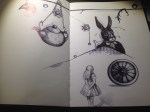
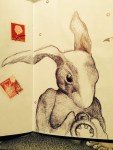
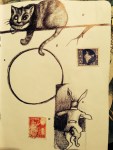
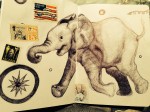
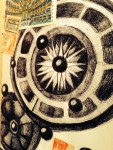
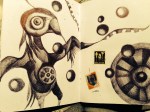
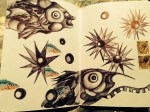
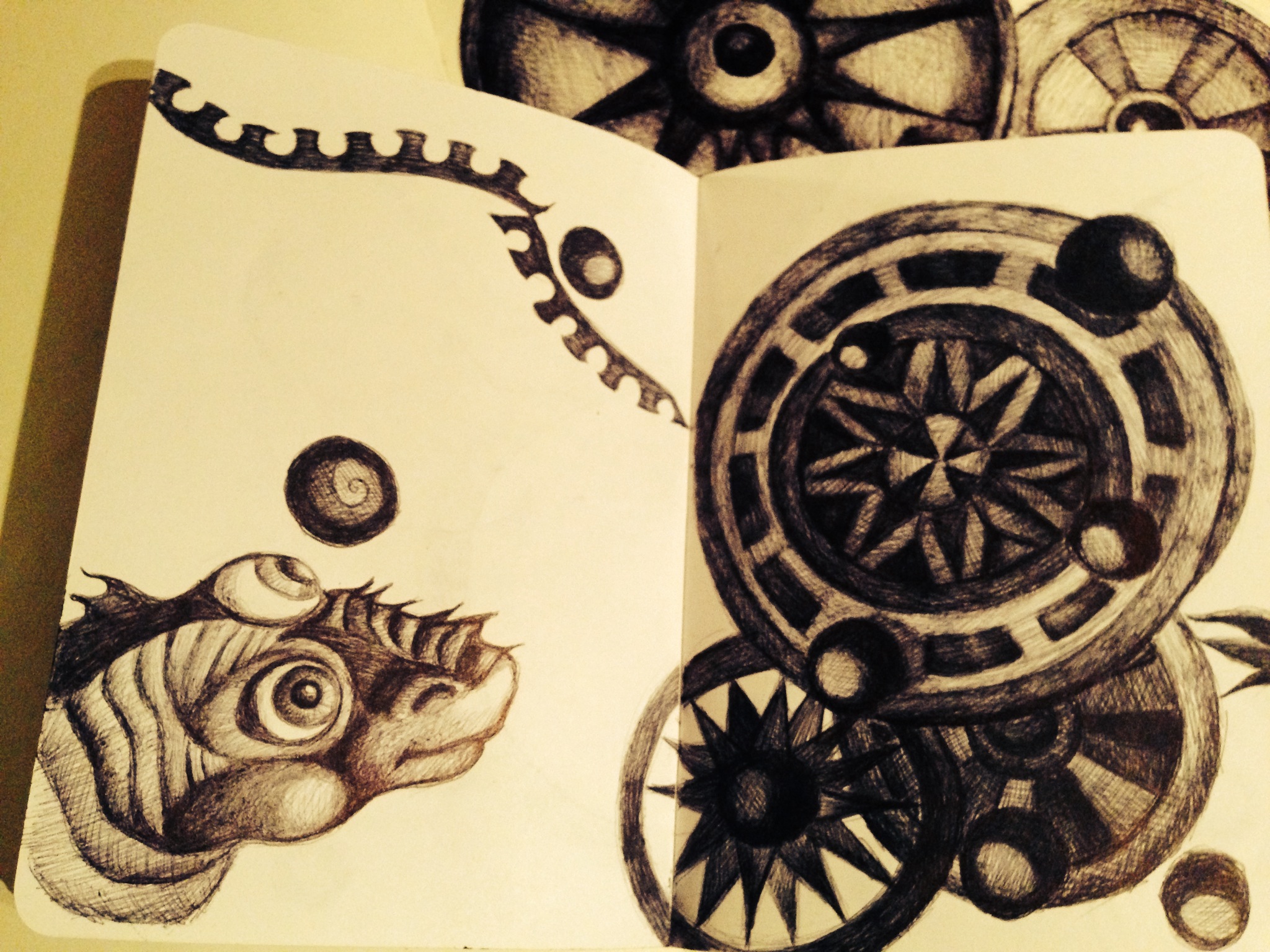
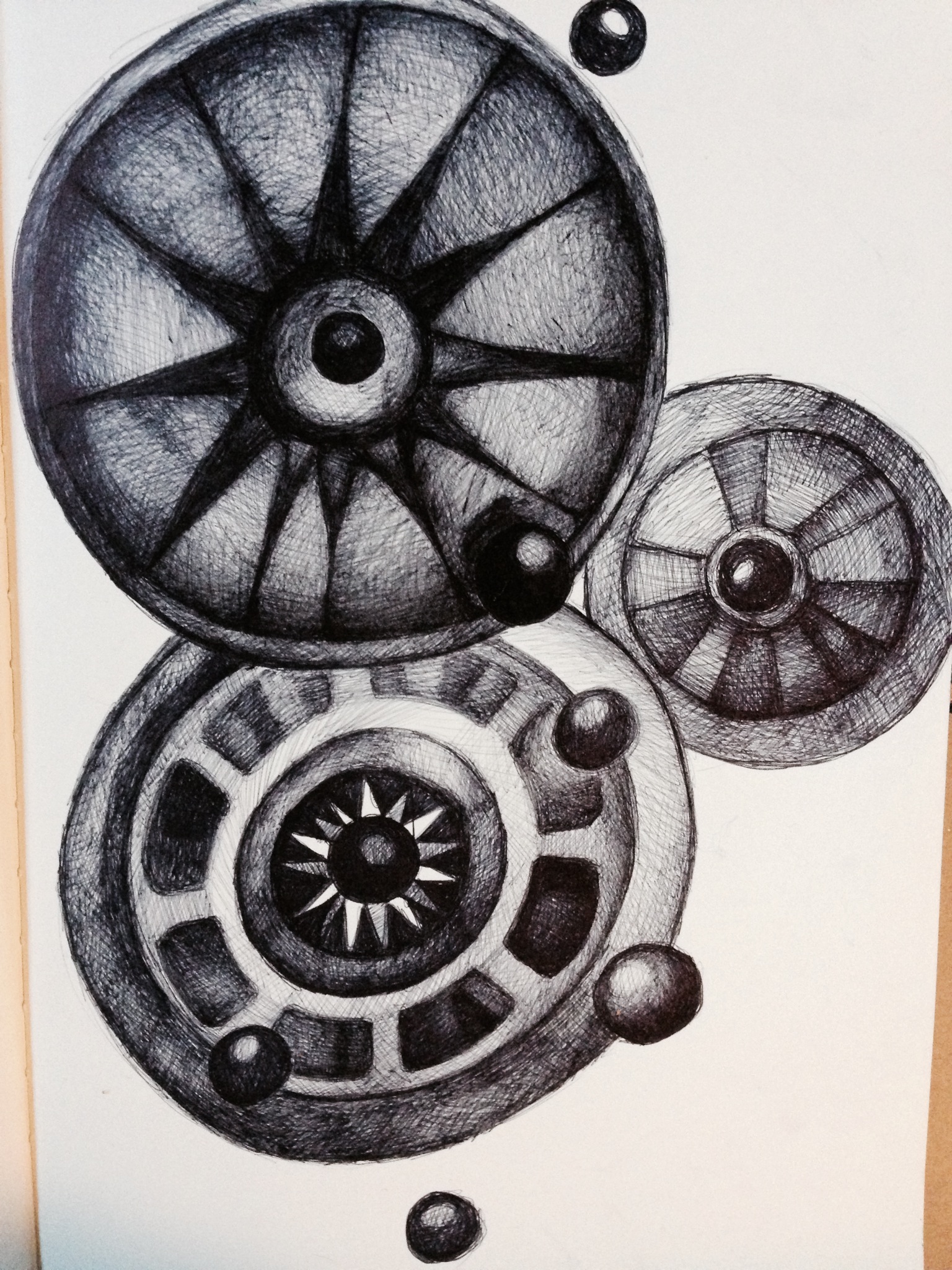
This sketchbook titled “The Mechanics of Longing”  (working title) is going to be my second submission … to be postmarked by January 15th which actually means that I have to be finished by Sunday night. This submission is by far more ambitious than my previous selection to the Brooklyn Art Library, the simple childhood story “The Whisper”. I have come quite a distance, finally allowing myself to draw, to illustrate – the pages are in a narrative sequence, moving through time not just be the sequence of the pages turning which indicates the passing of time in almost any book but by the “time wheels” which on every page actually function as a clockwork of a fairly abstract idea of storytelling. The creatures still have a storybook like quality but are allowed to look much more sophisticated than before. To explain why that kind of art work seemed out of the question for me before is material for a separate blog post (I need to get back to drawing) but for now I am absolutely enchanted by the creatures appearing underneath my pen. I am still pushing my boundaries, exploring how far I think I can go without compromising artistic integrity. These don’t have to sell. They are allowed to breathe. So I can.Foto

Fall from Grace / excerpt from a new novel, working title: the stone mason

Foto

For the stonemason in particular the death of his stillborn son felt like a betrayal. It was as if he had livd in the never acknowledged faith that his profession granted him some kind of special reprieve from death, that someone had agreed to that it was not to occur in his private life as long as he continued to carve memorials for the dead, and that this someone now had let him down. He was an atheist in the service of the church and loosing his unborn child felt like a disciplinary measure for his godlessness. Like many atheists he had a system of inner convictions that replaced religion. He did not believe in a creator, an organizer, a final judge, and yet he felt like he had fallen from grace.

Iris quietly  lived in the shadow of their loss, simply mourning and nourishing the inconceivable thought that they should now never know him, their son, certainly not by the way of a new pregnancy as friends and relatives suggested. These well-meaning people did not realize that the depth of her grief was rooted in the very circumstances that they thought would alleviate the loss – the fact that neither she nor anybody else had ever seen this child alive; that it had in fact never been born in the true sense as he had died in utero. Her grief was that her child had lived, if ever so briefly, unknown to her, and that she would never know it. She sat at the kitchen table with her encyclopedia and with a three hair sable brush paint stamp-sized paintings on miniature panels of oak wood while thinking about all the small things she would not ever know about her son. She wouldn’t know his face. She wouldn’t know the sound of his voice. She would never hear him laugh. She would never hold him in her arms. And yet he had lived.

The Twelve Nights of Christmas, the journey concluded: Night 12, the Mechanics of Longing

Foto

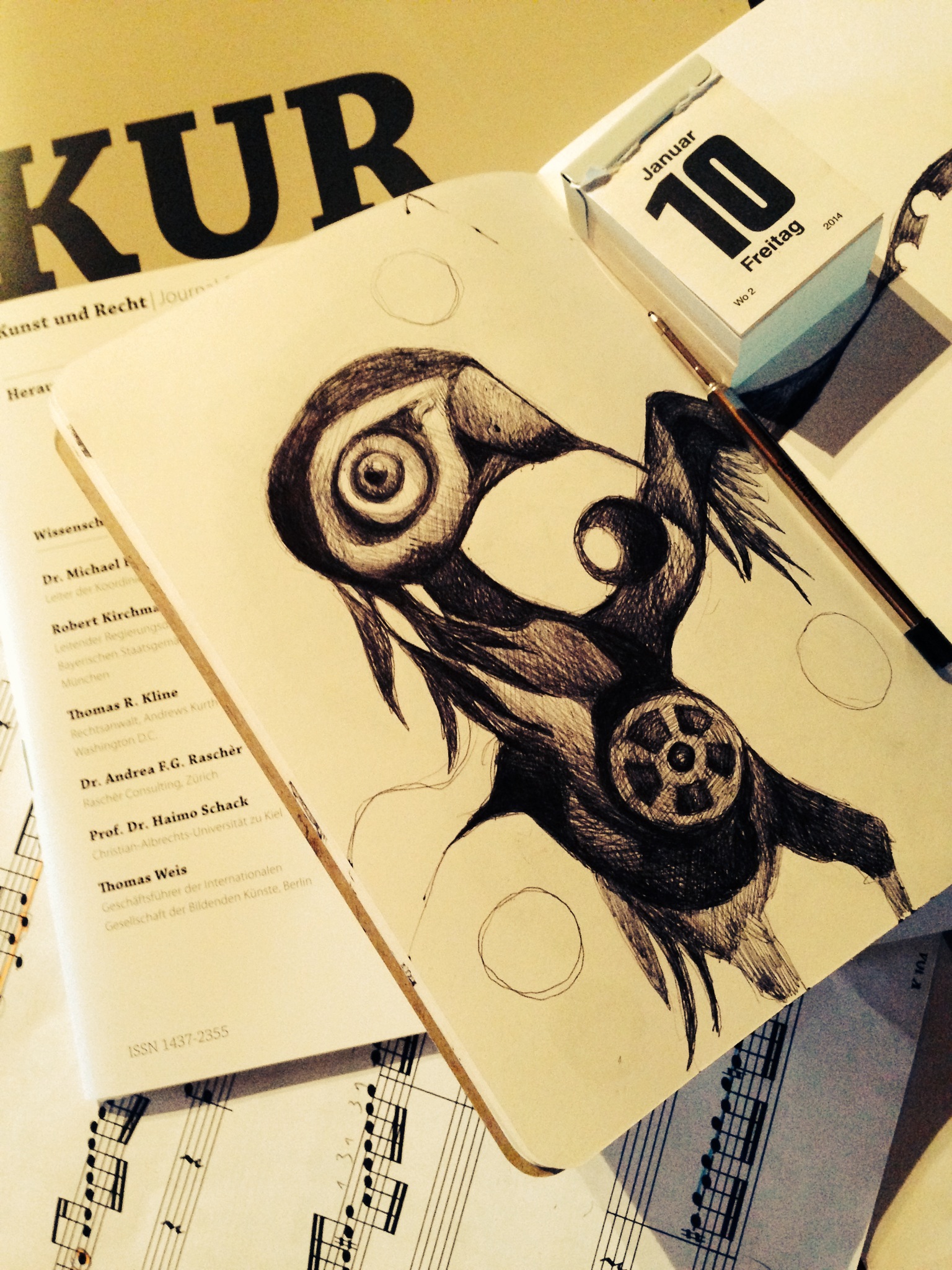
The title came as swiftly as the image and the artist obeyed both. The Mechanics of Longing.

This drawing concludes my twelve night drawing meditation. As the new year is already starting to make its demands, these drawings carry with them 12 nights of focus on a non-revealed question. Sometimes during those twelve nights I felt I could catch a glimpse of things yet to be. Now there will be time to look at these pieces for a while, maybe polish them a bit.I’ll keep you posted.

New artistic challenges are ahead for the year.

January 15th is the deadline for another Sketchbook Project of the Brooklyn Art Llibrary, check out the website if you haven’t yet. Their digital library is stunning.

http://www.sketchbookproject.com/library/13754 The link will take you to my previous year contribution “The Whisper”, a simple, wistful story about a childhood memory.

My new book, a young adult science fiction novel, is about to be finished and another one waiting to be continued on my desk.

In Fall I hope to open an exhibition of 41 canvases, acrylic on raw jute canvas (aka coffee and chocolate bags) in Berlin, 30 of which are finished by now. The 12 nights have strengthened my will to continue living in multiple universes.

Thank you for following my blog, this certainly  is the day to acknowledge that my readers are an important part of my creative discipline. It is a good thought that someone may be going to weigh the outcome of a night’s work and maybe find some use for it, if only in the fleeting way that art, all art, can enrich a moment.

I am wishing you, my readers, all the courage, health and gladness necessary to live a meaningful New Year and if you should be lacking any one of these for some of all of the time the will to give it your best shot anyways! 

The Twelve Nights of Christmas, Night Eleven: Nevermore …

Once upon a midnight dreary, while I pondered weak and weary,
Over many a quaint and curious volume of forgotten lore …

Foto

I couldn’t make this the twelfth night theme. “Nevermore” is not the note I’d choose to conclude this season’s “Twelve Nights”. But on the eleventh night it brings together further elements of reading, words, images evoking coherent comprehension beyond words, night time, magic realism, dreams, illusions, delusions, sleep deprivation, time, meditation, past, progression,automatons, determinism, choice, knowledge, intuition, desperation, endurance …

Two weeks ago  I listened to a musician on DRKultur (radio) talking about time and about the experience of time during extemporaneous composition and performance  on the piano. He talked about experiencing eternity not as an endless repetition of events in a space of time never ending but about as an experience of time being suspended. I think about art  – writing, painting and illustrating – as taking place in just that space of time being suspended, a space that I can enter and where I can linger at will.

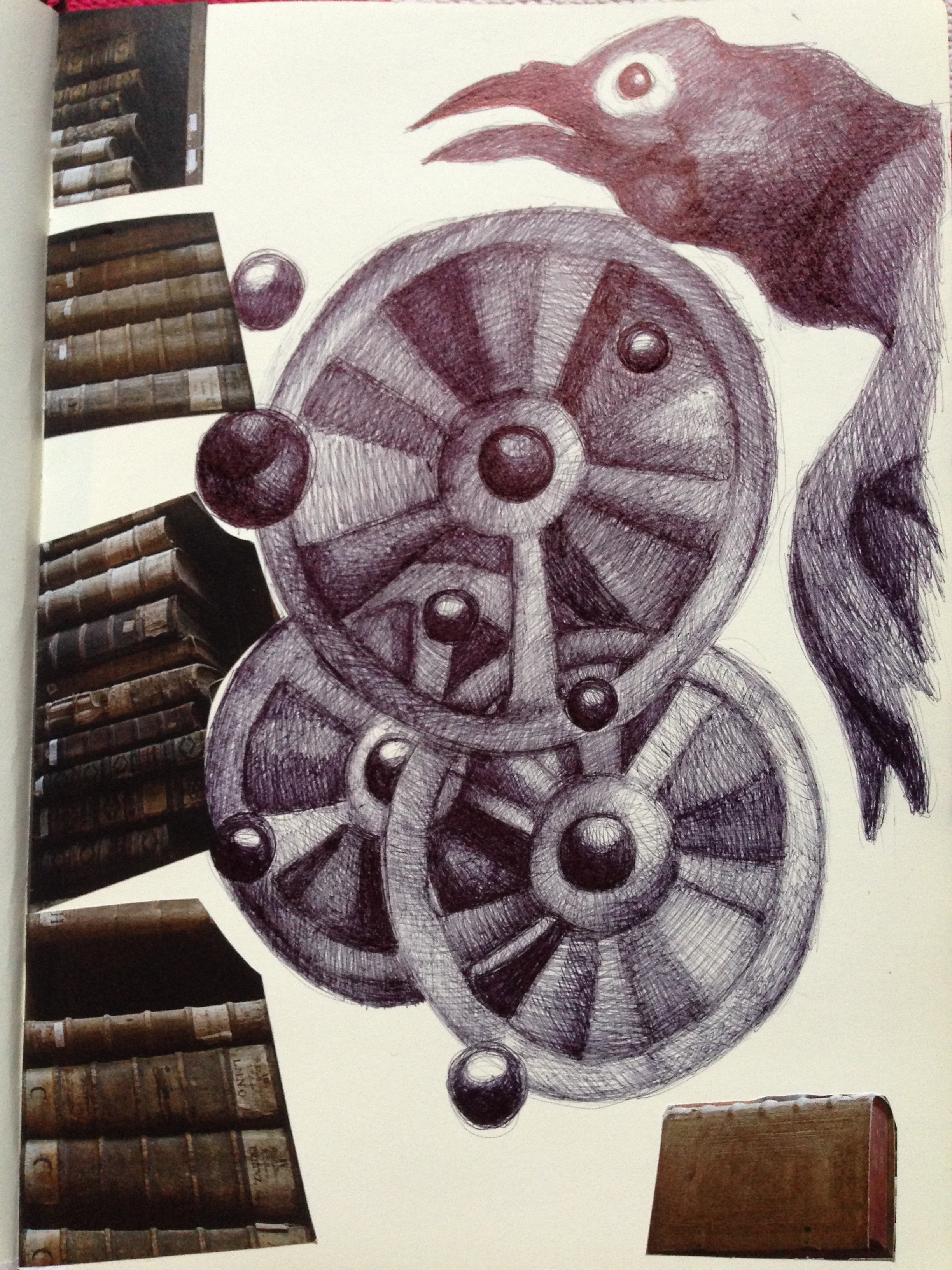
The Twelve Nights of Christmas, night ten: Raw data or further reflections on the nature of Borges Library

ImageI’d like to think of drawing as of transforming raw data with my pen to “mean” a specific thing and not another though it is not in the nature of data to actually be one specific thing to the exclusion of all other possible “things” (meaning, manifested form, reality) in all their variations (written and unwritten) any more than a child’s building block used in a fleeting structure soon to be knocked over is identical with that intended structure’s purpose or “meaning”. A building block stays a building block, a zero stays a zero and a one stays a one no matter what it is used to communicate. It assumes  a participating function in the meaning of one thing ( and not another ) but it also creates that one thing without adopting its separate ( separate from other possible thing’s) nature simply by describing it.  The “thing” actually has no separate ( from other possible thing’s) nature – it is but a description of the configuration of the raw data (building blocks) at a specific moment from a specific perspective. So that, at any given moment, any thing, rearranged, could be (and is) any other thing, idea, let’s call it “book”, existing or non-existing, written and unwritten, in all possible variations. I assume that would upon further reflection have to be one of the conclusions drawn of the cosmology principle but I am getting a bit out of my depth here.

All we ever do in life is  to assume a specific perspective to describe what is really a homogeneous distribution of raw data – each one of us is, with other words, but a specific, erratic close up view of that homogeneous distribution. We have no separate nature. The “separateness” of our nature not only of one thing to the exclusion of all other possible things but also of the experiencing “conscience”, the “I” to the exclusion of all other possible perspective’s (you, the other) is clearly illusional, possibly delusional.