Page 4 of 8

what is it?

what is it?

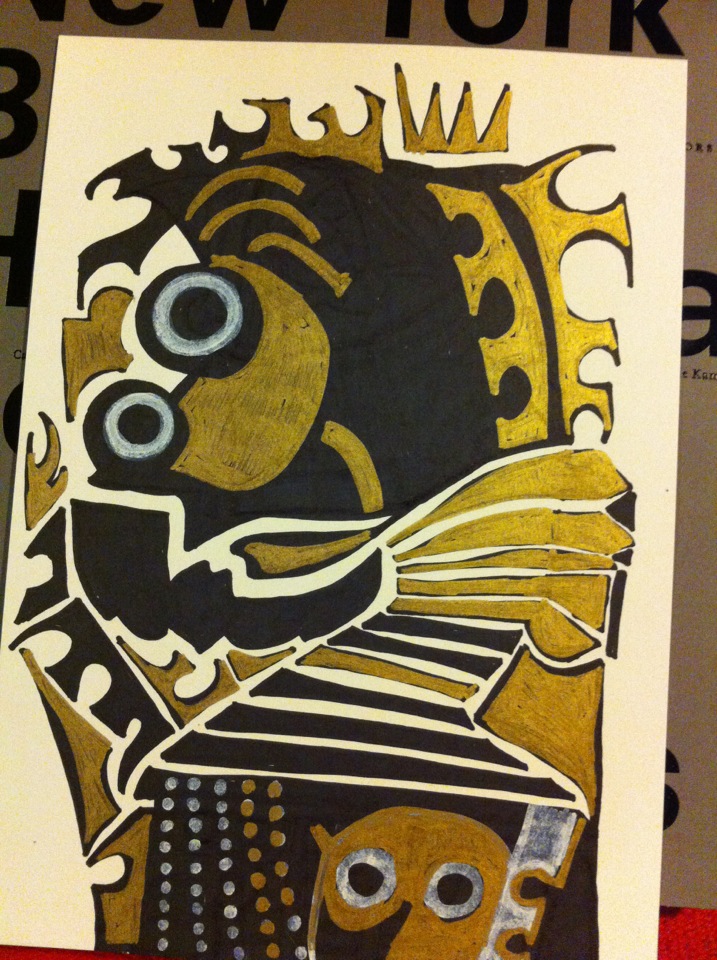
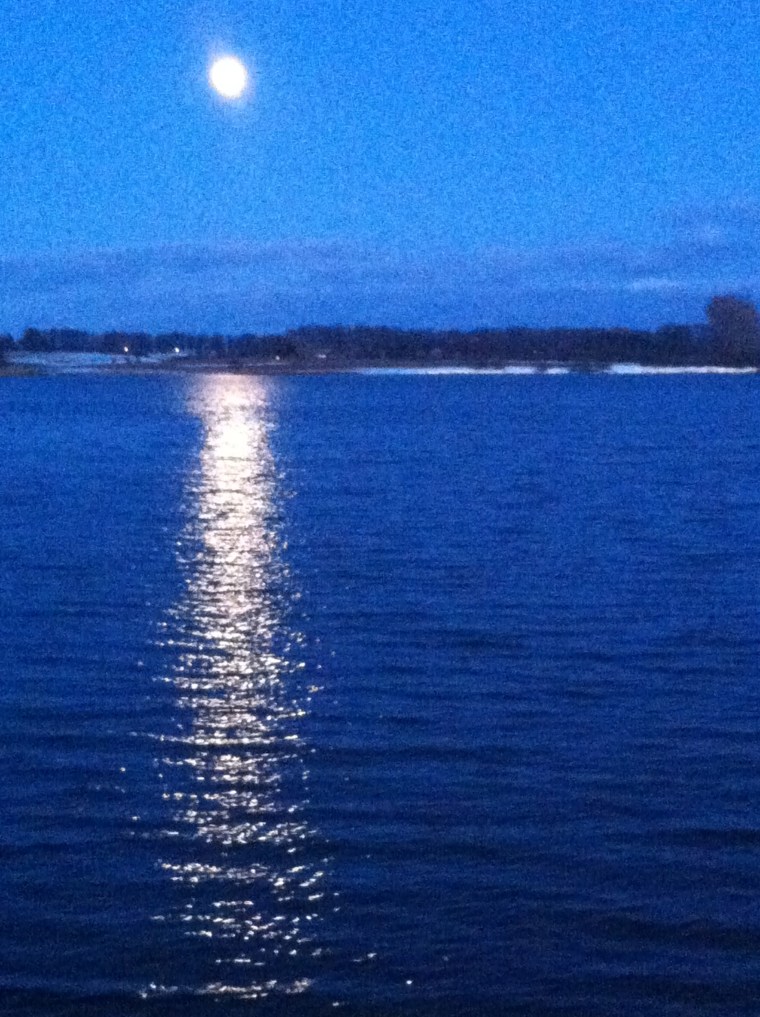
what i want to see in these images (and you might see something else, they are as much yours as they are mine): freedom, mindfulness, compassion. a furious gentleness towards life. i see old stories in new clothes. there are stones, there are shadows. there is a smooth path under a tree. and i can relate all this and then return to what i know. because what i paint and write is what i confess not to know. and yet it is not ignorance i serve but the luminous mystery of a letter, a line, a word, a constellation, 20 degrees south-east of the belt of Orion, 23 times more luminous, twice the mass and the diameter of “our” sun. what i know is that if i could indeed throw an object hard enough, it would escape gravitational attraction, that there is a black hole in the galaxy M87, and that freedom is attainable through our words and acts.

artist statement (mine)

this knowing “you are on to something good” is exactly where the artist meets the scientist. only that in general the scientist will be patient and disciplined enough to acquire the skills necessary to actually explore and eventually understand that unfounded suspicion and the artist will just take a cursory inventory of the idea’s implications and then take to the type writer (or the canvas) like the monkey, ready to blindly shell out the sequence of letters to actually and surprisingly eloquently prove that “it” was always known.Bild

the what is the who

IMG_4323Once, when I was about seven years old, I had asked my mother whether she thought that the idea of me had existed before me, and who could had stored this kind of information and where and how (just to be complete), and she had looked at me with that dreamy look she always gets when she comes up with an idea for a new story. She hadn’t answered me but had rushed over to her desk and started scribbling. You probably know the wacky kids’ book “The What is the Who”. It ‘s still in print. She never answered my question, by the way. Maybe you have to find out some things by yourself.

digital sadness

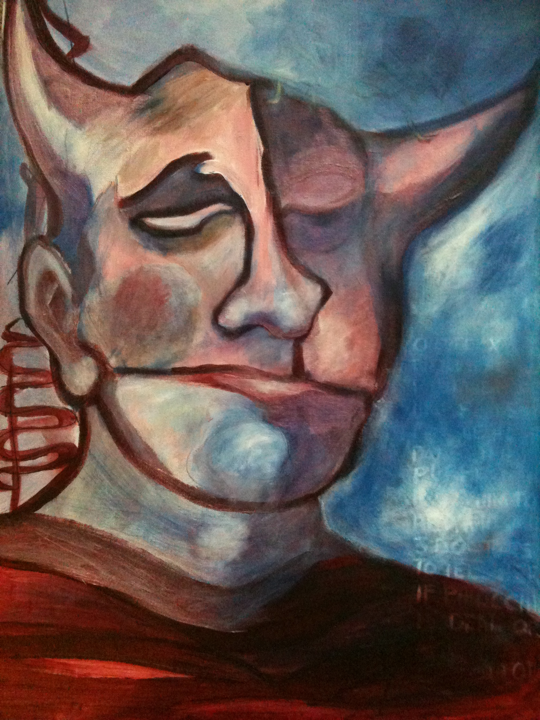
Bildthere were lights and colors washing down the cab window, there was the rain, transparent movement, the cab driving through the night, time suspended. i had memorized the painting that had been burned and now i let go of the image of the devilish creature and just looked out of the cab window, letting the city images pass by. All was said and done. My hands still carried an ashen smell.

I let go of my specific self, and I knew with quiet certainty that everything out there was coded in a simple, elegant way. The needlepoint lights of the far away office buildings were 1, and the red lights over there, the cab coming to a stop, those lights were 0, the raindrops running down the window pane like external tears were 011001, and the guy running down the street holding a soppy edition of the times over his head was, let me see, 1, for what he had just done, and 0 for his existence and another 1 for someone waiting for him with an unwelcome surprise, 101.

There was no sadness just then, no joy either, just a stillness in everything, an acceptance of now, the cab driver talking about night time driving, 100101001, and the drunken guy who had no money left to pay for the fare, 001, and the traffic and people coming from out of town, and my life was not measured by birthdays, one year like the other, my life was suspended too – and I was weightless against the dark

looking down at the stars

looking down at the stars

When I was five, my mother, an artist, told me that over time the use of the words “up” and “down” had been reversed through what she called “accumulated acts of lazy thinking”. Consequently, she told me, people had gotten used to seeing the world in a crooked way. With other words: where other people look up into the tangled branches of a tree, to the clouds, an airplane, the sky, my mother had trained herself to look down into the depths of the endless oceans of the universe.

The amazing thing is that the moment you try this, it feels just like the right way to look at things and you will feel like you have never truly seen the sky before. Stretching myself I reach deep down into the world whereas before, when I understood up and down in the usual way, the sky seemed more or less like a painted stage decoration.

Often, on late summer nights my mother, my sister and I would lay down flat on the lawn of our front yard and look down into the stars. The grass of our lawn was long and wavy, different from the short cut golf course front lawns of our neighbors, and woven through with moonflowers that smelled lovely in the warm, damp night air and in their whiteness actually glowed like little stars themselves.

I remember one night when I felt particularly light and small, and grateful to gravity for holding me securely to the surface of my own planet. The stars glittered in the distant depth. My mother giggled when she noticed that my little sister had fallen asleep right there on the lawn, her head nestled onto my mother’s shoulder.

Suddenly it seemed so unlikely to me that in all of the universe expanding before my eyes our planet should be the only one with life on it. I asked my mother, who had been silently holding my hand whether she thought that there was life out there. My voice sounded like a whisper. It was the kind of question to which you don’t really expect an answer.
kids and art – life is an adventure!

kids and art - life is an adventure!

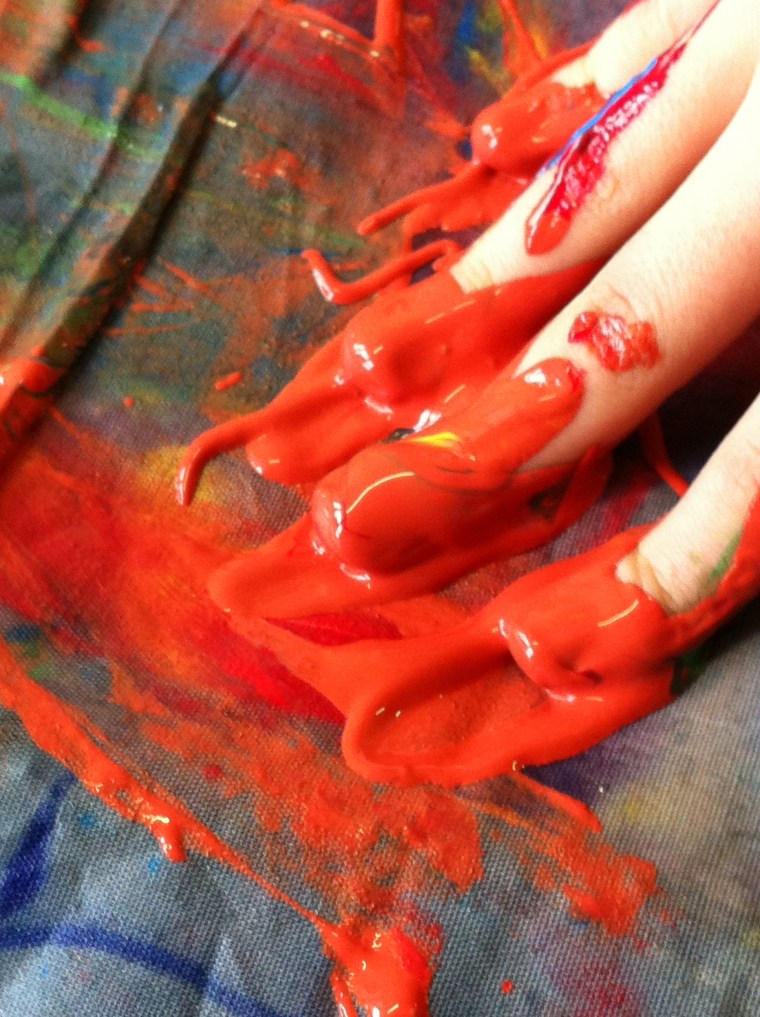
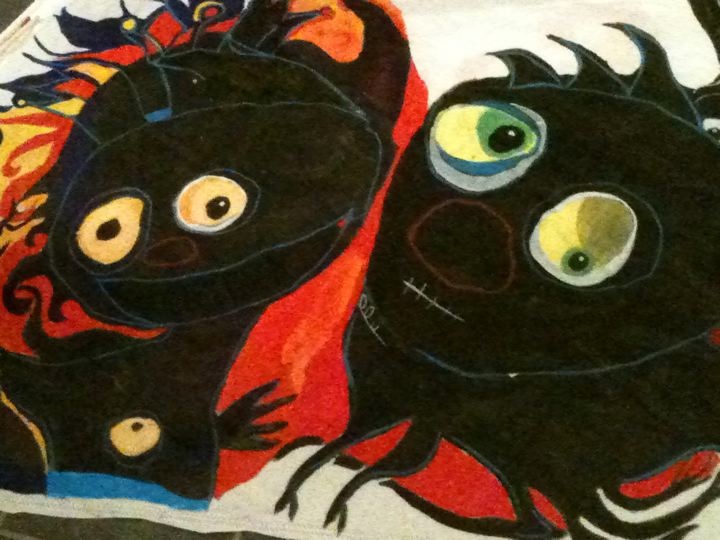
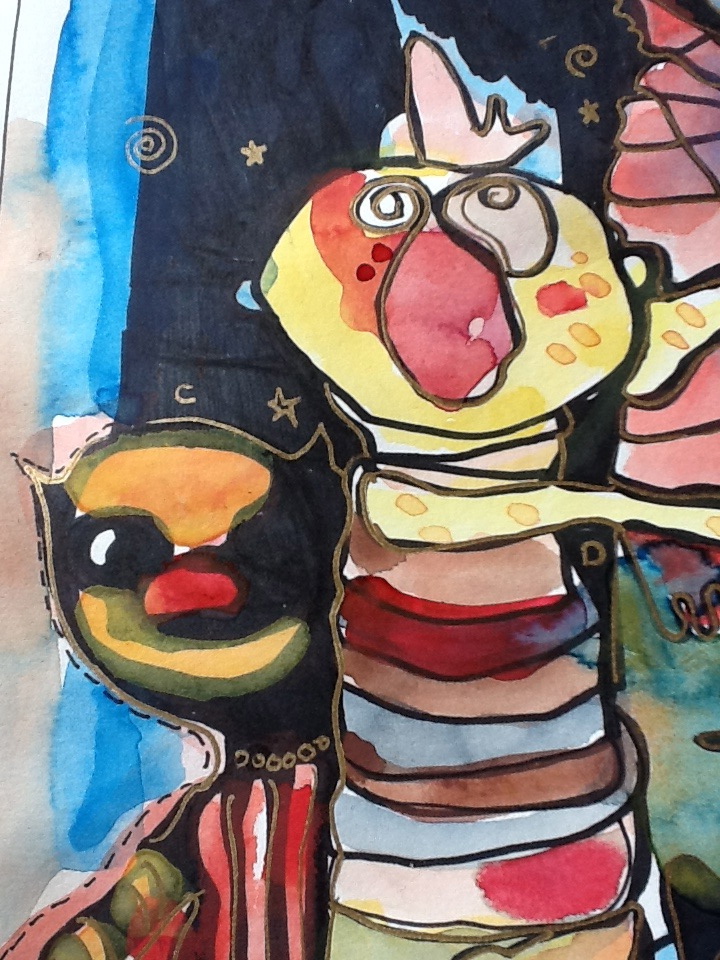
Children are born with the natural ability to “make art”. Without ever having received formal instruction they will still alter their environment in a way that reveals the creative mind all humans possess. A stick is used to scribble in the sand, stones are arranged in pleasing patterns, flowers and leaves are strung on grass, a pencil is picked up and a wall decorated.

Children – like adults – use art to answer the challenges of their lives. Art is a medium to contemplate and resolve the essential questions of who we are, why we are alive and what is expected of us.

In a child’s life this can mean: What do I do when I am bored, feel tension, do not understand what is expected of me, but also: how do I communicate that I am happy, that I saw something amazing, remind my parents and caretakers that life is an adventure and that I ask you to be in the moment with me?

Teaching art in a classroom can strengthen the confidence a child needs to hold on to this amazing skill beyond childhood.

Keeping in mind that art is not an external experience, but is rooted deep inside each child, we understand why it can be confusing and discouraging to children if art is presented to them as belonging to an inaccessible adult sphere. Data of artist’s biographies are of little relevance to a second grader.

Instead we can talk to them about the origins of art and ask them about their own experiences as artists. A wealth of beautifully illustrated children’s’ books can help the teacher and the parent in the classroom (or at home) to do so in words that relate to the children’s’ need for a coherent, honest and joyful encounter with art. Artful children’s’ books acknowledge that art is relevant in the child’s own sphere. Asking children to talk about their own art always leads to fruitful discussions and true insight into the nature of artistic expression.

In order for children to develop the ability to love, they need to be loved first. In the same way it is true that children are enabled to acquire a true appreciation of the cultural products presented to them as “art” by a sincere recognition and appreciation of their own natural authority as artists. It is in this sense that the German artist Joseph Beuys stated that every person is – also – an artist and that Picasso reflected on his own artistic journey with the words: “It took me a lifetime to paint like a child”.

artist statement – freedom is attainable

artist statement

compulsion to paint. is there a name for that? from that name was my compulsion born? and if my creative activity is to be described as compulsive behavior, do i wish to be free from it? as much as i desire freedom from life.

i am awake. through my waking mind images pass. i take a brush, a pen, and through brush and pen these images record themselves. i might be highly organized, efficient, sober, inquisitive etc. in my rational mind, but these images are what they choose to be.

there is no agenda, no program, don’t ask me for one. just a life between pillar and post.

what i want to see in these images (and you might see something else, they are as much yours as they are mine): freedom, mindfulness, compassion. a furious gentleness towards life. i see old stories in new clothes. there are stones, there are shadows. there is a smooth path under a tree. and i can relate all this and then return to what i know. because what i paint and write is what i confess not to know. and yet it is not ignorance i serve but the luminous mystery of a letter, a line, a word, a constellation, 20 degrees south-east of the belt of Orion, 23 times more luminous, twice the mass and the diameter of “our” sun. what i know is that if i could indeed throw an object hard enough, it would escape gravitational attraction, that there is a black hole in the galaxy M87, and that freedom is attainable through our words and acts.

rabbit’s heart

rabbit heart

scared
sacred
so close.

i would make the case
that my rabbit heart
is sacred

but i know a lost case
when i see one.
success and failure,
what are the odds
for one or the other.
sometimes you just know.

my rabbit heart
is scared,

a fool’s heart,
no more.

but at least
it admits
to being a fool,
scared of the shadow on the wall,
scared of the whisper in the dark,
like don quichotte
it is yet willing to fight
against windmills.

because not to defend
what is sacred
against the shadows
of your own imagination
would be erraneous.

among those shadows,
camouflaged as doubt,
lies a shadow
cast by someone
who considers
rabbit heart
a good dinner.

betrayal

betrayal

the death of his unborn son,
for the stonemason
it felt like a betrayal.

death was to be
a professional matter,
something to take place
in the realm of his customers,
who commissioned him
with carving memorial stones
for their dead,
not something to occur
in his own private life.

does not every profession
come with a privilege?
was it unreasonable
to expect a reprieve from death
as long as he carved memorials,
folded hands, lamenting angels?

he felt he had been let down
though by whom
he could not have said.

an atheist
in the service of the church,
loosing his unborn son
felt like a disciplinary measure
for his godlessness.

he had a system of inner convictions
unacknowledged rituals,
replacing religion.
he held on to the sacred
in the profane
he did not believe in a creator,
an organizer, a final judge,
and yet
he knew to have fallen from grace.

and no place to handle his complaint.