The Priest – 1861
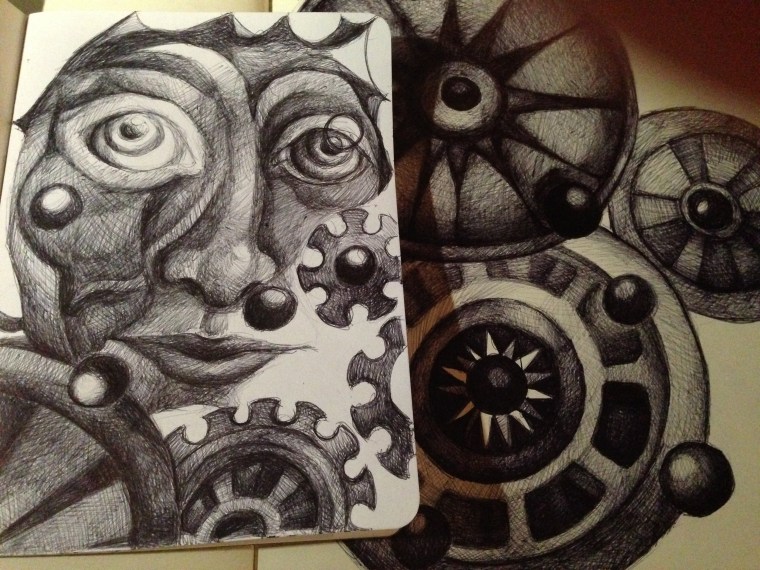 He had lived in the rectory for over 35 years. When he had arrived to take care of the parish, people had soon introduced him to their daughters for he was young, unmarried, of a well known family. But he had kept to himself, had dedicated his time to his parish and his academic studies. He was especially interested in the work of a catholic lawyer, philosopher and counter-revolutionary, Joseph de Maistre, mainly his Essai sur le principe générateur des constitutions politiques et des autres institutions humaines (“Essay on the Generative Principle of Political Constitutions and other Human Institutions,”). He was intrigued by de Maistre’s doctrine that war and the shedding of blood were necessary for the expiation of sin. Also that sin was inevitable, that physical evil is the necessary corollary of moral evil, expiated and lightened through prayer and sacrifice only. These ideas resonated with him in a very deep and personal way, he was severe and unforgiving and so were his sermons. He had to redress these ideas to make them acceptable to the views of his own church, and it hurt him personally to offer forgiveness for mere remorse in the name of Christ. Over time, as he became older and his severity started to show in the deep lines in his face and the emaciated appearance of his body, people started to fear him and went out of his way where possible. There were no more attempts to introduce him to an unmarried daughter or niece and less invitations to other social events, which was a welcome development in his eyes, as it provided him with more time for his studies. He suspected himself to be prone to a weakness that both churches would have condemned and was relieved that in consequence of his social isolation there was only limited temptation to give in to his desires. If one of his young male students would catch his attention in this unwelcome manner, he treated the boy with special unkindness to keep at a safe distance. While his philosophical comprehension and reasoning deepened over the years, recorded in countless journals, he did not manage to overcome his burden, and realized that he actually suffered more severely from it the older he got. This in turn supported his views on the inevitability of evil, for as evil he regarded his infliction, but also as unavoidable, as nothing he had done to purge himself from it had been successful. His life was complicated and joyless for the most part.
He did take an avid interest in the building of the new church that was to replace the old wooden steeple. It’s neo-gothical style resonated with his ideas about a purer world and society. He contributed generously to its building cost out of his inheritance as had other wealthy landowners in the parish. The new church was a symbol at the same time of their moral purity and economical wealth. His contribution was so significant that he was chosen to model for the statues that were to be put on the roof and overlook the parish. The idea of watching over the life of the parish from a far distance appealed to him. The last winter before the completion of the new church he had an encounter with a stranger who had called upon him repeatedly and who was staying at the town’s only inn. He was dressed in simple, yet elegant clothes, cut out of fine, dark cloth. In a small town a stranger like this would normally have generated a great deal of curiosity. But he was so quiet and unassuming in his manner as to almost appear invisible. He went for daily visits to the rectory where he was served tea and would have long conversations with the pastor. The elegance of his appearance was so convincing that it took a while for the pastor to notice that the stranger wore but a kind of biblical footwear, close to being shoeless.
It was late fall. The trees were brilliantly red as if with religious fervor. The pastor felt alert, alive almost as if a lifetime of doubt and study suddenly held some promise, as if the dark aspects of his life were less weighing on him. Then the stranger came down with a severe flu which delayed his departure. High fevers made him delirious, and the doctor and priest both were called to soothe the rage which seemed to devour the man who had been a quiet guest until he came down with this fever. After three days he lost his consciousness and did not regain it. He died in the fourth night without the pastor at his side. The pastor himself was delirious in fever at this time and died only two days after the stranger.
previous chapter – next chapter
 The shallow hole the boy had dug became deeper with time as he scooped out the red colored clay the ground was made of. He filtered it through his hands, taking out stones, sticks, decomposed leaves and roots. Punching and smoothing it he compacted the clay to one block, thus slowly building up a monolith from clay. He devoted great care to this process, making sure that he would have a structurally sound mass with which to work. Over the course of building hundreds of small people from mud he had gotten quite skilled at this craft. Only when he was content with the sound that a slap against the block produced, a deep, saturated thud, would he proceed to sculpt. With deliberate slowness he worked from the general form to the details. Many times a form had collapsed when he had tried to overemphasize a movement or had placed the limbs too far outside the center of gravity. In the beginning he had tried to use sticks to support an arm reaching out or a leg stepping forward and though technically that solution had worked he didn’t like that the figure now seemed to defy the laws of gravity that nature put on the material and form. It was thus almost impossible by the mere use of sticks and clay alone to sculpt an outreached limb that looked natural. So he had returned to work from the inner core of the material and to rather hint at a movement that – though invisible – the eye would project into the empty space. He was always intrigued by what he could see without seeing it. He liked the way his sculptures randomly related to one another, all he had to do was to quietly look at both sculptures and discover this relationship of forms. Something deep inside him stirred when he looked at his creations and their silent endurance. He could see the form of the space in between two physical forms, it was nothing and yet visible if one cared to look, it changed constantly, stretched and diminished, even disappeared. It was actually easier for him to comprehend the properties of this in between space than the form itself. You could get out of the trajectory of any moving object if you controlled that space. If you made that space in between adhere to your inner voice you did not need sticks to build a figure. Why, you barely needed your hands, all you had to do was to look long and hard, look at the clay monolith and make some slight adjustments. Soon his people were crouching, stretching, running, turning. He took great pleasure from this.


 Art & Writing