Page 2 of 2

Working with young artists
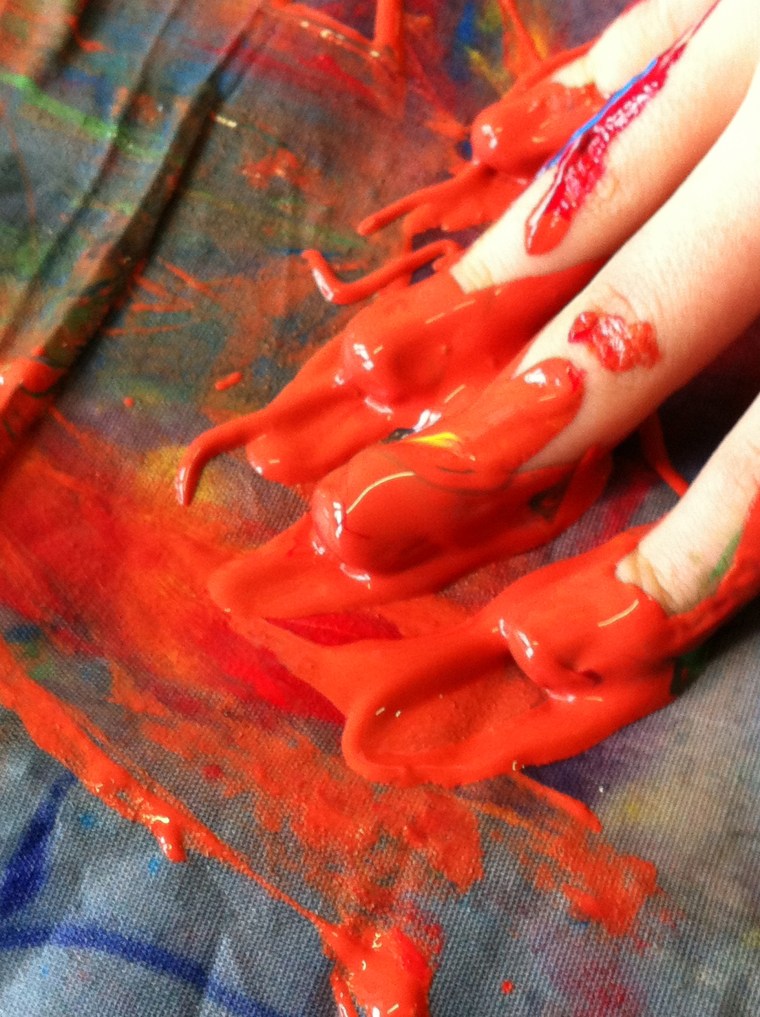
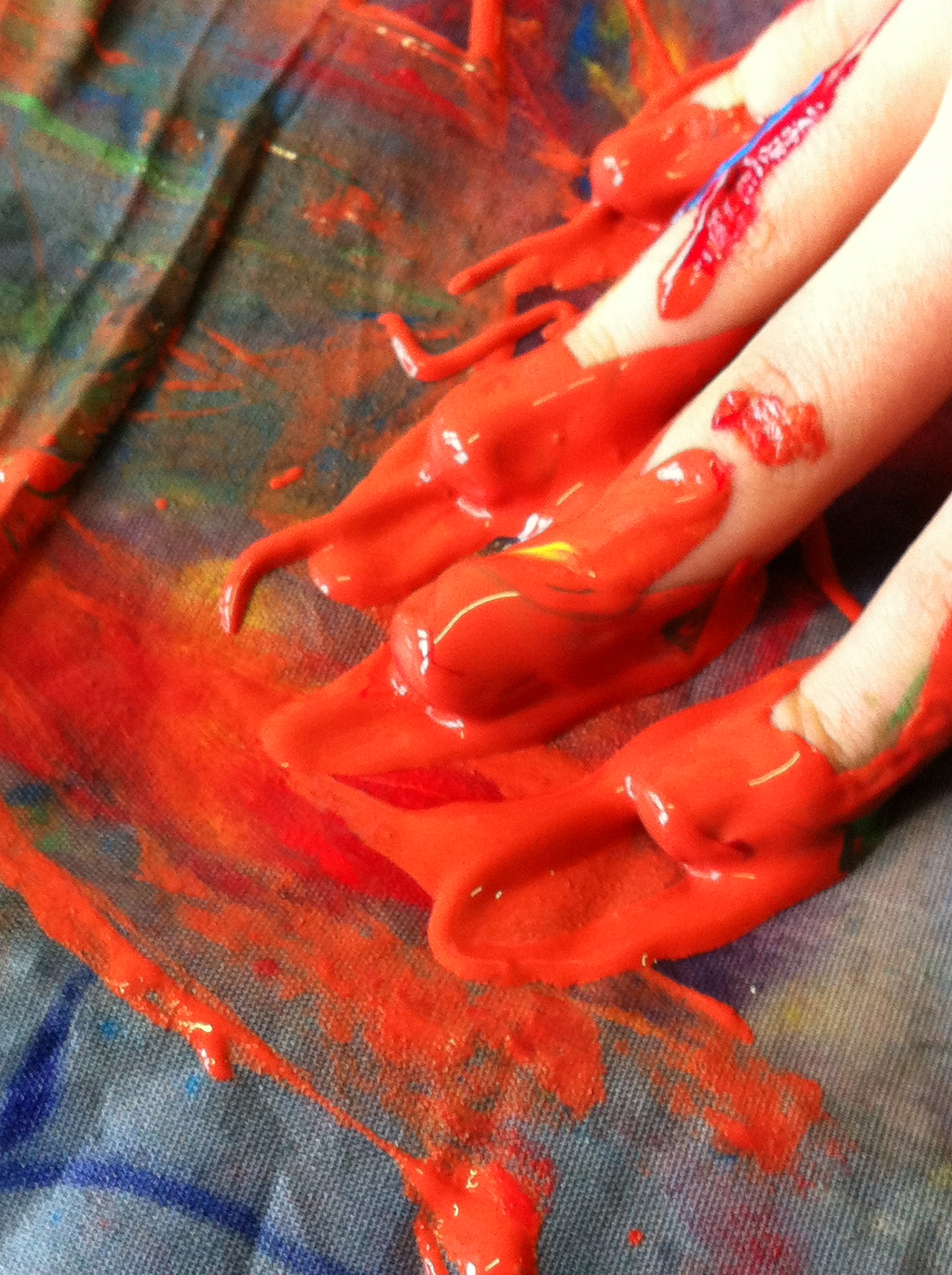
IMG_5531Working with Young Artists

By trade I am a lawyer. Many lawyers do have a passion besides their original profession though, I happen to have three, if you count my love for children in general and my own children in particular. The other two are writing and art. I mention this because you will surely want to know how I am qualified to “teach art” or as I prefer to say: to work with and alongside young artists.

My grandmother used to say I have been born with a brush in one and in pen in my other hand – and as far as I can remember I have been scribbling and drawing on every appropriate surface – and some less suited. That I came to study law is strange, all things considered, but I guess I wanted to try out if I could succeed doing something else and law had always been intriguing to me. It turned out that I could succeed. I graduated with two law degrees – and came straight back to art. And at some point I started doing it both: art and law. Kids have always played a role. I have been teaching all kinds of classes, art and law, over the last ten years, and it has been a truly rewarding part of my life, not just my professional life. As you might imagine, I am never asked how I qualify to teach legal workshops, I am a lawyer after all, but often how come I teach art as well.

I do believe that art is not the esoteric, isolated endeavor that people sometimes take it to be. Artists are well advised to take notice of their world and have an understanding of it that transcends the visual. Beuys pointed out that every person is an artist, that artistic creation is at the center of human life. He went as far as demanding that every physician, scientist, philosopher be first trained in art. I will venture further by saying that the art world would profit if artists would first be trained in a trade that explores the practical aspects of their environment. Every artist is part of a tangible social reality. The training to become a lawyer might in the end not be either so far from or so detrimental to artistic process as is might seem at first.

Why I do love to work with young artists? Because it refreshing to leave the stereotypes that people retreat to as they become older. Every child I have ever had the pleasure to meet turned out to be an original artist (albeit sometimes a frustrated one …).
I respect the creative work children are capable of. As a first hand witness and as someone who still draws and paints, saws and glues every day: There is no time like childhood to experience the joy of art.

I had the good luck to be raised by a grandmother who had the wisdom of an older generation to pretty much let me do whatever I thought appropriate as long as I did not nail her good table linens onto a broomstick for a pirate sail (happened only once) or cut out my great grandmother’s lace to make curtains for fairy dwellings, also a one time never to happen again situation.

However I was allowed to make use of any tool that I would find in my grandfathers tool shed or in the kitchen without anyone trying to figure out if they were child appropriate. I was also allowed to make generous use of old newspapers and magazines, of the newsprint paper that my grandfather, who was publisher of a local newspaper, brought home, and in general of every piece of metal, screw, paper, feather, stone or yes, glass! that I would pick up on our long walks. It never occurred to my grandparents that I might pick up some dangerous germs on the way.

I brought everything home and assembled it very much the way every child will when you do not interfere. I do not know where our desire to “make” things has its origin but I do know that we already possess it as children, together with an instinct of how things fit together. If children are not allowed to roam as freely as I was, they will still build markers from pebbles and stones, they’d still use sticks to draw in sand, build strange, improvised gardens in mud, decorate prefabricated play structures with ritual signs.

To be creative is a basic desire of humans, all humans. It is a genuine expression of who we are even before we are defined by our social and economic circumstances. To teach a child to be creative therefore seems to me an elusive act. I look at children with a sense of awe, they are still there, right at the origin, and all I do as an art teacher is to take them on the same kind of  long walk that I had been privileged to undertake with my grandparents and I simply allow them to discover their world and to collect at will what responds to their own desire of creating this world new. If we’d allow our children more freedom and time to explore their own world and provide them with materials that are not dedicated to specific purposes, we could cut back on many extracurricular activities. Let them venture out there and the artist that lives in every one of us but is acutely alive in our children is ready to meet all the great challenges of art right in our neighborhood.

To come back to the question of my own expertise: I do believe with visionary clarity that it is not my academic expertise that is relevant. It is my willingness to acknowledge and celebrate children as the artists they are. I do believe that art is not a matter of paper and ink, of perspective and shading, I do believe though art techniques can be taught art cannot, no more than breathing, walking, seeing. It is something that happens when things go right or when you have to make them come out right. Art is life.
do you feel like you are being watched?

fearful knowledgeit’s because you are. the recent discussions about the privacy of data – or the absence of such privacy when it comes to any form of telecommunication or electronic communication – has revealed that for now that even the basic implications that could lead to a meaningful discussion of the issues at stake are at best only vaguely understood.

the increasingly public lives we seem to live obscure the nature of information even further. the general public as judged by news coverage and political discussion seems somewhat nonchalant about their own data privacy, maintaining that private data could not be of any use to those who fish for it (what do you care about what I had for breakfast?), and that those who had anything to hide should better be found out early, with other words that to the law-aiding citizen the privacy of data is not of great urgency. The sheer mass of private, non-relevant information creates the further illusion that what one reveals in electronic form was as elusive as a thought shared with a friend in a crowd of people.

to reintroduce the idea  that information may not be – as more commonly understood – an abstract observation extracted from a state of reality to communicate the specific nature of that given state, but instead the first cause to make reality, with other words, that information is to the “thing” it describes what the letter is to the word and the line that draws the letter is to the letter, to reintroduce this thought at the moment when countless legal aspects of data privacy are already causing the discussion to meander without true force, may be pushing the discussion to the brink of madness, but it could also turn out to be immensely useful.

“In the beginning was the word”, this grand opening refers to the provenance of the idea – translating thus the term “logos”, which refers to the inherent logic and order of things. The order of things as encoded in a word very much like a program that at the same time provides a building plan for a specific “thing”, is the cause for its realization and provides the necessary algorithms to build it. Furthermore, if the chosen word, data, information, has “wisdom” (Hebrew for “word”), which means: knowledge of the world as a whole, to speak the right word is to give the initial and irrevocable impulse for the creative act out of which reality follows.

Maintaining authority over that kind of knowledge as far as it refers to your individual data, even if it included plainly what you had for breakfast, whom you’ll meet for lunch and what your favorite color is, might be a cautious and recommended approach until you could positively rule out that this kind of data is indeed what makes you. That could be the making or the unmaking of you.


the art of evolution

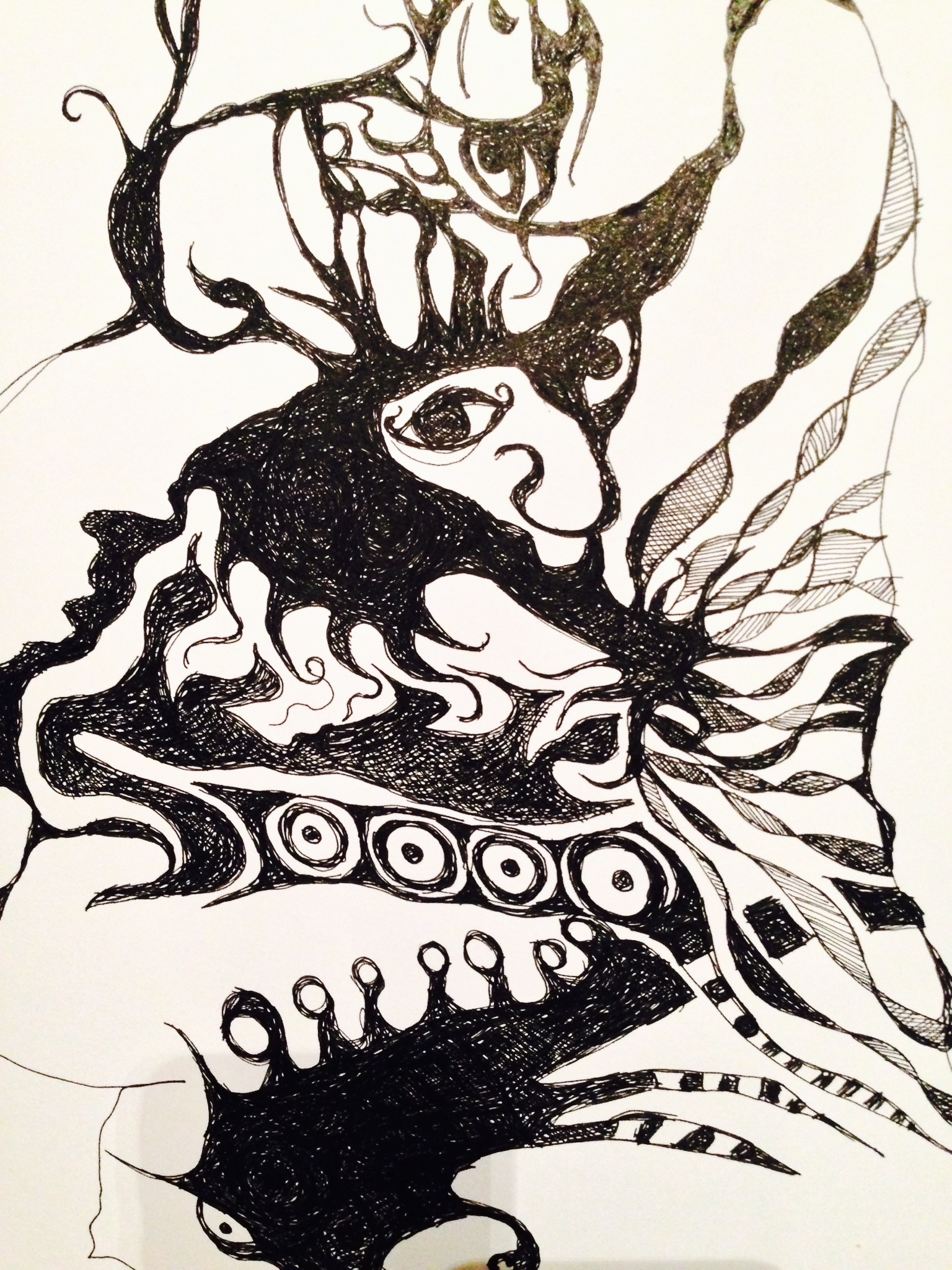
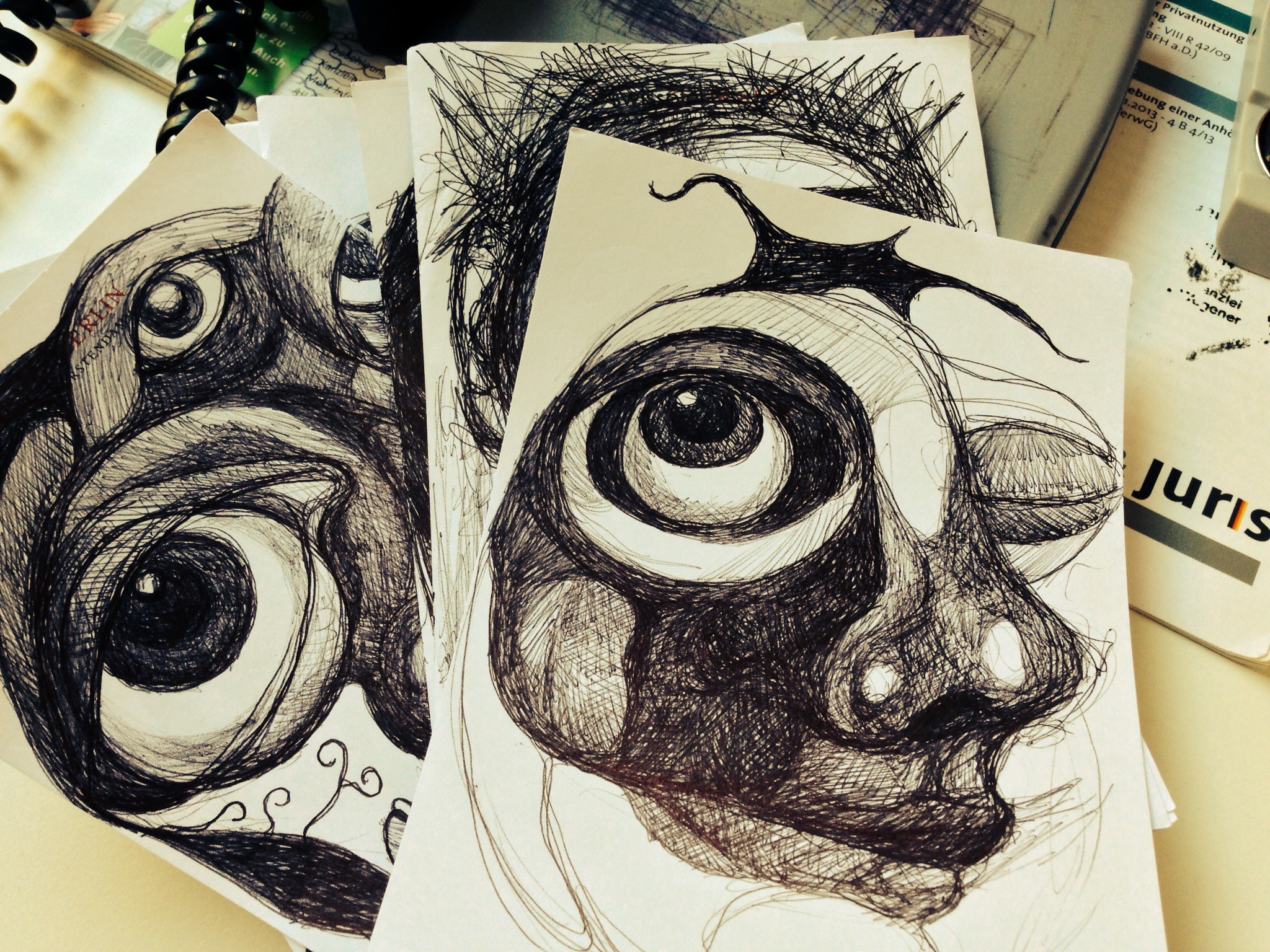
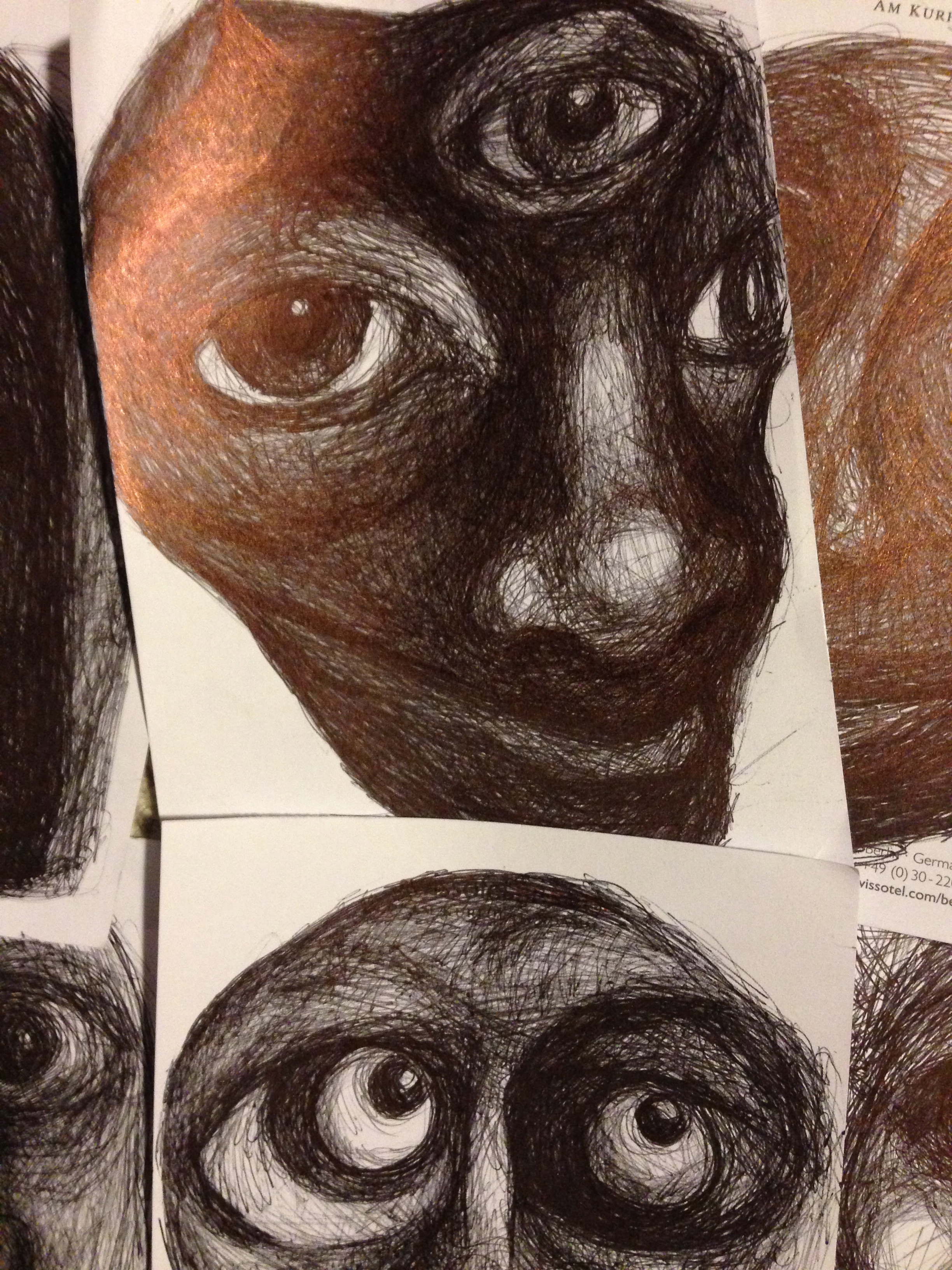
IMG_0875the line that weaves a monster creates a world of possibilities. hopeful monsters, evolution by systemic mutations, as developed by goldschmidt in his theory on “hopeful monsters”, provides, as a metaphorical recourse, the right to hope against all odds that what is uneven – think Kant and the crooked timber of humanity – might be not only necessary but at times preferable to what is normatively expected. (citation after: dartouth.edu/~dietrich/NRG2003.pdf
“a single mutational step affecting the right process at the right moment can accomplish everything, providing that it is able to set in motion the ever-present potentialities of embryonic regulation” Goldschmidt, R. The Material Basis of Evolution (Yale Univ. Press, New Haven, Connecticut, 1940).

thou shall not confuse night with darkness

Image 1


After all those years of quiet desperation spent in the library it finally occurred to them that the meaning of the phrases they had taken to be metaphorical actually was to be understood literally. One of them said it, said it twice as if a discovery this horrendous and yet simple and elegant, had to be given a reflecting twin to cast light into the darkness of their ignorance. One of them instantly began to tear at the fine web of cross references and foot notes he had been weaving patiently for years and without ever questioning the worthiness of this pursuit, but they were like angel hair or glass wool and cut his hands with fine sharp lines out of which blood emerged like red pearls on a string. “I shall not be told convinced” he blurted out, not holding back now, “All those weeks, months, even years, sitting in the dark like a toad, with my skin starting to resemble the parchment  of the oldest books we had delivered from unknown depths of the library, all that knowledge I have assembled in my humble brain that has me compete with the most elaborate encyclopedias of this library, all this weaving and threading of letters, words, meaning, phrases is to be ridiculed by a simple, single and singular shining truth. What of the darkness that we have illuminated with stray thoughts of meaning, what of the wondrous glimmer of an insight long desired and yet so small that it is like a single candle flicker in a great hall. What of its beauty and possibilities? Look at your single truth that already shines into every corner now that you have unlocked its secret, that leaves no shadow, no desire, no discovery, no randomness and outshines all my small beautiful candles. How am I supposed to live with something so simple and shining when I have dedicated my whole life to the complex, hidden, wondrous discovery of paradox answers, when I love the darkness in which a single light shines, when i am a creature of the night and dedicated to a pursuit without hope? How am I to rise out of my darkness into this shining, merciless light?” And he began crying miserably, holding his bloodied hands out as if he was asking for a charitable donation, and the others looked on in silence.

moonflower

Canis Major as depicted in Urania's Mirror, a ...
Canis Major as depicted in Urania’s Mirror, a set of constellation cards published in London c.1825. Next to it are Lepus and Columba (partly cut off). (Photo credit: Wikipedia)

“Your fist like this”, she said, “covers about 10 degrees of the night sky.”  She moved my hand slowly over the dark water and spoke in her methodical way, no use to interrupt her. “20 degrees south-east of the belt of Orion, you see, there is the brightest star in the night sky, right in the constellation of Canis Major.” She waited for a moment for me to catch up with her. Our entwined hands travelled over the night sky and stopped. And there it was, deep underneath us, the brightest star of the night sky, as far as I could see. “Do you see this star?” she asked. “It is called Sirius. It is 23 times more luminous than our sun, twice the mass and the diameter of the sun. It is only 8.5 light years away.” The way she said “only 8.5 light years”, it sounded as if she was talking about a Sunday picnic destination. It sounded like: We could take the bike. It’s only 8.5 light years away. Before I had a chance to point that out to her, however, she had started talking again, and almost without warning, though in answer of my question, switched from her facts, from degrees between two points of light in the celestial sphere, luminosity and brightness, and mass of celestial objects, to a startling revelation.


The little gargoyle

A picture taken by Charles Negre in 1853. Of H...
A picture taken by Charles Negre in 1853. Of Henri Le Secq near the ‘Stryge’ chimera on Notre Dame de Paris. (Photo credit: Wikipedia)

Embedded in the otherwise raw stone was the face of a little boy. The details were not worked out but still the image unmistakably was that of a child. His eyes were almost closed; he had round cheeks and a high, equally round forehead. The face was still and yet there was something disturbing in these childish, lovely features, a hint of pain not overcome.

After a protracted moment of meditation, like a period of silence between two people who do not know how to talk to each other but do not want to part ways just yet, the mason had taken up his tools and finished his work. Within the hour he had transformed the boy into a beast by adding spiked ears, pointed horns on his head, a hairy body, large hands and feet and a curled-up tail, all roughly fashioned. He then had put down his instruments, and without evaluating his just completed work again, had turned away from the boy and had left.

common delight

common delight

in the beginning they had been one
undivided
one delight, one breath, one presence

looking at each other they had found
the same spark of life
that was flickering in their own mind
light the other’s eye

reaching for each other there had been
no more division between both of their fingers, touching,
than between their own two hands

but the small gods divided them
for the price of a name
and grammar

I shall henceforth be called I
and you shall be called you
and there shall be common delight
one breath, one presence, one light
no more

… consequently there cannot be an edge over which to lean to catch a glimpse of eternity

English version / German translation

Few travelers have ever reached the end of the world, even in the days of the Aelvor, for it is such an awful long way to go and full of obstacles, too. Yet when my grandmother told me about the Willow as I tell you about her now, it had seemed to me that I almost remembered her as if I had seen her with my own eyes and touched her with my own hands but couldn’t quite remember anymore where or when that could have been.

Of course you know that the earth is a ball and that consequently there cannot be an edge over which to lean to catch a glimpse of eternity. And yet, our elders might not have been as naïve as we are told today by believing that the world is located on a disc and that you can walk only so far before reaching an end. In our hearts we are closer related to ways that must end eventually than the Aelvor were who soberly talked about the eternal cyclic renewal of all times and beings.

Wenige Reisende haben jemals das Ende der Welt erreicht, selbst in den Tagen der Aelvor, denn es ist ein furchtbar langer Weg dorthin, wie jeder weiß, und,  wie es die alten Märchen erzählen, voller Hindernisse und Gefahren. Und dennoch, wenn meine Großmutter mir von der Weide am Ende der Welt erzählte, eben so, wie ich Dir jetzt von ihr erzähle, belebte sich ihre sonst oft müde Stimme und sie sprach so lebhaft und anschaulich, als erinnerte sie eine Geschichte aus ihrer eigenen Jugend, und mir, die ich ihr zuhörte, kam es wirklich so vor, als könne ich mich selbst beinahe erinnern, dass ich den Baum einst mit meinen eigenen Augen gesehen und mit meinen eigenen Händen berührt hätte, auch wenn ich, gefragt, nicht mehr zu sagen gewusst hätte, wann oder wo das hätte gewesen sein sollen.

Natürlich weißt Du, dass die Erde eine Kugel ist und dass es also keine Kanten geben kann, über die man in einen Abgrund stürzen oder über den man  sich auch nur hinauslehnen könnte, um einen Blick der Unendlichkeit zu erhaschen, wie es in den alten Geschichten heißt. Und dennoch waren die Menschen früher vielleicht nicht so naiv wie wir es mit ein wenig Überheblichkeit heute gerne glauben wollen, nur weil sie annahmen, dass die Welt eine Scheibe sei und man nur so weit gehen konnte, bis man an ihr Ende kam. Wenn wir aufrichtig sind, ist uns auch in unserer Zeit die Vorstellung, dass jeder Weg schließlich endet, immer noch vertrauter, als es die Geschichten der Aelvor sind, die nüchtern von der Unendlichkeit und der zyklischening, Wiederkehr aller Zeiten und Kreaturen zu erzählen verstanden.Bild