Page 3 of 4

Working with young artists
IMG_5531Working with Young Artists

By trade I am a lawyer. Many lawyers do have a passion besides their original profession though, I happen to have three, if you count my love for children in general and my own children in particular. The other two are writing and art. I mention this because you will surely want to know how I am qualified to “teach art” or as I prefer to say: to work with and alongside young artists.

My grandmother used to say I have been born with a brush in one and in pen in my other hand – and as far as I can remember I have been scribbling and drawing on every appropriate surface – and some less suited. That I came to study law is strange, all things considered, but I guess I wanted to try out if I could succeed doing something else and law had always been intriguing to me. It turned out that I could succeed. I graduated with two law degrees – and came straight back to art. And at some point I started doing it both: art and law. Kids have always played a role. I have been teaching all kinds of classes, art and law, over the last ten years, and it has been a truly rewarding part of my life, not just my professional life. As you might imagine, I am never asked how I qualify to teach legal workshops, I am a lawyer after all, but often how come I teach art as well.

I do believe that art is not the esoteric, isolated endeavor that people sometimes take it to be. Artists are well advised to take notice of their world and have an understanding of it that transcends the visual. Beuys pointed out that every person is an artist, that artistic creation is at the center of human life. He went as far as demanding that every physician, scientist, philosopher be first trained in art. I will venture further by saying that the art world would profit if artists would first be trained in a trade that explores the practical aspects of their environment. Every artist is part of a tangible social reality. The training to become a lawyer might in the end not be either so far from or so detrimental to artistic process as is might seem at first.

Why I do love to work with young artists? Because it refreshing to leave the stereotypes that people retreat to as they become older. Every child I have ever had the pleasure to meet turned out to be an original artist (albeit sometimes a frustrated one …).
I respect the creative work children are capable of. As a first hand witness and as someone who still draws and paints, saws and glues every day: There is no time like childhood to experience the joy of art.

I had the good luck to be raised by a grandmother who had the wisdom of an older generation to pretty much let me do whatever I thought appropriate as long as I did not nail her good table linens onto a broomstick for a pirate sail (happened only once) or cut out my great grandmother’s lace to make curtains for fairy dwellings, also a one time never to happen again situation.

However I was allowed to make use of any tool that I would find in my grandfathers tool shed or in the kitchen without anyone trying to figure out if they were child appropriate. I was also allowed to make generous use of old newspapers and magazines, of the newsprint paper that my grandfather, who was publisher of a local newspaper, brought home, and in general of every piece of metal, screw, paper, feather, stone or yes, glass! that I would pick up on our long walks. It never occurred to my grandparents that I might pick up some dangerous germs on the way.

I brought everything home and assembled it very much the way every child will when you do not interfere. I do not know where our desire to “make” things has its origin but I do know that we already possess it as children, together with an instinct of how things fit together. If children are not allowed to roam as freely as I was, they will still build markers from pebbles and stones, they’d still use sticks to draw in sand, build strange, improvised gardens in mud, decorate prefabricated play structures with ritual signs.

To be creative is a basic desire of humans, all humans. It is a genuine expression of who we are even before we are defined by our social and economic circumstances. To teach a child to be creative therefore seems to me an elusive act. I look at children with a sense of awe, they are still there, right at the origin, and all I do as an art teacher is to take them on the same kind of  long walk that I had been privileged to undertake with my grandparents and I simply allow them to discover their world and to collect at will what responds to their own desire of creating this world new. If we’d allow our children more freedom and time to explore their own world and provide them with materials that are not dedicated to specific purposes, we could cut back on many extracurricular activities. Let them venture out there and the artist that lives in every one of us but is acutely alive in our children is ready to meet all the great challenges of art right in our neighborhood.

To come back to the question of my own expertise: I do believe with visionary clarity that it is not my academic expertise that is relevant. It is my willingness to acknowledge and celebrate children as the artists they are. I do believe that art is not a matter of paper and ink, of perspective and shading, I do believe though art techniques can be taught art cannot, no more than breathing, walking, seeing. It is something that happens when things go right or when you have to make them come out right. Art is life.

But is it ART?

English: Butter making woman Français : femme,...
English: Butter making woman Français : femme, faisant du beurre Deutsch: Frau Butter stampfend (Photo credit: Wikipedia)

Alternative approaches to teaching ART

Joseph Beuys and the use of butter and animal fat in his work


This is a journal entry describing an indirect approach to the question if a certain object as later illustrated by Joseph Beuys “fat corner” is or is not art. Rather than to start by discussing what art might be, I took two sticks of butter and a box to a class of fifth graders. I opened the butter and started squishing it between my hands without explaining what I was doing and why I was doing it. The butter was slightly softened and was growing softer still through handling and it had good sculptural properties. As I worked air into it, it produced disgusting sounds. I walked around the room, talking about art in general,never referring to my activity, still working the butter between my hands. The kids were intrigued, their reaction ranged from mere disgust to laughter, on which i did not comment, but after a while they started to be fascinated by their own responses to the demonstration, how emotional, shocking, entertaining this seemed to them – and why, and so they talked about that. in the end I sculpted the butter into a corner of the box. I picked the box up and presented it to them like a diorama. then I asked: is it art?


Out of 21 kids, based on their own experience of the performance, 19 judged it to be art.”


someone’s watching you – privacy of data, an appeal / round two

Image 5

“Writers must oppose systems. It’s important to write against power, corporations, the state, and the whole system of consumption and of debilitating entertainments. I think writers, by nature, must oppose things, oppose whatever power tries to impose on us.  … You know, in America and in western Europe we live in very wealthy democracies, we can do virtually anything we want, I’m able to write whatever I want to write. But I can’t be part of this culture of simulation, in the sense of the culture’s absorbing of everything. In doing that it neutralises anything dangerous, anything that might threaten the consumer society. In Cosmopolis Kinski says, “What a culture does is absorb and neutralise its adversaries”. If you’re a writer who, one way or another, comes to be seen as dangerous, you’ll wake up one morning and discover your face on a coffee mug or a t-shirt and you’ll have been neutralised.” Don DeLillo (Panic #1, Nov. 2005, pp. 90-95.)

And is it not at the same time a cynical paradox and the hybris of writers, artists and maybe even lawyers, yes, now that I mentioned it, certainly lawyers as well, that in striving to be effective, successful, sharp, persuasive, unveiling, exposing, revealing, uncovering the workings of the machine we also strive for the kind of recognition that neutralizes our very effort. This is still the romantic idea of the individual rebel, the genius writer, the brilliant artist, a sly title afforded with societal approval by the very system that is being accosted, criticized and opposed just because this honor neutralizes, even castrates the very effort it lauds. Don DeLillo writes accordingly in Underworld that true proof of existence lies with the recorder not the recorded, the one who does not have a name but the authority to write the code which makes time tick. My words, his idea, by the way.

If you did indeed value the corrosive of your intellectual ability  you would choose to remain unknown behind a work that was known for its efficiency. you would not buy the idea of the genius writer who ends up on a t-shirt or, for that matter, on Facebook where you can democratically and to no specific end be approved of by the click of a button, but you would anonymously and in a group of like-minded minds labor towards the specific end of a realization of your ideas.

this is, coming round from yesterday’s etude on the privacy of data, another appeal to keep private if you can and claim the right and authority to do so.

do you feel like you are being watched?

fearful knowledgeit’s because you are. the recent discussions about the privacy of data – or the absence of such privacy when it comes to any form of telecommunication or electronic communication – has revealed that for now that even the basic implications that could lead to a meaningful discussion of the issues at stake are at best only vaguely understood.

the increasingly public lives we seem to live obscure the nature of information even further. the general public as judged by news coverage and political discussion seems somewhat nonchalant about their own data privacy, maintaining that private data could not be of any use to those who fish for it (what do you care about what I had for breakfast?), and that those who had anything to hide should better be found out early, with other words that to the law-aiding citizen the privacy of data is not of great urgency. The sheer mass of private, non-relevant information creates the further illusion that what one reveals in electronic form was as elusive as a thought shared with a friend in a crowd of people.

to reintroduce the idea  that information may not be – as more commonly understood – an abstract observation extracted from a state of reality to communicate the specific nature of that given state, but instead the first cause to make reality, with other words, that information is to the “thing” it describes what the letter is to the word and the line that draws the letter is to the letter, to reintroduce this thought at the moment when countless legal aspects of data privacy are already causing the discussion to meander without true force, may be pushing the discussion to the brink of madness, but it could also turn out to be immensely useful.

“In the beginning was the word”, this grand opening refers to the provenance of the idea – translating thus the term “logos”, which refers to the inherent logic and order of things. The order of things as encoded in a word very much like a program that at the same time provides a building plan for a specific “thing”, is the cause for its realization and provides the necessary algorithms to build it. Furthermore, if the chosen word, data, information, has “wisdom” (Hebrew for “word”), which means: knowledge of the world as a whole, to speak the right word is to give the initial and irrevocable impulse for the creative act out of which reality follows.

Maintaining authority over that kind of knowledge as far as it refers to your individual data, even if it included plainly what you had for breakfast, whom you’ll meet for lunch and what your favorite color is, might be a cautious and recommended approach until you could positively rule out that this kind of data is indeed what makes you. That could be the making or the unmaking of you.


the art of evolution

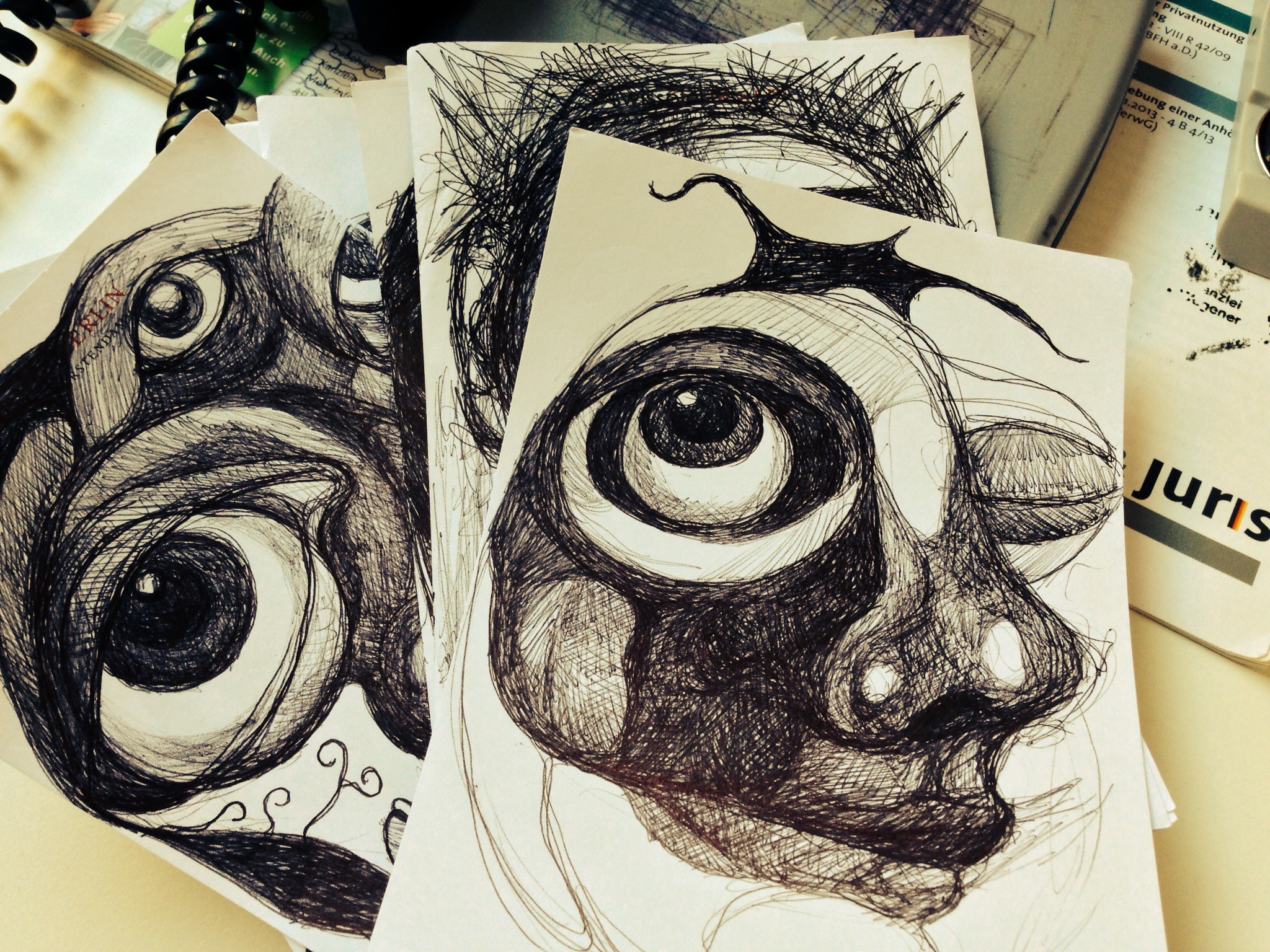
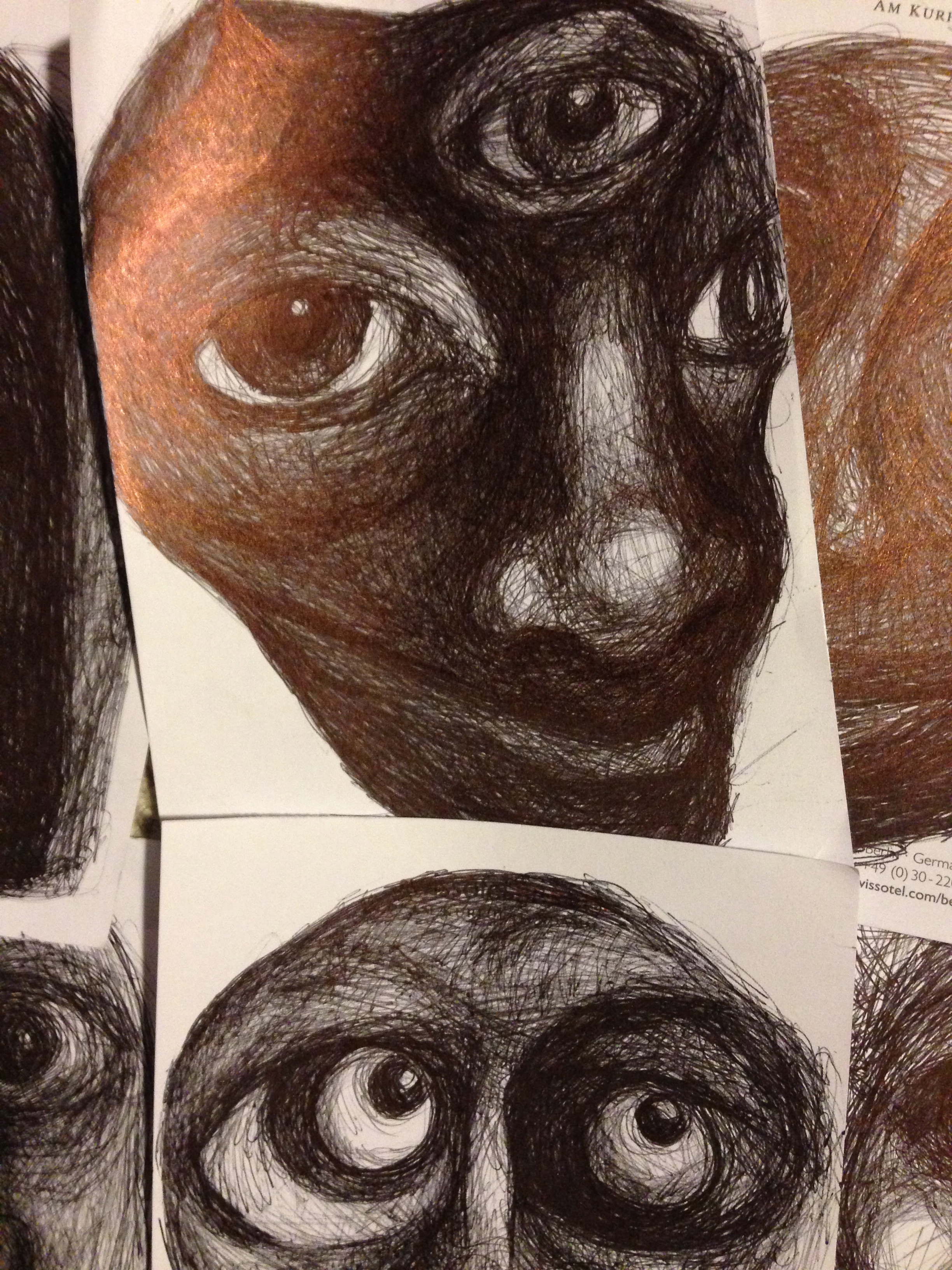
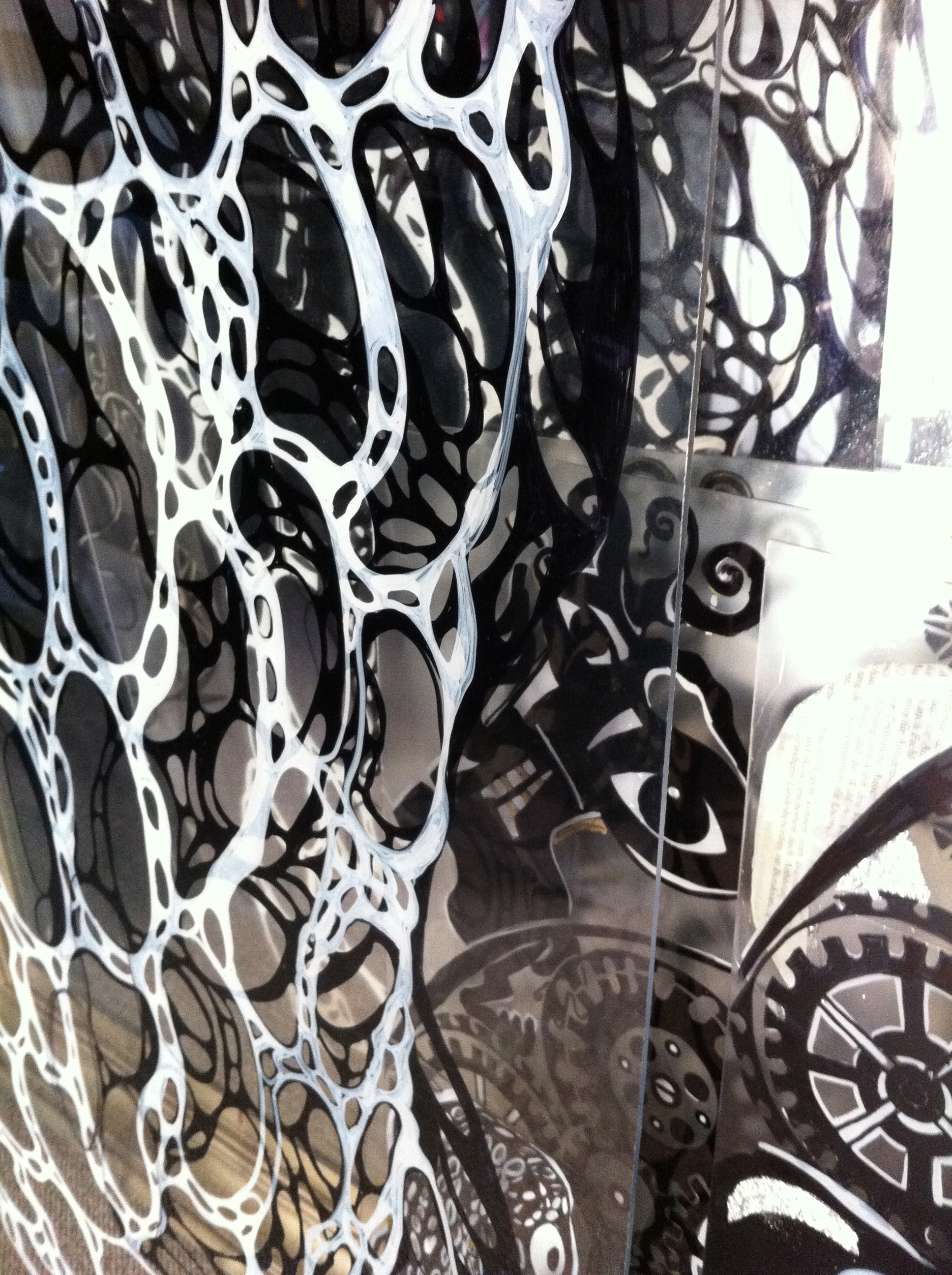
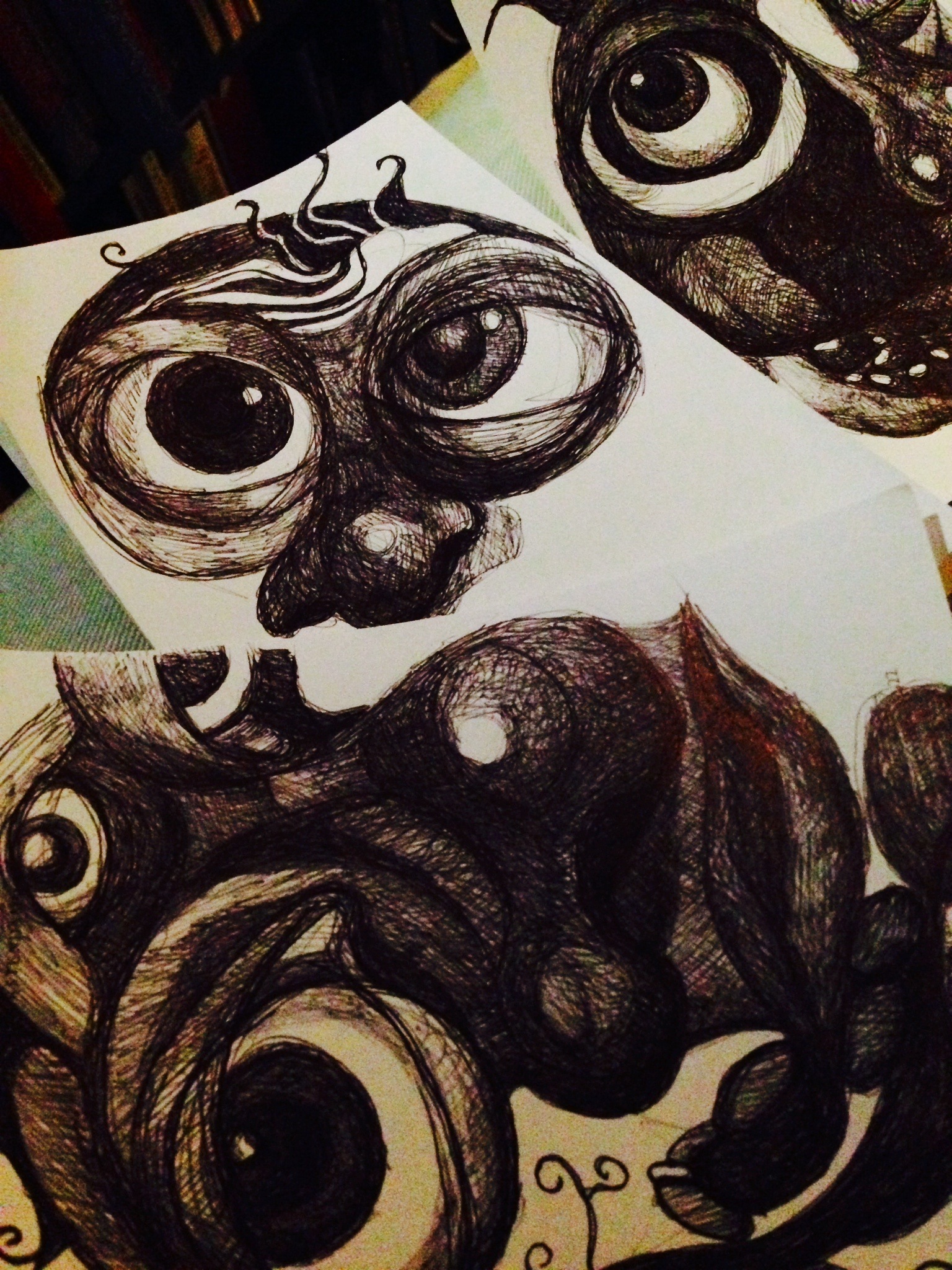
IMG_0875the line that weaves a monster creates a world of possibilities. hopeful monsters, evolution by systemic mutations, as developed by goldschmidt in his theory on “hopeful monsters”, provides, as a metaphorical recourse, the right to hope against all odds that what is uneven – think Kant and the crooked timber of humanity – might be not only necessary but at times preferable to what is normatively expected. (citation after: dartouth.edu/~dietrich/NRG2003.pdf
“a single mutational step affecting the right process at the right moment can accomplish everything, providing that it is able to set in motion the ever-present potentialities of embryonic regulation” Goldschmidt, R. The Material Basis of Evolution (Yale Univ. Press, New Haven, Connecticut, 1940).

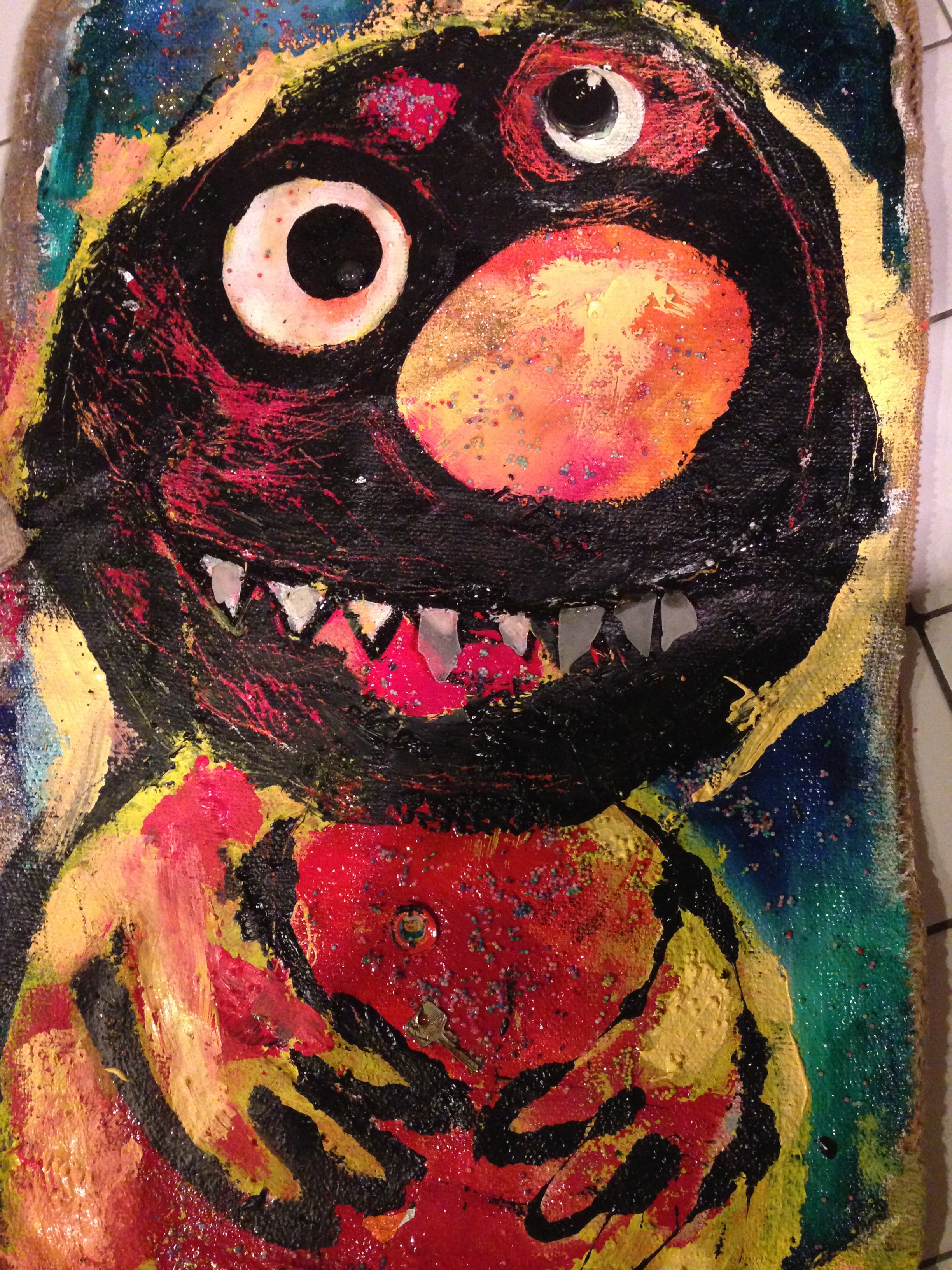
MONSTER Nr. 23

One wild thing: on closer inspection of these canvases you'd find bits and pieces of found objects enclosed such as children cherish. Pieces of beach glass substitute for teeth, small beads, glitter, all children I know love glitter!, keys and bottle caps and lost and found buttons. When did we forget to spin the dream, when did our world cease to hold small promises of meaning and adventure, a life time of stories still to be told? How did we grow up to forget the sensual richness of the world, the intense pleasure we can find only in  simple things and moments. When did we cease to live today in order to reach for a tomorrow that we never truly know will exist - and if it does it comes only to be given up and traded in for yet another tomorrow until there is none anymore? When did we start squandering our present moments for squalid projections? When did we tire of that what we have , right here and right now, the word, the discovery of nothing and everything, the breath of boredom and adventure alike? Ask an expert what life could be like, go hunt for chestnuts and bottle caps and pieces of this and that lost and found. Talk to a stranger and as for their story, smile every once in a while even if convention doesn't require you to, lift your eyes up and look at the disorderly lines of roofs and antennas and imagine Karlsson living up there somewhere or go to your knees and pick up something that glitters without whisking out a disinfectant afterwards. Be a MONSTER. Breathe. There is still some life to be had. Laugh without any particular reason. MONSTER Nr. 23

One wild thing: on closer inspection of these canvases you’d find bits and pieces of found objects enclosed such as children cherish. Pieces of beach glass substitute for teeth, small beads, glitter, all children I know love glitter!, keys and bottle caps and lost and found buttons.

When did we forget to spin the dream, when did our world cease to hold small promises of meaning and adventure, a life time of stories still to be told? How did we grow up to forget the sensual richness of the world, the intense pleasure we can find only in simple things and moments? When did we cease to live today in order to reach for a tomorrow that we never truly know will exist – and if it does, it comes only to be given up and traded in for yet another tomorrow until there is no tomorrow left? When did we start squandering our present moments for squalid projections of who we could be if only? When did we tire of that what we have , right here and right now, the word, the discovery of nothing and everything, the breath of boredom and adventure alike?

Ask an expert, a child no older than six, what life could be like if you’d find it again, go hunt for chestnuts and bottle caps and pieces of this and that, lost and found. Talk to a stranger and ask for their story, smile every once in a while even if convention doesn’t require it, lift your eyes up and look at the disorderly lines of roof shingles, chimneys and antennas and in your mind create a stage for a play that involves precarious acts of balance and skill. Think “Karlsson” by Astrid Lindgren.

Go down to your knees, seeking the perspective of a five year old,  and pick something from the ground that glitters just because it catches your eye – without whisking out a disinfectant afterwards. Be a MONSTER. Breathe. Laugh without any particular reason. Be the absolutely unremarkable, remarkable YOU you were born to be. Nothing more, nothing less. MONSTER Nr. 23

Infinite Jest …

IMG_5726It only occurred to me some years after first meeting him that his brain had been on fire probably day and night, during waking moments and during sleep. He was, I could see that right away, back then, high wired, hyper intelligent, super sensitive, coy, cornered, cynical. In was apparent in the first conversation one would have with him that he was constantly computing any kind of informational offering of his environment for bits and pieces of useful knowledge, useful in his own sense, not ruling out the value of overheard conversations of strangers, visual clues of bill board advertisement, the color scheme of the dioxin polluted NJ marsh lands, conspiracy theories and their opposites, math, astronomy, information technology, Shakespeare, even the CNN news ticker. He was reading, forever reading, and then reading some more, his brain was speed feeding itself knowledge, and he could recover this knowledge with the casual speed of a trained illusionist. When I knew him better he showed me the encyclopedic if highly individual work he was dedicated to, a work in many volumes bound in blue linen as soon as a new one was considered completed. A friend who worked at a university library did this for him volume by volume, one for the shelf in his den, and a twin one that he archived openly secretely in said library, for everyone to see and no one to find in maybe another century. It was a work so biased and yet so beautiful that it was unquestionable that I had been admitted to a unique work of art though he preferred to call it a scientific study of random code.

And still, it was only years later when in the course of an increase of my English language skills I could not only read but  also hear all the different voices merging in “Infinite Jest” by David Foster Wallace that I realized I had actually met a man who is – if that is at all possible considered who Wallace was – the dark twin of David Foster Wallace, sharing his semantics, his obsession, his socioeconomic circumstances, his despair, his addiction, his near autistic ingenuity to gain access to ever deeper layers of information and information encoded within this information,and that he was the man who had to be expected to exist in the margins of literary history, never to be found, as we know that there is never just one genius at any given time, but often just one to emerge to public consciousness , maybe to his own destruction. so that, with other words, i know there to be one other living madman, or genius, or whatever you’d like to call a man with a brain on fire, to weave the net still, to still find the words, to write the chronic of what is and was and will be in all its Borgean implications, thereby freely accepting the responsibility of calling the world into existence.

moonflower

Canis Major as depicted in Urania's Mirror, a ...
Canis Major as depicted in Urania’s Mirror, a set of constellation cards published in London c.1825. Next to it are Lepus and Columba (partly cut off). (Photo credit: Wikipedia)

“Your fist like this”, she said, “covers about 10 degrees of the night sky.”  She moved my hand slowly over the dark water and spoke in her methodical way, no use to interrupt her. “20 degrees south-east of the belt of Orion, you see, there is the brightest star in the night sky, right in the constellation of Canis Major.” She waited for a moment for me to catch up with her. Our entwined hands travelled over the night sky and stopped. And there it was, deep underneath us, the brightest star of the night sky, as far as I could see. “Do you see this star?” she asked. “It is called Sirius. It is 23 times more luminous than our sun, twice the mass and the diameter of the sun. It is only 8.5 light years away.” The way she said “only 8.5 light years”, it sounded as if she was talking about a Sunday picnic destination. It sounded like: We could take the bike. It’s only 8.5 light years away. Before I had a chance to point that out to her, however, she had started talking again, and almost without warning, though in answer of my question, switched from her facts, from degrees between two points of light in the celestial sphere, luminosity and brightness, and mass of celestial objects, to a startling revelation.


thin ice

IMGP0071_2on an early winter’s day a small girl is contemplating the fine layer of ice that, over night, has been glazing over the surface of the fjord. the fine glass is firm enough to carry a duck sliding more that waddling on her webbed feet, making towards the dark canal of open water a fisher boat has left in its wake this morning. it is a comical sight to watch the duck struggling to make progress on the polished ice, the bird looks like harpo on skates.

a little further off the shore a small lake has been kept open by another group of water birds continuously swimming to keep their hole from freezing over, among them two swans who for the time being have resigned themselves to the company of the more common water fowl as their attempts at escape have been defied by their weight.

the girls narrows her eyes as she tentatively put one foot out on the ice, holding on to the orphaned pole the boat upon its return will bet tied to. a large bubble of air that somehow has been trapped underneath the ice near the pole displaces itself under the weight of the child’s feet and causes the ice to sigh. the child smiles with appreciation.

she is old enough to realize that the surface that will not carry a swan’s weight will not carry her own. furthermore, she has been firmly instructed to never walk on the ice before being told that it is safe to do so.

but no ones knows that she is as fast as lightning. they don’t know that she can make herself as light as a feather by breathing just so. with her eyes she follows the path her light foot would take, by a split second faster than the breaking ice. she would reach the other shore before the fjord could ever hope to claim her, she can see it now, can see herself running out there, triumphantly, defying nature and convention in one glorious run.