Page 4 of 4

The little gargoyle

A picture taken by Charles Negre in 1853. Of H...
A picture taken by Charles Negre in 1853. Of Henri Le Secq near the ‘Stryge’ chimera on Notre Dame de Paris. (Photo credit: Wikipedia)

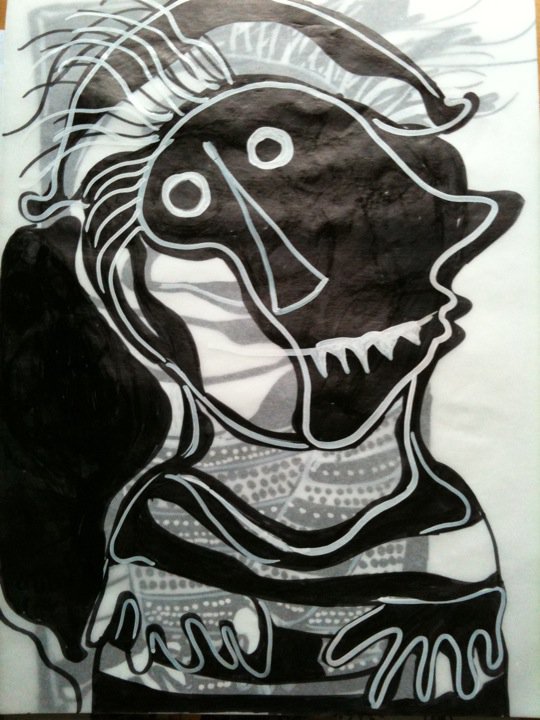
Embedded in the otherwise raw stone was the face of a little boy. The details were not worked out but still the image unmistakably was that of a child. His eyes were almost closed; he had round cheeks and a high, equally round forehead. The face was still and yet there was something disturbing in these childish, lovely features, a hint of pain not overcome.

After a protracted moment of meditation, like a period of silence between two people who do not know how to talk to each other but do not want to part ways just yet, the mason had taken up his tools and finished his work. Within the hour he had transformed the boy into a beast by adding spiked ears, pointed horns on his head, a hairy body, large hands and feet and a curled-up tail, all roughly fashioned. He then had put down his instruments, and without evaluating his just completed work again, had turned away from the boy and had left.

Uncle Gustave

Uncle Gustave

wearing a black ribboned straw hat, gustave,
uncle gustave,
slowly walked down our street
with the help of an ivory colored walking cane,
vulnerable, yet erect like a king who
though victoriously
has fought his last battle and now
has nothing left to prove.


he left his sun yellow house with the forest green shutters
at exactly 2.10 pm every day the weather was fair
to an agonizingly slow approach of his bench.
even the birds stopped twittering and held their breath
as he was passing by
for fear to startle him.


his bench: dark green under an old chestnut tree,
facing away from the the bay, towards the street.
he carefully sat down, pulling up the legs of his dark suit,
and i climbed onto the bench right next to him,
but threading my legs through the wooden lattice of the back rest
i saw the silver water of the bay, the light caught in the crescents
of the small waves the undercurrent stirred up.
he looked at the street, I looked at the bay,
and we were silent
or talked in low, whispering voices.


we both knew he was dying,
right there and then,
and then for some more days to come.
we did not mind,
neither the three nor the ninety-three year old,
i had not been alive for the longest part
of his life,
and he would be dead for the longest
time of mine.

the process of multiplying y – or: the power of “what if …”

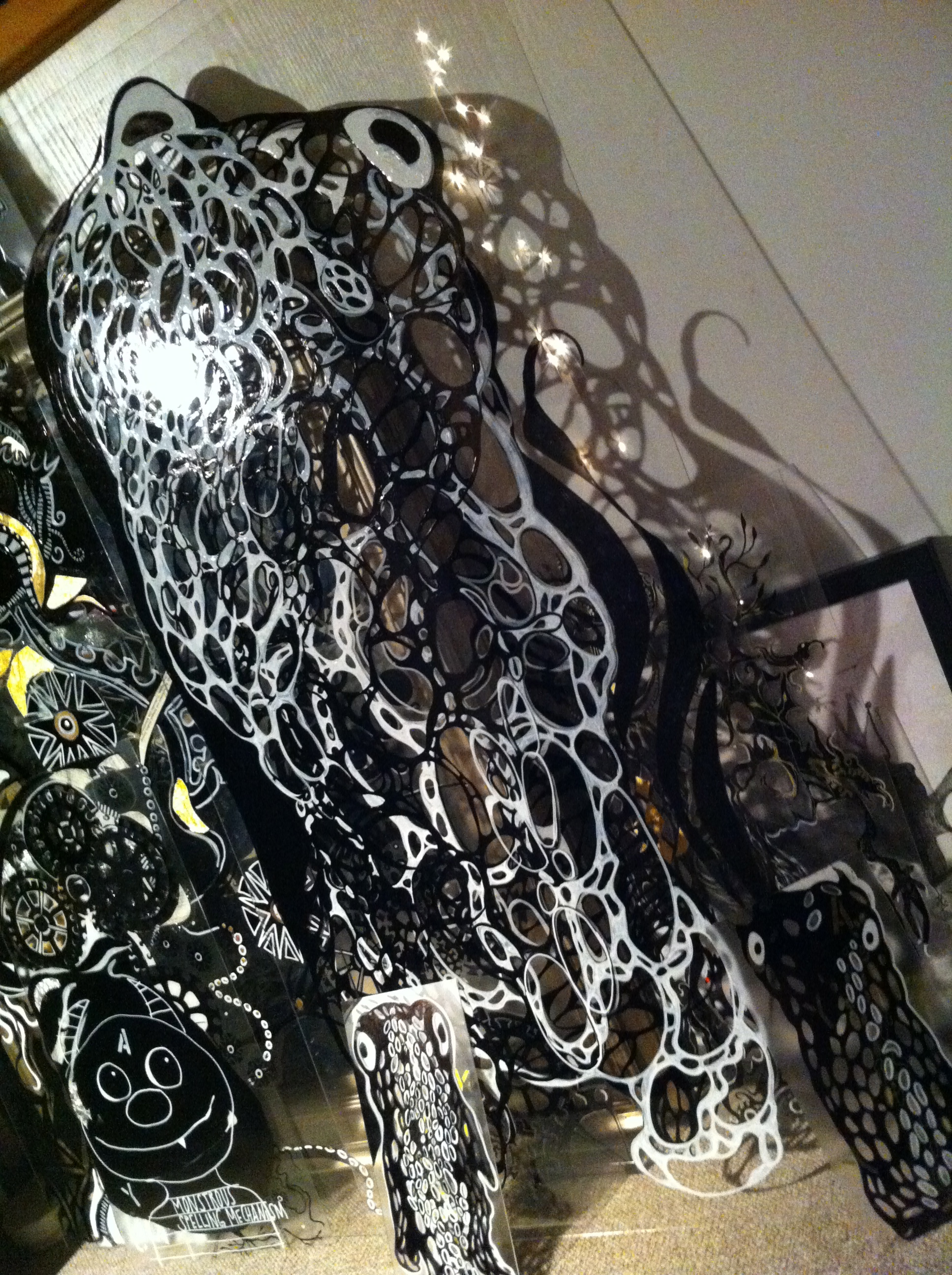
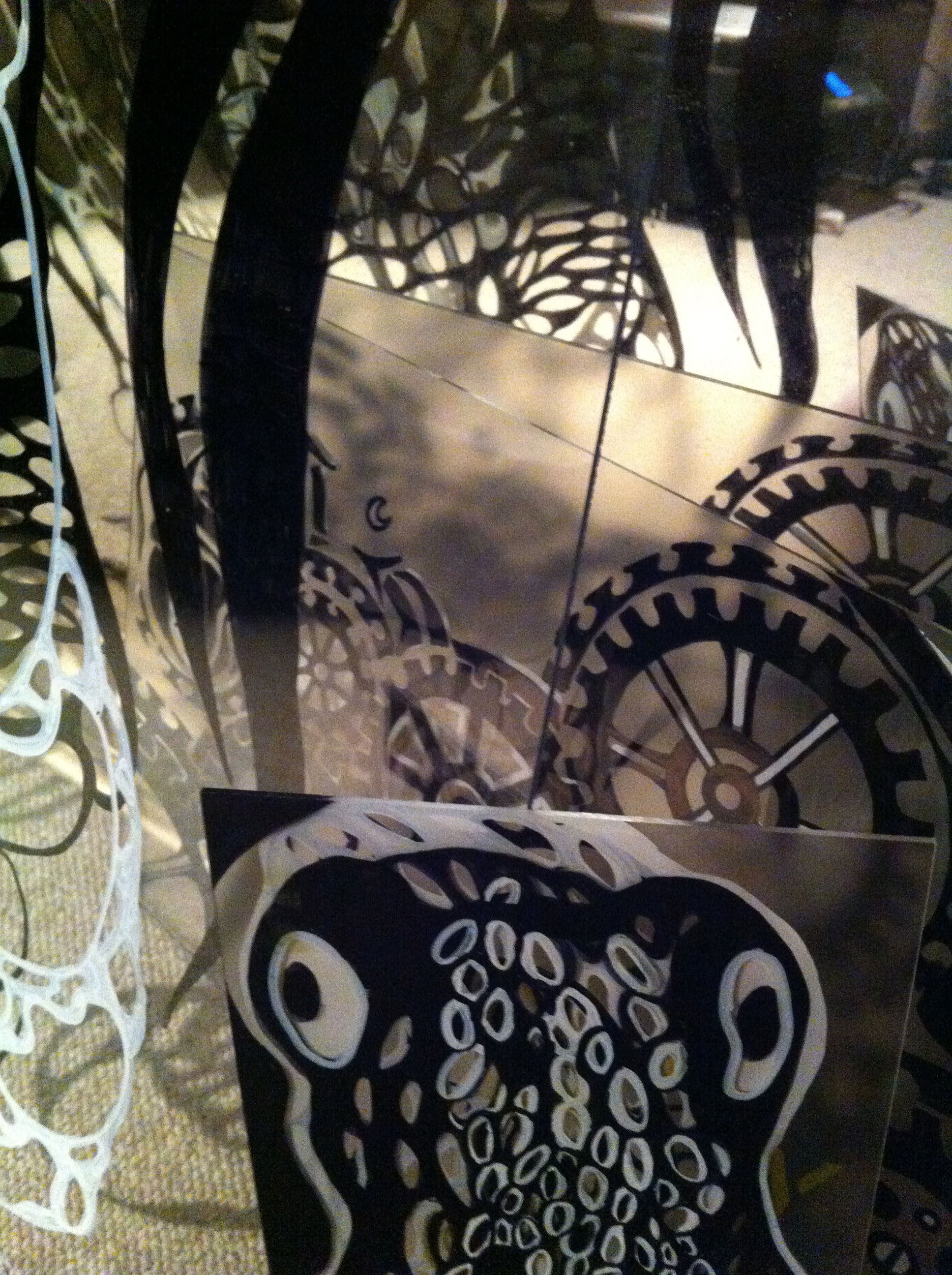
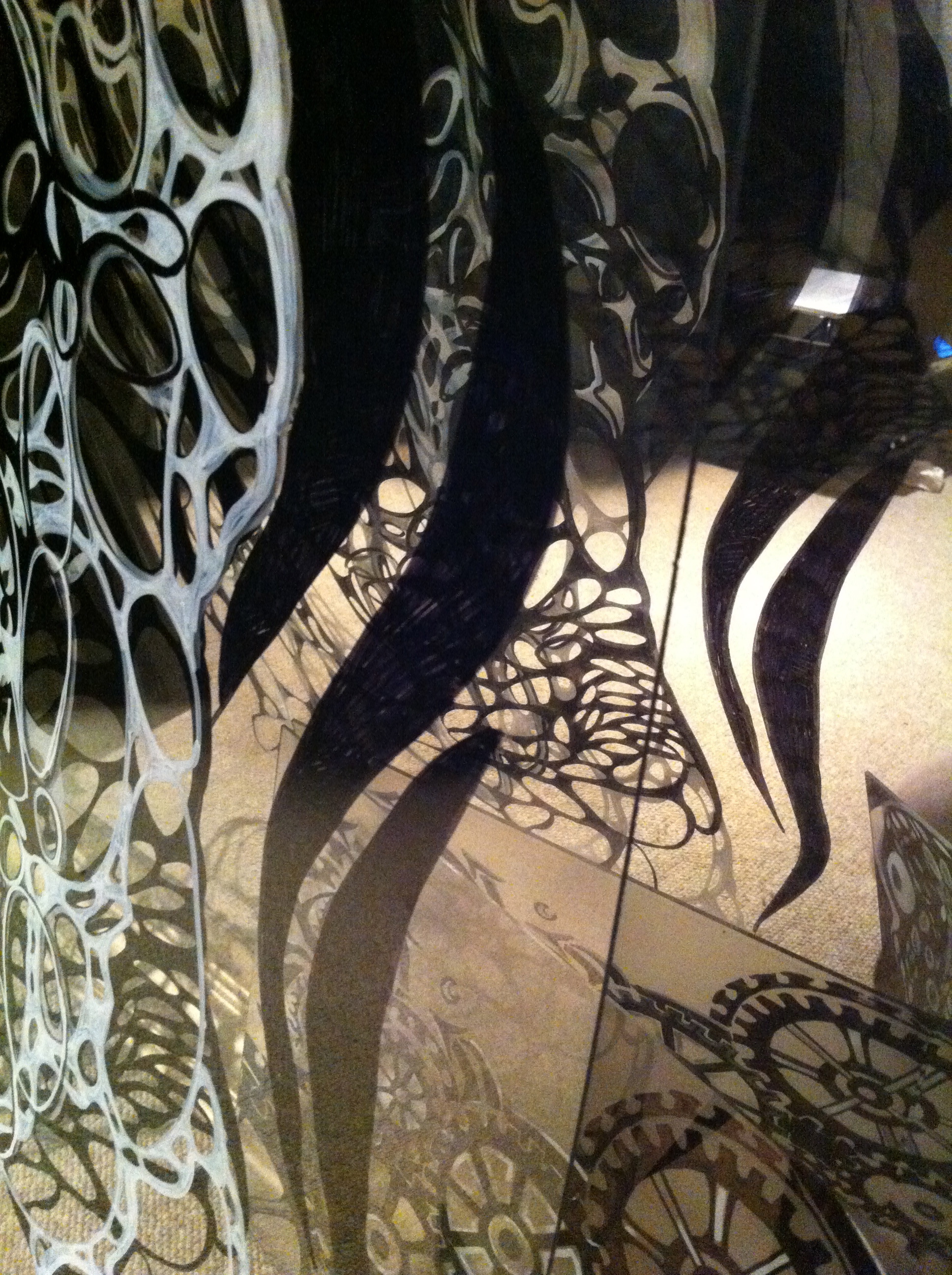
Art is a question. Or, more precisely an active research framework where one question leads to another through tangible action. In my case, at the moment, that tangible action is drawing. Every night. On acrylic glass panes.

As an artist you know the question every finished work asks of you. What if? Every night since December 26th I have finished one drawing and every morning I have looked at it and asked myself a simple “What if …?”.

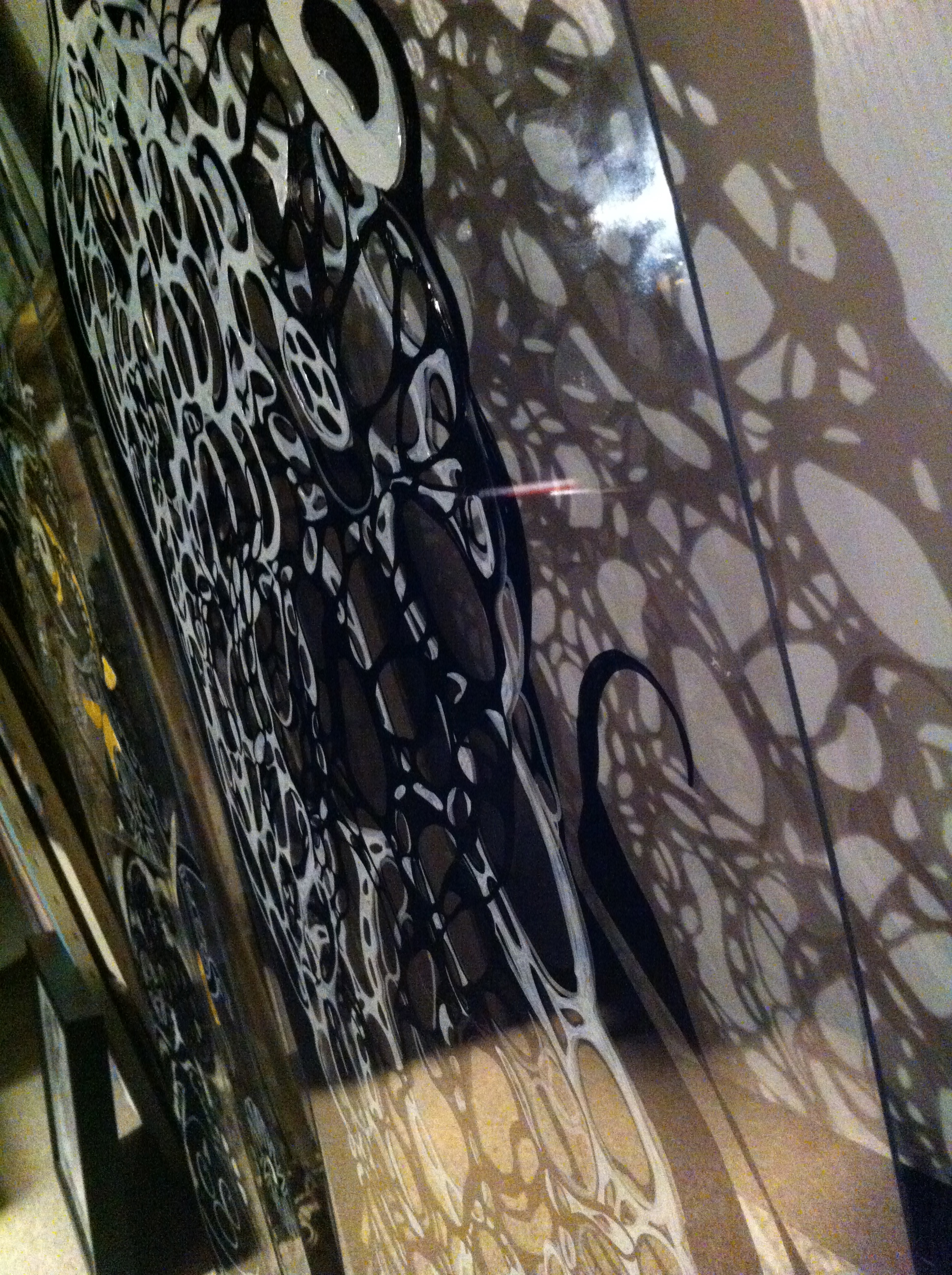
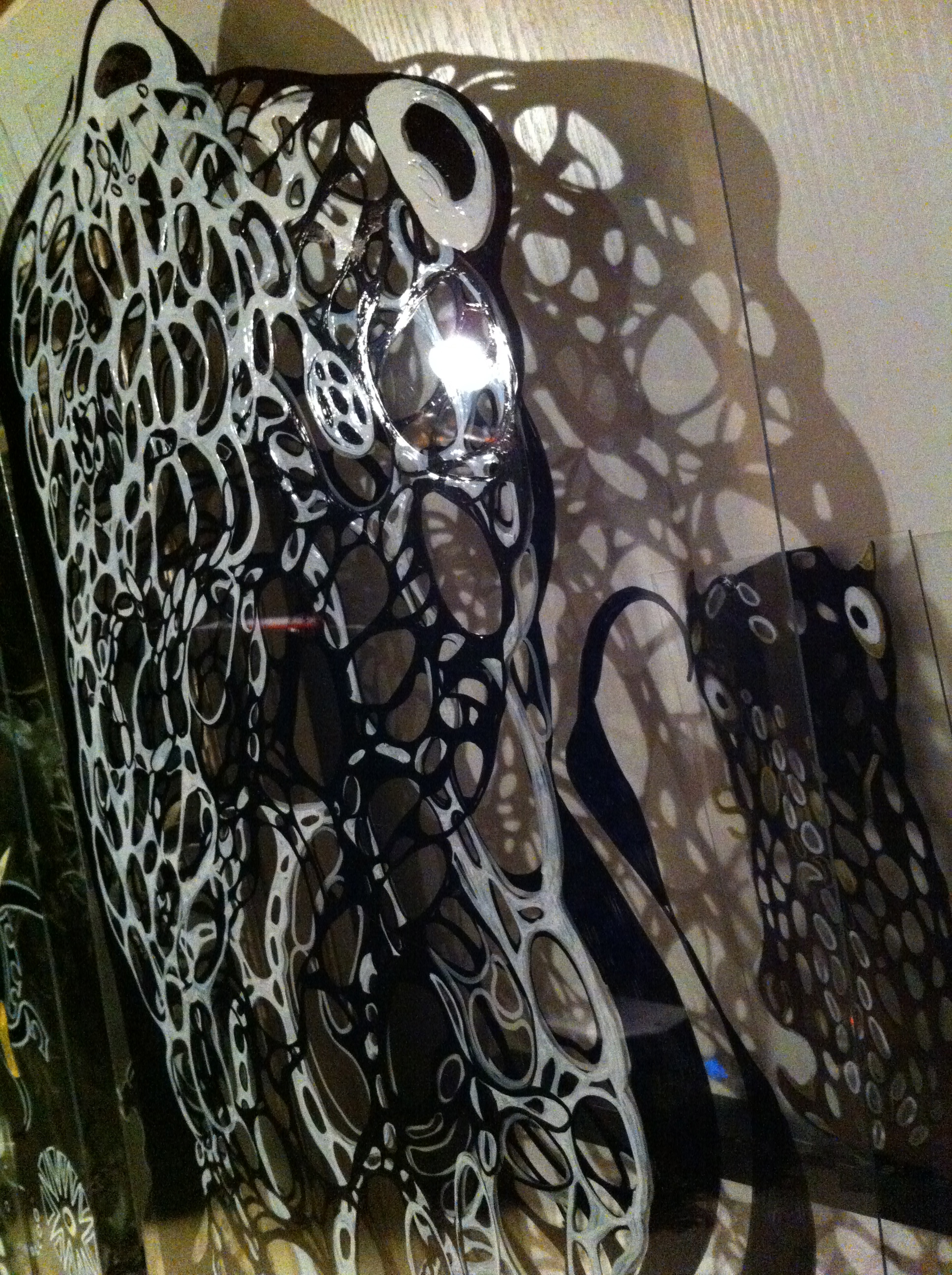
What if, for example, instead of one layer of that net-like surface the creature I called into visual reality I tried two layers, or three? So, that is what I will do the following night. And once finished, I will study it and realize that something happened when I multiplied the net-like layers (actually by five). The feeling that one net-like layer caused me to encounter has deepened. As this is art and not science, this was not necessarily predictable.

But the drawing is still small, more like a study of the possibilities of layering net-like patterns. So, today’s question will be “What if … I took a much larger glass pane?” I still happen to have one of those, by the way.

At some point I might ask myself: Why? Y? Why layer net-like patterns night after night? Why nets of all things? Small. Larger. One layer, Five layers. But asking for the meaning of the pattern or symbols does not follow inevitably as part of the inquiry. I might just as well choose not to ask that question and stay with the mere technical observation.

The one question I never ask myself is: “Does it make sense?” I have been asked that by others, of course. Repeatedly. The implication being: Isn’t it a waste of time?

The answer, to that question is so obvious, that I don’t have to ask myself. (More obvious at least than the right of someone else to ask me why I actively waste my life-time). Does it make sense?

The answer is that if it would make sense in the spirit of that question I would not do it. I would not do it even if I felt like it. Even if I had an urge to do it. I just wouldn’t, if it made sense.

I am like a cartographer, stringing together points on a map. Does is make sense to look at the stars and wonder how far one could go? Does it make sense to accelerate a particle? Does it make sense to be breathe? Rather than to contemplate such a question I ask: “What if.” Many times over. Night after night. Dream after dream.

Art is a question.

trop jolie … too pretty

trop jolie ... too pretty

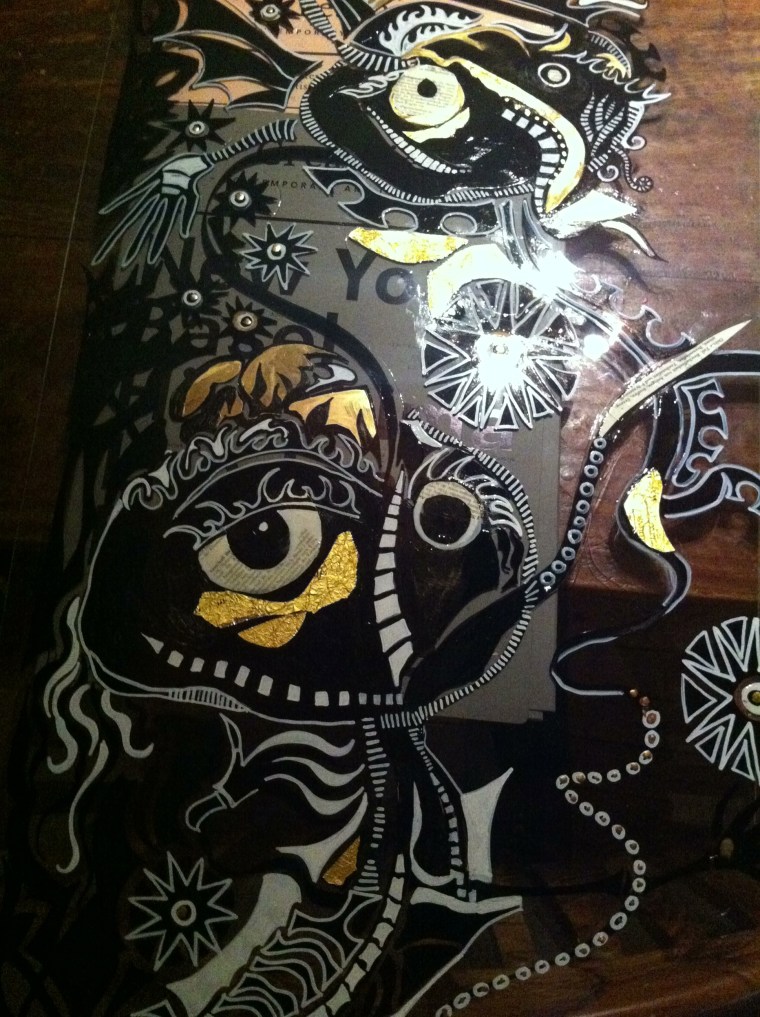
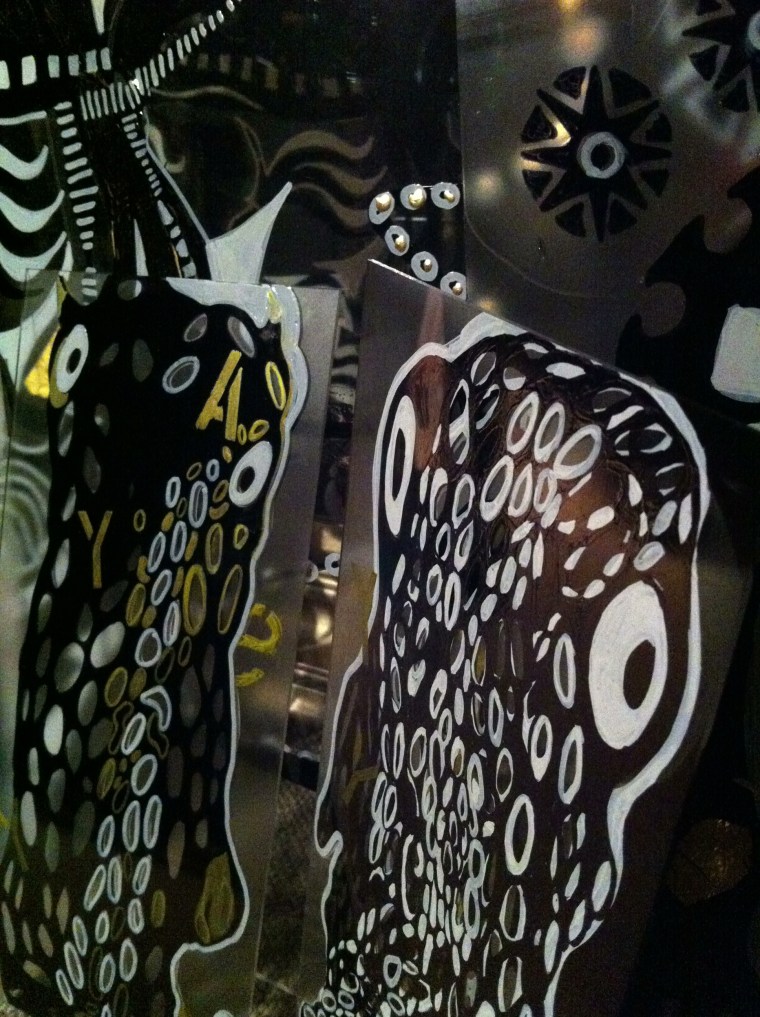
Back to the subject of pretty: Even after granting myself the liberty to let go of my need to create things that are at least scraping on the verge of comical, ugly, surreal, infantile I still do get a slight stomach ache looking at these new works. The drawing you see here at least is a bit dark, the creature in the front displaying its rib-cage like an x-ray – but the execution is doubtless pretty, shining dark (Edding marker and Poyurethane) and gold with snippets of legal text incorporated on glass.

I have two large, eight medium and multiple small acrylic plates waiting for me, and I think I will continue drawing in this very calm and slightly upsetting manner of “pretty” even if it is just to find out WHY it matters so much. Maybe it is the surface itself, the ephemeral, light quality of the glass pane rather than the coffee and potato sacks I was layering paints and disposed off objects on before.

The only rule I play by is that there must be no preliminary drawing, no careful execution – and I am thinking about incorporating more precious materials (chocolate wrappers, glitter etc.) to make it even more intolerable to my eyes.

Yes, there is a fun element here, observing myself how much “pretty” I can take.

Interestingly, parallel to these glass drawings I am working on a translation from a small English novel I have published some years ago into German, and I find that this folk-tale that sounded sober enough in English to work for me now has a pretty ring to it in the translation, too, as the words just have different associations (while pointing towards the same thing).

Ideas about that difficult relationship between pretty, sober and ugly, would be very welcome at this moment.

no fear

no fear

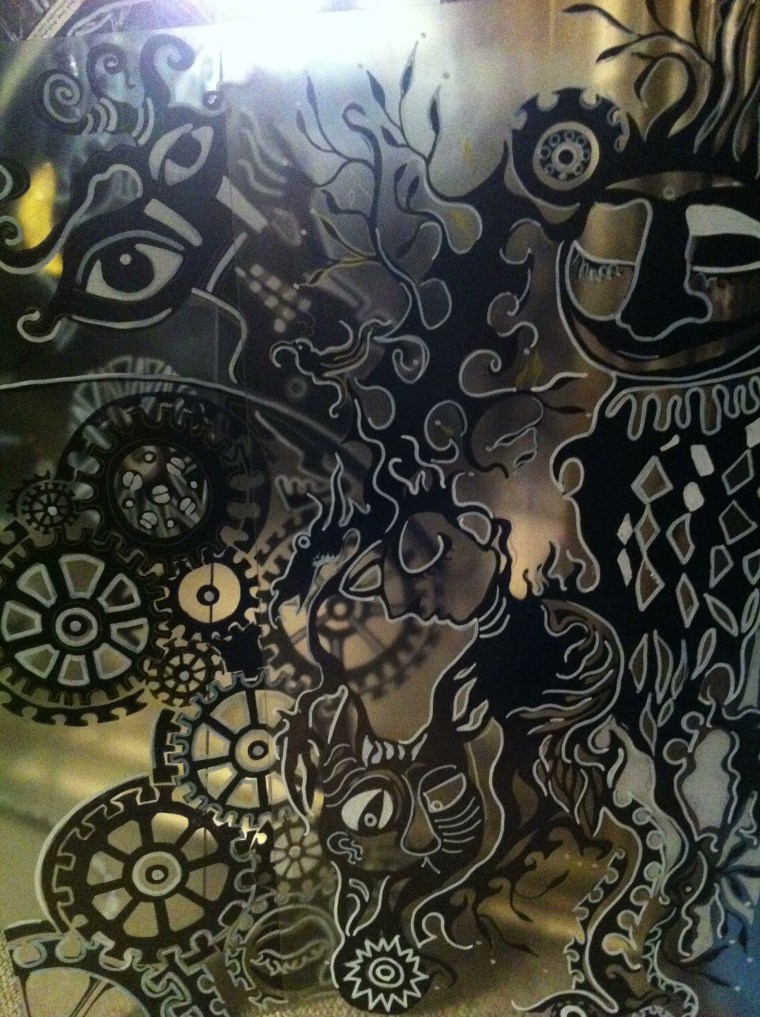
The title offers itself as an afterthought to the completed drawing. Or: almost completed as these are works in progress. “No fear” seems like a big title for such a pleasing drawing but it actually refers to the relative beauty of the subject – very unusual for me. I do have a deep appreciation for the seemingly ugly, small, cheap, scratchy, discarded quality of objects and ideas, for those scraps and pieces deemed not to measure up. I am deeply suspicious of the superior quality of a single piece of work (not mine), of the brilliance and self-sufficiency that is in no need of a contribution by whoever may chance to look at it because I feel that our visual environment is saturated with ideas that are complete and in no need of further discourse, thereby actively discouraging original creative failure. Seems at times we all live in a society of mad overachievers. So I love the frail, the ugly to the point where I censor my own work when it’s getting too pleasing. But these drawings I have let go uncensored by myself, not even knowing why. Maybe I am in need of some beauty. And far be it from me to think that these are perfect. Maybe quite the opposite. So for a while, I will be like a child at play, drawing and arranging these small characters, without fear that they shall be considered too light. Let there be some light ….