Page 2 of 4

Working with young artists
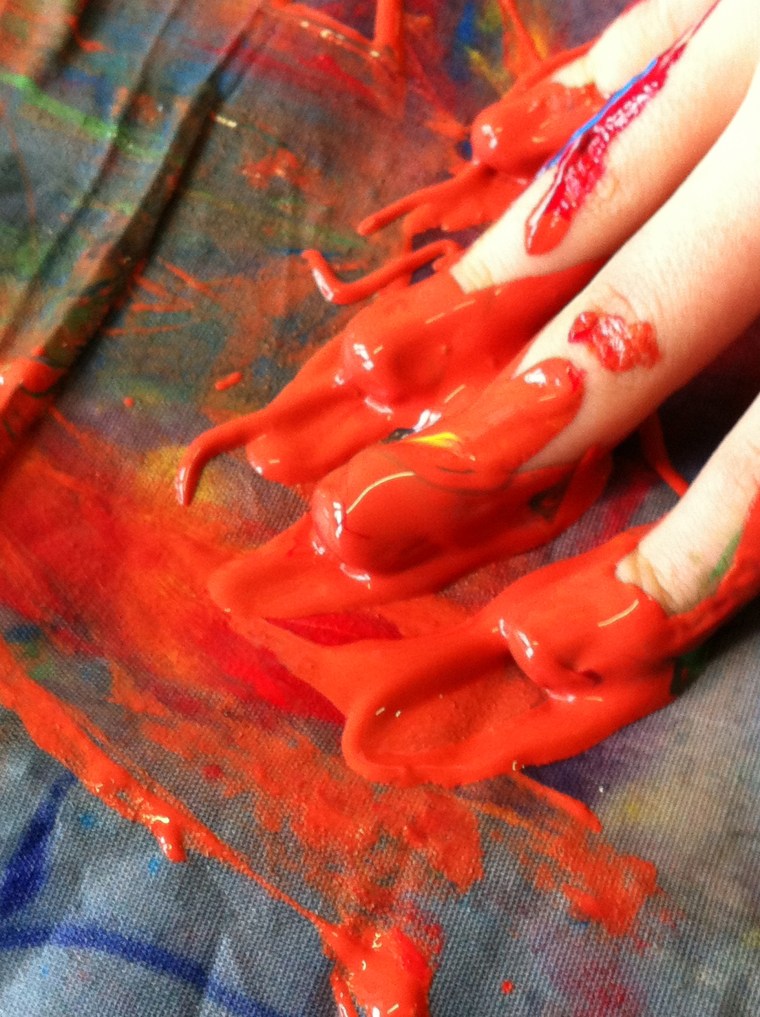
IMG_5531Working with Young Artists

By trade I am a lawyer. Many lawyers do have a passion besides their original profession though, I happen to have three, if you count my love for children in general and my own children in particular. The other two are writing and art. I mention this because you will surely want to know how I am qualified to “teach art” or as I prefer to say: to work with and alongside young artists.

My grandmother used to say I have been born with a brush in one and in pen in my other hand – and as far as I can remember I have been scribbling and drawing on every appropriate surface – and some less suited. That I came to study law is strange, all things considered, but I guess I wanted to try out if I could succeed doing something else and law had always been intriguing to me. It turned out that I could succeed. I graduated with two law degrees – and came straight back to art. And at some point I started doing it both: art and law. Kids have always played a role. I have been teaching all kinds of classes, art and law, over the last ten years, and it has been a truly rewarding part of my life, not just my professional life. As you might imagine, I am never asked how I qualify to teach legal workshops, I am a lawyer after all, but often how come I teach art as well.

I do believe that art is not the esoteric, isolated endeavor that people sometimes take it to be. Artists are well advised to take notice of their world and have an understanding of it that transcends the visual. Beuys pointed out that every person is an artist, that artistic creation is at the center of human life. He went as far as demanding that every physician, scientist, philosopher be first trained in art. I will venture further by saying that the art world would profit if artists would first be trained in a trade that explores the practical aspects of their environment. Every artist is part of a tangible social reality. The training to become a lawyer might in the end not be either so far from or so detrimental to artistic process as is might seem at first.

Why I do love to work with young artists? Because it refreshing to leave the stereotypes that people retreat to as they become older. Every child I have ever had the pleasure to meet turned out to be an original artist (albeit sometimes a frustrated one …).
I respect the creative work children are capable of. As a first hand witness and as someone who still draws and paints, saws and glues every day: There is no time like childhood to experience the joy of art.

I had the good luck to be raised by a grandmother who had the wisdom of an older generation to pretty much let me do whatever I thought appropriate as long as I did not nail her good table linens onto a broomstick for a pirate sail (happened only once) or cut out my great grandmother’s lace to make curtains for fairy dwellings, also a one time never to happen again situation.

However I was allowed to make use of any tool that I would find in my grandfathers tool shed or in the kitchen without anyone trying to figure out if they were child appropriate. I was also allowed to make generous use of old newspapers and magazines, of the newsprint paper that my grandfather, who was publisher of a local newspaper, brought home, and in general of every piece of metal, screw, paper, feather, stone or yes, glass! that I would pick up on our long walks. It never occurred to my grandparents that I might pick up some dangerous germs on the way.

I brought everything home and assembled it very much the way every child will when you do not interfere. I do not know where our desire to “make” things has its origin but I do know that we already possess it as children, together with an instinct of how things fit together. If children are not allowed to roam as freely as I was, they will still build markers from pebbles and stones, they’d still use sticks to draw in sand, build strange, improvised gardens in mud, decorate prefabricated play structures with ritual signs.

To be creative is a basic desire of humans, all humans. It is a genuine expression of who we are even before we are defined by our social and economic circumstances. To teach a child to be creative therefore seems to me an elusive act. I look at children with a sense of awe, they are still there, right at the origin, and all I do as an art teacher is to take them on the same kind of  long walk that I had been privileged to undertake with my grandparents and I simply allow them to discover their world and to collect at will what responds to their own desire of creating this world new. If we’d allow our children more freedom and time to explore their own world and provide them with materials that are not dedicated to specific purposes, we could cut back on many extracurricular activities. Let them venture out there and the artist that lives in every one of us but is acutely alive in our children is ready to meet all the great challenges of art right in our neighborhood.

To come back to the question of my own expertise: I do believe with visionary clarity that it is not my academic expertise that is relevant. It is my willingness to acknowledge and celebrate children as the artists they are. I do believe that art is not a matter of paper and ink, of perspective and shading, I do believe though art techniques can be taught art cannot, no more than breathing, walking, seeing. It is something that happens when things go right or when you have to make them come out right. Art is life.
the art of evolution

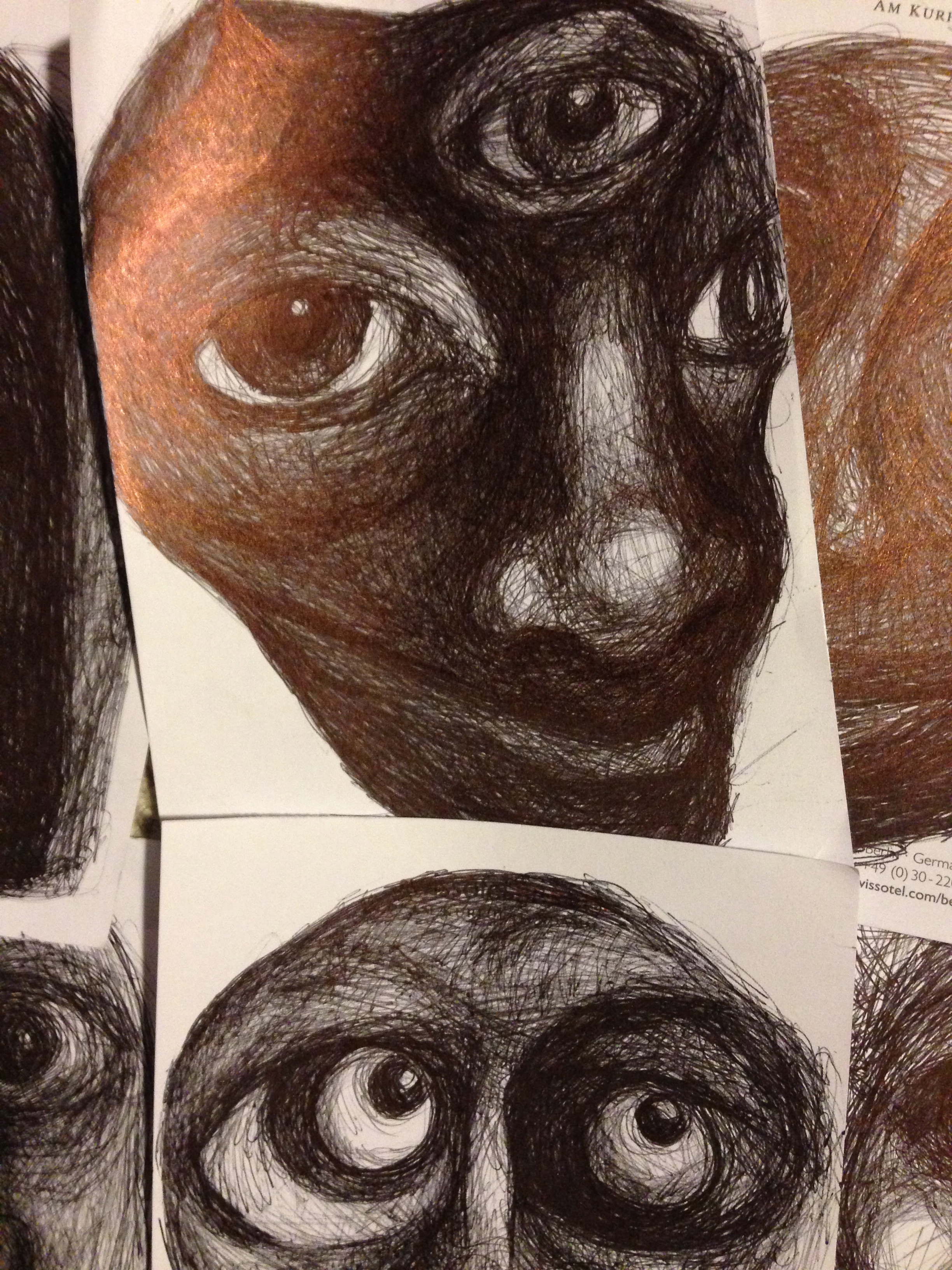
IMG_0875the line that weaves a monster creates a world of possibilities. hopeful monsters, evolution by systemic mutations, as developed by goldschmidt in his theory on “hopeful monsters”, provides, as a metaphorical recourse, the right to hope against all odds that what is uneven – think Kant and the crooked timber of humanity – might be not only necessary but at times preferable to what is normatively expected. (citation after: dartouth.edu/~dietrich/NRG2003.pdf
“a single mutational step affecting the right process at the right moment can accomplish everything, providing that it is able to set in motion the ever-present potentialities of embryonic regulation” Goldschmidt, R. The Material Basis of Evolution (Yale Univ. Press, New Haven, Connecticut, 1940).

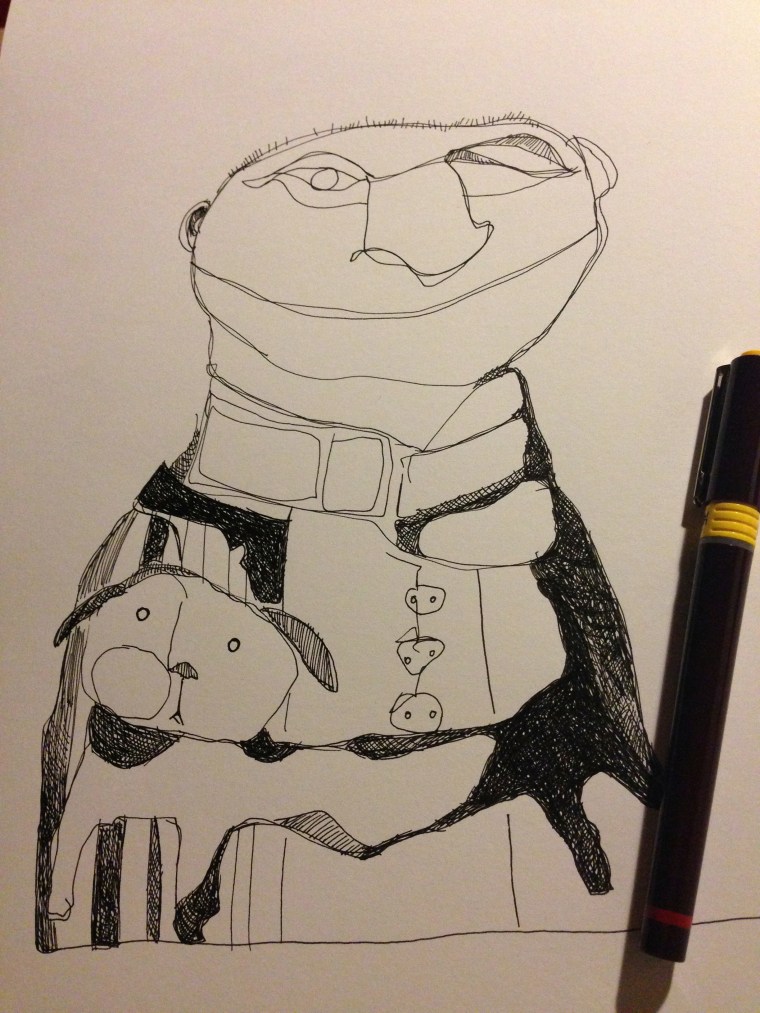
Monsieur Petit et son chien

Monsieur Petit et son chien

Did you know he existed?
I didn’t until yesterday
when he materialized underneath
the tip of my radiograph.

There he was
demanding my attention
yet remaining oddly silent,

Monsieur Petit et son chien.
Eh, bien.

I guess he is out there
somewhere,
in fact, I am almost certain he is.

Perhaps you know him?
Perhaps you have met him,

if you have,
please remember,
next time you see him,
to convey a small message
from me?
I’d be much obliged.

Just mention to him
that his image has separated
from him like his shadow could not
and has adopted a small dog.

And ask him to please
watch out for the real dog,
flea-riddled and shabby as he might be,
the dog,
and take care of him,
and be kind to him.

And tell him not to worry,
he will recognize him,
once he sees him.

Ask very gently,
be persuasive with a hint of
severe authority.
It’s important because,
you see,

his image would much like to keep the dog.

multiplying y – creating depth

multiplying y - creating depth

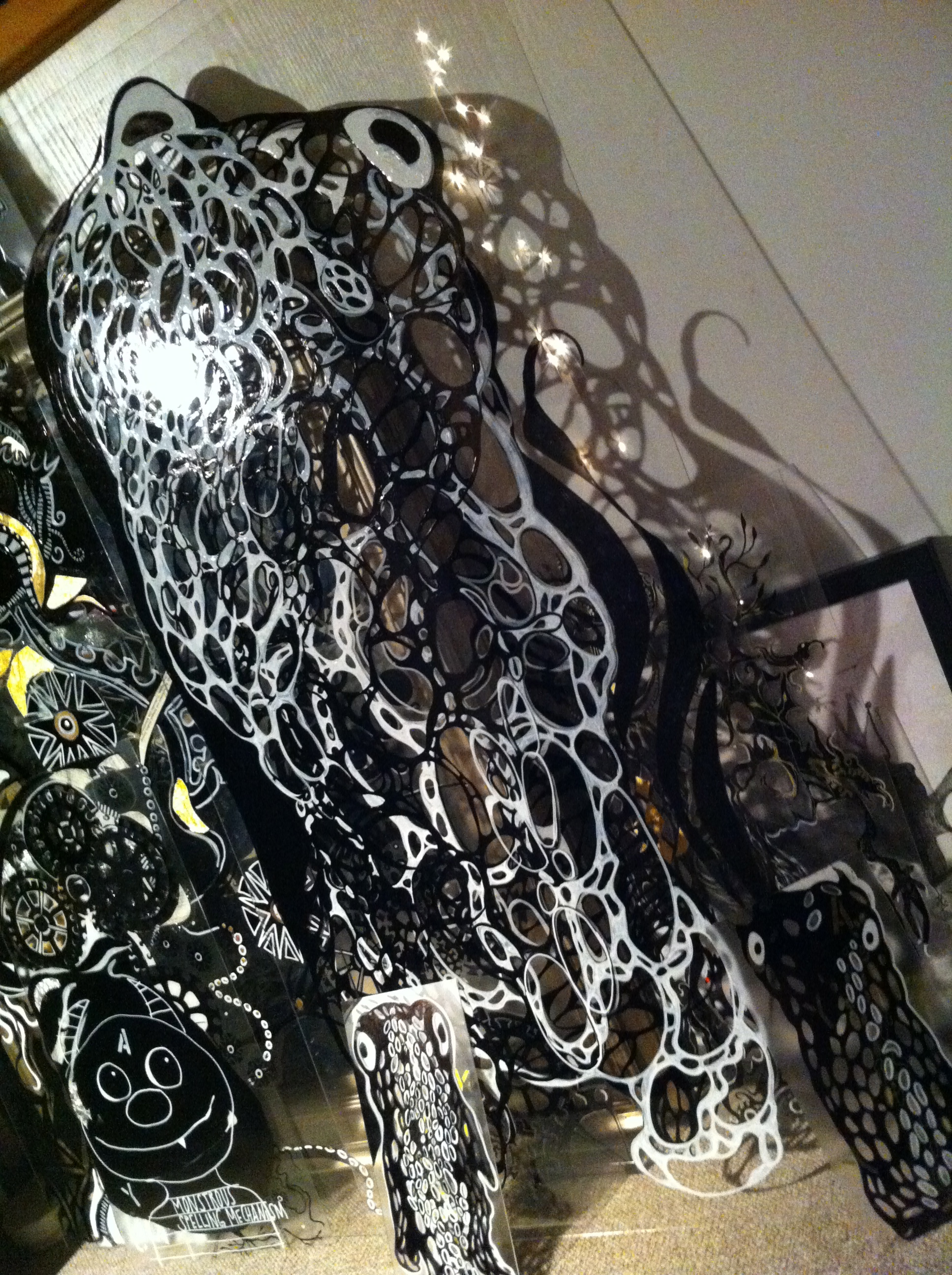
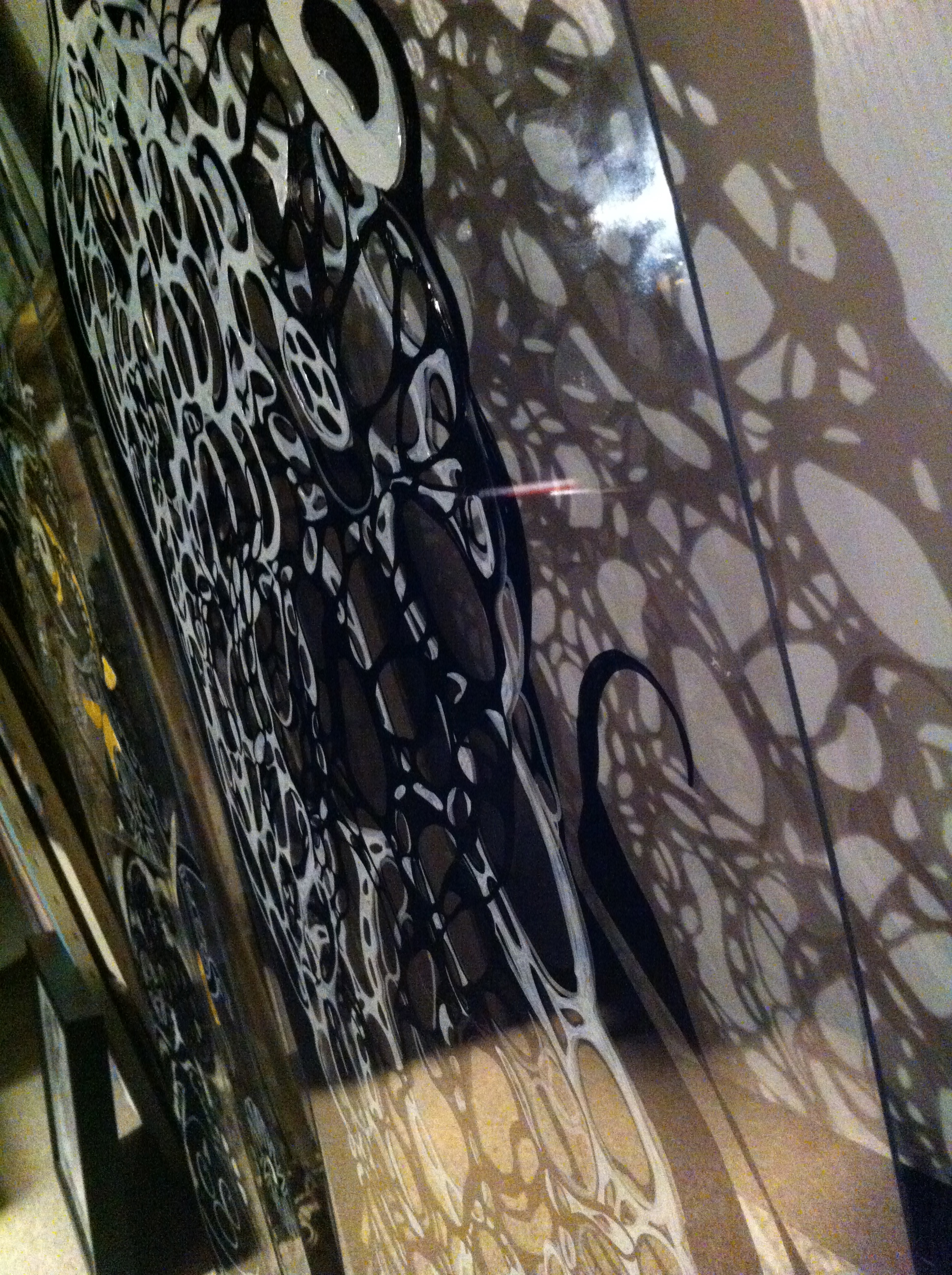
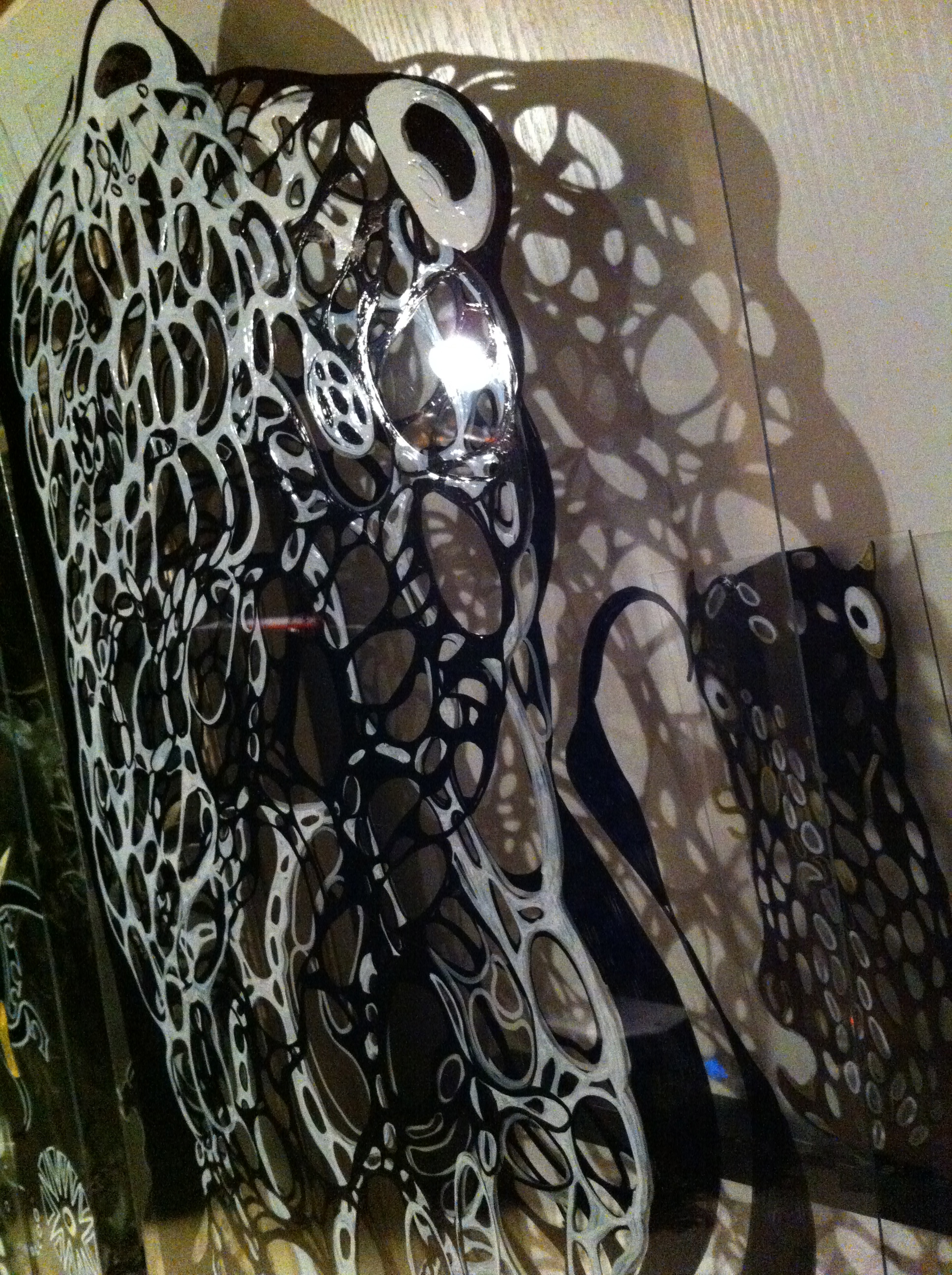
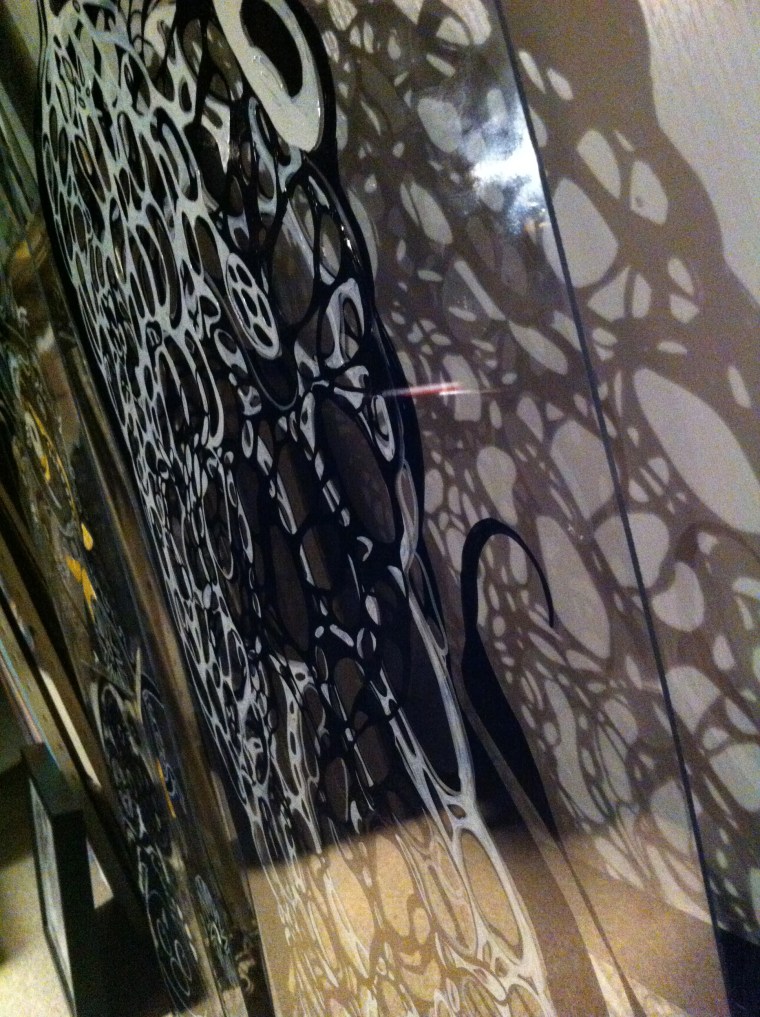
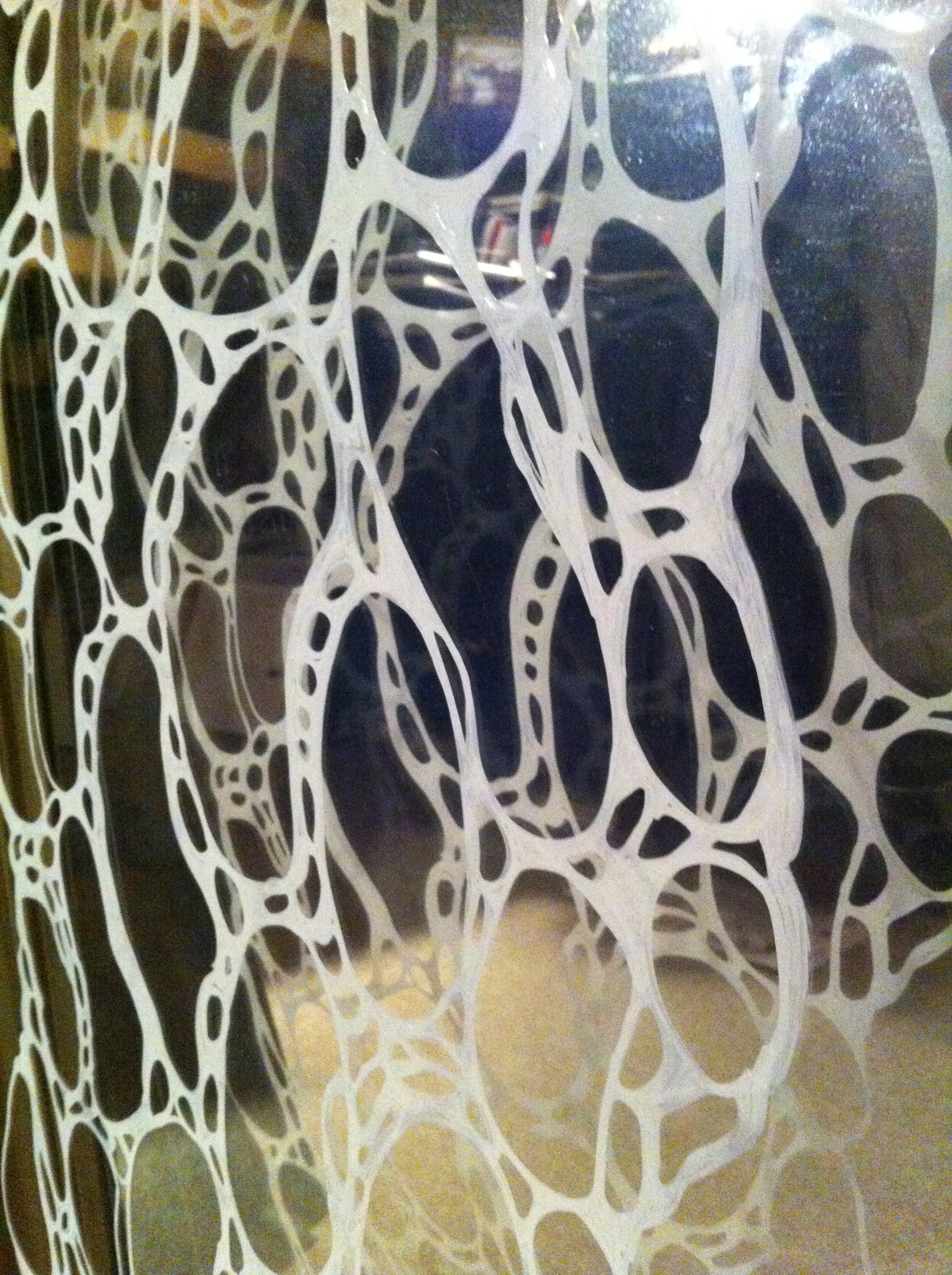
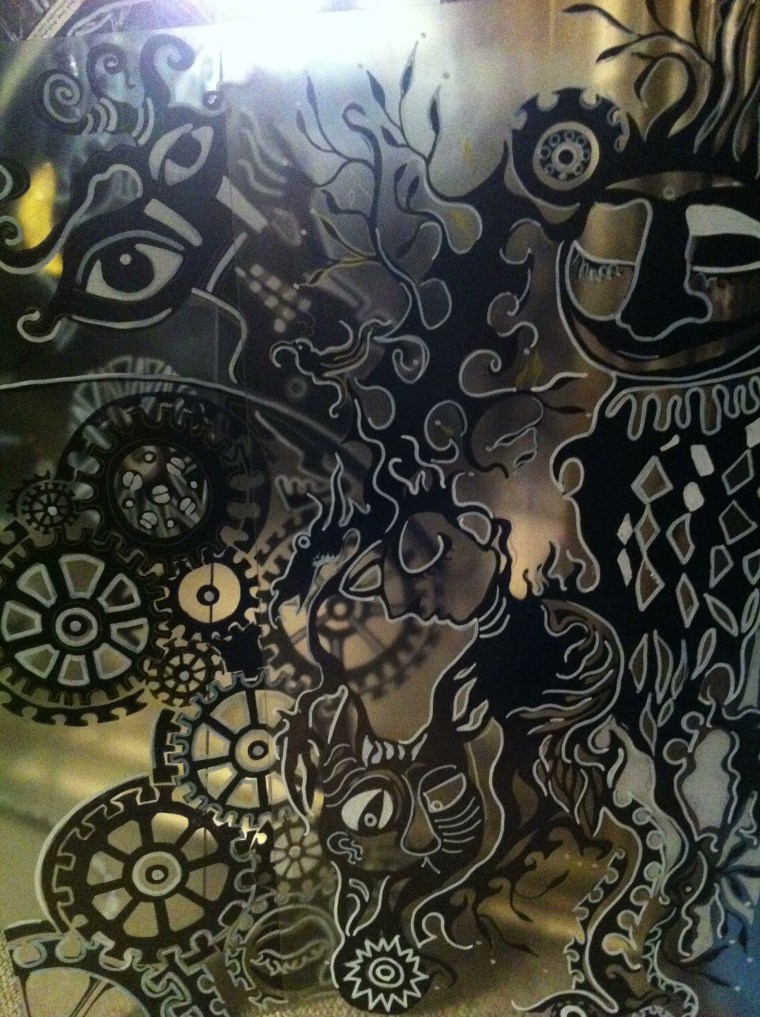
I thought it would take at least two more nights to finish this acrylic sheet but as I couldn’t stop drawing I finished it last night. I drew five layers altogether until I felt more lattice pattern would obscure the interlacing layers (which I drew on both sides).

It’s intriguing that working on a transparent sheet creates a drawing that feels at the same time tangible and elusive.

I think it would be great to multiply “y” further but this time not by adding more layers but by creating additional pieces in the same format. Five to ten sounds good for starters. I have always had a taste for the non-identical multiples in art. By the way, each sheet is about 1,30 m high. But I could also start by using up all the small panes I still have (about eight), drawing layered monsters, then proceed to the larger sheets.

Back to home depot it is …

multiplying y – the next night

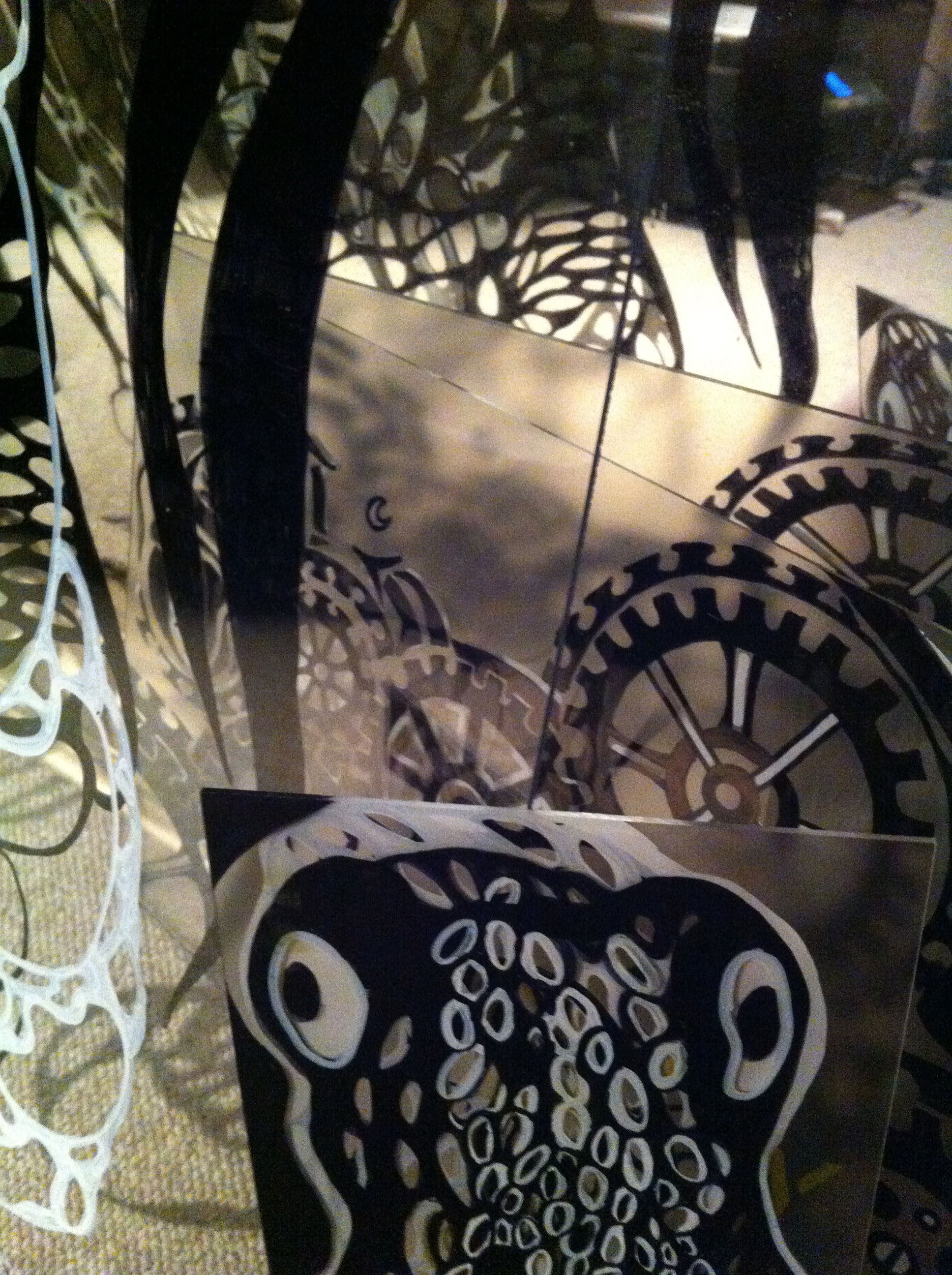
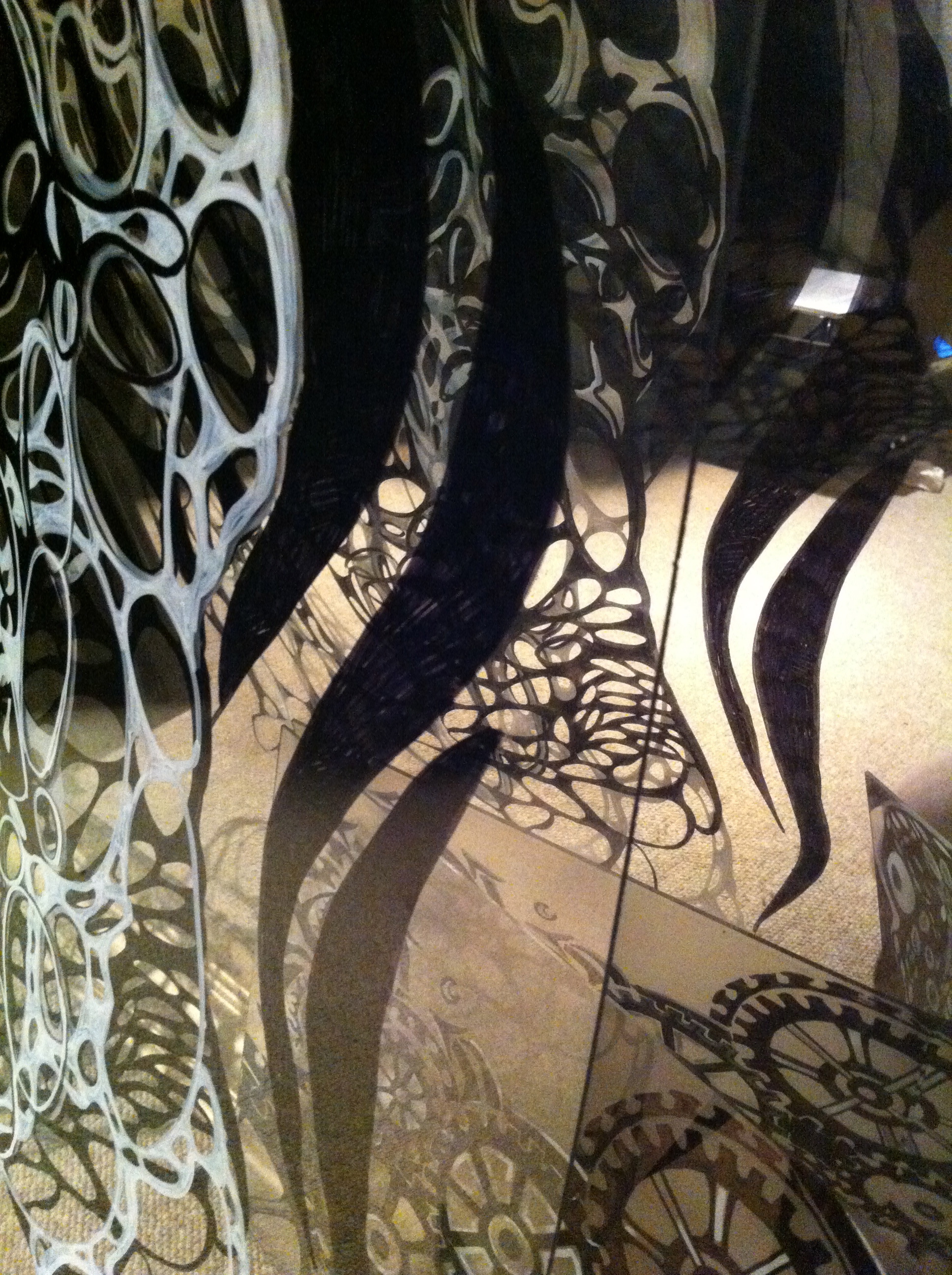
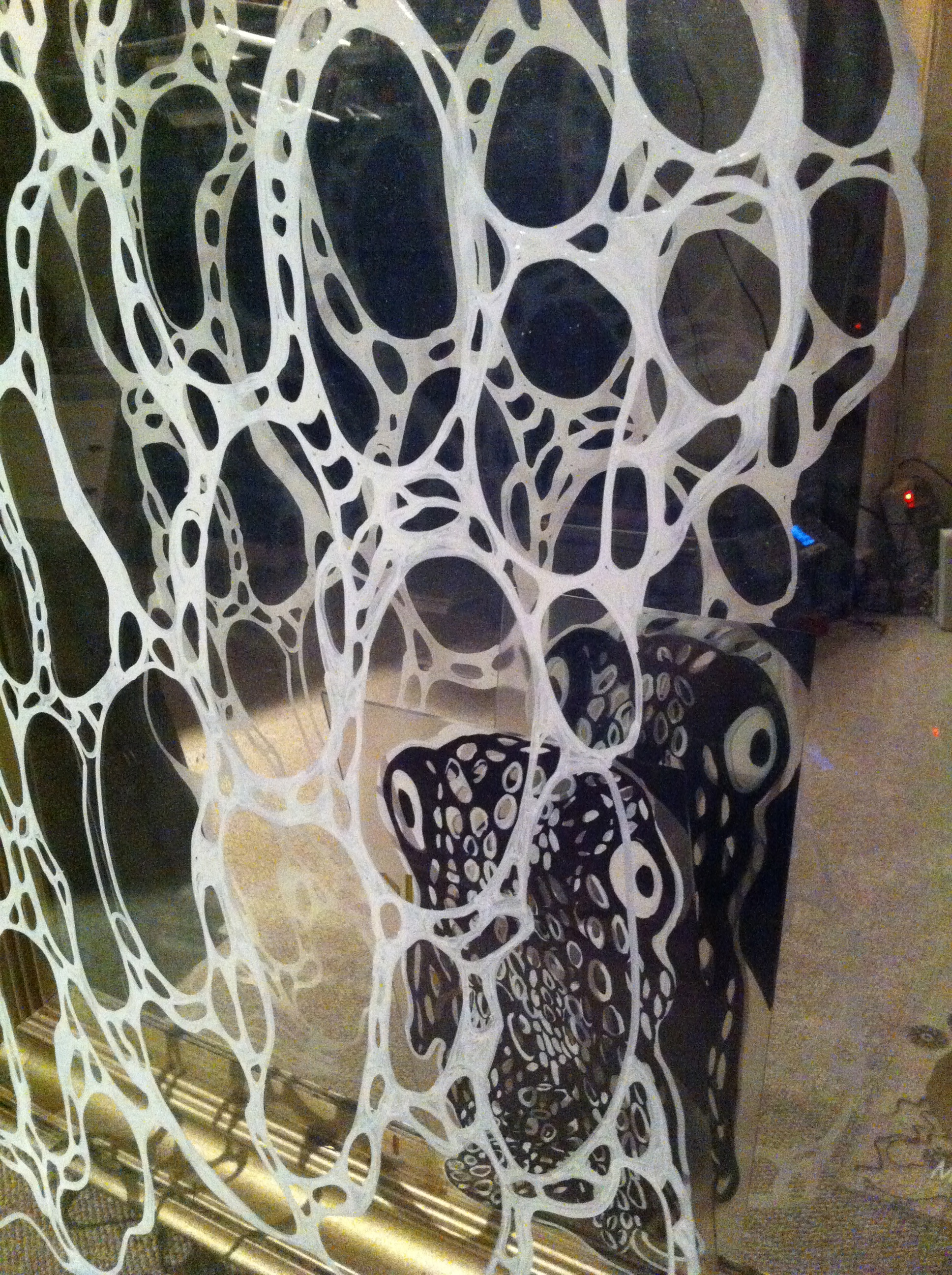
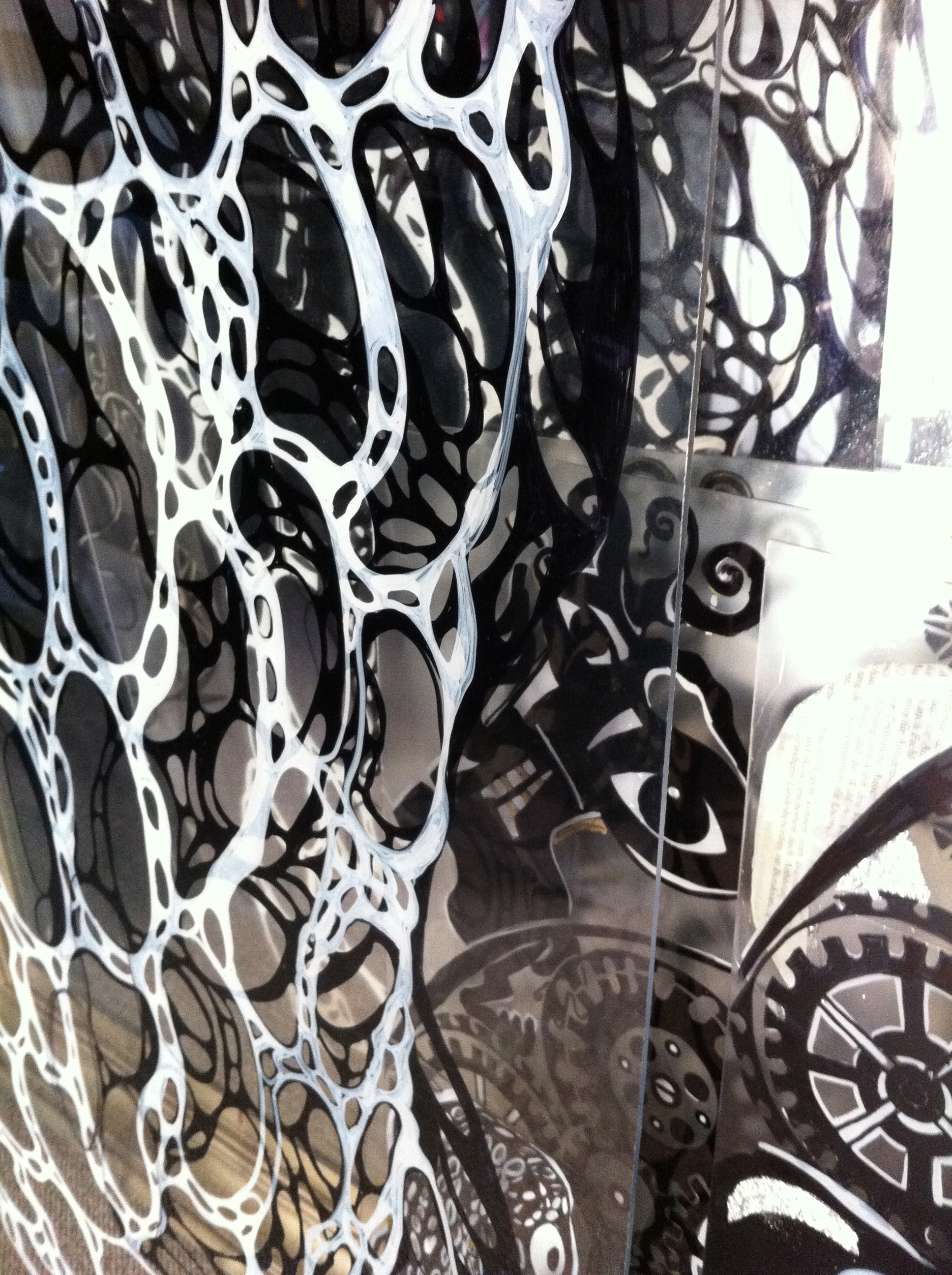
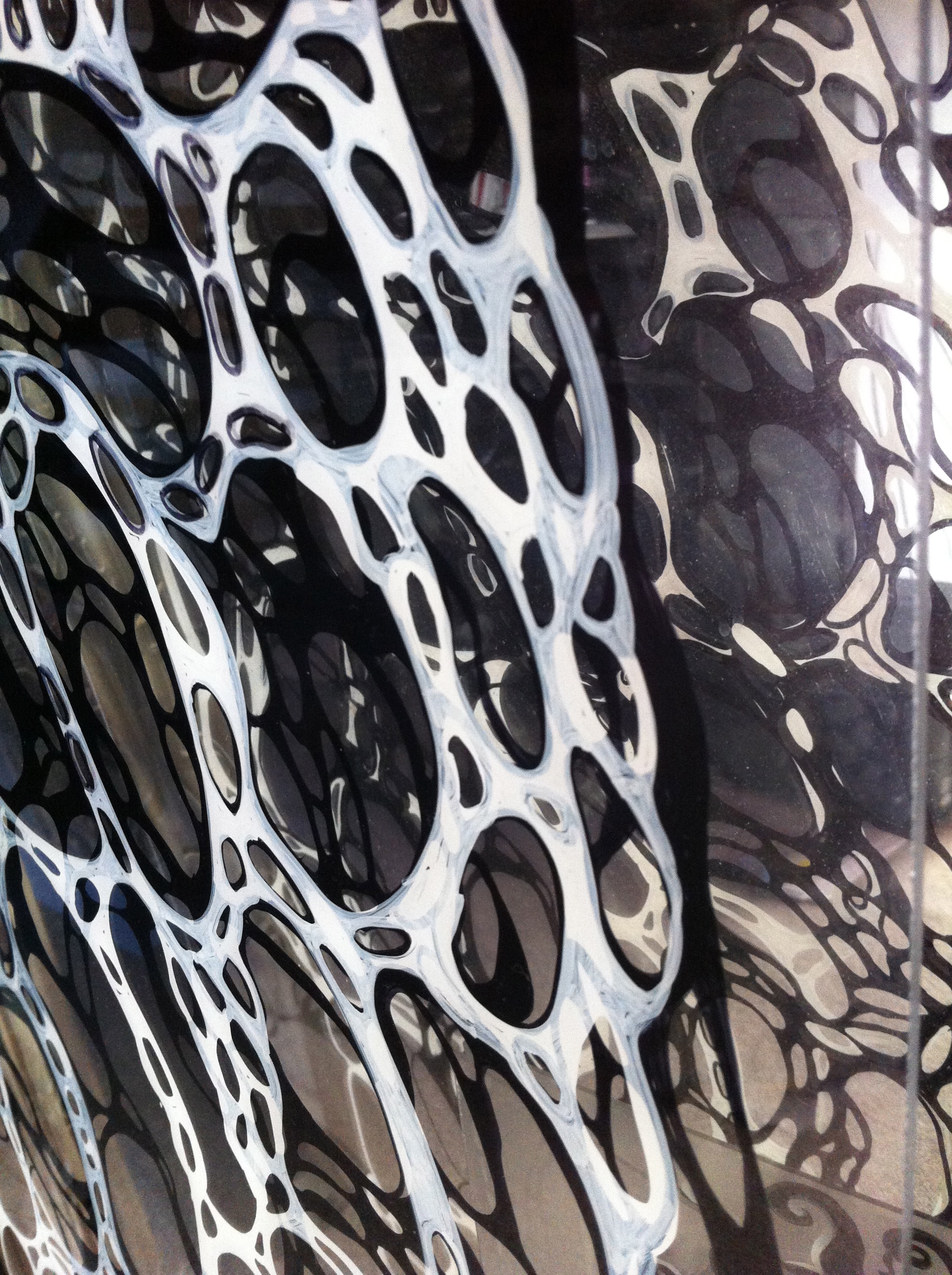
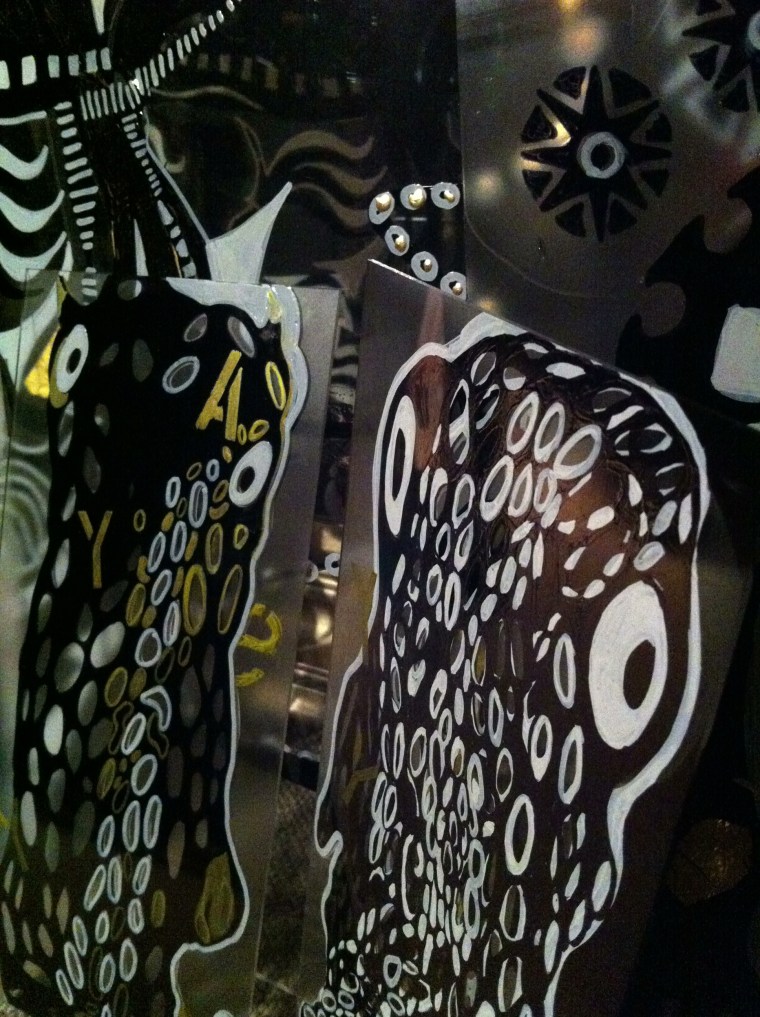
IMG_5722 IMG_5723 IMG_5724 IMG_5725 IMG_5726 IMG_5727So I started multiplying y. Drawing the net pattern on the larger glass panes allows the rhythm of the pattern to emerge. I started with white on one side of the acrylic sheet and drew a loose knit-like pattern. Then I layered black organic lace-work on top. I drew about five hours, then I called it a night. But not before playing a bit with my new building block system of drawings, creating deep, three-dimensional images by arranging and rearranging different elements in front of a big mirror. You can see that the combination of smaller drawings getting “caught” in the net-pattern of the larger pane really works well. I have to finish the larger drawing, I think it will be another two to three nights. After that I want to try a wilder, more impulsive web of lines on a large sheet. What if …

the process of multiplying y – or: the power of “what if …”

Art is a question. Or, more precisely an active research framework where one question leads to another through tangible action. In my case, at the moment, that tangible action is drawing. Every night. On acrylic glass panes.

As an artist you know the question every finished work asks of you. What if? Every night since December 26th I have finished one drawing and every morning I have looked at it and asked myself a simple “What if …?”.

What if, for example, instead of one layer of that net-like surface the creature I called into visual reality I tried two layers, or three? So, that is what I will do the following night. And once finished, I will study it and realize that something happened when I multiplied the net-like layers (actually by five). The feeling that one net-like layer caused me to encounter has deepened. As this is art and not science, this was not necessarily predictable.

But the drawing is still small, more like a study of the possibilities of layering net-like patterns. So, today’s question will be “What if … I took a much larger glass pane?” I still happen to have one of those, by the way.

At some point I might ask myself: Why? Y? Why layer net-like patterns night after night? Why nets of all things? Small. Larger. One layer, Five layers. But asking for the meaning of the pattern or symbols does not follow inevitably as part of the inquiry. I might just as well choose not to ask that question and stay with the mere technical observation.

The one question I never ask myself is: “Does it make sense?” I have been asked that by others, of course. Repeatedly. The implication being: Isn’t it a waste of time?

The answer, to that question is so obvious, that I don’t have to ask myself. (More obvious at least than the right of someone else to ask me why I actively waste my life-time). Does it make sense?

The answer is that if it would make sense in the spirit of that question I would not do it. I would not do it even if I felt like it. Even if I had an urge to do it. I just wouldn’t, if it made sense.

I am like a cartographer, stringing together points on a map. Does is make sense to look at the stars and wonder how far one could go? Does it make sense to accelerate a particle? Does it make sense to be breathe? Rather than to contemplate such a question I ask: “What if.” Many times over. Night after night. Dream after dream.

Art is a question.

… consequently there cannot be an edge over which to lean to catch a glimpse of eternity

English version / German translation

Few travelers have ever reached the end of the world, even in the days of the Aelvor, for it is such an awful long way to go and full of obstacles, too. Yet when my grandmother told me about the Willow as I tell you about her now, it had seemed to me that I almost remembered her as if I had seen her with my own eyes and touched her with my own hands but couldn’t quite remember anymore where or when that could have been.

Of course you know that the earth is a ball and that consequently there cannot be an edge over which to lean to catch a glimpse of eternity. And yet, our elders might not have been as naïve as we are told today by believing that the world is located on a disc and that you can walk only so far before reaching an end. In our hearts we are closer related to ways that must end eventually than the Aelvor were who soberly talked about the eternal cyclic renewal of all times and beings.

Wenige Reisende haben jemals das Ende der Welt erreicht, selbst in den Tagen der Aelvor, denn es ist ein furchtbar langer Weg dorthin, wie jeder weiß, und,  wie es die alten Märchen erzählen, voller Hindernisse und Gefahren. Und dennoch, wenn meine Großmutter mir von der Weide am Ende der Welt erzählte, eben so, wie ich Dir jetzt von ihr erzähle, belebte sich ihre sonst oft müde Stimme und sie sprach so lebhaft und anschaulich, als erinnerte sie eine Geschichte aus ihrer eigenen Jugend, und mir, die ich ihr zuhörte, kam es wirklich so vor, als könne ich mich selbst beinahe erinnern, dass ich den Baum einst mit meinen eigenen Augen gesehen und mit meinen eigenen Händen berührt hätte, auch wenn ich, gefragt, nicht mehr zu sagen gewusst hätte, wann oder wo das hätte gewesen sein sollen.

Natürlich weißt Du, dass die Erde eine Kugel ist und dass es also keine Kanten geben kann, über die man in einen Abgrund stürzen oder über den man  sich auch nur hinauslehnen könnte, um einen Blick der Unendlichkeit zu erhaschen, wie es in den alten Geschichten heißt. Und dennoch waren die Menschen früher vielleicht nicht so naiv wie wir es mit ein wenig Überheblichkeit heute gerne glauben wollen, nur weil sie annahmen, dass die Welt eine Scheibe sei und man nur so weit gehen konnte, bis man an ihr Ende kam. Wenn wir aufrichtig sind, ist uns auch in unserer Zeit die Vorstellung, dass jeder Weg schließlich endet, immer noch vertrauter, als es die Geschichten der Aelvor sind, die nüchtern von der Unendlichkeit und der zyklischening, Wiederkehr aller Zeiten und Kreaturen zu erzählen verstanden.Bild

Art. 1 GG The dignity of a person shall remain untouchable.

Art. 1 GG The dignity of a person shall remain untouchable.

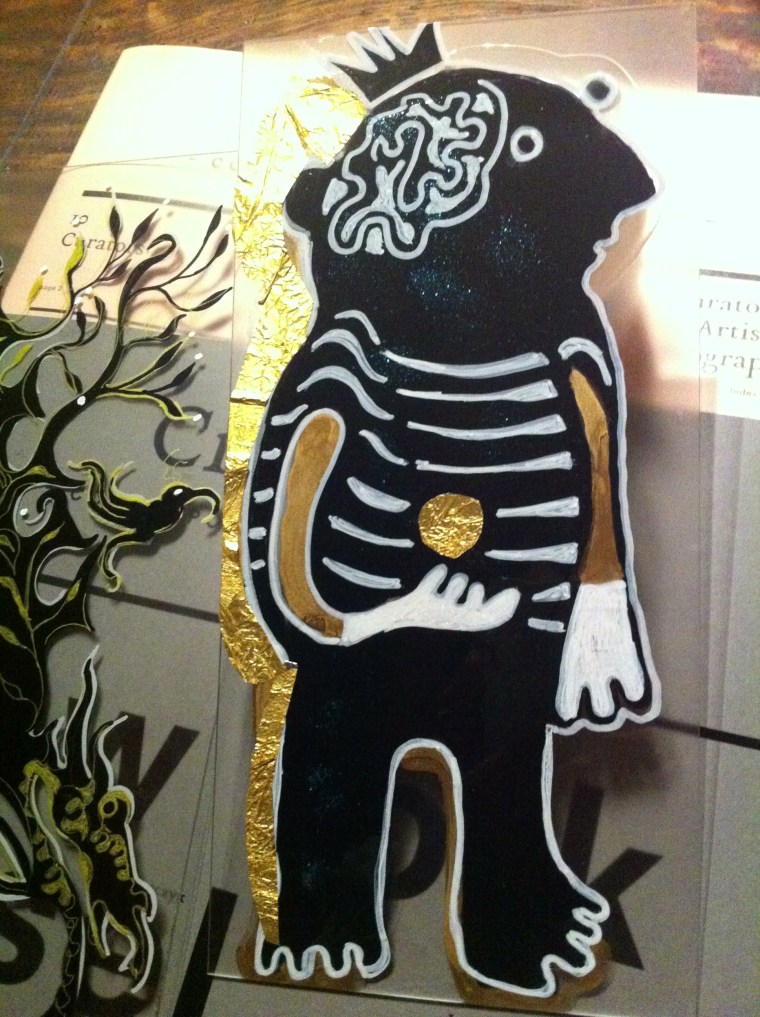
The first article of the German Constitution. Actually the wording in German (“ist unantastbar”, tranlslated: is untouchable) could be read in two different ways, one being “it cannot be touched”, the other “it shall not be touched”. Last week, in my legal class, I started a discussion with my students about whether human dignity can actually be denied or be broken (by the state, an authority, a group etc.), or whether there might be what could maybe be called a core of human dignity that remains untouched no matter which forces are used against it and under which circumstances a person is forced to live. No wrong answers, a strong discussion ensued.
It is a strange reality that humans are bound to such an abstract idea, dignity, something that is expressed in and through circumstances of their lives but also seems to reside deep within them, that they are bound to this in a way that life will seem desirable no longer once “it” – dignity – is effectively denied and that they, we, are incredibly inventive to defend at least a display of individual dignity in the face of even overwhelming adversity.
This illustration seems to lean towards the interpretation of human dignity actually being the unchangeable core of an idea, located in the brain but held by our hands (actions). I do know it can be denied like but I believe that it can’t be broken. The naive quality of the drawing insists on the relevance of the question in the face of a reality that is unforgiving and not as much in need of such contemplative studies and pretty pictures but of real change.

no fear

no fear

The title offers itself as an afterthought to the completed drawing. Or: almost completed as these are works in progress. “No fear” seems like a big title for such a pleasing drawing but it actually refers to the relative beauty of the subject – very unusual for me. I do have a deep appreciation for the seemingly ugly, small, cheap, scratchy, discarded quality of objects and ideas, for those scraps and pieces deemed not to measure up. I am deeply suspicious of the superior quality of a single piece of work (not mine), of the brilliance and self-sufficiency that is in no need of a contribution by whoever may chance to look at it because I feel that our visual environment is saturated with ideas that are complete and in no need of further discourse, thereby actively discouraging original creative failure. Seems at times we all live in a society of mad overachievers. So I love the frail, the ugly to the point where I censor my own work when it’s getting too pleasing. But these drawings I have let go uncensored by myself, not even knowing why. Maybe I am in need of some beauty. And far be it from me to think that these are perfect. Maybe quite the opposite. So for a while, I will be like a child at play, drawing and arranging these small characters, without fear that they shall be considered too light. Let there be some light ….