the nonsense dictionary of lifeforms on Helium-3 and other insignificant by-products of music-poisoning

English: Spectrum of helium
English: Spectrum of helium (Photo credit: Wikipedia)

or: when will we start to harvest the moon …

surprising studies show that if the anti-venom of bureaucratic correctness  is not injected in time and the victim instead continues to breathe slowly through the nose, the seemingly alarming condition develops from a hallucinatory episode to a temporal ability to find one of the hidden doors into the helium-3 universe. the first sign of this conversion from the three-dimensional limitation into a full comprehension of the “it” including helium-3 is a steady stream of blue light from the nostrils. this oscillating string of conscious matter should not alarm the victim nor bystanders as it is not a loss of matter but a reconfiguration of the same. slightly nasal intonation after readjustment not uncommon but overall harmless. for reassurance the progress of the victim’s condition can be  measured at a frequency of 8.665 GHz (3.46 cm), which is emitted naturally by ionized helium-3. the comprehension of the fact that most of the matter in the universe is non-baryonic, that is to say not made of any subatomic particle that include neutrons and protons, and that this matter is thought to be the primary source of gravity recording the constellation of the universe like the grooves on a record record a song, allows the observer to deduct from the state of rapture that the poisoned mind is – for a moment – privy to nothing less than a fusion of dark matter with consciousness, the first music of time.

an intervention at this point seems not indicated.

from: the dictionary of lifeforms on Helium-3 and other insignificant by-products of music-poisoning

moonflower

Canis Major as depicted in Urania's Mirror, a ...
Canis Major as depicted in Urania’s Mirror, a set of constellation cards published in London c.1825. Next to it are Lepus and Columba (partly cut off). (Photo credit: Wikipedia)

“Your fist like this”, she said, “covers about 10 degrees of the night sky.”  She moved my hand slowly over the dark water and spoke in her methodical way, no use to interrupt her. “20 degrees south-east of the belt of Orion, you see, there is the brightest star in the night sky, right in the constellation of Canis Major.” She waited for a moment for me to catch up with her. Our entwined hands travelled over the night sky and stopped. And there it was, deep underneath us, the brightest star of the night sky, as far as I could see. “Do you see this star?” she asked. “It is called Sirius. It is 23 times more luminous than our sun, twice the mass and the diameter of the sun. It is only 8.5 light years away.” The way she said “only 8.5 light years”, it sounded as if she was talking about a Sunday picnic destination. It sounded like: We could take the bike. It’s only 8.5 light years away. Before I had a chance to point that out to her, however, she had started talking again, and almost without warning, though in answer of my question, switched from her facts, from degrees between two points of light in the celestial sphere, luminosity and brightness, and mass of celestial objects, to a startling revelation.


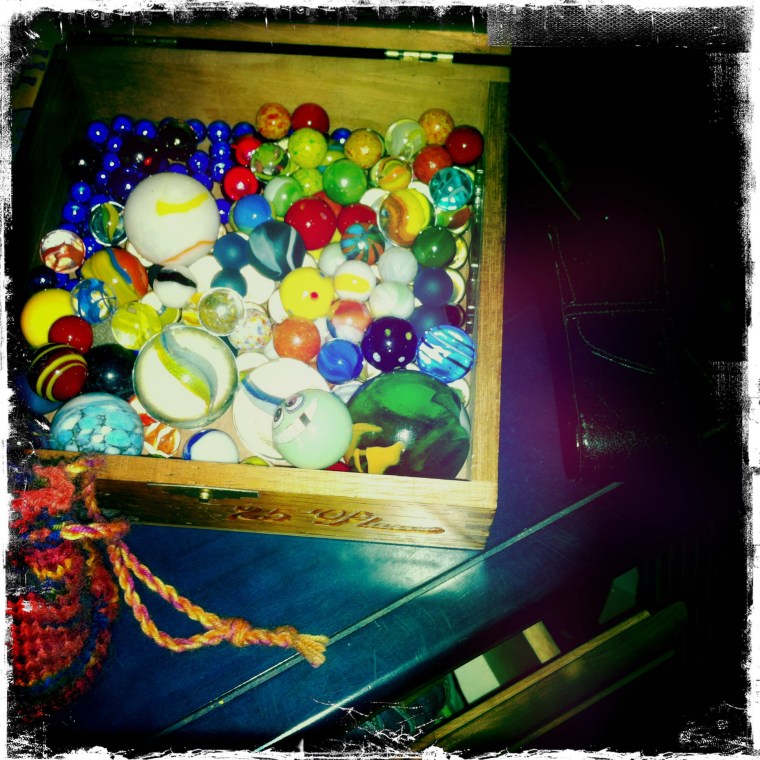
a galaxy of marbles

galaxy of marbles

Marbles are wonderful and mysterious. They are simple, fit in any pocket. You can take them with you wherever you go and start dreaming.

You see, in this marble I hand to you today, there is a whole world. If you can’t imagine that, if you object: ”But it’s much too small, how could there be a whole world in it?”, I would answer: “Just ask yourself how our planet Earth looks like for a voyager in space, like the astronauts of the Apollo Mission who eventually landed on the moon.”

Small. Perfectly round. Mysteriously blue. From the distance our planet is a beautiful marble in space. You wouldn’t know of the uncountable stories that take place there every day, so serene and peaceful does our planet look from not all that far away.

Yet you know better. Think of all the things that happen to you every day, add all those that you know happen to your friends and family, and their friends, and go on, and on, until you think of over 6 billion people, the whole population of this amazing, beautiful planet, until you get quite dizzy and confused with trying, and then you will have an idea how relative the words large and small are.

So, if you feel lonely, or bored, or if you have to write about something for school but don’t know where to start, or if you want to write or think about something no one else has thought about before you, or if you just desire to dream yourself far away from everything, take this marble, roll it in your hand, feel its pleasant weight, hold it against any source of light, a lamp, sunrays coming in through the window on a November morning, the full moon in a bright winter night, and you will find your story right there in your marble.

And it will be uniquely yours for that is the mystery of marbles: like humans from a distance they seem the same but upon closer inspection there are not two that are exactly alike.

And more, even if you cannot look at the little glass orb, after a while you will be able to imagine it, and the stories will come to you through the window of your open mind, from far away, from the gleaming galaxy of the marbles, way out there, right inside you.