Page 2 of 2

organic sources of light

“Recordings of what?” I inquired. His smile faded. Again it seemed like he was listening to my voice retreating in the library. “She said you were smart,” he remarked, more to himself. I was not sure that was supposed to be a compliment or a reminder to himself. “Who said?” I cut in. I had the uncomfortable feeling of him looking at me again and I felt reprimanded without him saying a word. “Sir, please, who said that?” I rephrased my words.

“Never leave a question before it has been answered,” he advised me, not answering either one of my questions. He fell silent.  I stared at him, then lowered my glance, then looked up at him again. He could sit perfectly still, looking very much like the archetypical image of a blind man. It seemed to me, again, that I noticed more visual detail than one should notice. More than I could process. The crease of his pant legs, the way the fine wool fabric folded itself, the nuanced shadows in those folds. His white, chiseled hands, holding on to the walking cane even as he was sitting. And yet, despite or maybe because of the rich details  I had an increasingly hard time focusing on him. It was like reading a book when you are very tired already and you can’t focus on the words. You are still reading them mechanically but you do not get their meaning. He faded or rather he diminished in size. He diminished in size but gained in clarity. I wanted to protest. I had a million questions. He looked like an illustration, I thought, feeling very tired, like one of my mother’s illustrations, done in a myriad of very fine, sharp lines. And each of these lines was emanating a fine, very precise, white light.

coloring idaho

My mother was busy preparing dinner and answering questions my sister had while sitting at the big wooden table and doing her homework. This evening she was coloring and cutting out the states and gluing them in the right place on a map of the US. Both my sister and I hated coloring in worksheets and my mother had brought out her expensive Sennelier pastels to persuade my sister to employ some effort on the task. The map as far as it was completed looked like a beautiful velvet patchwork quilt. You can’t achieve that with your Crayolas. I wondered whether her teacher would be able to appreciate the difference.

Montana was already pasted in its proper place. It was colored in layers of gorgeous deep Indigo and now, with a vengeance, Phoebe was wasting pale Vermillion Orange on Idaho. I sat down at the table and watched her. There is something nice about a little kid coloring in even if she detests it. My mother walked past me and ruffled my hair in a distracted way. It was just as much part of her dinner routine as cleaning dishes right after using them. For a moment I was back in a comprehensible, friendly world. No opportunistic cannibalism, no aliens. Phoebe pasted Idaho on to her map and contemplated color choices for Washington State. “Why do they have to be different colors?” she complained but her heart wasn’t in it, you could see that she did enjoy choosing a new pastel stick. According to my mother you can never work with materials that are too good and you should always strive for beauty but I still felt a bit doubtful whether you actually needed art pastels to complete this kind of homework.

Phoebe still had the whole west coast and Alaska to color and paste and she grunted disapprovingly as she studied the worksheet after cutting out Washington State. Washington was going to be Cinnabar Green. I liked the way she held her tongue between her lips when she had to cut something out or color something in. She looked a lot like Plinius, our cat, after his dinner when he sits down on the table and probably contemplates dessert choices waiting outside in the dark beyond the kitchen door. Phoebe looked like that whenever she was focusing on something. Right now she smeared Cinnabar Green all over Washington. The pastel stick made a fat, smacking sound on the paper. At the kitchen bar behind us my mother cracked an egg. The splintering  was very clear and pleasing to me. I thought that recently I had been much more perceptive to small sounds. Only this morning on my way to school I had stopped to listen to the sparrows hopping over the path to the front door of our school, their tiny claws scratching the bricks. How much does a sparrow weigh? 35 g?

Phoebe looked up. “Mommy?” she asked. My mother looked up from her mixing bowl. “Which language do they speak in California?”

perfection and love

When the boy was about five, old enough to overhear grown-up conversations, Iris had told him in carefully phrased sentences that she and her husband were not his biological parents. She told him that he belonged to them and that they considered themselves to be his parents just as if he would have been born to them. He had listened to her rehearsed words with an expression of inward contemplation. She had looked at his face while she was speaking, overwhelmed by the insufficiency of her own words, their stupidity even. How was he supposed to know what the term biological parents implied? When she had finished nervously and had braced herself for questions or tear or anger or resent (even though she could find no reason why he should feel resent against them learning that they had taken him in to be their son), he had stayed quiet for a while and they had looked at each other as two grown adversaries would, appraising the other’s strength and resources. Then, suddenly, his face had lost the frozen expression, and he had smiled at her, an overwhelmingly bright smile, and had asked her whether he could go outside to play with the mud people.
If they fullfilled their parental obligation towards him without ever truly finding the kind of love a parent might feel for a child, he did love them as a child loves his parents without contemplating nature, extent or meaning of his love. If he ever felt that he was missing something he never betrayed such a feeling through his behaviour or his words.
Sometimes there was a strained look in his eyes when his father left the room as if he recalled being left behind which of course was impossible as he had only been a few hours old when the custodian had found him. At other times Iris caught him looking at her inquiringly. But whatever question he was expecting her to answer he never put it in words. How could they have suspected that there were moments when sudden terror would overcome him, like a feeling of unmendable loss, how could they have known as those were moments when he was at his quietest, looking at a page in a book, an illustration, a word, waiting for the moment to pass. In time the random words he had stared at when the feeling had overcome him came to stand for the darkness. Solanum tuberosum. Common potatoe. Dampness and desperation. Polygala Alba. Milkworth. Sudden death. The word stood for the thing as much as the thing stood the word, even the spoken word. He saw the lines of letters when these words were spoken, and the letters formed the words in an inexorable logic and the words frightened him. The feeling never lasted for longer than a few seconds, seconds that questioned his whole existence and spelled extinction. It was not in his nature to display even this intense fear, he was separated from it as if it happened to another person, and the stillness in his own heart prohibited to revolt against the stranger who took over a five year old to feel what the child would have had no reason to feel himself. Unless memory holds those first few dramatic hours when it is decided whether we shall live or die before knowing even our parents. It was as if he had to carry a glass full of water without spilling a single drop – he literally held his breath while he lived ever so carefully. Only that he didn’t hold a glass but that it was himself who contained something that he was afraid to spill by sudden movement.
Maybe it was his composure that made it so difficult to love him. It didn’t help that he was completely self sufficient. Or that he did not seem to be aware of the extent of their generosity in accepting him as their son. And as it is difficult to love what is complete in itself and beyond the need for protection, it is equally challenging not to resent the person, even a child, who receives a gift with an air of leisure acceptance. He certainly did not behave as if they owed him any care but it was as if he accepted the gift of their being his parents as a favour and generosity towards them.
«But after all», Iris wrote in her journal «isn’t it quite normal that children are not grateful for their existence, and isn’t it indeed true that they are a gift to their parents? » And yet it felt as if there was a mistake in her observation. If there were none of the disturbances children will cause willfully or by the pure fact of their existence, there was little laughter either. Disturbances of the kind that children cause shake the core of life and make it vibrant. The average child will break the rules, not keep them, and this unwillingness to obey rules as much as it may annoy and exhaust a parent lies the true reason for love. We cannot love what follows us blindly, in our hearts we want to be reminded that there is life outside the prison of our self imposed rules. We do want to laugh at ourselves and at the world that we have build and have considered good while we knew better. And yet it is almost impossible to admit not to love someone due to the fact that they are – perfect.
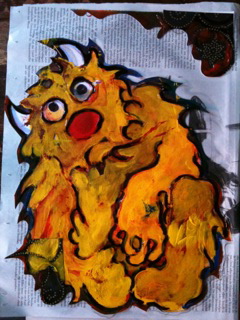
night watches

acrylic and mixed media on poster board, 2011

That night I kept watch. My journal lay open on my desk but I mainly just looked at the small breathing forms of the hatchlings. The rest of the aquatic doodle bugs continued their dance. I had switched off all but a small desk light, barely enough to illuminate the surface of my workplace. When I looked up the darkness in front of my window seemed impenetrable for a moment until my eyes adjusted to the night. The rook was still perched on a high branch of the acorn, solemnly keeping watch with me. I knew that my sister was probably asleep by now but that my mother would be painting until the early hours.
Keeping watch. It was strange to be quiet, just watching. It occurred to me that most of the time we are actively doing something, except for the few moments when we are waiting in between scheduled activities. But even waiting, to be precise, is a form of activity. It is seldom that we just empty our minds. I said I was keeping watch that night, and that was true, but I wasn’t really waiting for anything to happen. Of course I expected the hatchlings to start moving around in the tank at some point, but I was not impatient for that moment nor was my wish to see them swimming the reason for my sitting at the desk. There was a moment when I realized that I was not, indeed, waiting. There was something else I had to do. I had to try to comprehend the reality of what was happening right here, in my room, on my ordinary student desk, before my very eyes. And in order to understand that this was real, not a fantasy, not a dream, I needed to sit still and open my mind.
It is difficult to describe how time changes when you stop. Just stop. I thought then I knew that time was space, a blue space in which I was suspended like the mermaids in their green world. Time was a wide room with neither up nor down, neither front or back. As I sat in the night, the world that was not human started whispering in a multitude of voices. I thought of my little sister. Did she still hear these voices? Was she awake to all of this?
I listened to the slight hissing sound the radiator valves produced, to the occasional car engine, I listened to the night in front of my window, the rustling of branches, I thought I even heard the rook shifting feet in its watchful sleep. The red stone in my tank glowed silently, and even the silence had a sound to it because I was in the silence.