Page 2 of 4

One second of eternity at Lake Willoughby
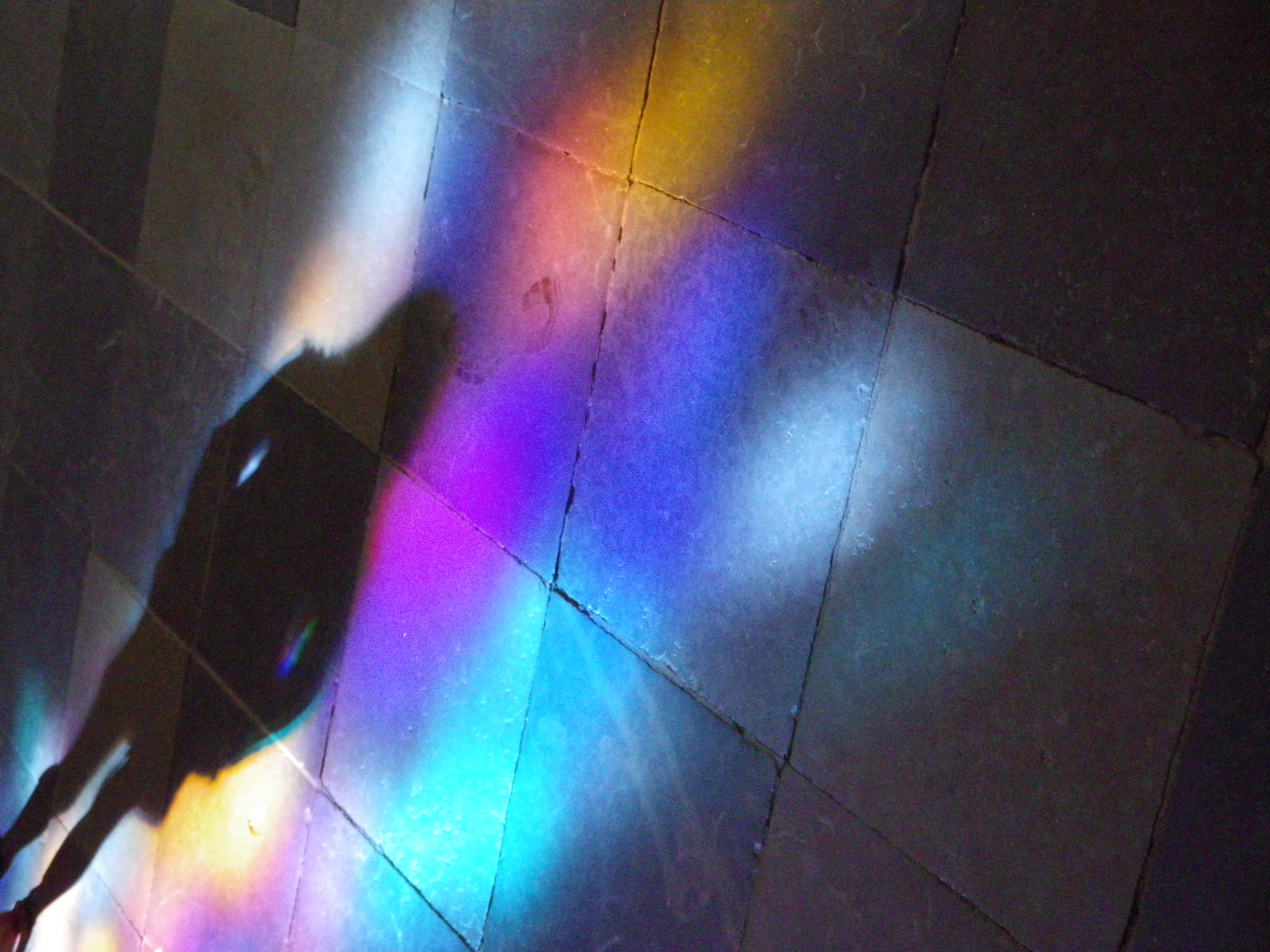
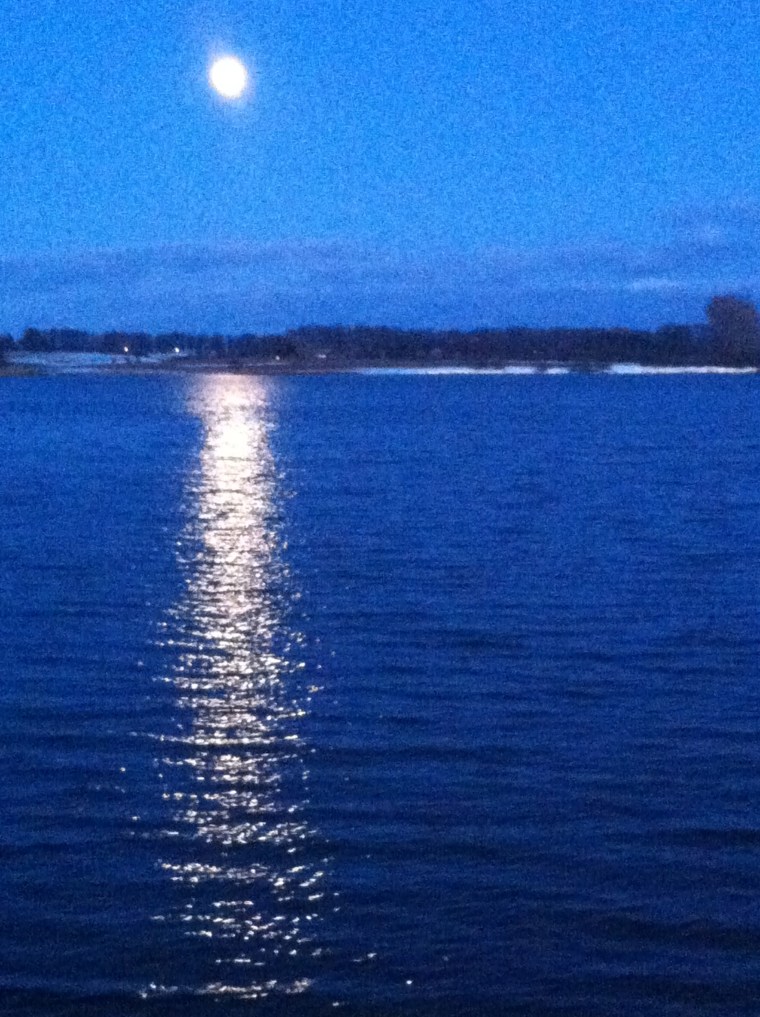
IMGP1041Lake Willoughby, grated into plutonic rock by a deep glacier, is a 300 feet deep, water filled scar between two mountains with biblical names, Mount Hor to the West and the Eastern Mount Pisgah. If you stand on the North Shore of the lake, it actually has the appearance of a deep fjord, though there is no outlet to the sea. Instead there is said to be an underground aquifer connecting the basin of Lake Willoughby to that of another eerie body of water beyond Mount Hor, Crystal Lake. In my mind that acquifer had the form of a water filled cathedral, in my mind I saw swimmers gliding swiftly through a space abandoned by a people even older than they were. There was an incredible, inexplicable light the way I imaged this. You have to keep in mind that I imagined this within a dream without actually seeing it, two steps down and under. Even though my sober mind took offense with the inexplicability of the light.

While I was thinking and conjuring up images within the dream I stood at the waters edge of the lake as I had done many summers and the water exactly like the water of lake Willoughby as I remembered it acted like a mirror. The surface seemed to be like a sheet of glass of finest quality, separating the clearly visible underneath from the still world above, and the mirror image of this world like an incomprehensible fourth dimension in between both worlds. Again I saw the forms in the distance, gathering around precariously piled up, submerged boulders. Each winter these boulders avalanche down Mount Pisgah and roll into the lake to form the outline of an inaccessible stone city, creating an intricate mountainous terrain. I wondered how long it would take to fill the deep ravine of the lake with boulders and fleetingly thought of the old story about the small bird wearing away a mountain with his beak to mark the passing of the first second of eternity. In my dream I had this thought.
The Twelve Nights of Christmas, night ten: Raw data or further reflections on the nature of Borges Library

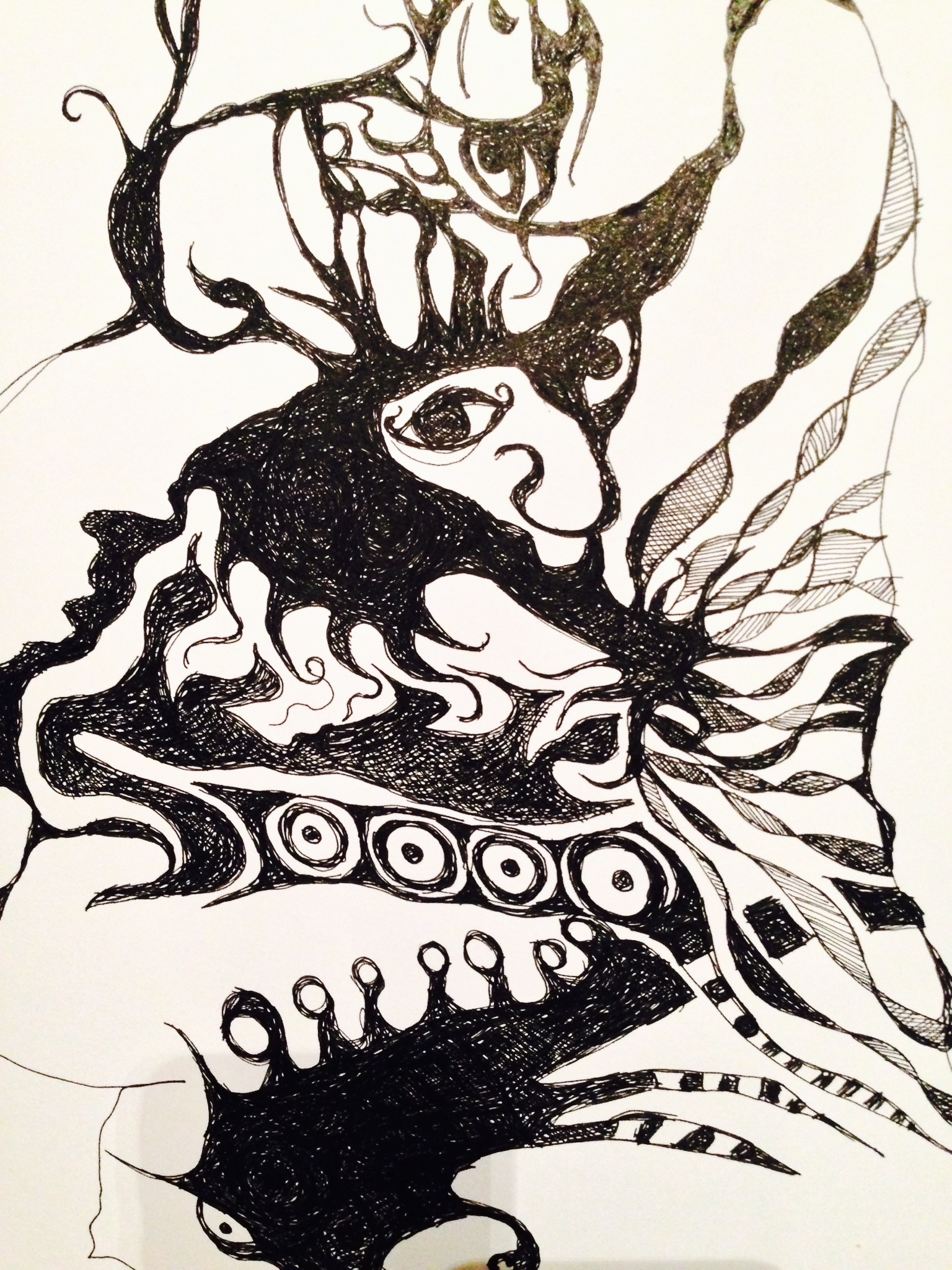
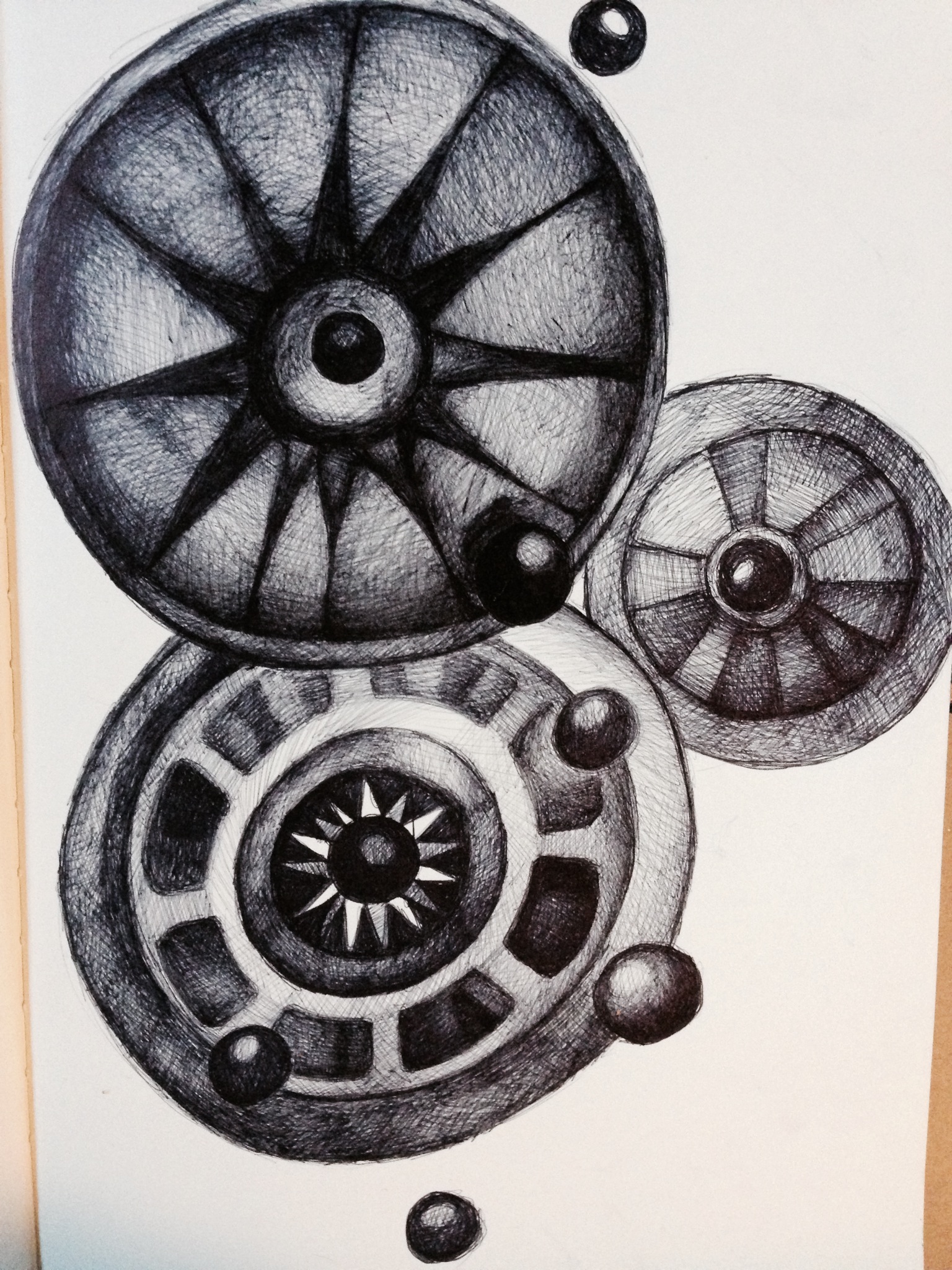
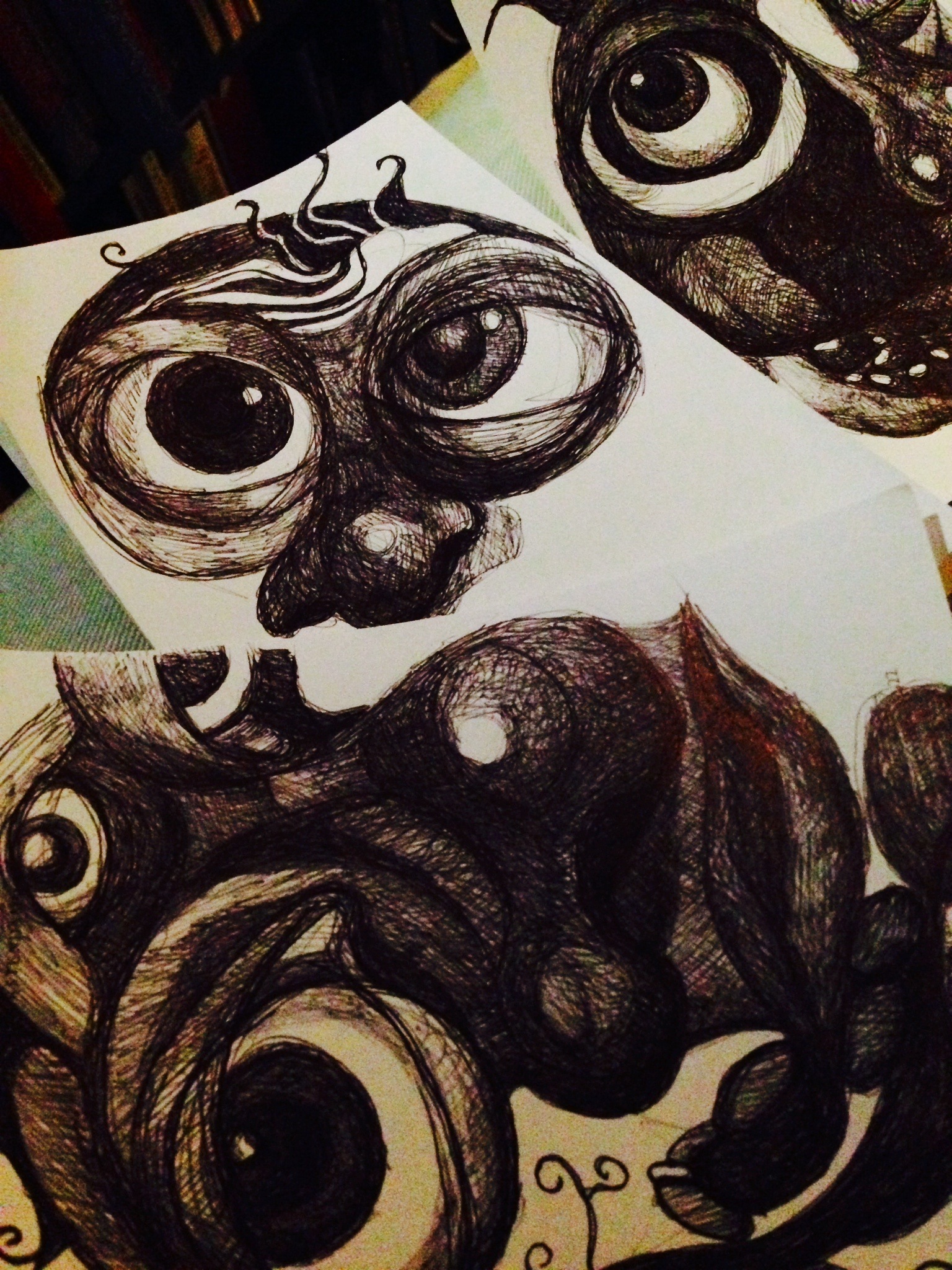
ImageI’d like to think of drawing as of transforming raw data with my pen to “mean” a specific thing and not another though it is not in the nature of data to actually be one specific thing to the exclusion of all other possible “things” (meaning, manifested form, reality) in all their variations (written and unwritten) any more than a child’s building block used in a fleeting structure soon to be knocked over is identical with that intended structure’s purpose or “meaning”. A building block stays a building block, a zero stays a zero and a one stays a one no matter what it is used to communicate. It assumes  a participating function in the meaning of one thing ( and not another ) but it also creates that one thing without adopting its separate ( separate from other possible thing’s) nature simply by describing it.  The “thing” actually has no separate ( from other possible thing’s) nature – it is but a description of the configuration of the raw data (building blocks) at a specific moment from a specific perspective. So that, at any given moment, any thing, rearranged, could be (and is) any other thing, idea, let’s call it “book”, existing or non-existing, written and unwritten, in all possible variations. I assume that would upon further reflection have to be one of the conclusions drawn of the cosmology principle but I am getting a bit out of my depth here.

All we ever do in life is  to assume a specific perspective to describe what is really a homogeneous distribution of raw data – each one of us is, with other words, but a specific, erratic close up view of that homogeneous distribution. We have no separate nature. The “separateness” of our nature not only of one thing to the exclusion of all other possible things but also of the experiencing “conscience”, the “I” to the exclusion of all other possible perspective’s (you, the other) is clearly illusional, possibly delusional.

someone’s watching you – privacy of data, an appeal / round two

Image 5

“Writers must oppose systems. It’s important to write against power, corporations, the state, and the whole system of consumption and of debilitating entertainments. I think writers, by nature, must oppose things, oppose whatever power tries to impose on us.  … You know, in America and in western Europe we live in very wealthy democracies, we can do virtually anything we want, I’m able to write whatever I want to write. But I can’t be part of this culture of simulation, in the sense of the culture’s absorbing of everything. In doing that it neutralises anything dangerous, anything that might threaten the consumer society. In Cosmopolis Kinski says, “What a culture does is absorb and neutralise its adversaries”. If you’re a writer who, one way or another, comes to be seen as dangerous, you’ll wake up one morning and discover your face on a coffee mug or a t-shirt and you’ll have been neutralised.” Don DeLillo (Panic #1, Nov. 2005, pp. 90-95.)

And is it not at the same time a cynical paradox and the hybris of writers, artists and maybe even lawyers, yes, now that I mentioned it, certainly lawyers as well, that in striving to be effective, successful, sharp, persuasive, unveiling, exposing, revealing, uncovering the workings of the machine we also strive for the kind of recognition that neutralizes our very effort. This is still the romantic idea of the individual rebel, the genius writer, the brilliant artist, a sly title afforded with societal approval by the very system that is being accosted, criticized and opposed just because this honor neutralizes, even castrates the very effort it lauds. Don DeLillo writes accordingly in Underworld that true proof of existence lies with the recorder not the recorded, the one who does not have a name but the authority to write the code which makes time tick. My words, his idea, by the way.

If you did indeed value the corrosive of your intellectual ability  you would choose to remain unknown behind a work that was known for its efficiency. you would not buy the idea of the genius writer who ends up on a t-shirt or, for that matter, on Facebook where you can democratically and to no specific end be approved of by the click of a button, but you would anonymously and in a group of like-minded minds labor towards the specific end of a realization of your ideas.

this is, coming round from yesterday’s etude on the privacy of data, another appeal to keep private if you can and claim the right and authority to do so.

thou shall not confuse night with darkness

Image 1


After all those years of quiet desperation spent in the library it finally occurred to them that the meaning of the phrases they had taken to be metaphorical actually was to be understood literally. One of them said it, said it twice as if a discovery this horrendous and yet simple and elegant, had to be given a reflecting twin to cast light into the darkness of their ignorance. One of them instantly began to tear at the fine web of cross references and foot notes he had been weaving patiently for years and without ever questioning the worthiness of this pursuit, but they were like angel hair or glass wool and cut his hands with fine sharp lines out of which blood emerged like red pearls on a string. “I shall not be told convinced” he blurted out, not holding back now, “All those weeks, months, even years, sitting in the dark like a toad, with my skin starting to resemble the parchment  of the oldest books we had delivered from unknown depths of the library, all that knowledge I have assembled in my humble brain that has me compete with the most elaborate encyclopedias of this library, all this weaving and threading of letters, words, meaning, phrases is to be ridiculed by a simple, single and singular shining truth. What of the darkness that we have illuminated with stray thoughts of meaning, what of the wondrous glimmer of an insight long desired and yet so small that it is like a single candle flicker in a great hall. What of its beauty and possibilities? Look at your single truth that already shines into every corner now that you have unlocked its secret, that leaves no shadow, no desire, no discovery, no randomness and outshines all my small beautiful candles. How am I supposed to live with something so simple and shining when I have dedicated my whole life to the complex, hidden, wondrous discovery of paradox answers, when I love the darkness in which a single light shines, when i am a creature of the night and dedicated to a pursuit without hope? How am I to rise out of my darkness into this shining, merciless light?” And he began crying miserably, holding his bloodied hands out as if he was asking for a charitable donation, and the others looked on in silence.

time, oscillating

Station Clock
Station Clock (Photo credit: Wikipedia)

In the meantime I discovered the places “where the seams come undone”, as my mother called it. Every classroom in my school had a clock on the wall right over the door, and all the clocks had identical clock faces, and every one of them showed a slightly different time.

I don’t know whether clocks in classrooms today are all connected to one central, totalitarian time piece as I suspect might be the case, though I hope it is not so. I always loved the way time oscillated between classes, obstinately refusing to be tamed. Officially, students had three minutes to walk to the next classroom after a period ended. But for the way from science to math, for example, you’d better made do with 1 minute and 29 seconds – the clock in Ms. Kirsch’s class was as fast as our teacher’s ability to conjure numbers out of the back entrance to Hilbert’s Hotel and as inexorable as her refusal to admit to time measured outside her class room.

On the other hand, you could afford to leisurely stroll to French after that, using not only the 1 minute and 31 leftover seconds from math but also the 40 seconds the French clock was late, giving you an ample 5 minutes and 11 seconds (not counted the additional minute or two Mme. Petite rustled with her papers, ignoring her students’ ongoing conversation). The clock in language arts had the peculiar and infamous habit of stopping at exactly 12.01 pm every couple of weeks and could only be persuaded back into service by Superintendent Segrob who, for that very reason, was particularly fond of it, and year after year insisted on repairing rather than replacing it.

Every day for a few moments just before noon instruction in language arts paused and everyone’s eyes followed the unhurried second hand making its way from 11.59.59 am to just after 12.01.02 pm. It was almost like a pagan ritual, these approximately sixty-three seconds of silence, as if we were paying our respects to the spirit of the clock, Time. Time, sputtering, fleeing, stopping, resuming its course, divided itself up over the 79 clocks in our school according to its own preference. With other words, it seemed to be on our side and refused to be institutionalized.

I know that the language art clock did not stop on that day. I don’t think it would have been possible for it to stop while I was willing it on. Apart from Time herself though nobody noticed that I counted every second of the school day, 24,000 seconds in all, stops, gains and losses, until, at last, the 2.47 pm bell wrapped it all up hurriedly and dropped the leftovers for the time dogs.

a very small portrait of a marriage

日本語: 日本で開催された第12回国際鳥類保護会議を記念する朱鷺を描く切手。
日本語: 日本で開催された第12回国際鳥類保護会議を記念する朱鷺を描く切手。 (Photo credit: Wikipedia)


They never talked to each other of their feelings. After a while it was difficult to say whether they didn’t talk because they didn’t want to deepen the grief in the other, whether they were anxious that even the one person they shared their grief with would not be able to relate to its depth or even feel hurt by it – or whether it was because they were guarding their own grief with a certain possessive jealousy. The spring changed their marriage. It was the first time they did not talk to each other about something that kept their minds occupied.  It became more difficult to talk about the daily life as well.


Thus they were quiet in each other’s company. Iris was dedicating herself to creating miniature watercolors, none of them larger than the palm of a woman’s hand, some as small as a postal stamp. She used the finest brushes and worked deliberately slow. She had perched a nature encyclopedia on the kitchen table and truthfully to nature had copied illustrations of small insects and birds, placing them in imaginary and impossible landscapes filled with a soft green light that on better days implied a spring day, on days of more severe depression dark and damp shadows.

The little gargoyle

A picture taken by Charles Negre in 1853. Of H...
A picture taken by Charles Negre in 1853. Of Henri Le Secq near the ‘Stryge’ chimera on Notre Dame de Paris. (Photo credit: Wikipedia)

Embedded in the otherwise raw stone was the face of a little boy. The details were not worked out but still the image unmistakably was that of a child. His eyes were almost closed; he had round cheeks and a high, equally round forehead. The face was still and yet there was something disturbing in these childish, lovely features, a hint of pain not overcome.

After a protracted moment of meditation, like a period of silence between two people who do not know how to talk to each other but do not want to part ways just yet, the mason had taken up his tools and finished his work. Within the hour he had transformed the boy into a beast by adding spiked ears, pointed horns on his head, a hairy body, large hands and feet and a curled-up tail, all roughly fashioned. He then had put down his instruments, and without evaluating his just completed work again, had turned away from the boy and had left.

8.5 light years

8.5 light years

She moved my hand slowly over the dark water and spoke in her methodical way, no use to interrupt her. “20 degrees south-east of the belt of Orion, you see, there is the brightest star in the night sky, right in the constellation of Canis Major.” She waited for a moment for me to catch up with her. Our entwined hands travelled over the night sky and stopped. And there it was, deep underneath us, the brightest star of the night sky, as far as I could see. “Do you see this star?” she asked. “It is called Sirius. It is 23 times more luminous than our sun, twice the mass and the diameter of the sun. It is only 8.5 light years away.” The way she said “only 8.5 light years”, it sounded as if she was talking about a Sunday picnic destination.

looking down at the stars

looking down at the stars

When I was five, my mother, an artist, told me that over time the use of the words “up” and “down” had been reversed through what she called “accumulated acts of lazy thinking”. Consequently, she told me, people had gotten used to seeing the world in a crooked way. With other words: where other people look up into the tangled branches of a tree, to the clouds, an airplane, the sky, my mother had trained herself to look down into the depths of the endless oceans of the universe.

The amazing thing is that the moment you try this, it feels just like the right way to look at things and you will feel like you have never truly seen the sky before. Stretching myself I reach deep down into the world whereas before, when I understood up and down in the usual way, the sky seemed more or less like a painted stage decoration.

Often, on late summer nights my mother, my sister and I would lay down flat on the lawn of our front yard and look down into the stars. The grass of our lawn was long and wavy, different from the short cut golf course front lawns of our neighbors, and woven through with moonflowers that smelled lovely in the warm, damp night air and in their whiteness actually glowed like little stars themselves.

I remember one night when I felt particularly light and small, and grateful to gravity for holding me securely to the surface of my own planet. The stars glittered in the distant depth. My mother giggled when she noticed that my little sister had fallen asleep right there on the lawn, her head nestled onto my mother’s shoulder.

Suddenly it seemed so unlikely to me that in all of the universe expanding before my eyes our planet should be the only one with life on it. I asked my mother, who had been silently holding my hand whether she thought that there was life out there. My voice sounded like a whisper. It was the kind of question to which you don’t really expect an answer.

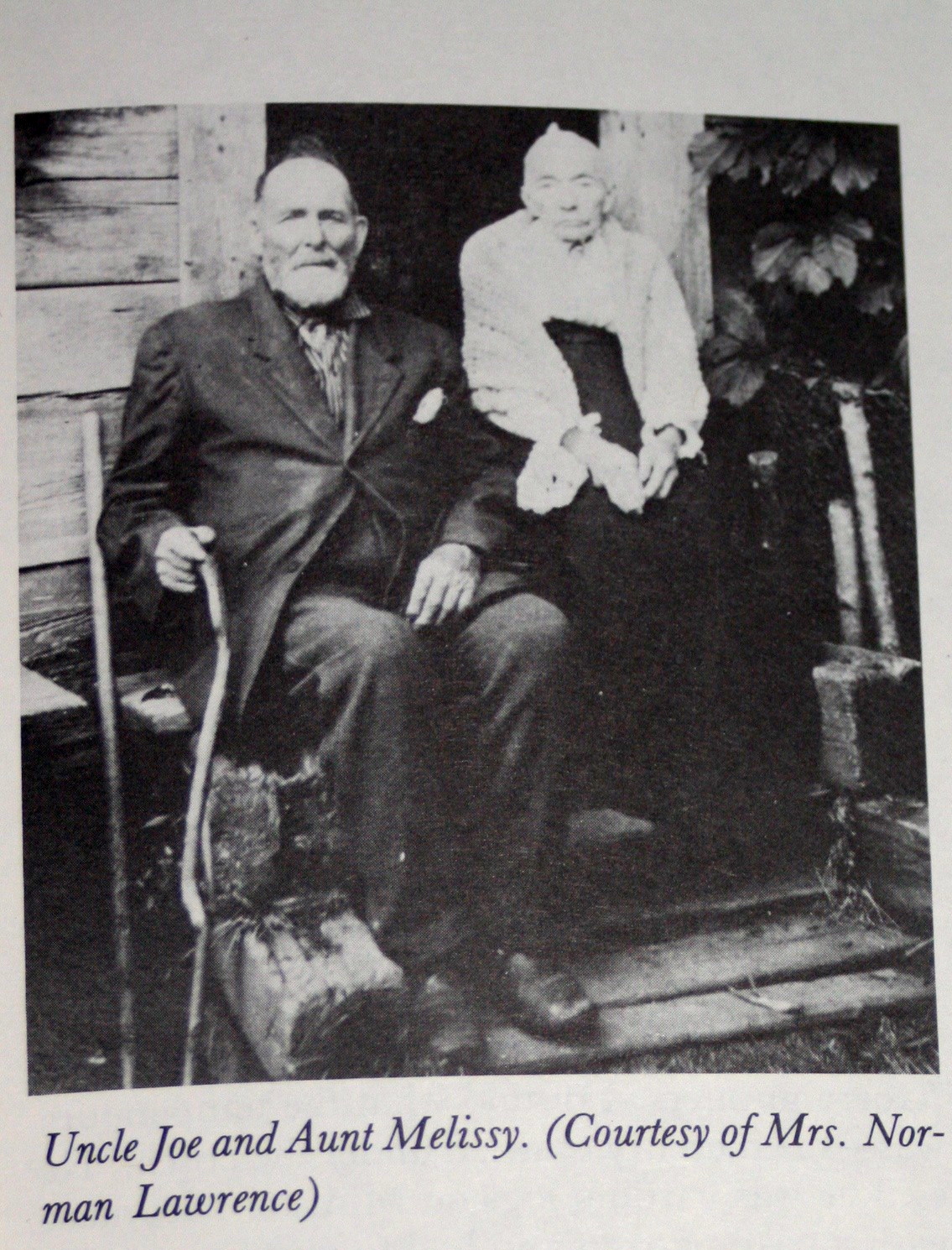
Aunt Melissy and Uncle Joe

Image - Version 2

Uncle Joe was as talkative as his wife was quiet – but she had a quick wit, accentuating his stories with dry remarks that he returned with good natured smiles. “The smartest girl in the Northern County she was”, he would sometimes say, “and imagine, she agreed to marry me! But only after I cut my beard and swore off tobacco. She would not have had me otherwise, and I have become a better man for it. “

As I started to get stronger and could sit up in bed, still wrapped up in the blankets, Uncle Joe would entertain me with outrageously funny stories of his youth. He was given to enraptured fits of laughter triggered by his own jokes. When he got too carried away with his stories, Aunt Melissy would look up from her work – for she was never idle – and comment sternly: “Never be rash with your mouth, nor let your heart be quick to utter a word before God, for God is in heaven, and you upon earth; therefore let your words be few.” Then Uncle Joe smiled good-naturedly and continued his story with just as much zest while Aunt Melissy continued with her chores as if the words had not been spoken. Only on Sundays she did not tolerate his spinning of tales but insisted on bible study and quiet prayer and he obeyed her without complaint.

I have never again met a husband and wife who seemed so comfortable in their home and so content with their life and each other. Despite his stockiness Uncle Joe was quick to jump up like a cat when Aunt Melissy entered the cottage and eager to please her with some little errand or kindness. She returned his pleasantries with home baked goods and fragrant meals. Her only love besides Uncle Joe were the snow white chicken in her yard for which she was known in the county. Aunt Melissy and her white hens. Children they had none.