Page 4 of 4

space, void of people

I woke up when a hand was gently nudging my shoulder. My neck was stiff. I was still sitting in the library chair. Dr. Hausner was gone. “Miss, I am afraid we are closing.” A woman’s voice. I looked up. Ms. Clarice stood right next to my chair, smiling. All other visitors were gone. I got up drowsily and carefully checked the window reflections, too. All visitors were gone. “Are you alright?” Ms. Clarice inquired. I looked at her closely. Her small golden earrings reflected the fluorescent library lights, transforming the miniature reflections of the library on the convex mirror of the gleaming curves  into a warmer, more elegant version of the actual space. An alternate space more suitable for someone like Dr. Hausner than the mundane space of Summerville library.

“When did Dr. Hausner leave?” I asked. Ms. Clarice narrowed her eyes. She ignored my question.  “You must be very tired,” she replied, “go home and sleep.” “Did you see him?”, I insisted. “Go home and sleep, Miss, I have to switch off the lights now.” I wanted to protest but she anticipated my notion and gently shoved me along. “Come back tomorrow,” she repeated, not unfriendly. We walked down the staircase together.

There was nobody downstairs either. From the winding staircase I could see  the lower floor breathing calmly. The tessellation of the carpet tiles looked like the exposed skin of an ancient creature. An empty library is a marvelous space. Really any space empty of people holds some kind of promise that seems to disappear once it gets populated. When I slowed down to linger on the staircase, I felt Ms. Clarice’s warm hand on my shoulders again, encouraging me to continue down the last few steps. I sighed. “It’s beautiful, the library, “ I said apologetically, “at night, I mean. When all the visitors have left.” We reached the ground floor. I took care not to step on the lines of the irregular tile pattern. I have never been quite able to just move without paying attention to the rhythm of any kind of tile, responding to it in some way, and today was not the day to start with it. Ms. Clarice remained silent while I gingerly crossed the open space. I wondered if I ever would get used to people not answering. Strictly speaking, I had not asked a question though. Ms. Clarice looked the kind of woman who did not have an appreciation for idle conversation.

She waited patiently while I balanced over to the cubbies to pick up my bag. I pulled out my jacket first. A small piece of paper trundled to the floor like a feeble bird. Folded from yellow legal paper. I bent over and picked it up. Ms. Clarice was still waiting for me at the door, so I simply slid it into my pocket, shouldered my bag and walked over. She still smiled, never once complaining about the delay. “Good night now,” she said simply. I nodded. She locked the door right behind me. It was cold outside. When I turned around, the lights in the library had already been switched off. The building looked deserted. I started walking into the evening.
organic sources of light

“Recordings of what?” I inquired. His smile faded. Again it seemed like he was listening to my voice retreating in the library. “She said you were smart,” he remarked, more to himself. I was not sure that was supposed to be a compliment or a reminder to himself. “Who said?” I cut in. I had the uncomfortable feeling of him looking at me again and I felt reprimanded without him saying a word. “Sir, please, who said that?” I rephrased my words.

“Never leave a question before it has been answered,” he advised me, not answering either one of my questions. He fell silent.  I stared at him, then lowered my glance, then looked up at him again. He could sit perfectly still, looking very much like the archetypical image of a blind man. It seemed to me, again, that I noticed more visual detail than one should notice. More than I could process. The crease of his pant legs, the way the fine wool fabric folded itself, the nuanced shadows in those folds. His white, chiseled hands, holding on to the walking cane even as he was sitting. And yet, despite or maybe because of the rich details  I had an increasingly hard time focusing on him. It was like reading a book when you are very tired already and you can’t focus on the words. You are still reading them mechanically but you do not get their meaning. He faded or rather he diminished in size. He diminished in size but gained in clarity. I wanted to protest. I had a million questions. He looked like an illustration, I thought, feeling very tired, like one of my mother’s illustrations, done in a myriad of very fine, sharp lines. And each of these lines was emanating a fine, very precise, white light.

coloring idaho

My mother was busy preparing dinner and answering questions my sister had while sitting at the big wooden table and doing her homework. This evening she was coloring and cutting out the states and gluing them in the right place on a map of the US. Both my sister and I hated coloring in worksheets and my mother had brought out her expensive Sennelier pastels to persuade my sister to employ some effort on the task. The map as far as it was completed looked like a beautiful velvet patchwork quilt. You can’t achieve that with your Crayolas. I wondered whether her teacher would be able to appreciate the difference.

Montana was already pasted in its proper place. It was colored in layers of gorgeous deep Indigo and now, with a vengeance, Phoebe was wasting pale Vermillion Orange on Idaho. I sat down at the table and watched her. There is something nice about a little kid coloring in even if she detests it. My mother walked past me and ruffled my hair in a distracted way. It was just as much part of her dinner routine as cleaning dishes right after using them. For a moment I was back in a comprehensible, friendly world. No opportunistic cannibalism, no aliens. Phoebe pasted Idaho on to her map and contemplated color choices for Washington State. “Why do they have to be different colors?” she complained but her heart wasn’t in it, you could see that she did enjoy choosing a new pastel stick. According to my mother you can never work with materials that are too good and you should always strive for beauty but I still felt a bit doubtful whether you actually needed art pastels to complete this kind of homework.

Phoebe still had the whole west coast and Alaska to color and paste and she grunted disapprovingly as she studied the worksheet after cutting out Washington State. Washington was going to be Cinnabar Green. I liked the way she held her tongue between her lips when she had to cut something out or color something in. She looked a lot like Plinius, our cat, after his dinner when he sits down on the table and probably contemplates dessert choices waiting outside in the dark beyond the kitchen door. Phoebe looked like that whenever she was focusing on something. Right now she smeared Cinnabar Green all over Washington. The pastel stick made a fat, smacking sound on the paper. At the kitchen bar behind us my mother cracked an egg. The splintering  was very clear and pleasing to me. I thought that recently I had been much more perceptive to small sounds. Only this morning on my way to school I had stopped to listen to the sparrows hopping over the path to the front door of our school, their tiny claws scratching the bricks. How much does a sparrow weigh? 35 g?

Phoebe looked up. “Mommy?” she asked. My mother looked up from her mixing bowl. “Which language do they speak in California?”

the library, a visitor

Dr. Aaron Hausner cocked his head as if he was listening to the retreating sound of my voice slowly travelling into the distance of the library, finally getting caught in some shelves, its individual corresponding vibrations disintegrating and archiving themselves alphabetically in the juvenile fiction section somewhere between Susan Cooper, E.L. Königsburg and Madeleine L’Engle. “Dr. Hausner,” I whispered, “do you remember me?” He smiled. “You sound tired,” he observed instead of an answer, “I say, you don’t sound well at all.” I felt a brief wave of frustration and annoyance. No one ever answered my questions. But then the warmth of compassion in his voice reached me and to my surprise I felt my eyes filling with tears. I swallowed hard. It had been a while since someone had showed an interest in how I was feeling. We sat in silence for a while. Dr. Hausner didn’t press for an answer, and I sat back, not feeling the pressure to make any kind of conversation. There was a strange, comforting feeling that he kept me in his focus even though he didn’t inquire any further. We sat almost next to each other in silent company. I felt real and alive.

I don’t know whether I was crying. I might have been. There were a few moments when I felt peaceful. But after a while the questions came sneaking back to my mind. They were destructive and very smart about it. And I started feeling agitated again. Hell, I didn’t even know whether this grandfather, his reassuringly old fashioned, three piece suit clashing with his white skinned, bare feet in biblical sandals, who was providing me with his compassionate company, whether this man actually existed.  He immediately sensed my aggravation and shifted in his seat as if releasing me from his interest. Maybe my breathing pattern changed. Or maybe he was just a part of my mind, responding to me because he was me.  I briefly contemplated if I could ask some other visitor whether Dr. Hausner existed, but the problem was really, that everybody I would maybe choose to ask could equally be a fabrication of my mind. I couldn’t prove anybody’s existence. Not even my own. I just had to operate on the assumption that I existed and that people I talked to existed, too.

red snow


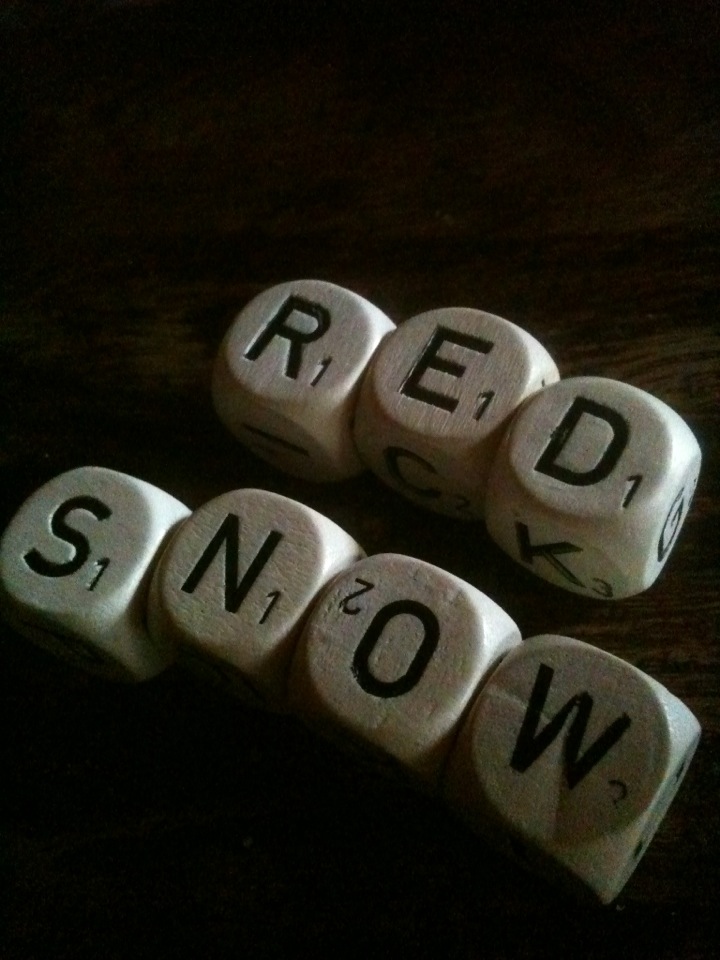
“Why is it out on permanent loan, Sir?” I asked instead. Now it was his turn to ignore me. “When they started the program, you see,” he answered in a low voice to a question I hadn’t asked yet, “it wasn’t particularly secret. No classified information, just a bunch of scientists with an idea.” I felt a chill. This was Somerville Public Library where kids get their sufficiently outdated material for school assignments and hang out between the dusty shelves in the little frequented art section. “It started with a culture collection of cryophilic algae and microbes, for example pyrolobus fumari.” Sensing my bewilderment, he added ”you need to take notes, you know, you can’t expect me to explain every detail.” As I grabbed one of the H2 library pencils and a stack of note-paper from the table in front of us, he relented somewhat and began to lecture. “Cryophilic algae, also known as red snow, have specialized on thriving under extreme conditions in the polar regions. They grow in the very cold, acidic, high in ultra-violet radiation, and nutrient-poor confines of melting snow. Fascinating, right? Pyrolobus fumari, collected from hydrothermal vents about 200 miles off of Washington State and nearly 1.5 miles deep in the Pacific Ocean on the other hand, survive at 235 degrees Fahrenheit. And we cultured yet another microbe from a yet unnamed strain that Penelope Hoffmann insisted even remains stable at 266 degrees Fahrenheit, when all other life ceases. But the most interesting aspect is that these microbes and algae go through long periods of dormant life cycles. We have isolated microbes from the Siberian permafrost, about three million years old. Bacteria germinated from spores preserved in Dominican amber, 30 million years old!” He leaned back. I looked at him expectantly, but he remained silent. One couldn’t get comfortable in the library arm-chairs with their beech-wood frames and their dust blue fabric over a dense kind of upholstery material and I had fidgeted around in my chair since we had taken our places, but despite the position his malformed spine imposed on him he looked completely relaxed. It actually looked as if he was relaxed within the frame of his bent body, as if that was his frame of reference, not the environment. My initial anxiety had settled too and I had begun to think. “

Small Rabbit Bookstore


After school I went to the town library. The sky was bright grey and diffusely glaring as if the sun was about to break through. The bare branches of the late November trees were once again settled with crows who moved lazily and could be mistaken for dark leaves. Shivering in the crisp air, I wrapped my double helix hand-knitted scarf twice around my neck (there was enough material to go around four times and still leave the ends falling over my shoulders), picked up speed and felt the pompom of my matching hat bouncing rhythmically with my steps. The feeling of the pompom reassured me as if childhood was still a possibility to be considered in this strange game I had taken to playing lately.

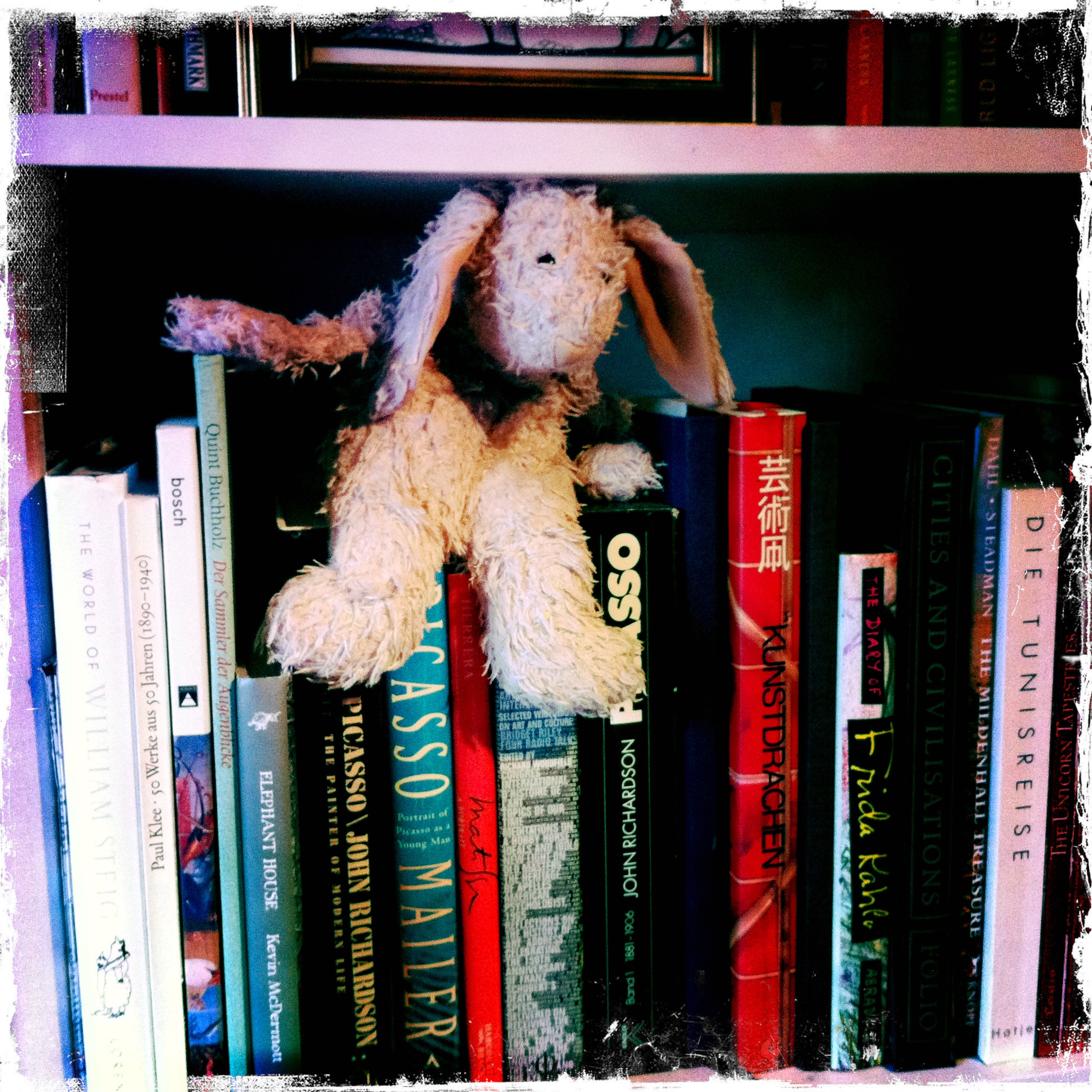
Until the event of the blockbuster bookstore I have always loved any kind of book store or library, and I had quickly found an appreciation for the smallish library in Summerville (not at least due to pretty and efficient Ms. Clarice) and loved the “Small Rabbit Bookstore” in town, too. The owner of the “Small Rabbit” was a nervous, wiry guy who looked very much like a hare. He rarely talked, never left his corner behind the register, and always wore a hat, even on hot summer days.

The store was nothing much compared the Strand Bookstore on Broadway we used visit too frequently when we still lived in the city, or the Crawford’s Childrens’ Book Store on Madison and 93rd Street, and neither did the Summerville Memorial Library compare to the New York Public library city branch we used to go to every Monday after school. My mother had refined the skill of dragging us, my sister still riding on her hip, through the whole library following without doubt a well planned route, while filling a tote with amazing speed: art books, do-it-yourself-guides for plumbing, mathematical treatises, and any selection of dusty volumes on obscure topics. Feeling out the frail limits our patience predictably imposed on her, she would finally settle down in the kids’ section and spent the next two hours finding treasures for us, reading with us and following my sister’s lead crawling through the labyrinth of shelves.

Sometimes I longed to be back in New York, in our cramped walk-up apartment, sharing a bed-room with my little sister. I also longed to be a mere child a little longer, relying on my mother’s ingenuity to entertain and educate me – often by the same idea. I still loved sitting in her kitchen in the afternoon or at night, talking with her or listening to her monologues on H+, the idea of transhumanism, or her doubt concerning the accepted theory of Vincent van Gogh’s suicide.

I also still enjoyed occasionally joining her on weekends for trips or excursions to the city – but things were different than they used to be. Not as simple. It was understood now that I could say no, that I was allowed to choose my own entertainment. My mother still took my sister Phoebe along on every one of her quests whether Phoebe wanted to or not – but I often decided to stay at home even though it made me feel uncannily excluded.<a

Tessalation

In the meantime I stood by and just waited, too impatient to take care of my weekly list of reading and also afraid to let the old man out of sight. My head still throbbed lightly and the smell of the new scrubby grey floor tiles did not help to improve it. I concentrated on the unusual pattern of the otherwise ordinary floor covering. The tiles were light and dark grey and laid out in an unexpectedly complex pattern. Areas can be filled completely and symmetrically with tiles of 3, 4 and 6 sides, but it was long believed that it was impossible to fill an area with 5-fold symmetry though Kepler played with the idea. I knew this because my mother loved the work of M.C. Escher who was intrigued my mathematic patterns and used them in his illustrations. It did perplex me that the library floor tiles were cut out of so called kite and dart shapes which actually do allow a surface to be completely tiled in an asymmetrical, non-repeating manner in five-fold symmetry with just two shapes based on phi. As a result the tessellation of the dense felt tiles in the lobby made it impossible to arrange my thoughts according to the floor pattern – a technique I had used since childhood to soothe anxiety.

meadowlands

I had to switch trains in Newark. The train to the city left from the same track, and the platform was pretty full with commuting traffic already. There was an unsupervised group of teenaged kids with backpacks on the platform as well, chatting and laughing, and I kept in their vicinity and tried to blend in. A girl with a blue sweater eyed me curiously. We were separated while squeezing into the already full train to New York Penn Station. I got pushed against a window in the foyer and found a rail to hold on. People still wore their morning faces and it was surprisingly quiet on the train considered how many people were sharing the ride. I heard the kids from the platform somewhere in one of the adjoining cars but I couldn’t see them. As we were pulling out of the station I stared out of the window again.
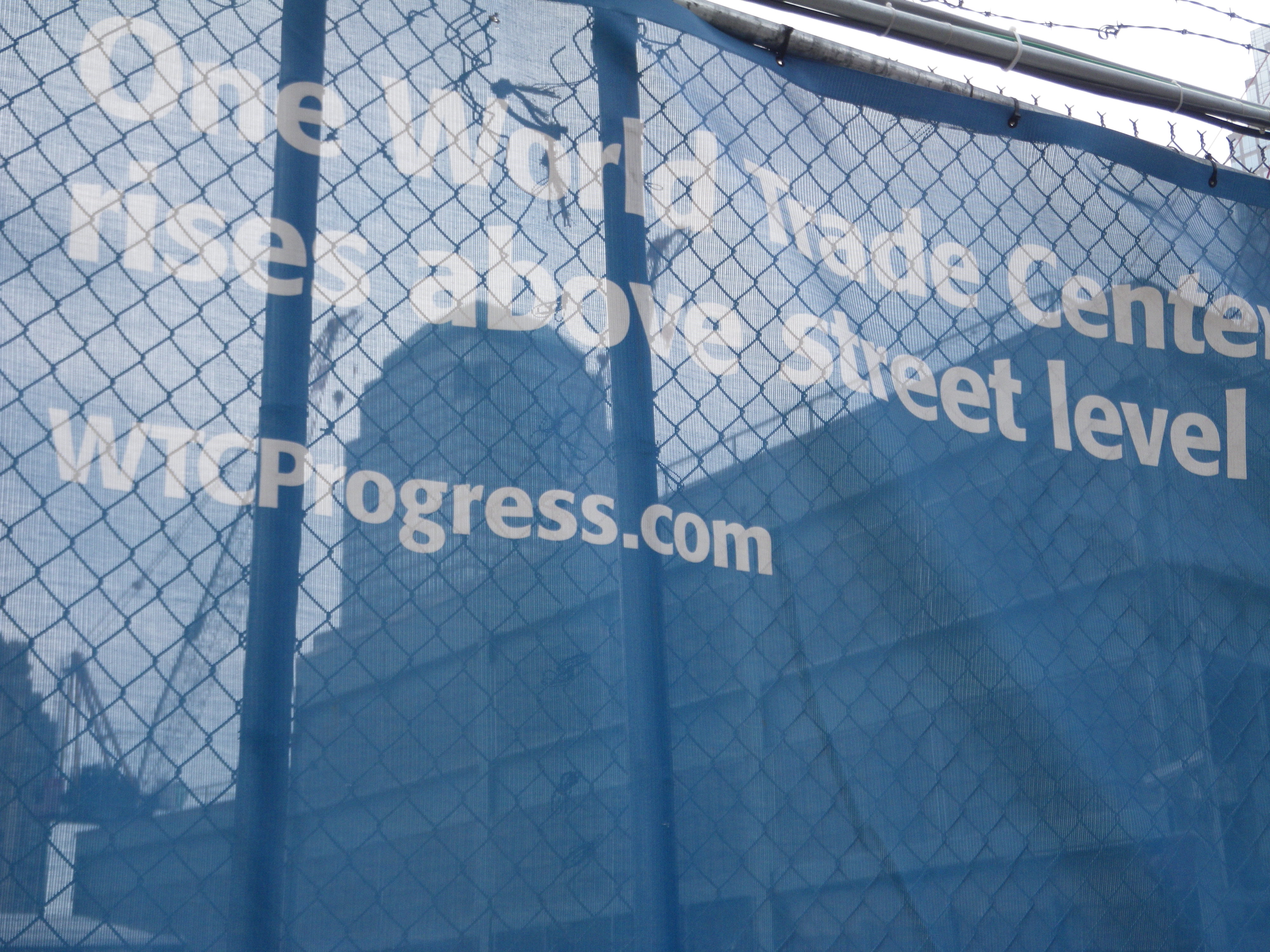
Morning sun was reflecting brightly off the water on the marshes of the meadowlands. Though part toxic industrial wasteland the marshes were home to countless species of birds. I loved this stretch of the commute to the city, the skeleton bridges’ dark structure against the luminous sky, silver glitter on tidal pools of water, herons fishing in dioxin contaminated estuaries, abandoned cars driven into the muck, parked utility trucks on well maintained dirt roads leading into nowhere, fast moving toy sized cars on elevated highways on the horizon, discarded metal scraps sticking out of the reeds like letters of a forgotten language, the wind caressing the rushes causing water like ripples, overhead electrical wires, seagulls circling in the lower skies, high voltage station feeding the catenary, finally the silhouette of the city and the new world trade center towers still rising in construction in the distance. Every time I was on the train I felt that the progression of scenes outside the window was like a silent movie on a screen of stray light. The meadowlands were beautiful, but against the lure of the silver light I remained aware that it was a poisonous landscape. I wondered how the herons survived here. I wondered if eventually our whole word would look like this.