Page 2 of 5

British Storybook illustration – the golden time of the childrens’ book …

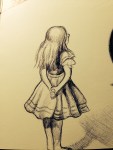
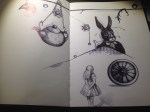
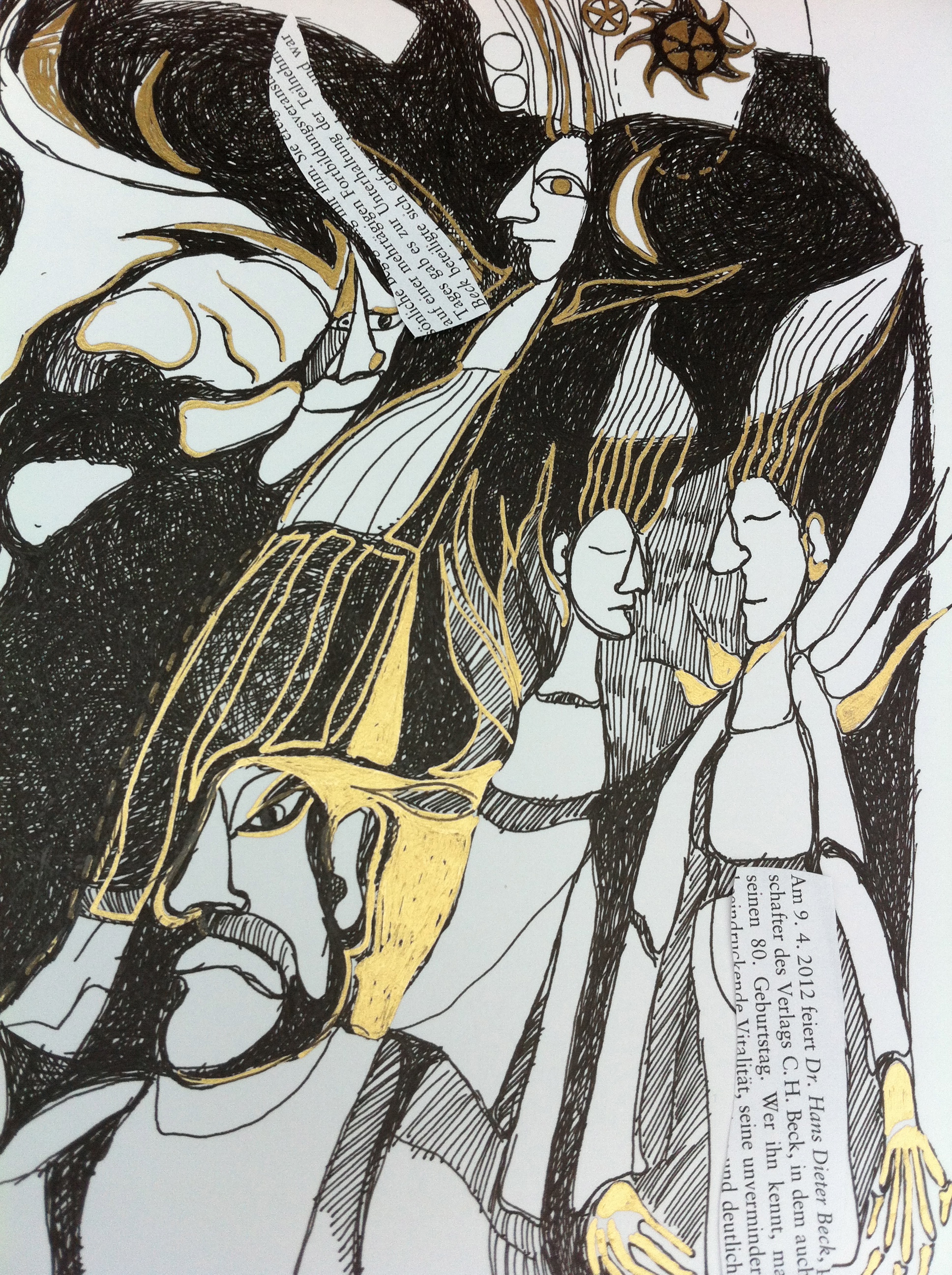
After drawing for many nights I didn’t feel I wanted to let go just yet. True, my paintings are calling urgently, but what are a few hours? So I kept on drawing and I used John Tenniel’s Alice in Wonderland illustrations as an inspiration. Alice again, why do I keep coming back to Alice? Well, if I do at least I am in good company. To this day Lewis Carroll and John Tenniel keep inspiring artists worldwide.

These ball pen drawings are based on the original illustrations by John Tenniel. One cannot tire of those original illustrations any more than one could tire of Arthur Rackham’s illustrations of Grimm’s Fairy Tales. There have been many beautifully illustrated versions of Lewis Caroll’s Alice (Alice in Wonderland  and Through the Looking Glass), for example the great illustrated version by Robert Ingpen,  and Grimms’ Fairy Tales as well (have a look at the version illustrated by Albert Schindehütte!) – but Tenniel and Rackham are surely not only the archetypes of Alice and Grimms’ illustrations but also provide some kind of archetypical blueprint for childrens’ book illustration in general.

Arthur Rackham also illustrated Alice in a fluid, strange way, I think 1907, but as a child I clearly preferred the Tenniel characters in their weird, warped precision. Yet I seemed to have known that the Rackham illustrations of Grimms’ fairy Tales provided a direct gate into the realm of the story and later, much with the same feeling, I swooned over the Hawthorn’s Book of Wonder illustrations by Rackham but then didn’t care as much for the Walter Crane edition. Kate Greenaway, though once as successful as one of the best British illustrators, was not quite dark enough for my five-year-old taste. I still remember, children do have an appreciation for the dark places, for their imminent terror and promise alike.  Well, you see, this small excursion into the world of Tenniel was a nice diversion for me. Next weekend I will take some of the characters and try to use in a Photoshop-Crashcourse my very talented cousin and illustrator Lotta NUSUM will treat me to. I’ll keep you posted!

This is the sort of book we like

(For you and I are very small),

With pictures stuck in anyhow,

And hardly any words at all.

C.H Chesterton about Randolph Caldecott

The Twelve Nights of Christmas, the journey concluded: Night 12, the Mechanics of Longing

Foto

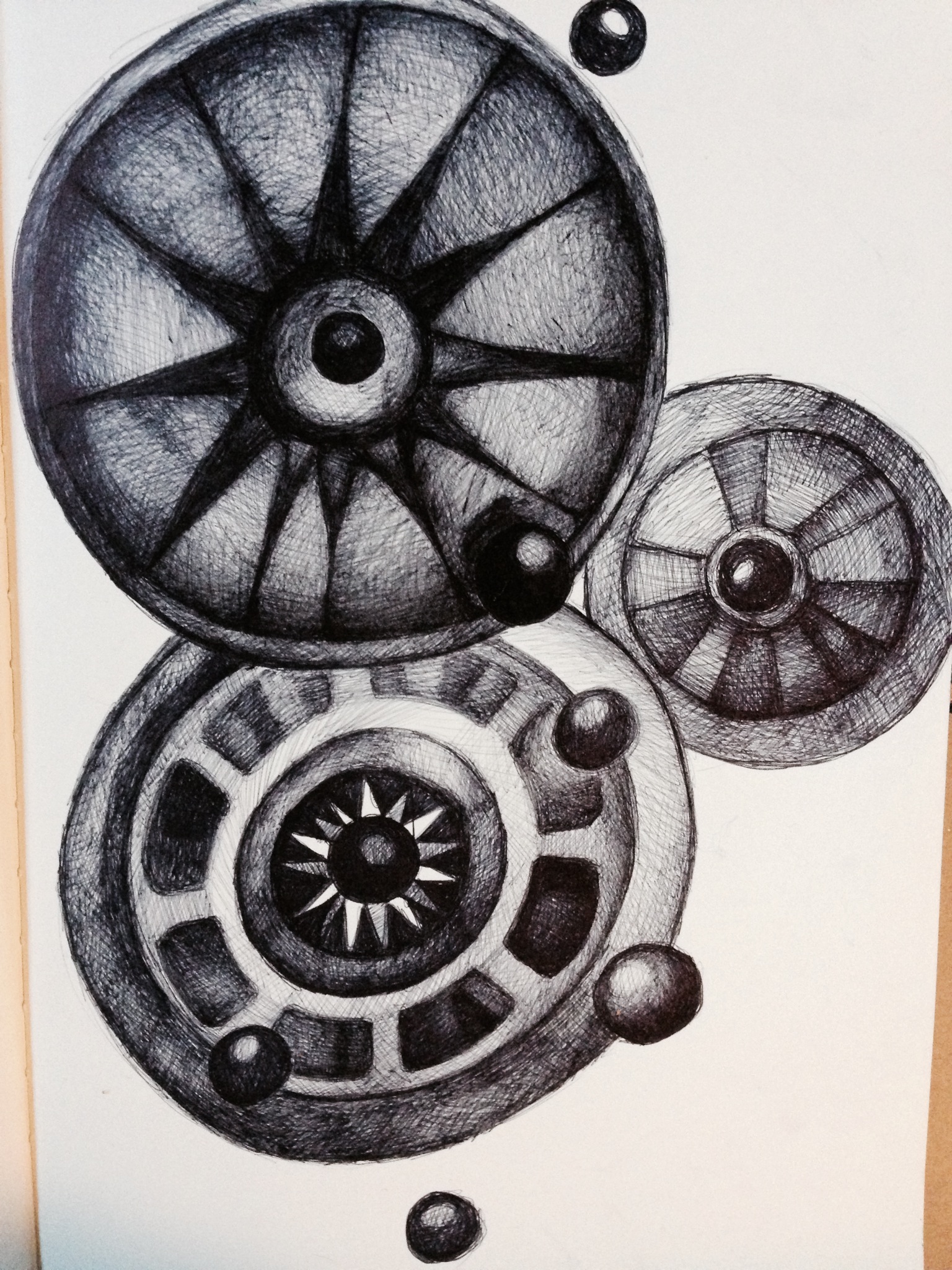
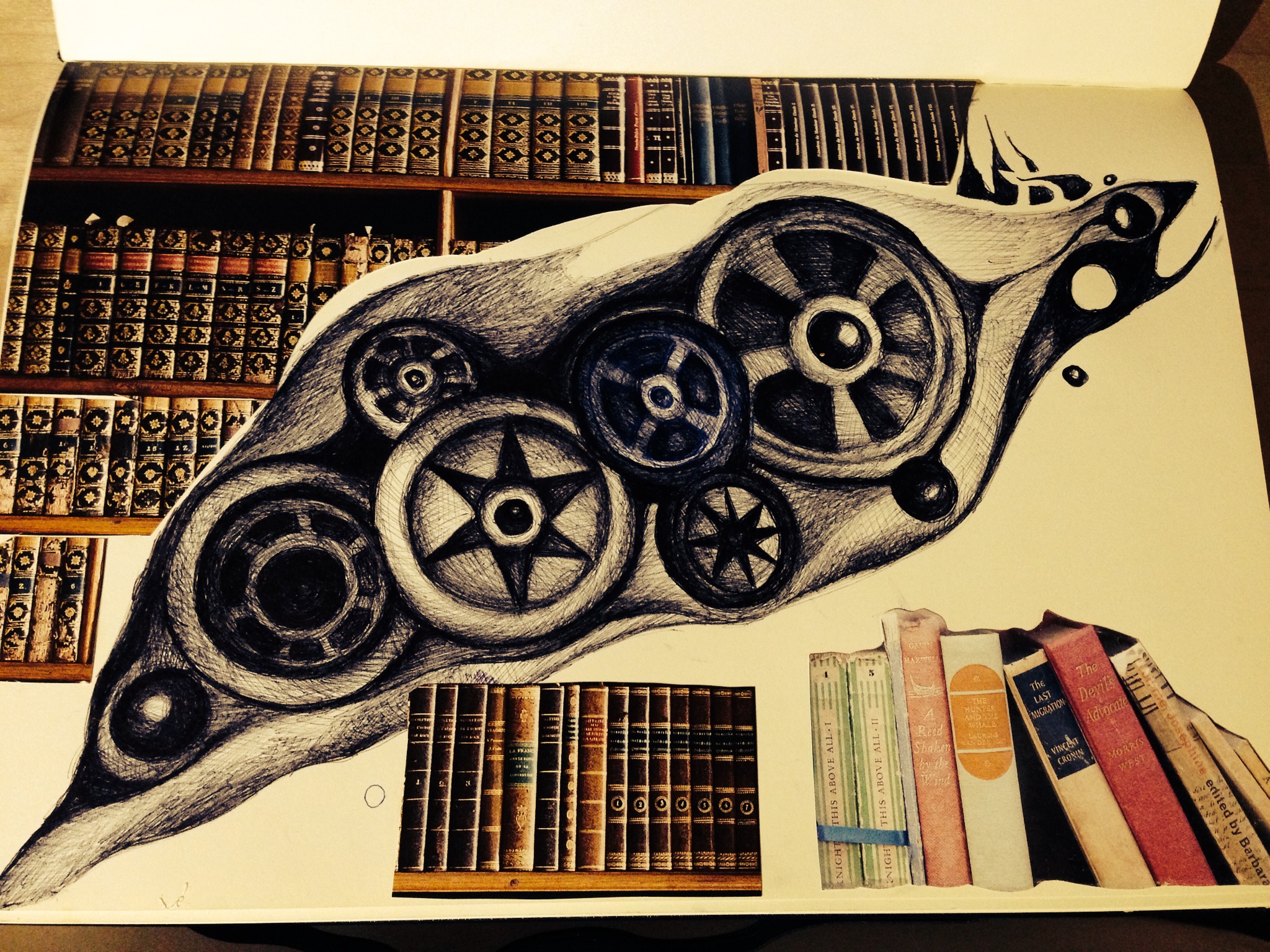
The title came as swiftly as the image and the artist obeyed both. The Mechanics of Longing.

This drawing concludes my twelve night drawing meditation. As the new year is already starting to make its demands, these drawings carry with them 12 nights of focus on a non-revealed question. Sometimes during those twelve nights I felt I could catch a glimpse of things yet to be. Now there will be time to look at these pieces for a while, maybe polish them a bit.I’ll keep you posted.

New artistic challenges are ahead for the year.

January 15th is the deadline for another Sketchbook Project of the Brooklyn Art Llibrary, check out the website if you haven’t yet. Their digital library is stunning.

http://www.sketchbookproject.com/library/13754 The link will take you to my previous year contribution “The Whisper”, a simple, wistful story about a childhood memory.

My new book, a young adult science fiction novel, is about to be finished and another one waiting to be continued on my desk.

In Fall I hope to open an exhibition of 41 canvases, acrylic on raw jute canvas (aka coffee and chocolate bags) in Berlin, 30 of which are finished by now. The 12 nights have strengthened my will to continue living in multiple universes.

Thank you for following my blog, this certainly  is the day to acknowledge that my readers are an important part of my creative discipline. It is a good thought that someone may be going to weigh the outcome of a night’s work and maybe find some use for it, if only in the fleeting way that art, all art, can enrich a moment.

I am wishing you, my readers, all the courage, health and gladness necessary to live a meaningful New Year and if you should be lacking any one of these for some of all of the time the will to give it your best shot anyways! 

The Twelve Nights of Christmas, Night Eleven: Nevermore …

Once upon a midnight dreary, while I pondered weak and weary,
Over many a quaint and curious volume of forgotten lore …

Foto

I couldn’t make this the twelfth night theme. “Nevermore” is not the note I’d choose to conclude this season’s “Twelve Nights”. But on the eleventh night it brings together further elements of reading, words, images evoking coherent comprehension beyond words, night time, magic realism, dreams, illusions, delusions, sleep deprivation, time, meditation, past, progression,automatons, determinism, choice, knowledge, intuition, desperation, endurance …

Two weeks ago  I listened to a musician on DRKultur (radio) talking about time and about the experience of time during extemporaneous composition and performance  on the piano. He talked about experiencing eternity not as an endless repetition of events in a space of time never ending but about as an experience of time being suspended. I think about art  – writing, painting and illustrating – as taking place in just that space of time being suspended, a space that I can enter and where I can linger at will.

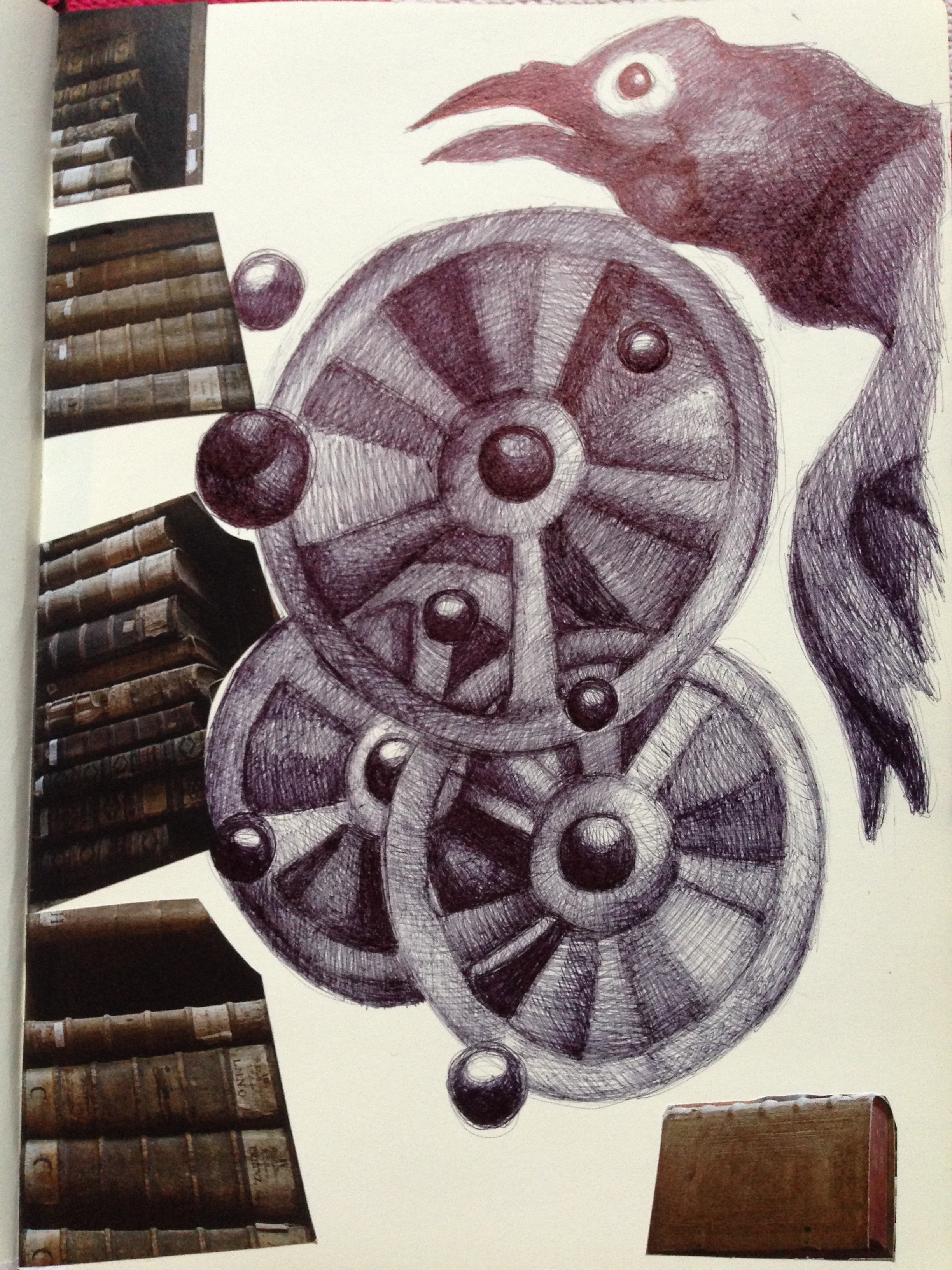
The Twelve Nights of Christmas, night ten: Raw data or further reflections on the nature of Borges Library

ImageI’d like to think of drawing as of transforming raw data with my pen to “mean” a specific thing and not another though it is not in the nature of data to actually be one specific thing to the exclusion of all other possible “things” (meaning, manifested form, reality) in all their variations (written and unwritten) any more than a child’s building block used in a fleeting structure soon to be knocked over is identical with that intended structure’s purpose or “meaning”. A building block stays a building block, a zero stays a zero and a one stays a one no matter what it is used to communicate. It assumes  a participating function in the meaning of one thing ( and not another ) but it also creates that one thing without adopting its separate ( separate from other possible thing’s) nature simply by describing it.  The “thing” actually has no separate ( from other possible thing’s) nature – it is but a description of the configuration of the raw data (building blocks) at a specific moment from a specific perspective. So that, at any given moment, any thing, rearranged, could be (and is) any other thing, idea, let’s call it “book”, existing or non-existing, written and unwritten, in all possible variations. I assume that would upon further reflection have to be one of the conclusions drawn of the cosmology principle but I am getting a bit out of my depth here.

All we ever do in life is  to assume a specific perspective to describe what is really a homogeneous distribution of raw data – each one of us is, with other words, but a specific, erratic close up view of that homogeneous distribution. We have no separate nature. The “separateness” of our nature not only of one thing to the exclusion of all other possible things but also of the experiencing “conscience”, the “I” to the exclusion of all other possible perspective’s (you, the other) is clearly illusional, possibly delusional.

The Twelve Nights of Christmas, night 9: A rip in the fabric of the universe reveals the true nature of time

It is Borges’ library that makes another appearance in this drawing meditation. One of the themes that is never far off my mind. How does our mind chooses the images that are essential for its own comprehension of the world? How come an image such as Borges library can be so powerful that it assumes an reality of its own, in an alternate universe not so far of our own house number? Just try a different key, open a small door you have never quite paid attention to before and beyond you will find the octagonal library with all possible version of all possible books, written and unwritten … my kind of paradise.
Foto

the day the shadows disappeared

Mahabaratha, detailthe shadows were moving slowly, swaying like branches in a light breeze or high buildings on a windy day. to detect purpose in these gentle movements required a slight degree of paranoia, and yet there was no apparent natural cause to explain the shift of the shadows away from their corresponding objects and towards the center of the village like water draining from upset glasses.
finally, there were just a bits of shadow left, like drops in a sink adhering to the enamel by their surface tension. these droplets of shadow were sparkling like rainbows, no grayness reflected. the air was still and non-expectant, noon in a depressed small town, and the realization that the world was without shadows had not yet sunk in. in a dirty jeep, parked close to the village center, a woman lit a marlboro
even those who had dismissed the shadows as inessential, felt disconcerted when the birds ceased to sing. on the morning of the third day, after a dawn without luminosity had given way to dull day light, small insects began their crawling procession towards the centers that had swallowed the shadows.
and someone laughed at the gray man in his wrinkle free woolen suit who solicited signatures on retro-active insurance policies. “one day only”, he implored, “an amazing offer”, but they shooed him away while watching the myriad of tiny, scarlet colored spiders tie a living ribbon between the outskirts of the village and the shadow drain.
and yet, the spiders said, too easily do you accept that we form a living ribbon, and wander into oblivion. one by one. what to your eyes a living ribbon is, to ours is a band of pain, and joy, and hope against all odds.

Working with young artists

IMG_5531Working with Young Artists

By trade I am a lawyer. Many lawyers do have a passion besides their original profession though, I happen to have three, if you count my love for children in general and my own children in particular. The other two are writing and art. I mention this because you will surely want to know how I am qualified to “teach art” or as I prefer to say: to work with and alongside young artists.

My grandmother used to say I have been born with a brush in one and in pen in my other hand – and as far as I can remember I have been scribbling and drawing on every appropriate surface – and some less suited. That I came to study law is strange, all things considered, but I guess I wanted to try out if I could succeed doing something else and law had always been intriguing to me. It turned out that I could succeed. I graduated with two law degrees – and came straight back to art. And at some point I started doing it both: art and law. Kids have always played a role. I have been teaching all kinds of classes, art and law, over the last ten years, and it has been a truly rewarding part of my life, not just my professional life. As you might imagine, I am never asked how I qualify to teach legal workshops, I am a lawyer after all, but often how come I teach art as well.

I do believe that art is not the esoteric, isolated endeavor that people sometimes take it to be. Artists are well advised to take notice of their world and have an understanding of it that transcends the visual. Beuys pointed out that every person is an artist, that artistic creation is at the center of human life. He went as far as demanding that every physician, scientist, philosopher be first trained in art. I will venture further by saying that the art world would profit if artists would first be trained in a trade that explores the practical aspects of their environment. Every artist is part of a tangible social reality. The training to become a lawyer might in the end not be either so far from or so detrimental to artistic process as is might seem at first.

Why I do love to work with young artists? Because it refreshing to leave the stereotypes that people retreat to as they become older. Every child I have ever had the pleasure to meet turned out to be an original artist (albeit sometimes a frustrated one …).
I respect the creative work children are capable of. As a first hand witness and as someone who still draws and paints, saws and glues every day: There is no time like childhood to experience the joy of art.

I had the good luck to be raised by a grandmother who had the wisdom of an older generation to pretty much let me do whatever I thought appropriate as long as I did not nail her good table linens onto a broomstick for a pirate sail (happened only once) or cut out my great grandmother’s lace to make curtains for fairy dwellings, also a one time never to happen again situation.

However I was allowed to make use of any tool that I would find in my grandfathers tool shed or in the kitchen without anyone trying to figure out if they were child appropriate. I was also allowed to make generous use of old newspapers and magazines, of the newsprint paper that my grandfather, who was publisher of a local newspaper, brought home, and in general of every piece of metal, screw, paper, feather, stone or yes, glass! that I would pick up on our long walks. It never occurred to my grandparents that I might pick up some dangerous germs on the way.

I brought everything home and assembled it very much the way every child will when you do not interfere. I do not know where our desire to “make” things has its origin but I do know that we already possess it as children, together with an instinct of how things fit together. If children are not allowed to roam as freely as I was, they will still build markers from pebbles and stones, they’d still use sticks to draw in sand, build strange, improvised gardens in mud, decorate prefabricated play structures with ritual signs.

To be creative is a basic desire of humans, all humans. It is a genuine expression of who we are even before we are defined by our social and economic circumstances. To teach a child to be creative therefore seems to me an elusive act. I look at children with a sense of awe, they are still there, right at the origin, and all I do as an art teacher is to take them on the same kind of  long walk that I had been privileged to undertake with my grandparents and I simply allow them to discover their world and to collect at will what responds to their own desire of creating this world new. If we’d allow our children more freedom and time to explore their own world and provide them with materials that are not dedicated to specific purposes, we could cut back on many extracurricular activities. Let them venture out there and the artist that lives in every one of us but is acutely alive in our children is ready to meet all the great challenges of art right in our neighborhood.

To come back to the question of my own expertise: I do believe with visionary clarity that it is not my academic expertise that is relevant. It is my willingness to acknowledge and celebrate children as the artists they are. I do believe that art is not a matter of paper and ink, of perspective and shading, I do believe though art techniques can be taught art cannot, no more than breathing, walking, seeing. It is something that happens when things go right or when you have to make them come out right. Art is life.

But is it ART?

English: Butter making woman Français : femme,...
English: Butter making woman Français : femme, faisant du beurre Deutsch: Frau Butter stampfend (Photo credit: Wikipedia)

Alternative approaches to teaching ART

Joseph Beuys and the use of butter and animal fat in his work


This is a journal entry describing an indirect approach to the question if a certain object as later illustrated by Joseph Beuys “fat corner” is or is not art. Rather than to start by discussing what art might be, I took two sticks of butter and a box to a class of fifth graders. I opened the butter and started squishing it between my hands without explaining what I was doing and why I was doing it. The butter was slightly softened and was growing softer still through handling and it had good sculptural properties. As I worked air into it, it produced disgusting sounds. I walked around the room, talking about art in general,never referring to my activity, still working the butter between my hands. The kids were intrigued, their reaction ranged from mere disgust to laughter, on which i did not comment, but after a while they started to be fascinated by their own responses to the demonstration, how emotional, shocking, entertaining this seemed to them – and why, and so they talked about that. in the end I sculpted the butter into a corner of the box. I picked the box up and presented it to them like a diorama. then I asked: is it art?


Out of 21 kids, based on their own experience of the performance, 19 judged it to be art.”


Die Banalität der Zeit als Gegenwart (aus dem Roman: Nachtwachen)

Die Banalität der Zeit als Gegenwart

Stamp Hannah Arendt
Stamp Hannah Arendt (Photo credit: Wikipedia)

Den Großvater zu verstehen heißt nicht zwangsläufig, eine ganze Generation zu verstehen, heißt nicht, Deutschland während der Zeit des Nationalsozialismus zu verstehen. Aber dennoch scheint es K unausweichlich, auch nach ihrem eigenen Großvater zu fragen. Seit der Lektüre von Hannah Ahrendts Buch “Die Banalität des Bösen”, das sie während ihrer Seminararbeit zum Fall Eichmann  studiert hatte, hatte sie die Idee verfolgt, gerade dem Banalen, der Alltäglichkeit  in der Biographie ihres Großvaters nachgehen zu wollen. Wobei sie nicht notwendigerweise nach der Alltäglichkeit des Bösen in der Biographie des Großvaters suchte, sondern eher nach der scheinbaren Bedeutungslosigkeit alltäglicher Entscheidungen oder dem kumulativen Effekt vieler scheinbar banaler Entscheidungen zu einem unveränderlichen, verheerenden Ganzen, eben nach der Banalität der Zeit, wenn sie als Gegenwart daher kommt, und vielleicht auch nach ihrer Gewichtigkeit, wenn sie vergangen ist. Nach der banalen Abfolge von als Anekdoten und Geschichten wiedererzählten Ereignissen, die angeblich die Entscheidung für die NSDAP vor 1933 als ein nahezu natürliches Ereignis erscheinen ließ. Weltwirtschaftskrise. Hunger. Hoffnung. Aufrüstung. Krieg. Erzählt in Ereignissen der einzelnen Tage, während derer sie sich zutrugen.

Sie suchte auch nach einer Erklärung danach, warum unter denselben Umständen einer zum Dieb wird und der andere ein ehrlicher Mensch bleibt. Warum Gottfried Benn und ihr Großvater den Nationalsozialisten vorauseilenden Gehorsam geleistet hatten und Klaus Mann die mörderischen Absichten der Partei hingegen von Beginn an verstanden und verabscheut hatte. Die Frage, die sich ihr letztlich stellte, war, ob ihr Großvater nicht doch in die NSDAP eingetreten war, eben weil er das Parteiprogramm und die Absichten der Nationalsozialisten sehr wohl verstanden hatte und sie mit zu tragen bereit gewesen war. Sie wollte verstehen, was den Großvater dazu bewogen hatte, bereits 1931 in die NSDAP einzutreten. Das 25 Punkte Programm der 1922 von Preußen und anderen deutschen Ländern auf Grundlage des Republikschutzgesetzes verbotenen NSDAP hatte als Programmpunkt die Entrechtung der Juden durch den Entzug der deutschen Staatsbürgerschaft  schon enthalten.

K entsinnt sich des späten Bekenntnisses des Großvaters , “man habe den Juden Unrecht getan, auch wenn sie keine Deutschen waren. “Dem Wertheim, zum Beispiel,” hatte er anerkennend gesagt,  “das war ein ganz ausgezeichneter Geschäftsmann.”  Noch über vierzig Jahre später hatte er nicht sehen können oder wollen, dass die in Deutschland verfolgten Juden Deutsche gewesen waren. “Die Nationalsozialisten haben den Juden in Deutschland doch die deutsche Staatsbürgerschaft überhaupt erst entzogen.” hatte sie eingeworfen. “Das musst Du als Juristin doch einsehen, Katja,” hatte der Großvater erwidert, “Es war ja ein wirksames Gesetz, auch wenn es manchen nicht gefiel, aber Gesetz war es doch.”

K konnte dem Großvater höchstens zu Gute halten, dass er sich  nie mit der Floskel verteidigt hatte, “man habe von all dem doch gar nichts gewusst.” Vielmehr hatte er, allerdings auch unter Verwendung des neutralen Infinitivpronomens, gesagt: ” Man habe sich geirrt.” Als habe es sich um einen Rechtschreibfehler gehandelt. Ein Aktenversehen. Und eben: “Das kann Deine Generation gar nicht mehr verstehen, Katja.” Und dann hatte er das Thema gewechselt und wieder aus seiner Kindheit als Lehrersohn erzählt.

Erst jetzt, mit dem Abstand von zehn Jahren seit dem letzten Gespräch, mit dem Abstand des Todes, der zwischen ihnen liegt und der sich weitet wie ein Fluss, der über die Ufer tritt, und dessen anderes Ufer schwerer und schwerer erkennbar wird, erst jetzt, mit dem Abstand von einem Kontinent und einem Meer, kommt es ihr in den Sinn, dass in diesen Geschichten aus dem Dorf, den Geschichten von dem Jungen Nick Rieper vielleicht etwas von dem Alltäglichen der Zeit zu finden ist, das sie damals vergeblich aufzuspüren versucht hat.

Die Sprache der Welt

The location of Samoa
The location of Samoa (Photo credit: Wikipedia)

Rafiq unterhält sich mit dem UPS Boten, der in seiner braunen Uniform breitbeinig wippend vor dem Tresen steht und auf seinen Bagel wartet. Auch er hält einen Pappbecher mit Kaffee in der Hand. Trotz der Kälte trägt er ein kurzärmeliges Hemd und Shorts. Wie immer fühlt K sich beim Anblick der UPS Uniform an die Uniformen der Hitler Jugend erinnert, selbst hier, in einem palästinensischen Coffee Shop in der Upper West Side New Yorks. Unwillig über sich selbst wendet sie ihren Kopf ab und studiert statt dessen den Umschlag, der neben ihrem Teller liegt. Auf dem Papier haben sich Fettflecken gebildet. Die Konstellation und Form der Flecken weisen eine verblüffende Ähnlichkeit mit einer geographischen Karte von Samoa mit den Inseln Upolu, Savai!i, Apolima und Manono auf. Eine neues Cluster von Assoziationen folgt dem visuellen Impuls, der für sich bereits eine Assoziation ist. Es endet auf dem Misston “Deutsch-Samoa”. Sie schließt die Augen.

Das klingende Scheppern von Münzen auf dem Counter, das Öffnen und Schließen der Registrierkasse, das Ticken und Dampfen der Kaffeemaschine, Rafiqs Stimme, ein Messer, das zu Boden fällt, das Knistern des beschichteten Papiers, in das Samir, Rafiqs Bruder, ein Sandwich wickelt. Wie wäre es, wenn alles, was sie erlebte, eine Abfolge von Worten in einem Buch wäre? Und wenn diese Worte gleichzeitig in zwei Sprachen gelesen und verstanden werden könnten, aber in jeder dieser Sprachen vollkommen verschiedene Geschichten erzählten? Und eine Sprache wäre die Sprache der Welt, von der ihr Großvater ihr als Kind berichtet hatte.

K öffnet die Augen wieder und schlägt ein frisches Blatt in ihrem Skizzenbuch auf. Für einen Augenblick noch hört sie auf all jene Geräusche, die zusammen das Lied eines Morgens in einem Coffee Shop orchestrieren.

Dann beginnt sie zu schreiben. Sie sucht nach Worten, nach Wortklängen. Sie schreibt eine Liste von Worten, die in verschiedenen Sprachen vollkommen unterschiedliche Bedeutung  annehmen. Die Sprache der Welt.

IL. EEL. 1. Franz. m. Personalpronomen 2. Engl. Substantiv Fischart SPRING. SPRING! 1. Deutsch, Verb, Imperativ, zum Sprung auffordern 2. Engl. Substantiv, Jahreszeit

DIE. DIE! 1. Deutsch best. fem. Artikel 2. Engl. Verb, Imperativ, Aufforderung zum Sterben
HELL. HELL. 1. Deutsch Adjektiv, Anwesenheit von Licht 2. Englisch, Substantiv, Inferno

ESSE. ESSE. 1. Latein Verb, Infinitiv, sein, sich befinden 2. Deutsch, Verb, Imperativ, zur Nahrungsaufnahme auffordern
PETIT.PETIT 1. Latein, Verb, erstreb