Page 5 of 5
Small Rabbit Bookstore
After school I went to the town library. The sky was bright grey and diffusely glaring as if the sun was about to break through. The bare branches of the late November trees were once again settled with crows who moved lazily and could be mistaken for dark leaves. Shivering in the crisp air, I wrapped my double helix hand-knitted scarf twice around my neck (there was enough material to go around four times and still leave the ends falling over my shoulders), picked up speed and felt the pompom of my matching hat bouncing rhythmically with my steps. The feeling of the pompom reassured me as if childhood was still a possibility to be considered in this strange game I had taken to playing lately.
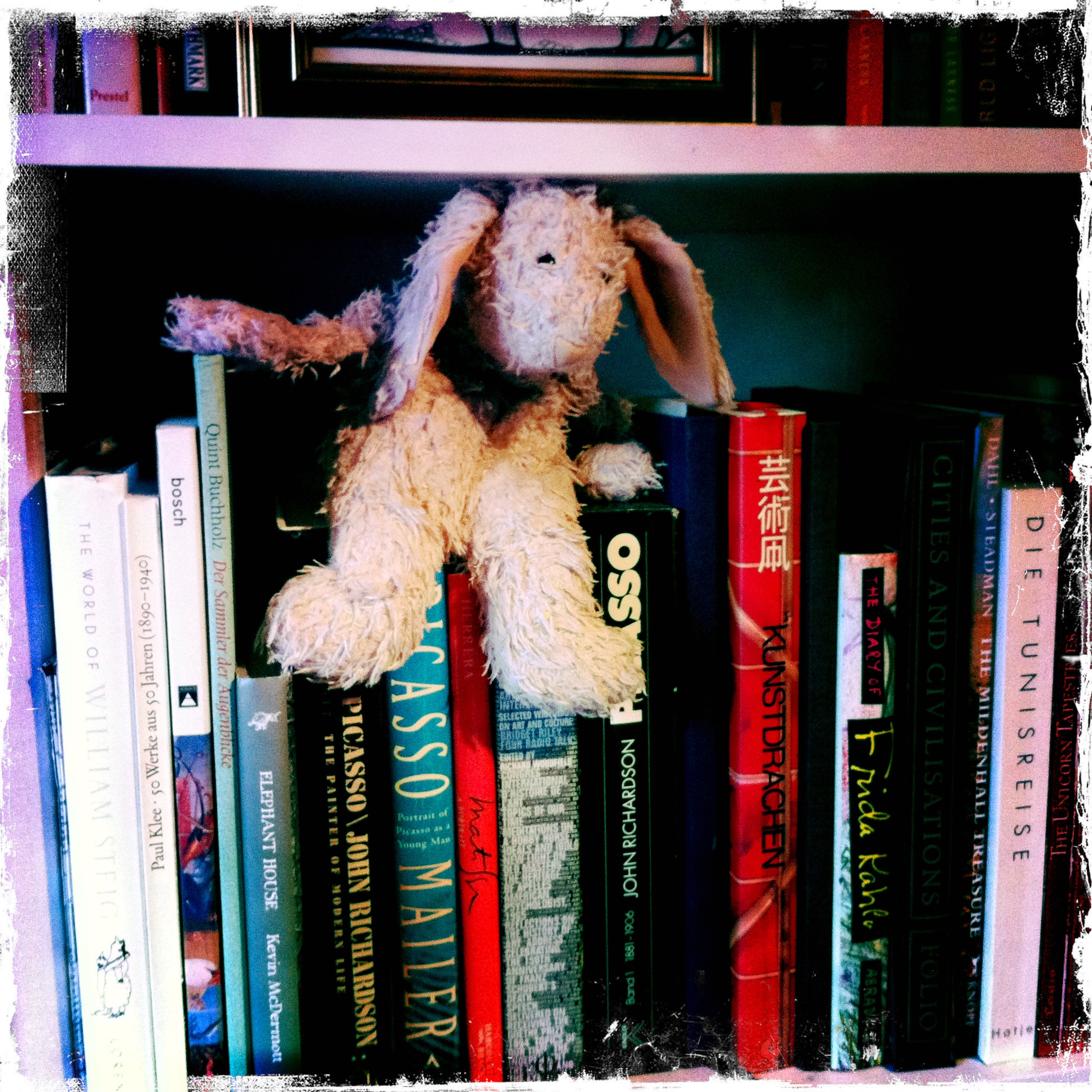
Until the event of the blockbuster bookstore I have always loved any kind of book store or library, and I had quickly found an appreciation for the smallish library in Summerville (not at least due to pretty and efficient Ms. Clarice) and loved the “Small Rabbit Bookstore” in town, too. The owner of the “Small Rabbit” was a nervous, wiry guy who looked very much like a hare. He rarely talked, never left his corner behind the register, and always wore a hat, even on hot summer days.
The store was nothing much compared the Strand Bookstore on Broadway we used visit too frequently when we still lived in the city, or the Crawford’s Childrens’ Book Store on Madison and 93rd Street, and neither did the Summerville Memorial Library compare to the New York Public library city branch we used to go to every Monday after school. My mother had refined the skill of dragging us, my sister still riding on her hip, through the whole library following without doubt a well planned route, while filling a tote with amazing speed: art books, do-it-yourself-guides for plumbing, mathematical treatises, and any selection of dusty volumes on obscure topics. Feeling out the frail limits our patience predictably imposed on her, she would finally settle down in the kids’ section and spent the next two hours finding treasures for us, reading with us and following my sister’s lead crawling through the labyrinth of shelves.
Sometimes I longed to be back in New York, in our cramped walk-up apartment, sharing a bed-room with my little sister. I also longed to be a mere child a little longer, relying on my mother’s ingenuity to entertain and educate me – often by the same idea. I still loved sitting in her kitchen in the afternoon or at night, talking with her or listening to her monologues on H+, the idea of transhumanism, or her doubt concerning the accepted theory of Vincent van Gogh’s suicide.
I also still enjoyed occasionally joining her on weekends for trips or excursions to the city – but things were different than they used to be. Not as simple. It was understood now that I could say no, that I was allowed to choose my own entertainment. My mother still took my sister Phoebe along on every one of her quests whether Phoebe wanted to or not – but I often decided to stay at home even though it made me feel uncannily excluded.<a
Tessalation
In the meantime I stood by and just waited, too impatient to take care of my weekly list of reading and also afraid to let the old man out of sight. My head still throbbed lightly and the smell of the new scrubby grey floor tiles did not help to improve it. I concentrated on the unusual pattern of the otherwise ordinary floor covering. The tiles were light and dark grey and laid out in an unexpectedly complex pattern. Areas can be filled completely and symmetrically with tiles of 3, 4 and 6 sides, but it was long believed that it was impossible to fill an area with 5-fold symmetry though Kepler played with the idea. I knew this because my mother loved the work of M.C. Escher who was intrigued my mathematic patterns and used them in his illustrations. It did perplex me that the library floor tiles were cut out of so called kite and dart shapes which actually do allow a surface to be completely tiled in an asymmetrical, non-repeating manner in five-fold symmetry with just two shapes based on phi. As a result the tessellation of the dense felt tiles in the lobby made it impossible to arrange my thoughts according to the floor pattern – a technique I had used since childhood to soothe anxiety.
Circus Utopia Art Press reads: Thomas Moore
Circus Utopia reads Thomas Moore
It seems to me that where private properties exist, where all men measure all things in relation to money, it is hardly possible to establish, in public affairs, a regime at once just and prosperous, unless you esteem it just that the best things belong to the worst persons, or unless you judge it well that all goods be shared among the fewest people who even then are not entirely satisfied, whilst all others are in the direst poverty. This is why I reflect upon the Constitution of the Utopians, so wise, so morally irreproachable, among whom with the fewest possible laws all is regulated for the good of all, in such a way that merit is rewarded; and that, in a sharing from which no one is excluded, everyone has nonetheless a large part.
Thomas Moore
night watches
That night I kept watch. My journal lay open on my desk but I mainly just looked at the small breathing forms of the hatchlings. The rest of the aquatic doodle bugs continued their dance. I had switched off all but a small desk light, barely enough to illuminate the surface of my workplace. When I looked up the darkness in front of my window seemed impenetrable for a moment until my eyes adjusted to the night. The rook was still perched on a high branch of the acorn, solemnly keeping watch with me. I knew that my sister was probably asleep by now but that my mother would be painting until the early hours.
Keeping watch. It was strange to be quiet, just watching. It occurred to me that most of the time we are actively doing something, except for the few moments when we are waiting in between scheduled activities. But even waiting, to be precise, is a form of activity. It is seldom that we just empty our minds. I said I was keeping watch that night, and that was true, but I wasn’t really waiting for anything to happen. Of course I expected the hatchlings to start moving around in the tank at some point, but I was not impatient for that moment nor was my wish to see them swimming the reason for my sitting at the desk. There was a moment when I realized that I was not, indeed, waiting. There was something else I had to do. I had to try to comprehend the reality of what was happening right here, in my room, on my ordinary student desk, before my very eyes. And in order to understand that this was real, not a fantasy, not a dream, I needed to sit still and open my mind.
It is difficult to describe how time changes when you stop. Just stop. I thought then I knew that time was space, a blue space in which I was suspended like the mermaids in their green world. Time was a wide room with neither up nor down, neither front or back. As I sat in the night, the world that was not human started whispering in a multitude of voices. I thought of my little sister. Did she still hear these voices? Was she awake to all of this?
I listened to the slight hissing sound the radiator valves produced, to the occasional car engine, I listened to the night in front of my window, the rustling of branches, I thought I even heard the rook shifting feet in its watchful sleep. The red stone in my tank glowed silently, and even the silence had a sound to it because I was in the silence.
 Art & Writing