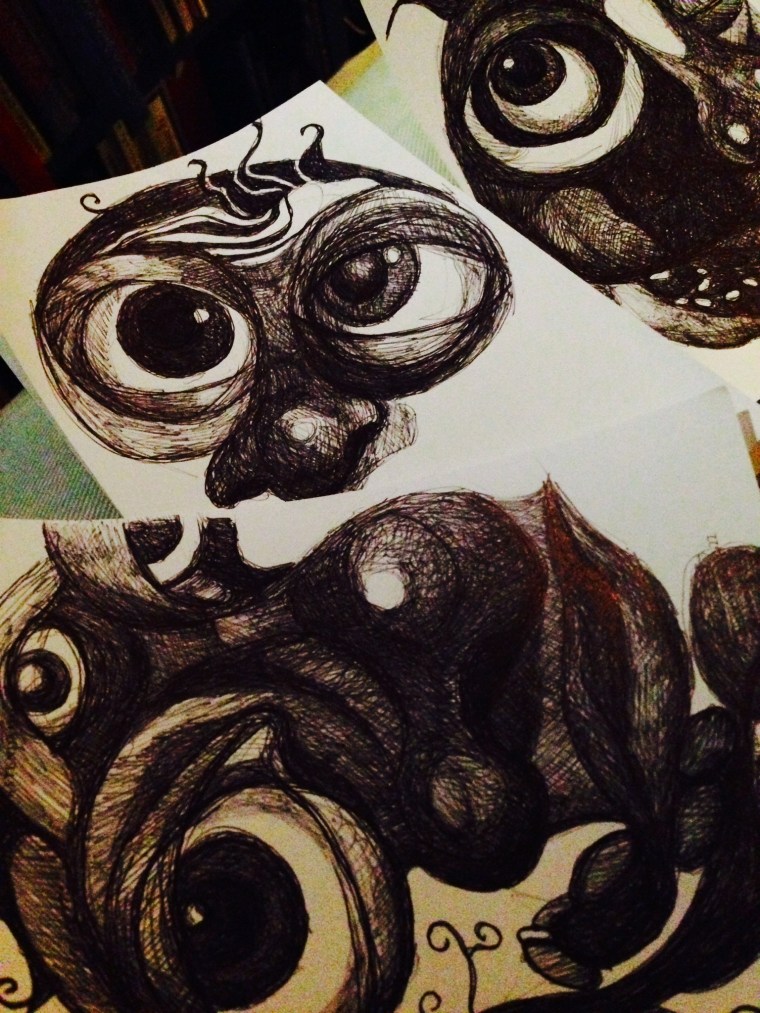
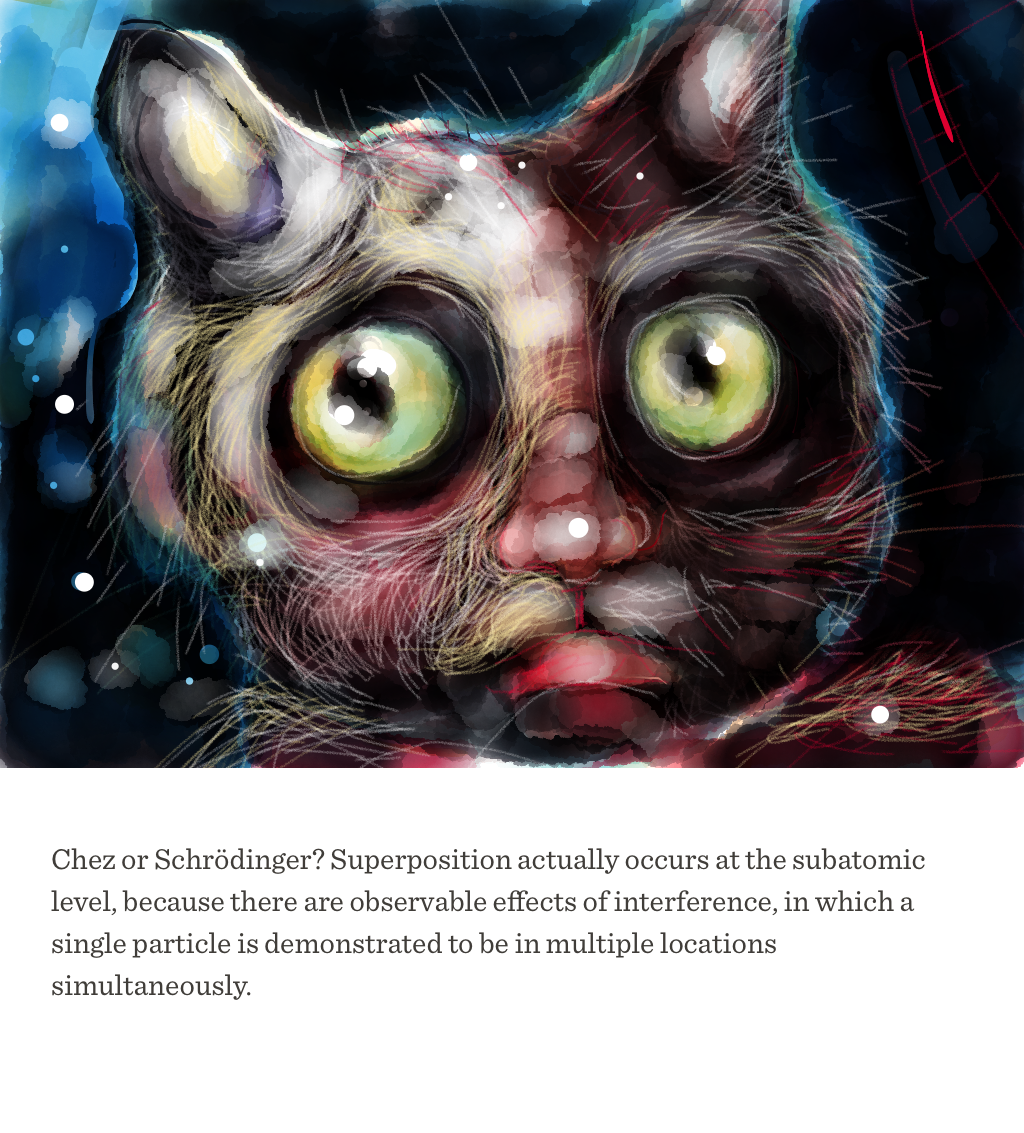
Schrödinger’s cat – or: On the art of being in multiple locations simultaneously

 
After a couple of years working  part time as a lawyer I just started working in a full time position. The first week brought me to about 50 hours and an additional 13 hours commuting time. My brain – while obviously mostly occupied with cases and briefs – feverishly tries to establish a parallel sphere in which running, art and writing might still have a serious existence. While it is hard to get out paints at night digital sketches have been a kind of substitute for my art deprived brain. As for non- legal language impact I have been listening to David Foster Wallace while driving and Proust. In search of lost time. One does not need a psychologist to figure out why these are the choices that offered themselves. As for Schrödinger’s Cat: Only while rereading the small blurb on superposition under my sketch did I realize why the idea has found its way into my nightly art fix: the effect in which a single particle is demonstrated to be in multiple locations simultaneously. 

someone’s watching you – privacy of data, an appeal / round two

Image 5

“Writers must oppose systems. It’s important to write against power, corporations, the state, and the whole system of consumption and of debilitating entertainments. I think writers, by nature, must oppose things, oppose whatever power tries to impose on us.  … You know, in America and in western Europe we live in very wealthy democracies, we can do virtually anything we want, I’m able to write whatever I want to write. But I can’t be part of this culture of simulation, in the sense of the culture’s absorbing of everything. In doing that it neutralises anything dangerous, anything that might threaten the consumer society. In Cosmopolis Kinski says, “What a culture does is absorb and neutralise its adversaries”. If you’re a writer who, one way or another, comes to be seen as dangerous, you’ll wake up one morning and discover your face on a coffee mug or a t-shirt and you’ll have been neutralised.” Don DeLillo (Panic #1, Nov. 2005, pp. 90-95.)

And is it not at the same time a cynical paradox and the hybris of writers, artists and maybe even lawyers, yes, now that I mentioned it, certainly lawyers as well, that in striving to be effective, successful, sharp, persuasive, unveiling, exposing, revealing, uncovering the workings of the machine we also strive for the kind of recognition that neutralizes our very effort. This is still the romantic idea of the individual rebel, the genius writer, the brilliant artist, a sly title afforded with societal approval by the very system that is being accosted, criticized and opposed just because this honor neutralizes, even castrates the very effort it lauds. Don DeLillo writes accordingly in Underworld that true proof of existence lies with the recorder not the recorded, the one who does not have a name but the authority to write the code which makes time tick. My words, his idea, by the way.

If you did indeed value the corrosive of your intellectual ability  you would choose to remain unknown behind a work that was known for its efficiency. you would not buy the idea of the genius writer who ends up on a t-shirt or, for that matter, on Facebook where you can democratically and to no specific end be approved of by the click of a button, but you would anonymously and in a group of like-minded minds labor towards the specific end of a realization of your ideas.

this is, coming round from yesterday’s etude on the privacy of data, another appeal to keep private if you can and claim the right and authority to do so.
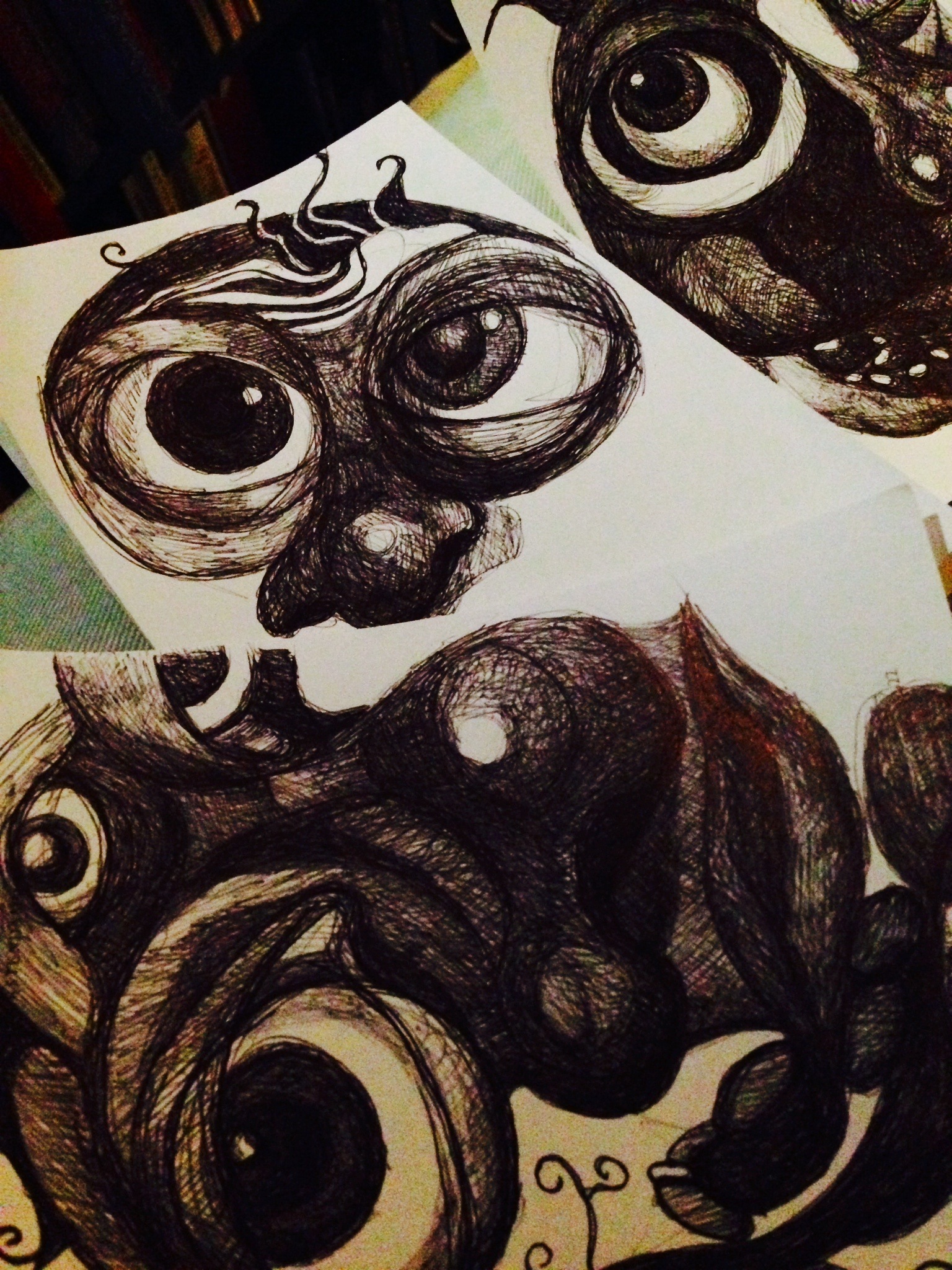
Infinite Jest …

IMG_5726It only occurred to me some years after first meeting him that his brain had been on fire probably day and night, during waking moments and during sleep. He was, I could see that right away, back then, high wired, hyper intelligent, super sensitive, coy, cornered, cynical. In was apparent in the first conversation one would have with him that he was constantly computing any kind of informational offering of his environment for bits and pieces of useful knowledge, useful in his own sense, not ruling out the value of overheard conversations of strangers, visual clues of bill board advertisement, the color scheme of the dioxin polluted NJ marsh lands, conspiracy theories and their opposites, math, astronomy, information technology, Shakespeare, even the CNN news ticker. He was reading, forever reading, and then reading some more, his brain was speed feeding itself knowledge, and he could recover this knowledge with the casual speed of a trained illusionist. When I knew him better he showed me the encyclopedic if highly individual work he was dedicated to, a work in many volumes bound in blue linen as soon as a new one was considered completed. A friend who worked at a university library did this for him volume by volume, one for the shelf in his den, and a twin one that he archived openly secretely in said library, for everyone to see and no one to find in maybe another century. It was a work so biased and yet so beautiful that it was unquestionable that I had been admitted to a unique work of art though he preferred to call it a scientific study of random code.

And still, it was only years later when in the course of an increase of my English language skills I could not only read but  also hear all the different voices merging in “Infinite Jest” by David Foster Wallace that I realized I had actually met a man who is – if that is at all possible considered who Wallace was – the dark twin of David Foster Wallace, sharing his semantics, his obsession, his socioeconomic circumstances, his despair, his addiction, his near autistic ingenuity to gain access to ever deeper layers of information and information encoded within this information,and that he was the man who had to be expected to exist in the margins of literary history, never to be found, as we know that there is never just one genius at any given time, but often just one to emerge to public consciousness , maybe to his own destruction. so that, with other words, i know there to be one other living madman, or genius, or whatever you’d like to call a man with a brain on fire, to weave the net still, to still find the words, to write the chronic of what is and was and will be in all its Borgean implications, thereby freely accepting the responsibility of calling the world into existence.

artist statement (mine)

this knowing “you are on to something good” is exactly where the artist meets the scientist. only that in general the scientist will be patient and disciplined enough to acquire the skills necessary to actually explore and eventually understand that unfounded suspicion and the artist will just take a cursory inventory of the idea’s implications and then take to the type writer (or the canvas) like the monkey, ready to blindly shell out the sequence of letters to actually and surprisingly eloquently prove that “it” was always known.Bild

Ez 9:4-6 KJV

IMG_5724

eliminating comforting words
seems an appropriate strategy
to counter the hours
relentlessly expanding
the fabric of the mind
between midnight and dawn.

left behind are words with letters
like ceramic blades
well suited to cut
sharp silhouettes into the darkness.
tau, Ez 9:4-6, KJV, they read,
but no comprehension follows.

Slay utterly old and young,
both maids, and little children,
and women
but come not near any man
upon whom is the mark.
let not your eye spare, neither have ye pity.

old testament, yet one eternal god,
this is the fabric of the mind, a thin membrane.

clearly, another cut is needed
to calculate the rate of emission
of radiant energy, radiant flux,
electromagnetic radiation
emitted by charged particles
while traveling through space.

light is
beyond that dark membrane
of the mind’s fabric,
serving as a selective barrier
between origin and time.

compared with the luminosity
seeping through those merciless cuts
i am
but an ordinary lie.


and so,

forsaking conventional wisdom,

i cut out letters of sober inquiry

with ceramic precision,

exchanging the comfort of an ordinary lie

for the shimmering beauty

of inconsequential pain.


Newton to Heisenberg

Newton to Heisenberg

What would you have me
Embroider on my dress
Or my coat?
And would it quell that sense of outrage
That haunts you?

What confession would you
Have me deliver
Or sign?
And would it satisfy your desire
To prove yourself?

(and to whom)

Which ideas would you have me
recant
Or change?
Would it give you a sense of safety
If I stated that
What should not be possible
Will not take place?

(as all children ask in the dark)

Too late, my friend.
The words have been said.
The deed’s done.
A door has been opened.
And there is a rip in the fabric
Of your three dimensions
Admitting a fourth
And a fifth

And so on.

I would gladly give you a hand
To help you find your way
From Newton to Heisenberg
But you see
I already slipped through
That rip
And I just don’t feel
Like coming back.

You’ll be fine.

space, void of people

I woke up when a hand was gently nudging my shoulder. My neck was stiff. I was still sitting in the library chair. Dr. Hausner was gone. “Miss, I am afraid we are closing.” A woman’s voice. I looked up. Ms. Clarice stood right next to my chair, smiling. All other visitors were gone. I got up drowsily and carefully checked the window reflections, too. All visitors were gone. “Are you alright?” Ms. Clarice inquired. I looked at her closely. Her small golden earrings reflected the fluorescent library lights, transforming the miniature reflections of the library on the convex mirror of the gleaming curves  into a warmer, more elegant version of the actual space. An alternate space more suitable for someone like Dr. Hausner than the mundane space of Summerville library.

“When did Dr. Hausner leave?” I asked. Ms. Clarice narrowed her eyes. She ignored my question.  “You must be very tired,” she replied, “go home and sleep.” “Did you see him?”, I insisted. “Go home and sleep, Miss, I have to switch off the lights now.” I wanted to protest but she anticipated my notion and gently shoved me along. “Come back tomorrow,” she repeated, not unfriendly. We walked down the staircase together.

There was nobody downstairs either. From the winding staircase I could see  the lower floor breathing calmly. The tessellation of the carpet tiles looked like the exposed skin of an ancient creature. An empty library is a marvelous space. Really any space empty of people holds some kind of promise that seems to disappear once it gets populated. When I slowed down to linger on the staircase, I felt Ms. Clarice’s warm hand on my shoulders again, encouraging me to continue down the last few steps. I sighed. “It’s beautiful, the library, “ I said apologetically, “at night, I mean. When all the visitors have left.” We reached the ground floor. I took care not to step on the lines of the irregular tile pattern. I have never been quite able to just move without paying attention to the rhythm of any kind of tile, responding to it in some way, and today was not the day to start with it. Ms. Clarice remained silent while I gingerly crossed the open space. I wondered if I ever would get used to people not answering. Strictly speaking, I had not asked a question though. Ms. Clarice looked the kind of woman who did not have an appreciation for idle conversation.

She waited patiently while I balanced over to the cubbies to pick up my bag. I pulled out my jacket first. A small piece of paper trundled to the floor like a feeble bird. Folded from yellow legal paper. I bent over and picked it up. Ms. Clarice was still waiting for me at the door, so I simply slid it into my pocket, shouldered my bag and walked over. She still smiled, never once complaining about the delay. “Good night now,” she said simply. I nodded. She locked the door right behind me. It was cold outside. When I turned around, the lights in the library had already been switched off. The building looked deserted. I started walking into the evening.

Sirius

Often, on late summer nights my mother, my sister and I laid down flat on the lawn of our front yard and looked down into the stars. The grass of our lawn was long and wavy, different from the short cut golf course front lawns of our neighbors, and woven through with moonflowers that smelled lovely in the warm, damp night air and in their whiteness actually glowed like little stars themselves. I remember one night when I felt particularly light and small, and grateful to gravity for holding me securely to the surface of my own planet. The stars glittered in the distant depth. My mother giggled when she noticed that my little sister had fallen asleep right there on the lawn, her head nestled onto my mother’s shoulder. Suddenly it seemed so unlikely to me that in all of the universe expanding before my eyes our planet should be the only one with life on it. I asked my mother, who had been silently holding my hand whether she thought that there was life out there. My voice sounded like a whisper. It was the kind of question to which you don’t really expect an answer.
My Mother took my hand and pointed down at the three stars of the belt of Orion. “Your fist like this”, she said, “covers about 10 degrees of the night sky.” She moved my hand slowly over the dark water and spoke in her methodical way, no use to interrupt her. “20 degrees south-east of the belt of Orion, you see, there is the brightest star in the night sky, right in the constellation of Canis Major.” She waited for a moment for me to catch up with her. Our entwined hands travelled over the night sky and stopped. And there it was, deep underneath us, the brightest star of the night sky, as far as I could see. “Do you see this star?” she asked. “It is called Sirius. It is 23 times more luminous than our sun, twice the mass and the diameter of the sun. It is only 8.5 light years away.” The way she said “only 8.5 light years”, it sounded as if she was talking about a Sunday picnic destination. It sounded like: We could take the bike. It’s only 8.5 light years away. Before I had a chance to point that out to her, however, she had started talking again, and almost without warning, though in answer of my question, switched from her facts, from degrees between two points of light in the celestial sphere, luminosity and brightness, and mass of celestial objects, to a startling revelation: “My grandfather, your great-grandfather, believed that there is life in the Sirius system. The Dogon, an African tribe with very acute astrological knowledge, have believed for centuries that there is life out there as have the ancient Egypts and the Sumerians. According to the Dogon Sirius is accompanied by two other stars, a very small and incredibly dense star they call Po Tolo, which means “very little star”, and which modern astrology has confirmed to exist only recently and calls Sirius B. Indeed it has turned out to be a small star with an incredible density, heavier than the iron we know on earth. The Dogon also claim that the other star in the Sirius-System is lighter and larger than Sirius. They call it Emme Ya. And around Emme Ya they say there orbits the home planet of the Nommos, the children of Sirius and Emme Ya.“