Page 2 of 4

moonflower

Canis Major as depicted in Urania's Mirror, a ...
Canis Major as depicted in Urania’s Mirror, a set of constellation cards published in London c.1825. Next to it are Lepus and Columba (partly cut off). (Photo credit: Wikipedia)

“Your fist like this”, she said, “covers about 10 degrees of the night sky.”  She moved my hand slowly over the dark water and spoke in her methodical way, no use to interrupt her. “20 degrees south-east of the belt of Orion, you see, there is the brightest star in the night sky, right in the constellation of Canis Major.” She waited for a moment for me to catch up with her. Our entwined hands travelled over the night sky and stopped. And there it was, deep underneath us, the brightest star of the night sky, as far as I could see. “Do you see this star?” she asked. “It is called Sirius. It is 23 times more luminous than our sun, twice the mass and the diameter of the sun. It is only 8.5 light years away.” The way she said “only 8.5 light years”, it sounded as if she was talking about a Sunday picnic destination. It sounded like: We could take the bike. It’s only 8.5 light years away. Before I had a chance to point that out to her, however, she had started talking again, and almost without warning, though in answer of my question, switched from her facts, from degrees between two points of light in the celestial sphere, luminosity and brightness, and mass of celestial objects, to a startling revelation.


looking down at the stars

looking down at the stars

When I was five, my mother, an artist, told me that over time the use of the words “up” and “down” had been reversed through what she called “accumulated acts of lazy thinking”. Consequently, she told me, people had gotten used to seeing the world in a crooked way. With other words: where other people look up into the tangled branches of a tree, to the clouds, an airplane, the sky, my mother had trained herself to look down into the depths of the endless oceans of the universe.

The amazing thing is that the moment you try this, it feels just like the right way to look at things and you will feel like you have never truly seen the sky before. Stretching myself I reach deep down into the world whereas before, when I understood up and down in the usual way, the sky seemed more or less like a painted stage decoration.

Often, on late summer nights my mother, my sister and I would lay down flat on the lawn of our front yard and look down into the stars. The grass of our lawn was long and wavy, different from the short cut golf course front lawns of our neighbors, and woven through with moonflowers that smelled lovely in the warm, damp night air and in their whiteness actually glowed like little stars themselves.

I remember one night when I felt particularly light and small, and grateful to gravity for holding me securely to the surface of my own planet. The stars glittered in the distant depth. My mother giggled when she noticed that my little sister had fallen asleep right there on the lawn, her head nestled onto my mother’s shoulder.

Suddenly it seemed so unlikely to me that in all of the universe expanding before my eyes our planet should be the only one with life on it. I asked my mother, who had been silently holding my hand whether she thought that there was life out there. My voice sounded like a whisper. It was the kind of question to which you don’t really expect an answer.

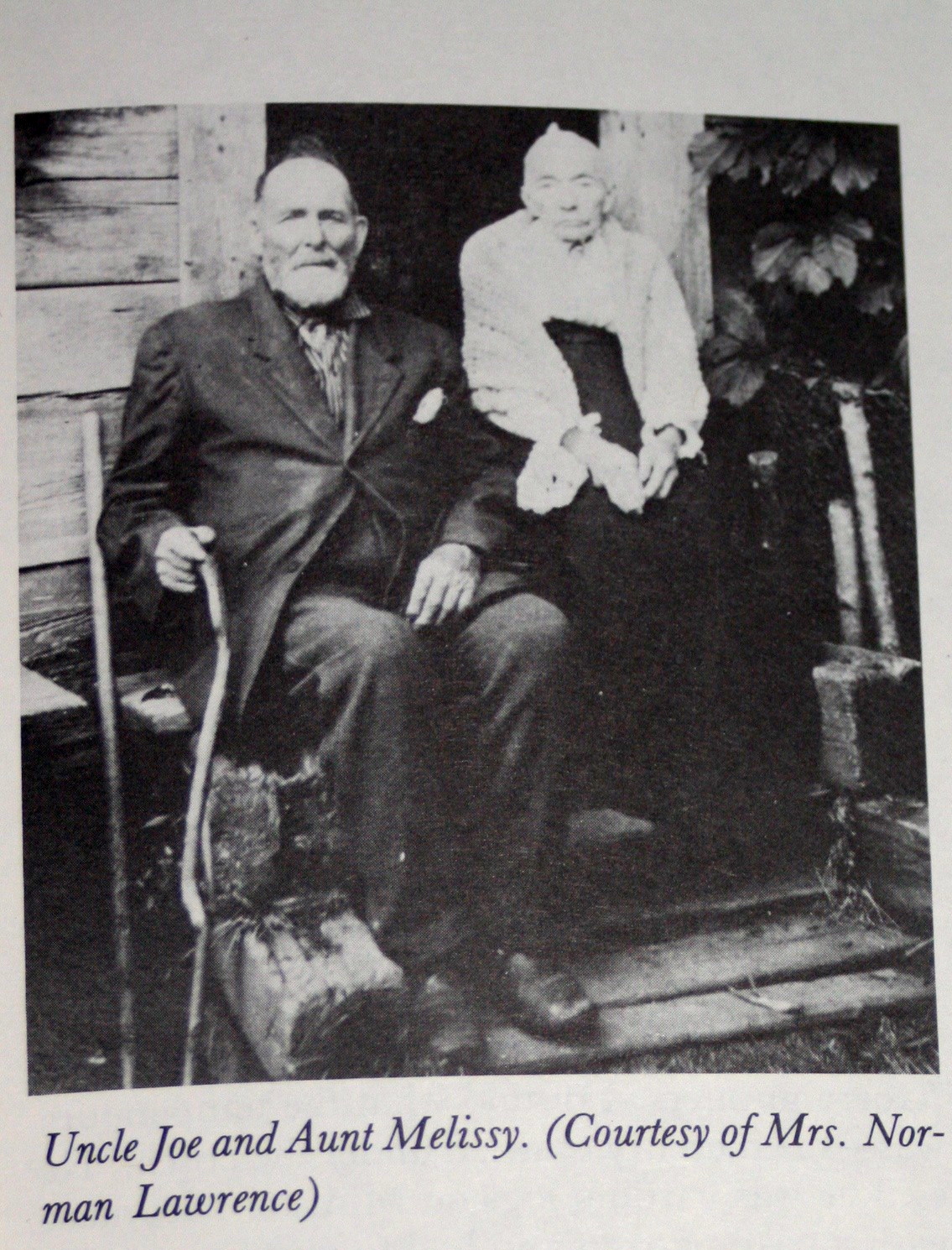
Aunt Melissy and Uncle Joe

Image - Version 2

Uncle Joe was as talkative as his wife was quiet – but she had a quick wit, accentuating his stories with dry remarks that he returned with good natured smiles. “The smartest girl in the Northern County she was”, he would sometimes say, “and imagine, she agreed to marry me! But only after I cut my beard and swore off tobacco. She would not have had me otherwise, and I have become a better man for it. “

As I started to get stronger and could sit up in bed, still wrapped up in the blankets, Uncle Joe would entertain me with outrageously funny stories of his youth. He was given to enraptured fits of laughter triggered by his own jokes. When he got too carried away with his stories, Aunt Melissy would look up from her work – for she was never idle – and comment sternly: “Never be rash with your mouth, nor let your heart be quick to utter a word before God, for God is in heaven, and you upon earth; therefore let your words be few.” Then Uncle Joe smiled good-naturedly and continued his story with just as much zest while Aunt Melissy continued with her chores as if the words had not been spoken. Only on Sundays she did not tolerate his spinning of tales but insisted on bible study and quiet prayer and he obeyed her without complaint.

I have never again met a husband and wife who seemed so comfortable in their home and so content with their life and each other. Despite his stockiness Uncle Joe was quick to jump up like a cat when Aunt Melissy entered the cottage and eager to please her with some little errand or kindness. She returned his pleasantries with home baked goods and fragrant meals. Her only love besides Uncle Joe were the snow white chicken in her yard for which she was known in the county. Aunt Melissy and her white hens. Children they had none.

shadows

IMG_5733

the shadows were moving slowly, swaying like branches in a light breeze or high buildings on a windy day. to detect purpose in these gentle movements required a slight degree of paranoia, and yet there was no apparent natural cause to explain the shift of the shadows away from their corresponding objects and towards the center of the village like water draining from upset glasses.

finally, there were just a bits of shadow left, like drops in a sink adhering to the enamel by their surface tension. these droplets of shadow were sparkling like rainbows, no grayness reflected. the air was still and non-expectant, noon in a depressed small town, and the realization that the world was without shadows had not yet sunk in. in a dirty jeep, parked close to the village center, a woman lit a marlboro.

even those who had dismissed the shadows as inessential, felt disconcerted when the birds ceased to sing. on the morning of the third day, after a dawn without luminosity had given way to dull day light, small insects began their crawling procession towards the centers that had swallowed the shadows.

and someone laughed at the gray man in his wrinkle free woolen suit who solicited signatures on retro-active insurance policies. “one day only”, he implored, “an amazing offer”, but they shooed him away while watching the myriad of tiny, scarlet colored spiders tie a living ribbon between the outskirts of the village and the shadow drain.

and yet, the spiders said, too easily do you accept that we form a living ribbon, and wander into oblivion. one by one. what to your eyes a living ribbon is, to ours is a band of pain, and joy, and hope against all odds.

She seemed to be right out of a historical reenactment society


I was so completely startled by this sudden change in behavior that I wasn’t even shocked to feel a hand grabbing my shoulder and yanking me down from my boulder and back to shore.
The hand was firm and muscular. It dragged me away from the shore a few steps, beyond the tree line and I had to oblige, stumbling backwards. When we reached the shelter of the tree, the hand let go. I turned around. The strong and determined grip had been misleading. Standing in front of me, inspecting me gravely with birdlike, black eyes, was a tiny, old woman. She wore a long rough shirt with an apron over a grey flannel shirt. Snow white hair done up in a tidy bun, her narrow shoulders wrapped in a grey woolen, triangular shawl, she seemed to be right out of a historical reenactment society. “And what did you think you were doing there, laddie,” she inquired with an authoritative voice. Apparently she mistook me for a boy, addressing me as laddie. “Speak up,” she demanded, quite clearly being used to be obeyed immediately and not one prone to put up with any nonsense. I shivered. She stepped closer again, then reached out and pushed my tangled hair out of my face. Taking a sharp look at my face she murmured to herself: “In a bad shape we are, aren’t we.” And inspecting me a few more moments she added: “A girl in a lad’s clothes, if I ever saw such a thing, lost too, I take it.” She put her hand on my forehead. I started shaking violently. “You are burning up,” she observed, again more to herself than to me. If I had had any more strength left in me, I might have inquired right there and then why she had yanked me away from the boulder. If I had been in my own time and place, I would have protested most decidedly about being ordered about by a woman who was a complete stranger to me. But here I was, meek, shivering with fever and cold and lost. The tiny lady took off her shawl and wrapped it around my shoulders. “That’s more like it,” she stated grimly, referring to my state of clothing, I am sure. Then she simply took my hand and pulled me along.

Woe to the unfortunate stranger who should come upon the gate they were keeping

For a brief moment also I did wonder now whether I was still dreaming. Yet the wet sand, the sea gulls of the lake circling overhead, the light on the water, the dark blue reflections of the two adjacent Mountains, Mount Hor and Mount Pisgah, in the misty mirror of the lake on the distant Southern shore, everything had a coherence that was not dreamlike. And yet the situation was surreal, not only because I had fallen asleep on my bed and woken up on a wet, cold beach hundreds of miles away from home. The sun, for example, was incredibly small, too small for our planet, planet earth. In the east the sharp crescent of a waxing moon, greeting the morning with disdain, was accompanied by a second crescent, a twin moon. And the surface underneath me was still breathing. And yet I knew the silhouettes of the twin peaks by heart. My mother used to tell us on warm summer nights, when the sun had already left the sky and only the patient outlines of the rock formations on both sides of the lake were still cutting into the advancing darkness, that the mountains were ancient guardians who were forgotten by their masters and not having been relieved of their duty had decided to keep their post to the edge of doom. Woe to the unfortunate stranger who should come upon the gate they were keeping. Lake Willoughby was an incredibly deep, glacial, water filled ravine, and there was some sparse folk lore about creatures living in the dark, about a connecting underground acquifer between the lake and its twin lake, Crystal Lake, to the West behind Mount Hor. It was a strange place, but being as remote had kept all stories at bay.

I sat still for a while, waiting for the scenery to change or disappear like dream images do, especially if you pay too much attention to the details, but the situation was as real as you can imagine, and not prone to change any more than Ms. Havenshire’s classroom during an especially tedious lecture on a philosophical concept that excited her. I stared around for a while, bravely ignoring the piercing cold, trying to take an inventory of everything. Except for the strange planetary constellations, the lake seemed real. I had never been up here in fall but I imagined it to look as lonely and cold as it did now. It is not exactly a lively place even in summer. And in winter, once the snow started, it would be one of those places that were cut off from the outside world for weeks on end, alas with the local people being prepared for it and not disconcerted by a few inches more or less of snow or even by massive boulders coming thundering down the mountains just like every winter. There was no skiing and therefore no seasonal dwellers in winter. Both, Mount Hor and Mount Pisgah were too steep and fully covered with trees.

I was shivering violently now, my clothes were as damp as if I had actually spent the night unprotected on the beach. When I finally stumbled up to my feet, it took me a moment to find my balance just as it would have on a big gym mat. I tried to disregard the breathing of the surface and made a few gingerly placed steps towards the water. What to do next? What to do if you are suddenly stranded in a place without any preparation or at least warning? Why was I here? In a dream, typically, events keep unfolding and you keep reacting but the lake was quiet with quick shadows dancing over the surface. I stopped at the water’s edge. Little waves arrived at the shore with a sweet sound. Light was dancing silver on the ripples. I was getting colder by the second, shaking most convincingly.

I had to find shelter. There was a colony of summer cottages at the North Beach, they would be boarded up for the winter, but maybe I could find a way in all the same to warm up and think. It seemed a reasonable plan, if you can at all call it reasonable that you have to think about finding shelter in a dream. Again I asked myself what I would do once I got inside. Maybe there would be a phone but even if there was, it probably would be disconnected for winter. Would it even make sense to call home and ask for someone to please come and rescue me? How ever to explain how I got here? And would it be possible to call home even if I found a working phone? I turned around to scan the tidy row of vacation cottages at the North Shore to find one that would suit my improvised plan and I faced an impenetrable row of trees. The cottages were gone.

the earth itself, underneath my body, was a breathing organism, like a gigantic whale you find yourself stranded on

How hard my mind had to work to keep control, to still try to make sense out of a wealth on information that had long stopped to be apprehensible by any rules I had been led to understand applied. But only submission to the world of grown-ups would have you believe that they were – in general – truthful about the world. I didn’t believe this anymore but tried to rely on my own senses instead. It was treacherous ground.

For example that night. As I lay in the dark, eyes closed though wide awake, the surface of my bed felt soft as was to be expected, but it felt soft in the way I had experienced and shied away from before. It seemed to be soft in an organic, breathing way. I tried to distinguish between my own breathing pattern and the breathing of that soft, pliable surface I felt underneath my body.  It was an uncanny feeling – but just ask yourself how many sensations you can really clearly distinguish besides soft and hard, warm and cold, pain and pleasure. Truth is, you constantly rely on additional sensations and context to tell you about the thing you are experiencing through just one of your senses to make sense of something.

What was it that I was feeling? Something that I feared, but I didn’t know why I feared it or whether I had reason to fear it in the first place as I was completely unaware of its nature. All I knew was that last time I checked my bed had not been breathing. As before it felt actually – and it made perfect sense to think those words as irrational as they might seem – that the earth itself, underneath my feet, my body, was a breathing organism, like a gigantic whale you find yourself stranded on. It didn’t make sense and I couldn’t explain to myself where that strange idea actually orginated. Nothing I had read or talked about lately had pointed in that direction. Remember, there was no internet and but little TV. None in our house, by the way.

And yet, I just felt it, right there and then, the surface underneath me belonged to something alive, and I knew I had to open my eyes to find out what was going on, but I was entirely too scared to live up to my own imaginative ability. All I could manage to do, pathetically,  was to continue breathing slowly just as I had done during those long ago nights when I had led some non-existing intruder to believe that I was asleep. And with each moment the sensation of a sighing, breathing surface underneath my body was getting stronger.

god and a decade ending with the brief and delirious ruling of acid freaks, post feminists and de-constructors of language

When I thought about the idea of god waking me (or not) I became afraid. There was a German lullaby by Brahms that my then ancient great-grandmother used to sing to me when I was really very little which ended with the words: “Tomorrow morning, if God wants so,
you will wake once again.…”  Our family life was altogether politically non-theistic, except for the great-grandmother who passed away when I was about four, but the idea of god deciding about my waking in the morning was still disconcerting. What if he did not want to? On a whim? Would I just sleep forever? Would I die? What if he plain forgot about me?

When I had asked my mother about the song she had explained to me that the lyrics dated to a time when it was understood that everything – everything – happened only with god’s consent and that these lines, by their content, did not deal primarily with the idea of god remembering to wake people or not.

I don’t know whether that explanation did much to put my anxiety to rest, I think probably not. But it certainly was with relief that one day I realized that I actively did not believe in god. That was an easy attitude to acquire in my family, by the way, and an easy attitude in that decade following the sixties, a decade ending with the brief and delirious ruling of acid freaks, post feminists and de-constructors of language which left a lasting impression on western societies and which was my intellectual parents’ undeniable contribution to a new cultural value system, a system that allowed for people like them to unfold their wings and discover entirely new horizons and ideas.  I don’t remember that we had ever attended any church service. Even wedding ceremonies in my parents’ circle of friends and family were civil ceremonies. No baptisms. Still, God remained a quaint distant relation who, after a history of misfortunes, had found asylum in old nursery rhymes and lyrics. All but forgotten and without charitable visitors, but hanging on.

My parents’ were avidly confessing atheists for many years until older age and the dawning sense of their own mortality softened their rhetoric. And yet, my childish sense of superstition, during the phase of their most decided and articulated stand on the topic, detected an ominous quality to the concept “god” and it took some years and my awakening intellect to overcome the threatening taste the fear of that forgotten but lingering god left in my mind. Maybe god explained and explored would have been easier to understand but I was pretty much left to my own devices to figure out what the idea of god stood for.  I vaguely feared god until I shed that fear pretty much like I had shed the fear of the nightly intruder eventually. Only much later did it occur to me that the elimination of god did not erase the randomness and with it the terror of the unpredictable nature of death.

page 176 – still in the library

I took out my small compact powder out of my jacket pocket. I clipped it open and looked into the little mirror in the lid. My face glowed sickly pale under the fluorescent lights. Winter pale.  I clipped the lid down, got up from my chair and stepped into U – Z. As I had expected, there was no one there. Velasquez, Varese and The Venetian School, gigantic volumes, with soft, yellow pages lingered pompously yet with a limp attitude between smaller books, waiting to be released from the boredom of their shelf lives. This is what immortality means, I thought, sitting on a shelf as an afterthought to your own life. Maybe to be lifted down every few years to be perused briefly for some kids’ art assignment.  I touched the laminated, slightly deformed backs with my fingers. Books do not endure lamination well, a laminated book resembles a plastic covered sofa. One cannot enjoy it. I apologized to the volumes that were sighing with age and discontent …

I have been working on this novel for a while now. There are passages that I really love, snippets, impressions that convey the atmosphere I want to create. There is also, almost surprisingly, some real plot (unusual for me) and a couple of protagonists I can vividly picture like I can picture friends. The novel could be read as science fiction – or it could be an account of a delusion. I don’t quite know which one it is, but so far it could coherently be read as either and it will depend on the conclusion to point in one direction or the other. Any kind of science fiction could of course be an account of the protagonist’s delusions if one chose to read it like that. This is one reason I chose the genre for this particular coming-of-age story in the first place. Another one is that I have been craving for a playing field for my interest in ephemeral science and have been having a ball researching and reading up on all kinds of science projects with marginal news interest from marine bioluminescence to quantum physics to astronomy.


Library, U – Z / another excerpt

I stared at the girl. She stared back, then, inexplicably, she smiled regretfully, rose out of her chair and smoothly walked over to the bookshelves, turned the corner and was immediately out of sight. Before I could follow her into art books U – Z and ask her to wait, I heard voices. Two elderly women were approaching us through the middle aisle. One of them held a library catalogue card and they both scanned the shelves. “Agnes, Denes, D, don’t think we will find anything here, Marie. Might just as well look for Leon Levinstein, L. Won’t find anything on him either, I bet. It’s all van Gogh and Monet and Renoir, coffeetable stuff. We will have to go to the New York Public Library for Agnes Denes, I tell you.”  Marie grunted. “Now, “ she admonished her friend “we will not know until we look, will we? These libraries sometimes are better than their reputation. Librarians are strange people, and they are in charge. “ The ladies turned corners at “D – H”. Their voices were swallowed by the books. It was too late to try and follow the girl into U – Z.