Page 4 of 4

raving madness

I had seen a lot of strange things recently, but nothing quite matched the moment when I first realized that the girl I had been looking for only existed in the reflection of the mirror. And yet I felt her standing right next to me. I wasn’t terrified. Thinking about that I still wonder about my comparative cool. My heart was beating like crazy and my stomach was churning. I was speed thinking, but in circles. I didn’t think “it’s impossible”, not once since I had ventured out to find Penelope Hofmann had I entertained that thought. But I was coming close to it this moment. All other inconsistencies with reality that I had noticed before had still born small elements of ambivalence that left open the possibility of an explanation to reestablish everyday logic. But there were only two explanations for the incredible appearance in the window: either there were more phenomena possible than had been scientifically accounted for so far – I wasn’t ready to think into the direction of supernatural beings – or I was raving mad. Whatever it was, it didn’t seem directly threatening. I was still sitting here, the girl was still standing right next to me in the reflection of my world in the window, and there was nothing I could do at this moment to change that. Maybe with the exception of an immediate termination of my belief that this was possible. Somehow. I realized at that moment that I would prefer to be raving mad to inhabiting of a world without surprises. I managed a weak smile in direction of the girl. She responded with a grin.
Leonardo and mirror script

I sat down on my chair and opened my notebook. A yellow, folded over sheet of legal paper slid out and in one smooth gliding motion fell onto the floor. The old lady. I had completely forgotten about her note. I picked it up and unfolded it. The creases were precise like origami folds and still remembered the birdlike fingers folding them with sharp determination. The lettering elegant and even, very pretty, did not at all resemble the kind of handwriting to jot down a passing thought on a small piece of legal paper. I could read it and couldn’t at the same time. I got the rhythm and it seemed strangely familiar. It wasn’t all that difficult to decipher and yet it took a moment to realize how the writing had been transformed without becoming a stranger to itself. Most everyone who is capable of reading will eventually grasp the concept of script as reflected in a mirror. The old lady had been writing in mirror script. Once I recognized that she had used mirror writing I could read it as you would, too. My mother had once told me that Leonoardo da Vinci had used mirror writing in his journals. He only ever used his right hand writing from the left to the right side of the page when he was addressing someone else through his writing. For all other purposes he chose to write right to left side of the page, reversing his letters as he spelled each word. Historians have discussed ever since what could have motivated him to do so. Some have said that he wanted to make it harder for others to steal his ideas. I don’t think that could have been the reason. Anyone can read mirror script fluently just with the tiniest bit of practice. A genius like Leonardo could have done much better encoding, thereby disguising his secrets. I think he just chose to write from left to right because he was – as is known – left handed. A man who loved to draw in the most precise, specific way, would he not have hated to smear his own writing? But anyhow, reading reverse script is not all that difficult. But I wanted to make sure I got it right. So I lifted it up against the window. There it was, the writing clear and beautiful. I had recognized it even in mirror image, even before I had recognized it as such, I had listened to the words so often and had read them many times, they were like a familiar face. “The Road goes ever on and on. Down from the door where it began. Now far ahead the Road has gone, And I must follow, if I can.” She had painted the letters JRT underneath. And I must follow if I can. As if I didn’t know. I stared at the lettering in the mirror of the window glass against the darkening sky. I stared at myself holding the sheet against the pane. I stared at myself n the window glass. Who was I? Where was I? The other me looked back, a pale, shimmering reflection.

anticipation and tesselation

The floor in the library greeted me with the reliable intricate tessellation I had marveled at since I had moved to Summerville. Knowing that it would have seemed strange if I had stood still and just stared at the carpet tiles I walked slowly towards the lockers trying to mirror the rhythm of the tiles with my feet. I stuffed my backpack into a cubby hole and tried to work out – not for the first time – the plan for quasi-periodic tiling of the plane with only 2 figures each with a five fold symmetry. It had a peculiar energy to it. Also not for the first time I asked myself who in the world had come up with this specific mathematical tessellation for a library floor carpet. Following the outlines of the tiles with my gaze I felt my heartbeat slow down and my fear subside.
Stepping to the side still following the edges of the tiles I had a sudden feeling that I would run into someone. For a split-second I felt an intense anticipation of a physical obstacle, a person I would run into whose body I already felt like you feel a chair in a dark room the moment before you hurt your shin. I had an apology on my lips as, looking up, I still waited for the run-in. But nothing happened. There was no one near me, in fact, the lobby was empty, even the front desk was temporarily unoccupied as a metal sign indicated. I felt confused. Have you ever mistaken a shadow on the pavement for a shallow hole in a road and stepped down too hard or, being preoccupied while walking up the stairs, have misjudged the number of steps and taken one more step than necessary to climb the staircase? I had exactly that kind of empty anticipation, a strange stomach upsetting emptiness as if I had taken one step too far, out into nowhere.
For a moment I waited. The hum of voices on the first floor of the library reassured me. I had missed a heartbeat just now, but after a moment of reconnecting with reality I finally crossed the lobby and walked up the stairs. And yet I felt like every step I took was echoed by a second, like I was walking with a friend at my side. I checked twice whether someone walked up the winding staircase right behind me, in my blind spot, so to speak, but there was no one.
Tuesday afternoon at the library. I like vacation as much as the next person, but there is something special about a school afternoon at the library. I like the idea that the library is a space solely dedicated to the transfer of knowledge from the pages of a book into a brain. I like the hushed atmosphere, people writing excerpts from gaping volumes, an old lady in woolen stockings inexplicably spending her days copying Anna Karenina in a beautiful script on fine stationary with the initials LNT, kids hanging out mostly with some kind of school assignment, procrastinating and talking in low voices with occasional shrieks.
Towards the back shelves of the first floor there was a little niche with a chair I favored. It was right at the window behind a safe wall of three aisles of age old art books. Art was clearly not a favorite topic in Summerville and the volumes were mainly collecting dust, emitting this strange smell only library books acquire over time (and that makes you want not to read whatever it is that is hiding inside because the smell indicates that the contents of the book have expired since, are deceased and encased in their last dwelling, like a body in a sarcophagus.)

cat doors and space time

How did he get in? The same way he got out, I guess. Slowly, really feeling borderline silly, I got down on all fours and crawled to the cat door. My legs felt heavy and cold and as the circulation started to work again were starting to tingle. I ignored them and bent my face down to the cat door as if I was a cat. Of course I knew that I wouldn’t fit through the small opening, just wide enough for Plinius, not even, after some adjustments, wide enough for the neighborhood raccoon who, attracted by Plinius cat food bowl, had twice raided the kitchen. I felt cold night air on my hand pushing up the slot and then on my face. I pushed closer to the opening and peeked out.

I felt like Alice in Wonderland after she had tumbled down the rabbit hole. I could see Plinius’ world bright and clear. Too bright actually. There was daylight out there, in front of my kitchen door, bright sun light reflected off the silver ripples of the lake. Plinius sat, back to me, at the shore, and washed his coat thoroughly with his cat tongue as if to cleanse himself of my human touch. I knew the lake by the characteristic shape of the mountains that surrounded it. The place existed. Only it was not in my backyard where I had, only moments before, watched Plinius through the doorglass as he was diving into the night. The lake glaring in the sunlight was far up in Vermont, Lake Willoughby, a deep glacial body of water wedged between two mountains with biblical names where my mother, Phoebe and I had spent our summer. I had not the first idea why I would see it through the cat door.

Plinius seemed to think nothing of it, and he just continued to lick his lower back, proceeding systematically to the tail. He paid no attention to me and would not have either if he had cleaned himself on the kitchen rug behind me. I turned back for a reality check, back to see the night kitchen in my own house, closing the cat door gently as if to protect the night in my house from that other wordly daylight. Or the daylight out there from the night leaking out of a cat door in my world. Because in my spacetime it was still night, my kitchen was still dark except for the weak glow of the night light.

Out there where Plinius roamed, it was not only bright day but an entirely different geographical place altogether. Not New Humble Jersey. I pressed my face again the cat door again. Plinius had taken advantage of my distraction and had removed himself from the scene. It was dark out there, the smooth, velveteen darkness of our own backyard. In the distance over the black leaved silhouettes of the tree tops I could see a star. My own backyard and starlight traveling over a distance of 430 light years.

perfection and love

When the boy was about five, old enough to overhear grown-up conversations, Iris had told him in carefully phrased sentences that she and her husband were not his biological parents. She told him that he belonged to them and that they considered themselves to be his parents just as if he would have been born to them. He had listened to her rehearsed words with an expression of inward contemplation. She had looked at his face while she was speaking, overwhelmed by the insufficiency of her own words, their stupidity even. How was he supposed to know what the term biological parents implied? When she had finished nervously and had braced herself for questions or tear or anger or resent (even though she could find no reason why he should feel resent against them learning that they had taken him in to be their son), he had stayed quiet for a while and they had looked at each other as two grown adversaries would, appraising the other’s strength and resources. Then, suddenly, his face had lost the frozen expression, and he had smiled at her, an overwhelmingly bright smile, and had asked her whether he could go outside to play with the mud people.
If they fullfilled their parental obligation towards him without ever truly finding the kind of love a parent might feel for a child, he did love them as a child loves his parents without contemplating nature, extent or meaning of his love. If he ever felt that he was missing something he never betrayed such a feeling through his behaviour or his words.
Sometimes there was a strained look in his eyes when his father left the room as if he recalled being left behind which of course was impossible as he had only been a few hours old when the custodian had found him. At other times Iris caught him looking at her inquiringly. But whatever question he was expecting her to answer he never put it in words. How could they have suspected that there were moments when sudden terror would overcome him, like a feeling of unmendable loss, how could they have known as those were moments when he was at his quietest, looking at a page in a book, an illustration, a word, waiting for the moment to pass. In time the random words he had stared at when the feeling had overcome him came to stand for the darkness. Solanum tuberosum. Common potatoe. Dampness and desperation. Polygala Alba. Milkworth. Sudden death. The word stood for the thing as much as the thing stood the word, even the spoken word. He saw the lines of letters when these words were spoken, and the letters formed the words in an inexorable logic and the words frightened him. The feeling never lasted for longer than a few seconds, seconds that questioned his whole existence and spelled extinction. It was not in his nature to display even this intense fear, he was separated from it as if it happened to another person, and the stillness in his own heart prohibited to revolt against the stranger who took over a five year old to feel what the child would have had no reason to feel himself. Unless memory holds those first few dramatic hours when it is decided whether we shall live or die before knowing even our parents. It was as if he had to carry a glass full of water without spilling a single drop – he literally held his breath while he lived ever so carefully. Only that he didn’t hold a glass but that it was himself who contained something that he was afraid to spill by sudden movement.
Maybe it was his composure that made it so difficult to love him. It didn’t help that he was completely self sufficient. Or that he did not seem to be aware of the extent of their generosity in accepting him as their son. And as it is difficult to love what is complete in itself and beyond the need for protection, it is equally challenging not to resent the person, even a child, who receives a gift with an air of leisure acceptance. He certainly did not behave as if they owed him any care but it was as if he accepted the gift of their being his parents as a favour and generosity towards them.
«But after all», Iris wrote in her journal «isn’t it quite normal that children are not grateful for their existence, and isn’t it indeed true that they are a gift to their parents? » And yet it felt as if there was a mistake in her observation. If there were none of the disturbances children will cause willfully or by the pure fact of their existence, there was little laughter either. Disturbances of the kind that children cause shake the core of life and make it vibrant. The average child will break the rules, not keep them, and this unwillingness to obey rules as much as it may annoy and exhaust a parent lies the true reason for love. We cannot love what follows us blindly, in our hearts we want to be reminded that there is life outside the prison of our self imposed rules. We do want to laugh at ourselves and at the world that we have build and have considered good while we knew better. And yet it is almost impossible to admit not to love someone due to the fact that they are – perfect.

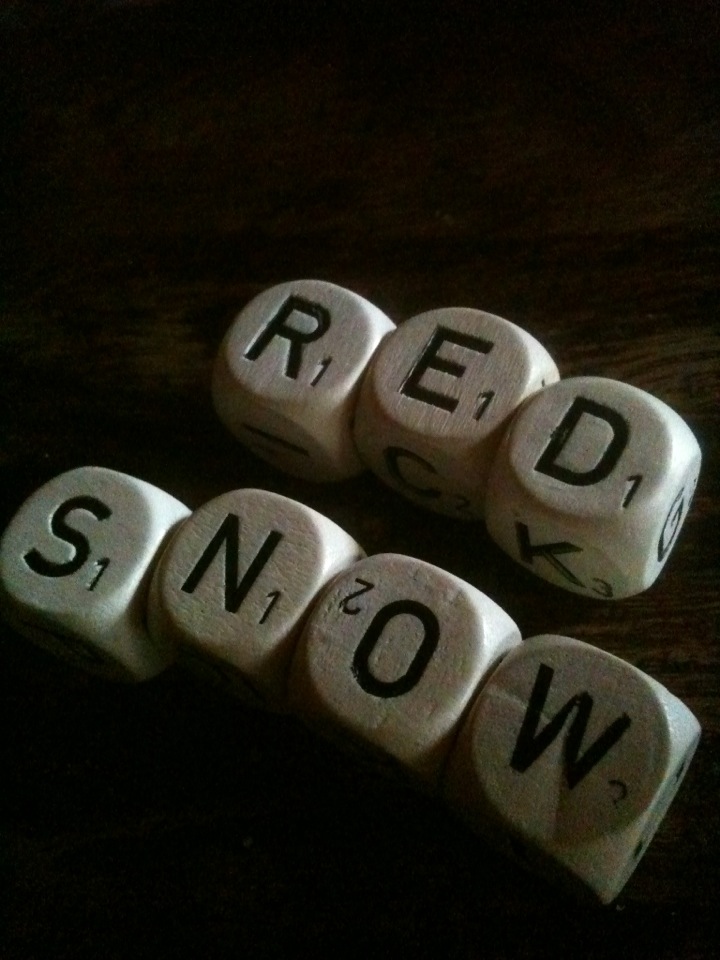
red snow


“Why is it out on permanent loan, Sir?” I asked instead. Now it was his turn to ignore me. “When they started the program, you see,” he answered in a low voice to a question I hadn’t asked yet, “it wasn’t particularly secret. No classified information, just a bunch of scientists with an idea.” I felt a chill. This was Somerville Public Library where kids get their sufficiently outdated material for school assignments and hang out between the dusty shelves in the little frequented art section. “It started with a culture collection of cryophilic algae and microbes, for example pyrolobus fumari.” Sensing my bewilderment, he added ”you need to take notes, you know, you can’t expect me to explain every detail.” As I grabbed one of the H2 library pencils and a stack of note-paper from the table in front of us, he relented somewhat and began to lecture. “Cryophilic algae, also known as red snow, have specialized on thriving under extreme conditions in the polar regions. They grow in the very cold, acidic, high in ultra-violet radiation, and nutrient-poor confines of melting snow. Fascinating, right? Pyrolobus fumari, collected from hydrothermal vents about 200 miles off of Washington State and nearly 1.5 miles deep in the Pacific Ocean on the other hand, survive at 235 degrees Fahrenheit. And we cultured yet another microbe from a yet unnamed strain that Penelope Hoffmann insisted even remains stable at 266 degrees Fahrenheit, when all other life ceases. But the most interesting aspect is that these microbes and algae go through long periods of dormant life cycles. We have isolated microbes from the Siberian permafrost, about three million years old. Bacteria germinated from spores preserved in Dominican amber, 30 million years old!” He leaned back. I looked at him expectantly, but he remained silent. One couldn’t get comfortable in the library arm-chairs with their beech-wood frames and their dust blue fabric over a dense kind of upholstery material and I had fidgeted around in my chair since we had taken our places, but despite the position his malformed spine imposed on him he looked completely relaxed. It actually looked as if he was relaxed within the frame of his bent body, as if that was his frame of reference, not the environment. My initial anxiety had settled too and I had begun to think. “