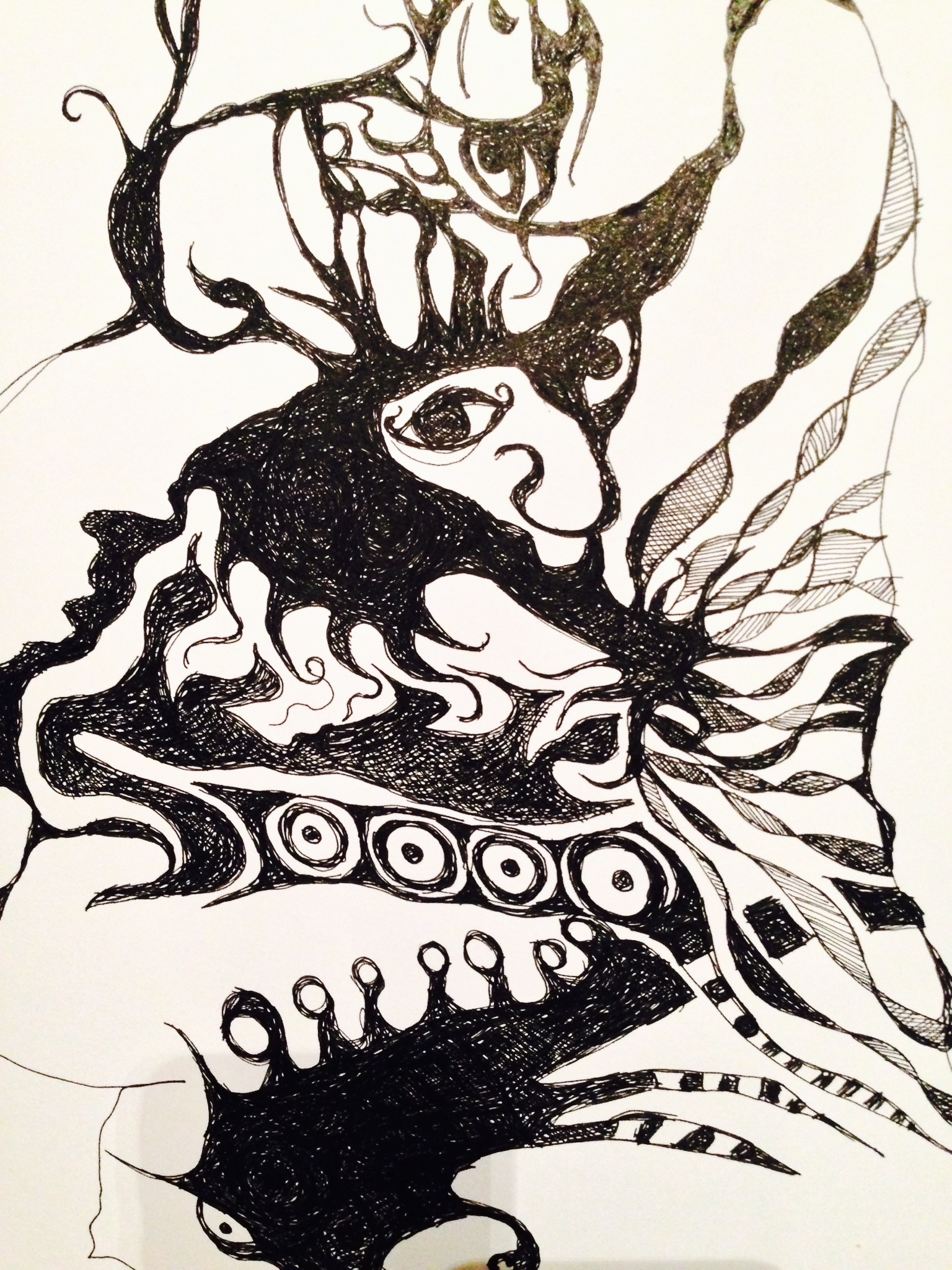
Mud people (excerpt from Gargoyle)
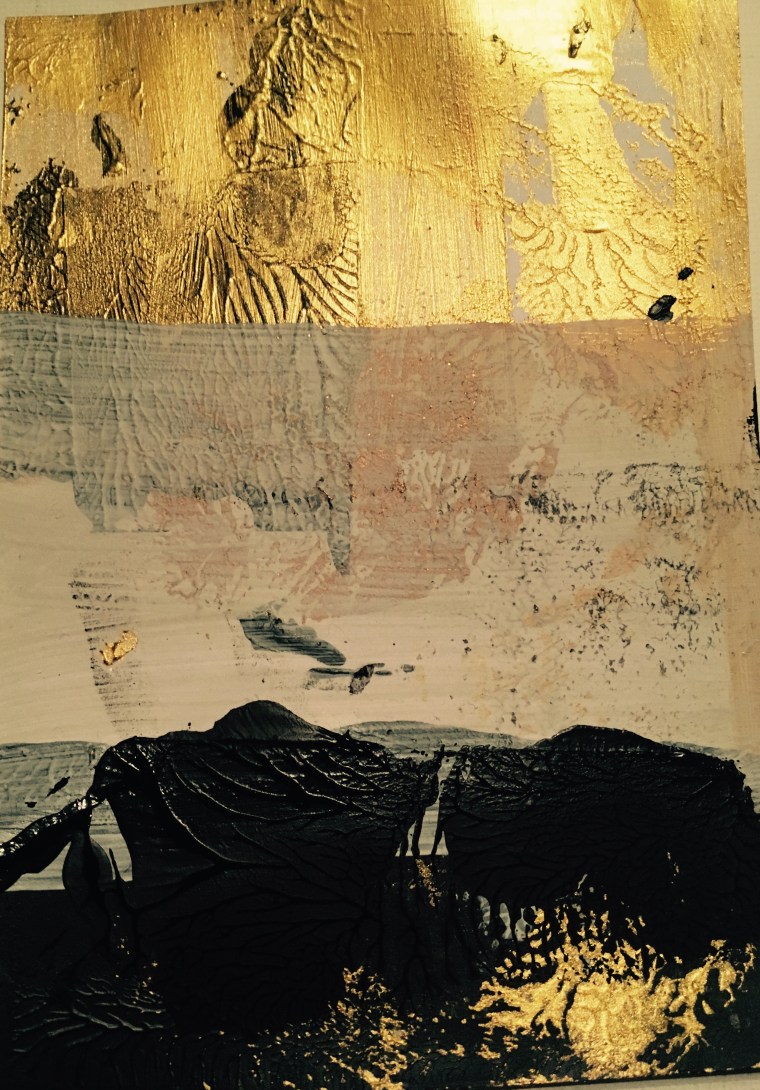
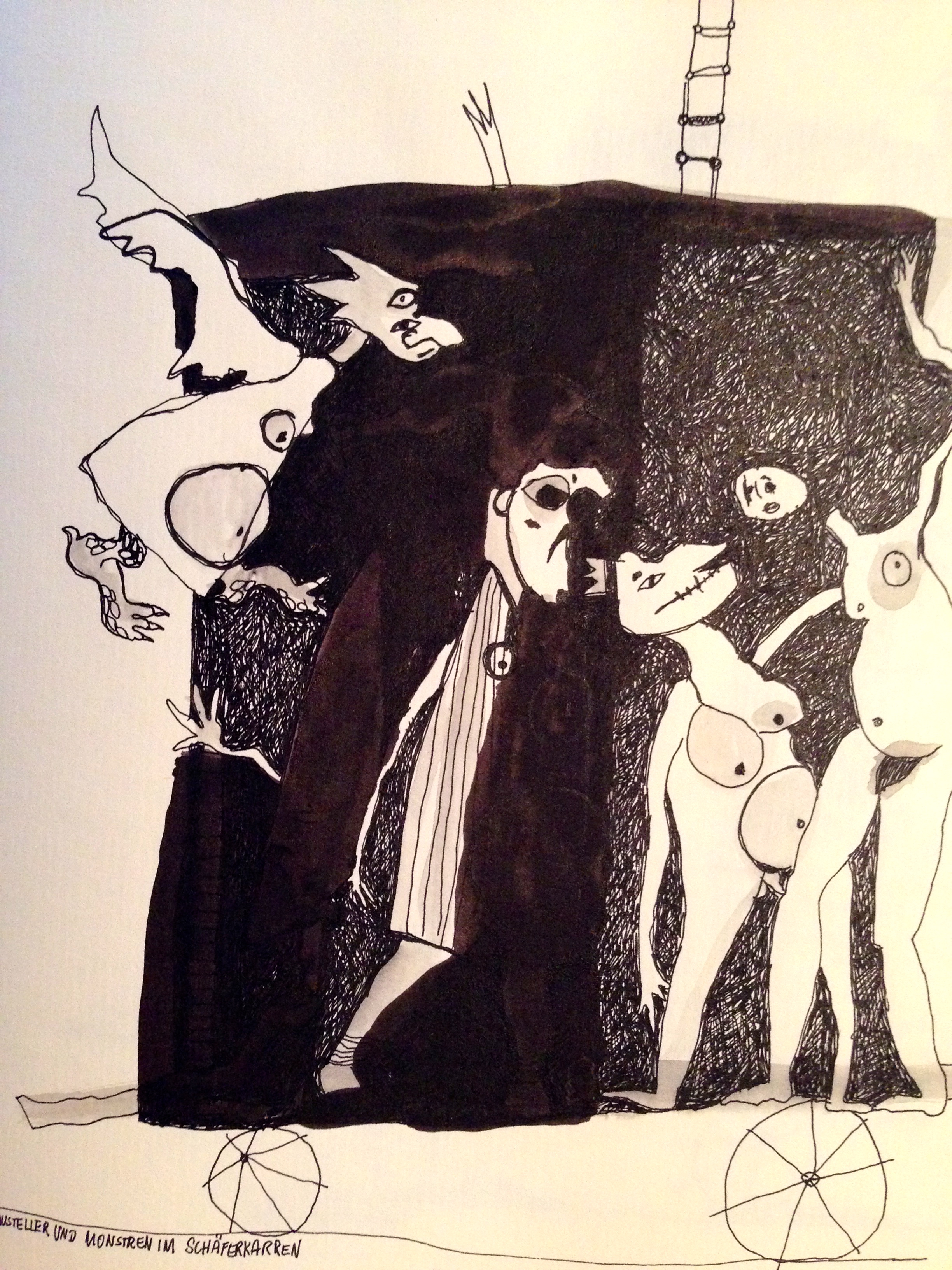
fullsizeoutput_b93 The shallow hole the boy had dug became deeper with time as he scooped out the red colored clay the ground was made of. He filtered it through his hands, taking out stones, sticks, decomposed leaves and roots. Punching and smoothing it he compacted the clay to one block, thus slowly building up a monolith from clay. He devoted great care to this process, making sure that he would have a structurally sound mass with which to work. Over the course of building hundreds of small people from mud he had gotten quite skilled at this craft. Only when he was content with the sound that a slap against the block produced, a deep, saturated thud, would he proceed to sculpt. With deliberate slowness he worked from the general form to the details. Many times a form had collapsed when he had tried to overemphasize a movement or had placed the limbs too far outside the center of gravity. In the beginning he had tried to use sticks to support an arm reaching out or a leg stepping forward and though technically that solution had worked he didn’t like that the figure now seemed to defy the laws of gravity that nature put on the material and form. It was thus almost impossible by the mere use of sticks and clay alone to sculpt an outreached limb that looked natural. So he had returned to work from the inner core of the material and to rather hint at a movement that – though invisible – the eye would project into the empty space. He was always intrigued by what he could see without seeing it. He liked the way his sculptures randomly related to one another, all he had to do was to quietly look at both sculptures and discover this relationship of forms. Something deep inside him stirred when he looked at his creations and their silent endurance. He could see the form of the space in between two physical forms, it was nothing and yet visible if one cared to look, it changed constantly, stretched and diminished, even disappeared. It was actually easier for him to comprehend the properties of this in between space than the form itself. You could get out of the trajectory of any moving object if you controlled that space. If you made that space in between adhere to your inner voice you did not need sticks to build a figure. Why, you barely needed your hands, all you had to do was to look long and hard, look at the clay monolith and make some slight adjustments. Soon his people were crouching, stretching, running, turning. He took great pleasure from this.

His father began to take notice too. One night when he had returned home from the workshop the little garden patch had first caught his attention. In the twilight the clay sculptures his son had build in the afternoon had a strange quality of perfection. There were seven fresh sculptures, six of them crouching on the ground, the seventh a small figure in flight, emerging out of a block of brick-colored earth, running.
From a distance it had seemed that all sculptures possessed distinct personalities and bore individual facial features. Something about these features seemed oddly familiar to the stonemason. Upon closer inspection he realized though that the impression of an actually sculpted face dissipated from a nearer perspective – but reinstated itself the moment he stepped back like a magical trick. The inability to confirm his initial finding, to come closer to the truth, was intriguing to him. He asked himself how a not yet six year old child could have created such a sophisticated illusion. He didn’t ever doubt that the impression was created deliberately. He studied the people his son had made for a long time. Inside the house the light from the boy’s bedroom shone dimly through the drawn curtains.
autocorrect

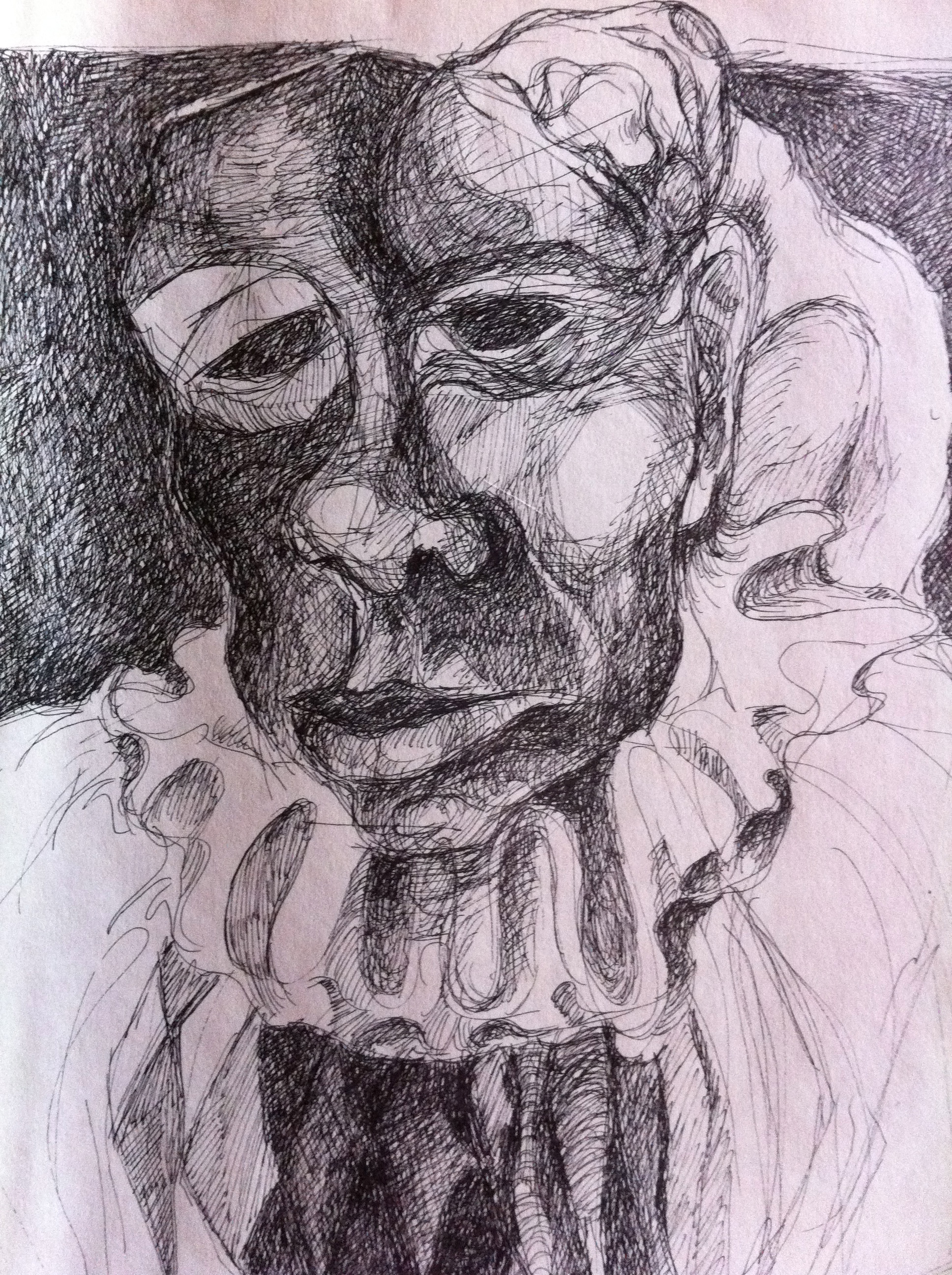
IMGP1041When she was ready to write, the first word that presented itself was: nocolor. Autocorrect corrected it three times over. Autocorrect wrote: “No color”. The word as it needed to be was: nocolor. She knew what it meant. It was a good word to start with. She could see that autocorrect was struggling with the concept. She took a piece of transparent drawing paper o and instead of typing she drew the word with a radiograph pen, 0,35 mm: nocolor. The paper endured the non mistake.

Autocorrect was a mediocre little man in a grey woolen suit. She knew him. Raymond Chandler had known him, too. Common sense, autocorrect, is the little grey man who never makes a mistake in addition. But it is always someone else’s money he is adding up. Oh, I have met the little man in the grey suit many times over. Here he lingers. I am sure autocorrect wears a grey suit, but I know better than to pay attention to him. nocolor is a good word to start writing about the exits that are not accounted for. the little grey man wouldn’t know them if he stood facing one. He would insist there was no door. And he’d be right there is no door. Only there is.

Alternative pathways to the primary visual cortex

impeached kingHe turned around and looked in my direction, his dark glasses reflecting the library lights like distant stars. Then he smiled. Automatically I smiled back at him, but then I remembered that he was blind, and my smile froze. I was frantically searching to find an appropriate opening sentence in my vacant mind. He held his smile still as he was addressing me. “I think we have a mutual friend, Ms. Clarice,” he said kindly, not commenting on my rude behavior. I was now searching for his eyes behind the dark shades and instead encountered my own mirror image, small like a doll. “I am sorry,” I finally stammered, addressing the little doll more than the man, “I am really sorry, but how do you know who I am?” I was still being rude, I realized. The small person reflected in the distant mirror of his glasses I had taken for my own reflection made an unexpected move that startled me even more if that was possible. She took a mocking bow towards me and disappeared into one of the bright reflections of the lights above. “Things are not what they seem, Ms.” responded the old man, why don’t we sit down somewhere so you can ask your questions. My name is Dr. Aaron Hausner. And who might you be?”

Dr. Hausner dedicated a long time to me. He was soft-spoken and had an uncanny ability to predict my next question – yet, at the same time he did not once directly answer any one of my articulated questions. After we had occupied a spot in a somewhat secluded corner of the library – he had been leading the way without ever hesitating – he had again turned directly towards me and had started speaking with a soft voice. “The route from eye through the primary visual cortex the is not the only visual pathway into the cortex. Other pathways exist that bypass the primary visual cortex. A blind man like me can learn to trust those pathways though they do not stimulate a sense of optical vision. I do know whether there is an object in my way, approximately which size it occupies and whether it is mobile or fixed in place, of organic or inorganic nature. I also know whether a person directly faces me or wether I face a person and whether this person smiles at me. Scientifically this phenomenon is called blindsight.“ I felt like a fool. He answered. “Don’t feel bad, most people feel inhibited when they first address an apparently blind person. And to be honest, not all blind people know about this phenomenon either, though most blind people I have talked to could relate experiences that strongly point towards their ability to process some visual information even though not in the way they expect.” I was stunned. We were silent for a moment. Finally I found my voice: “My mother is an artist. She draws objects as an intricate net of lines, and though the object is not directly represented through these lines, with a bit of patience one can usually tell what the drawing is about. I mean, you can see the object though you clearly can’t.” I drew a deep breath. Dr. Hausner seemed to listen but he didn’t come up with a typical grown-up response like: How interesting of you to point out the similarities between an artist’s perception and a blind person’s perception.

loopholes and the art of legislation

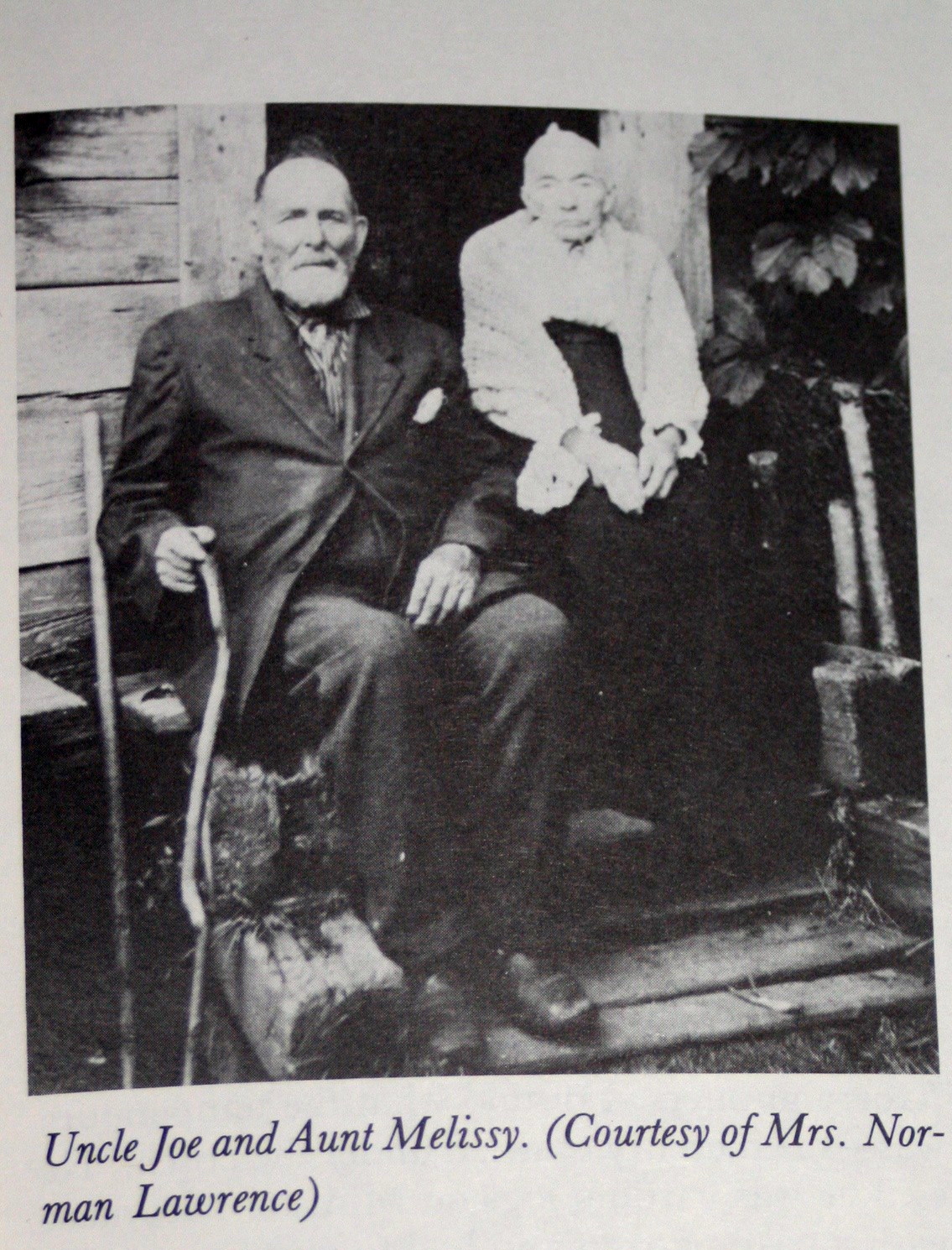
Image - Version 2When we arrived at the cottage we were basically frozen. Courtesy demanded to offer someone who came to the cottage door a cup of tea – but I would have offered it regardless of etiquette because the girl was in need of one. She gladly accepted and entered the cottage. The old people were at the Sunday meeting still and so I got busy rekindling the hearth fire and put on a kettle with fresh water to boil. I knew Aunt Melissy would approve of the church elder’s daughters having tea with me.

The girl had readily slipped into the bench at the window and had pulled her sock feet up to wrap her long skirt around them to warm up. As long as the fire wasn’t going it wasn’t too warm in the cottage either, but it was nicer than outside, and my feet started thawing.

The girl had put her chin on her kneecaps and looked at me without much expression, a bit as if we had been friends for a while. After a moment she lifted her head a bit and said: “I’m Fiona. Don’t tell me your name. My mom says I shouldn’t know you. So, if you don’t tell me your name I don’t know you, right. “ Fiona grinned. “She didn’t say we couldn’t have tea.”

She hugged her legs tight, I could see she was still cold. But there was something on her mind. As long as we were alone. “It’s difficult, to make rules.” She added gravely. As if she was not the one looking for loopholes. Or maybe as if looking for loopholes was her special function in the system of making good rules. “I mean,” she added “to make rules that are to be followed to a point. Not to forget anything. Though you know they will be looking for a loophole. And you have to make the rule as tight as possible. But still workable.” She took a deep breath. I had no idea where she was coming from. Why she was telling me this?

“Why would they?”, I asked. “Why would they look for loopholes, I mean.” Maybe it was an ignorant question but it was the first thing that came to my mind. I didn’t even now who “they” were supposed to be. “Why wouldn’t they?” Fiona retorted. “Doesn’t everybody crave freedom? Just everybody? And especially those who are bound by a contract to obedience?”

One second of eternity at Lake Willoughby

IMGP1041Lake Willoughby, grated into plutonic rock by a deep glacier, is a 300 feet deep, water filled scar between two mountains with biblical names, Mount Hor to the West and the Eastern Mount Pisgah. If you stand on the North Shore of the lake, it actually has the appearance of a deep fjord, though there is no outlet to the sea. Instead there is said to be an underground aquifer connecting the basin of Lake Willoughby to that of another eerie body of water beyond Mount Hor, Crystal Lake. In my mind that acquifer had the form of a water filled cathedral, in my mind I saw swimmers gliding swiftly through a space abandoned by a people even older than they were. There was an incredible, inexplicable light the way I imaged this. You have to keep in mind that I imagined this within a dream without actually seeing it, two steps down and under. Even though my sober mind took offense with the inexplicability of the light.

While I was thinking and conjuring up images within the dream I stood at the waters edge of the lake as I had done many summers and the water exactly like the water of lake Willoughby as I remembered it acted like a mirror. The surface seemed to be like a sheet of glass of finest quality, separating the clearly visible underneath from the still world above, and the mirror image of this world like an incomprehensible fourth dimension in between both worlds. Again I saw the forms in the distance, gathering around precariously piled up, submerged boulders. Each winter these boulders avalanche down Mount Pisgah and roll into the lake to form the outline of an inaccessible stone city, creating an intricate mountainous terrain. I wondered how long it would take to fill the deep ravine of the lake with boulders and fleetingly thought of the old story about the small bird wearing away a mountain with his beak to mark the passing of the first second of eternity. In my dream I had this thought.

Po Tolo

IMG_2146

“My grandfather, your great-grandfather, believed that there is life in the Sirius system. The Dogon, an African tribe with very acute astrological knowledge, have believed for centuries that there is life out there as have the ancient Egypts and the Sumerians. According to the Dogon Sirius is accompanied by two other stars, a very small and incredibly dense star they call Po Tolo, which means “very little star”, and which modern astrology has confirmed to exist only recently and calls Sirius B. Indeed it has turned out to be a small star with an incredible density, heavier than the iron we know on earth. The Dogon also claim that the other star in the Sirius-System is lighter and larger than Sirius. They call it Emme Ya. And around Emme Ya they say there orbits the home planet of the Nommos, the children of Sirius and Emme Ya.“

My mother inhaled deeply. I knew she was thinking of her grandfather. She still missed him. He died some years before I was born but she had told us many stories about him.  I had always imagined him a very stern man, rarely smiling, expecting a great deal of my mother. I couldn’t picture him indulging in fantasies about alien life.


The Twelve Nights of Christmas, the journey concluded: Night 12, the Mechanics of Longing

Foto

The title came as swiftly as the image and the artist obeyed both. The Mechanics of Longing.

This drawing concludes my twelve night drawing meditation. As the new year is already starting to make its demands, these drawings carry with them 12 nights of focus on a non-revealed question. Sometimes during those twelve nights I felt I could catch a glimpse of things yet to be. Now there will be time to look at these pieces for a while, maybe polish them a bit.I’ll keep you posted.

New artistic challenges are ahead for the year.

January 15th is the deadline for another Sketchbook Project of the Brooklyn Art Llibrary, check out the website if you haven’t yet. Their digital library is stunning.

http://www.sketchbookproject.com/library/13754 The link will take you to my previous year contribution “The Whisper”, a simple, wistful story about a childhood memory.

My new book, a young adult science fiction novel, is about to be finished and another one waiting to be continued on my desk.

In Fall I hope to open an exhibition of 41 canvases, acrylic on raw jute canvas (aka coffee and chocolate bags) in Berlin, 30 of which are finished by now. The 12 nights have strengthened my will to continue living in multiple universes.

Thank you for following my blog, this certainly  is the day to acknowledge that my readers are an important part of my creative discipline. It is a good thought that someone may be going to weigh the outcome of a night’s work and maybe find some use for it, if only in the fleeting way that art, all art, can enrich a moment.

I am wishing you, my readers, all the courage, health and gladness necessary to live a meaningful New Year and if you should be lacking any one of these for some of all of the time the will to give it your best shot anyways! 

The Twelve Nights of Christmas, night 9: A rip in the fabric of the universe reveals the true nature of time

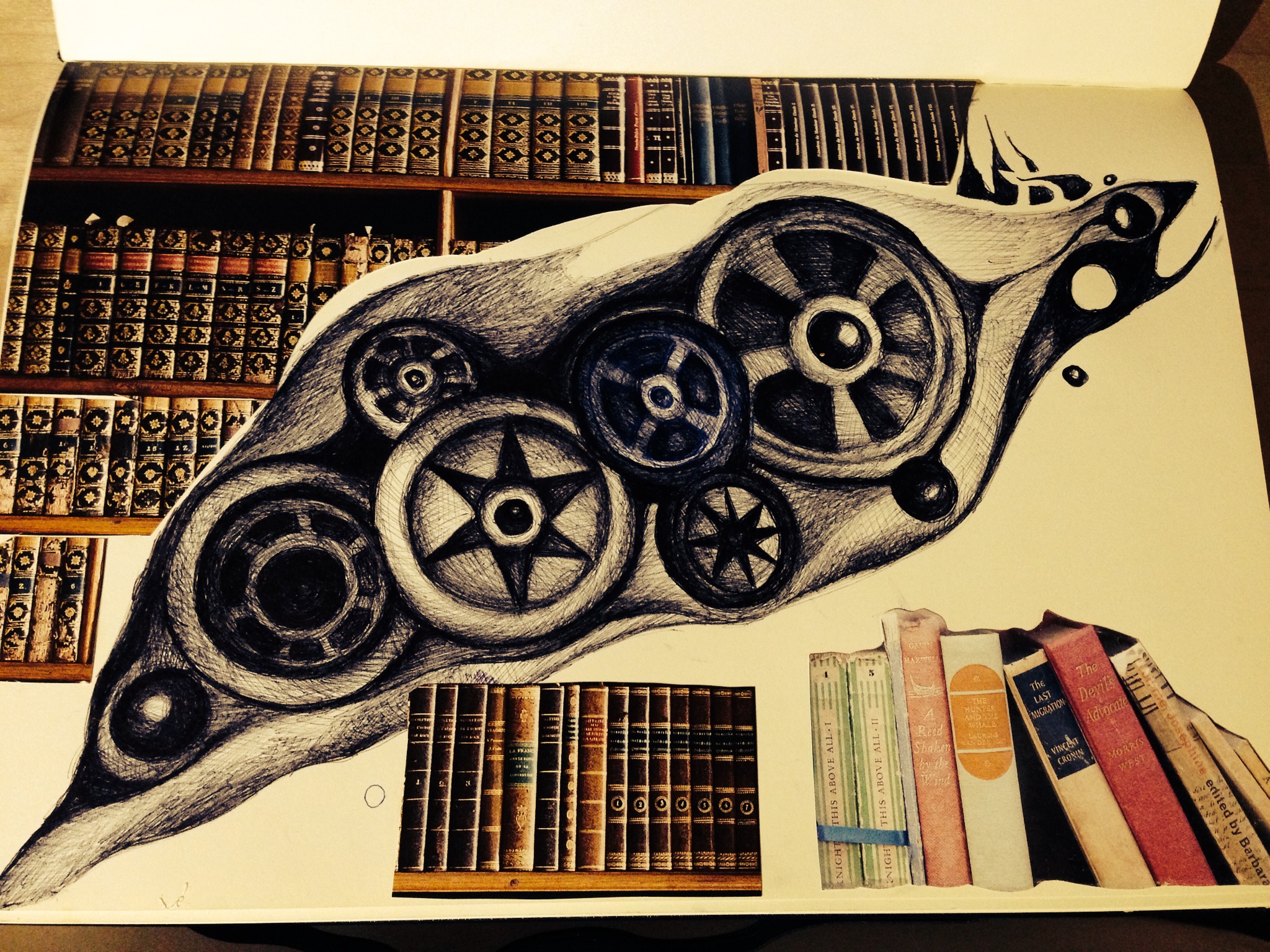
It is Borges’ library that makes another appearance in this drawing meditation. One of the themes that is never far off my mind. How does our mind chooses the images that are essential for its own comprehension of the world? How come an image such as Borges library can be so powerful that it assumes an reality of its own, in an alternate universe not so far of our own house number? Just try a different key, open a small door you have never quite paid attention to before and beyond you will find the octagonal library with all possible version of all possible books, written and unwritten … my kind of paradise.
Foto

everywhere and nowhere – a trip to berlin and back


IMG_0872IMG_0882


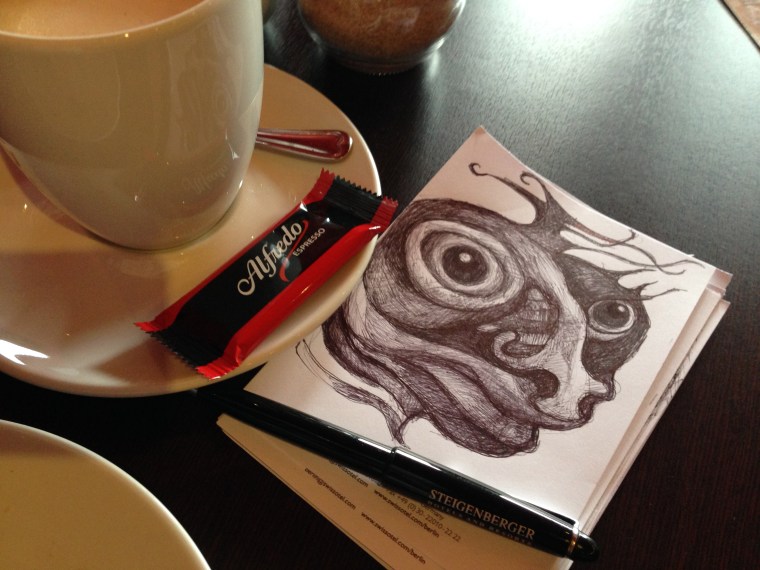
black ball pen, anywhere paper. while working as a lawyer specialized on the representation of visual artists, sometimes the time in between, travel time, waiting times, coffee breaks during a conference turns out to be a creative space in which not just some kind of creative maintenance seems to happen but actually – while I am using readily available art supplies like note paper and ball pens provided at said conference – something interesting, some original kind of work or an idea that will be worth developing. like this weekend. i added to my to do list for the day: buy plenty refills for black ball pens. something’s coming.

thou shall not confuse night with darkness

Image 1


After all those years of quiet desperation spent in the library it finally occurred to them that the meaning of the phrases they had taken to be metaphorical actually was to be understood literally. One of them said it, said it twice as if a discovery this horrendous and yet simple and elegant, had to be given a reflecting twin to cast light into the darkness of their ignorance. One of them instantly began to tear at the fine web of cross references and foot notes he had been weaving patiently for years and without ever questioning the worthiness of this pursuit, but they were like angel hair or glass wool and cut his hands with fine sharp lines out of which blood emerged like red pearls on a string. “I shall not be told convinced” he blurted out, not holding back now, “All those weeks, months, even years, sitting in the dark like a toad, with my skin starting to resemble the parchment  of the oldest books we had delivered from unknown depths of the library, all that knowledge I have assembled in my humble brain that has me compete with the most elaborate encyclopedias of this library, all this weaving and threading of letters, words, meaning, phrases is to be ridiculed by a simple, single and singular shining truth. What of the darkness that we have illuminated with stray thoughts of meaning, what of the wondrous glimmer of an insight long desired and yet so small that it is like a single candle flicker in a great hall. What of its beauty and possibilities? Look at your single truth that already shines into every corner now that you have unlocked its secret, that leaves no shadow, no desire, no discovery, no randomness and outshines all my small beautiful candles. How am I supposed to live with something so simple and shining when I have dedicated my whole life to the complex, hidden, wondrous discovery of paradox answers, when I love the darkness in which a single light shines, when i am a creature of the night and dedicated to a pursuit without hope? How am I to rise out of my darkness into this shining, merciless light?” And he began crying miserably, holding his bloodied hands out as if he was asking for a charitable donation, and the others looked on in silence.