Mud people (excerpt from Gargoyle)
fullsizeoutput_b93 The shallow hole the boy had dug became deeper with time as he scooped out the red colored clay the ground was made of. He filtered it through his hands, taking out stones, sticks, decomposed leaves and roots. Punching and smoothing it he compacted the clay to one block, thus slowly building up a monolith from clay. He devoted great care to this process, making sure that he would have a structurally sound mass with which to work. Over the course of building hundreds of small people from mud he had gotten quite skilled at this craft. Only when he was content with the sound that a slap against the block produced, a deep, saturated thud, would he proceed to sculpt. With deliberate slowness he worked from the general form to the details. Many times a form had collapsed when he had tried to overemphasize a movement or had placed the limbs too far outside the center of gravity. In the beginning he had tried to use sticks to support an arm reaching out or a leg stepping forward and though technically that solution had worked he didn’t like that the figure now seemed to defy the laws of gravity that nature put on the material and form. It was thus almost impossible by the mere use of sticks and clay alone to sculpt an outreached limb that looked natural. So he had returned to work from the inner core of the material and to rather hint at a movement that – though invisible – the eye would project into the empty space. He was always intrigued by what he could see without seeing it. He liked the way his sculptures randomly related to one another, all he had to do was to quietly look at both sculptures and discover this relationship of forms. Something deep inside him stirred when he looked at his creations and their silent endurance. He could see the form of the space in between two physical forms, it was nothing and yet visible if one cared to look, it changed constantly, stretched and diminished, even disappeared. It was actually easier for him to comprehend the properties of this in between space than the form itself. You could get out of the trajectory of any moving object if you controlled that space. If you made that space in between adhere to your inner voice you did not need sticks to build a figure. Why, you barely needed your hands, all you had to do was to look long and hard, look at the clay monolith and make some slight adjustments. Soon his people were crouching, stretching, running, turning. He took great pleasure from this.

His father began to take notice too. One night when he had returned home from the workshop the little garden patch had first caught his attention. In the twilight the clay sculptures his son had build in the afternoon had a strange quality of perfection. There were seven fresh sculptures, six of them crouching on the ground, the seventh a small figure in flight, emerging out of a block of brick-colored earth, running.
From a distance it had seemed that all sculptures possessed distinct personalities and bore individual facial features. Something about these features seemed oddly familiar to the stonemason. Upon closer inspection he realized though that the impression of an actually sculpted face dissipated from a nearer perspective – but reinstated itself the moment he stepped back like a magical trick. The inability to confirm his initial finding, to come closer to the truth, was intriguing to him. He asked himself how a not yet six year old child could have created such a sophisticated illusion. He didn’t ever doubt that the impression was created deliberately. He studied the people his son had made for a long time. Inside the house the light from the boy’s bedroom shone dimly through the drawn curtains.
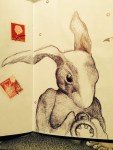
Time itself took notice of the unlikely creature

IMG_2513

“I  will be back.” Was it even meant to be a promise or rather the a mere, impulsive expression of an intent? The gargoyle pondered this question over many days, even weeks after the mason had left. He remembered the exact  sound of the words, their intonation, the expression of the mason’s face, the thoughtful gathering up of the tools, the turn of the head to once again rest his eyes upon the face of the stone creature, the final words – the gargoyle relived all of these moments and weighed them, day after day.

Every day up to midday he collected small reasons why chances were good that the man should appear this day, after midday he thought of excuses why he could not possibly have made it possible to come this day but would surely be able to fit it in tomorrow or at least before the week, the month , the season was over.

Perhaps the last gargoyle had been lonelier than he had cared to admit previously or maybe this obsession with the return of the mason was just yet another way to pass time.

Waiting for something to happen, somebody to appear, seemed to be far superior to just being, even if it infused his previously peaceful existence with a permanent sense of pain, a feeling that was so close to boredom that at times he would have been unable to distinguish it.

Boredom or pain both compromise our sense of regular time passing and whereas a day had just been a day, an hour just an hour before the advent of meaning and desire (now time had a direction, time existed so the mason could bridge it, so the gargoyle could subtract minutes from the greatest distance that separated him from the return, the moment when the mason had finally turned his back on him and left the roof), now a day could be excruciatingly long, especially if the gargoyle thought to have detected sounds coming from behind the closed roof door.

Expectation, gladness, desire, wishfulness, frustration, even despair were all variations on the same theme, waiting. Waiting in turn meant the refusal to accept time for what it was; it was like a progressing illness. It never occurred to the gargoyle to abandon his unreasonable expectation and to return to stone nature in order to gain the peace he longed for. Peace seemed attainable only if his curiosity about the reason for the return of the mason could be satisfied. Time passed and the mason did not return. Eventually the initially glad expectation turned into a numb pain, over time seemingly removed from any cause. A general disappointment  overcame the gargoyle, the most human of feelings, as if something that had been promised to him was now purposefully being withheld. It was as if his existence was gradually being tainted by something he could neither name nor really be completely sure of.

Time itself took notice of the unlikely creature and inexorably started gnawing at him with tiny teeth. The  gargoyle still formulated his thoughts in human phrases. But instead of patiently following a thought until it moved just out of grasp and then starting all over again like a child, he had taken to a summarizing his thoughts in a more generalist way, often colored by self-pity. A second rate stone poet he was now, defeated and ridiculous, utterly grown-up and utterly human. He felt contempt for himself, for his dependence, his passive waiting, his pathetic obsessiveness but he couldn’t help himself. There was no way to stop. No way to stop waiting. Tiny cracks were forming in the rough granite surface. Defeat was looming.

Brooklyn Art Library: The Sketchbook Project … to be postmarked by January 15th

http://www.sketchbookproject.com/brooklynartlibrary 

The Sketchbook Project is a global, crowd-sourced art project and interactive, traveling exhibition of handmade books by the Brooklyn Art Library.

Foto

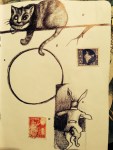
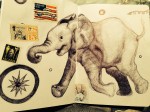
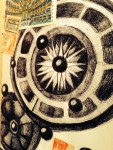
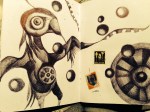
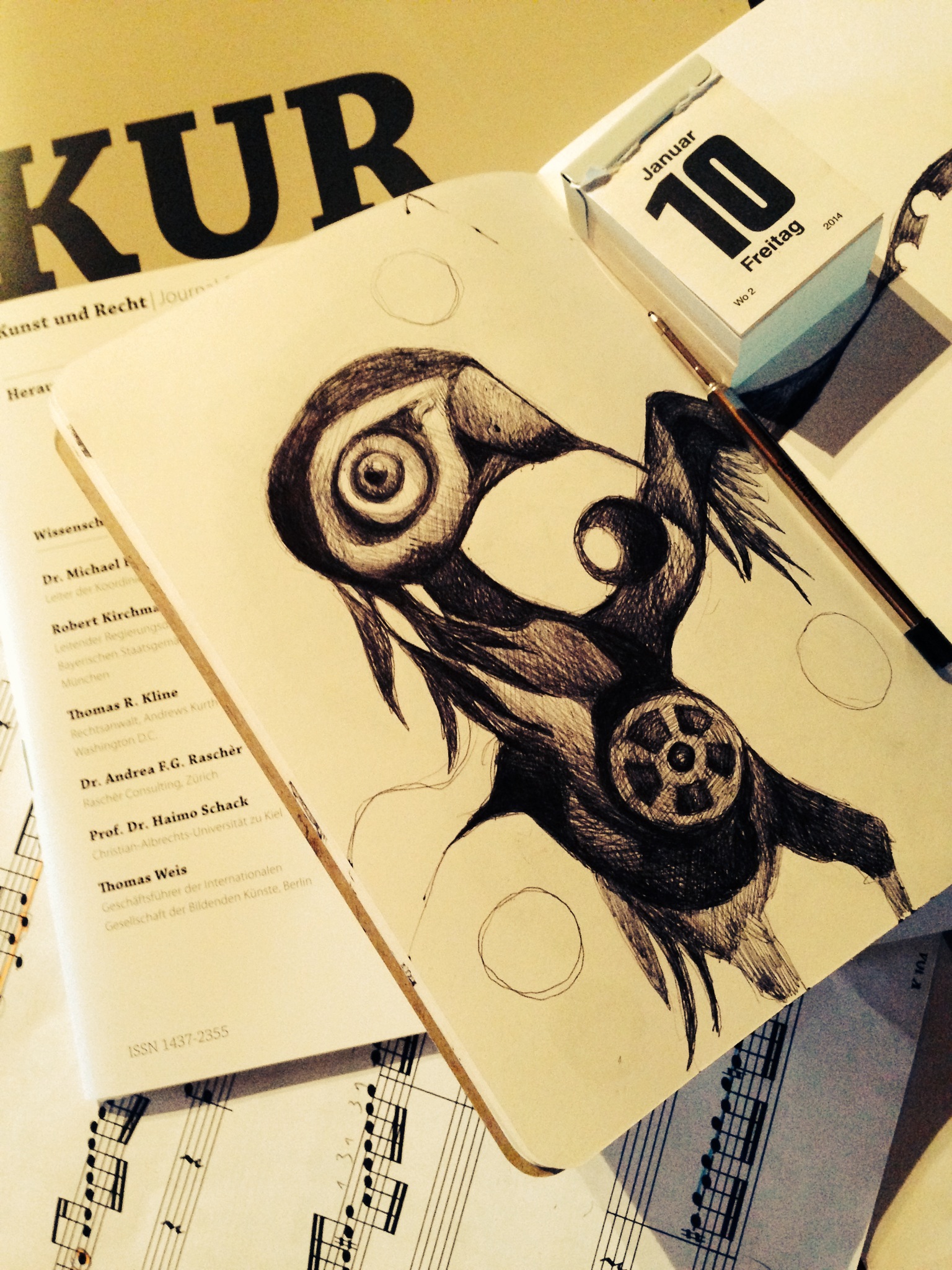
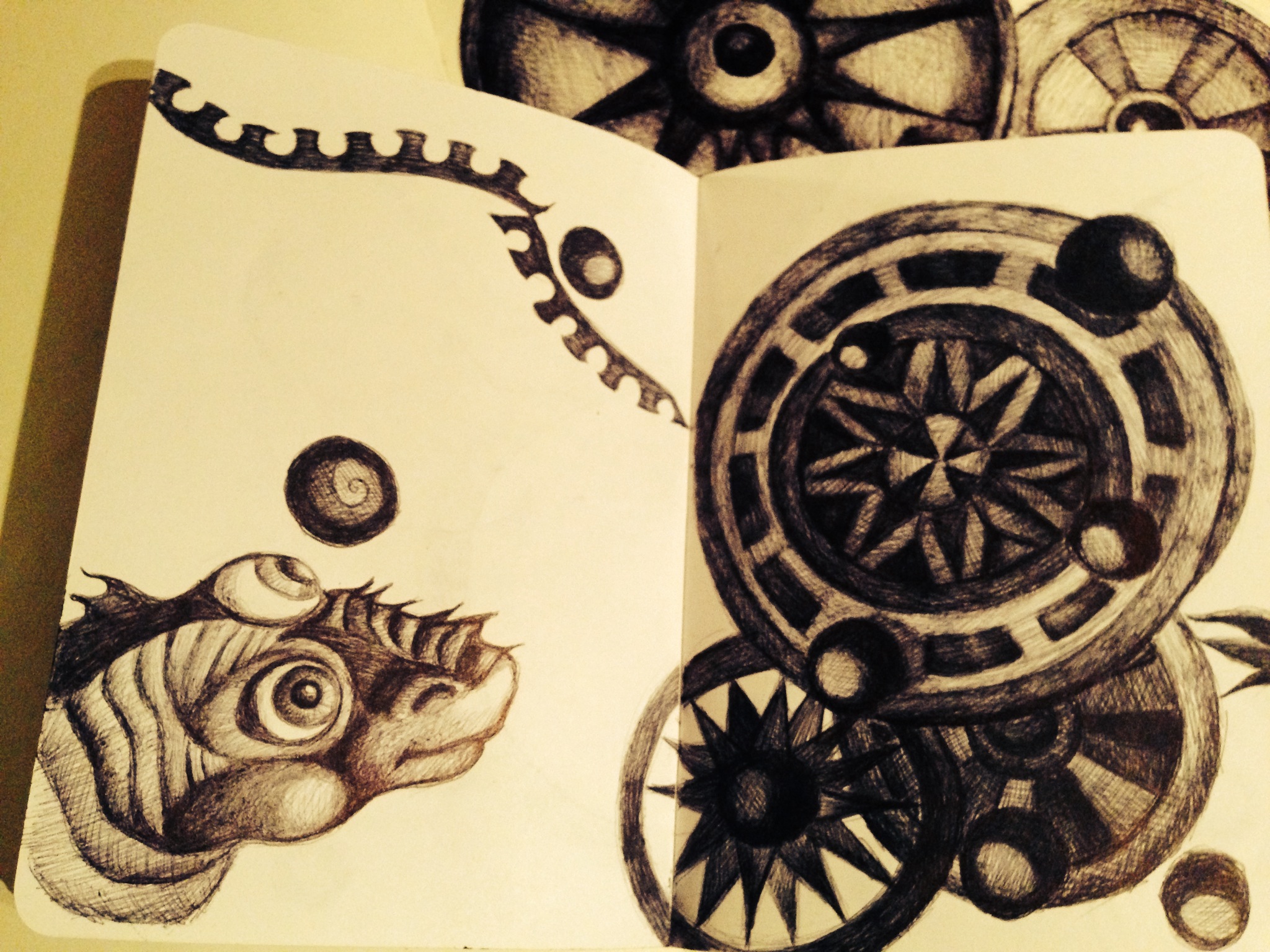
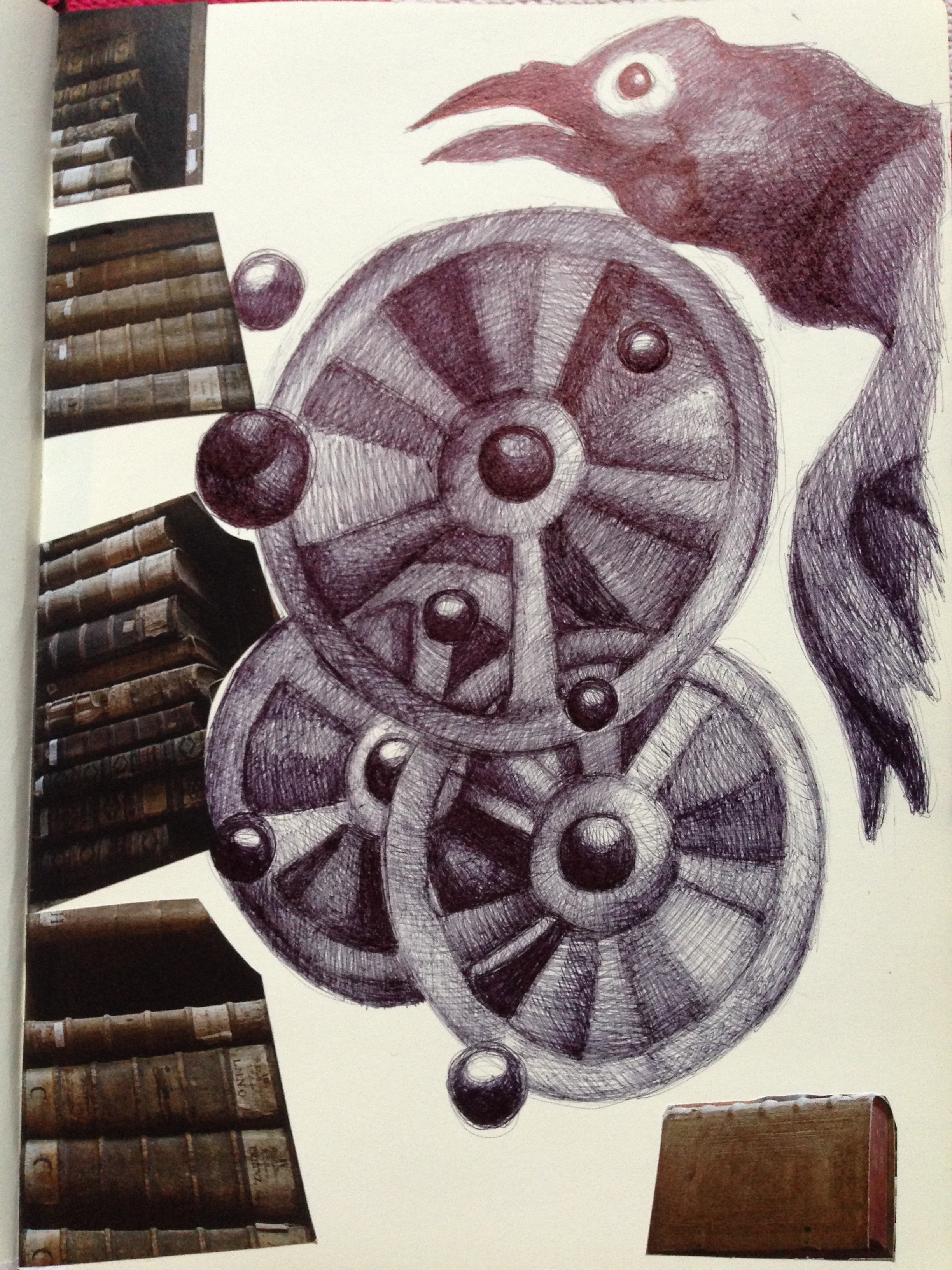
This sketchbook titled “The Mechanics of Longing”  (working title) is going to be my second submission … to be postmarked by January 15th which actually means that I have to be finished by Sunday night. This submission is by far more ambitious than my previous selection to the Brooklyn Art Library, the simple childhood story “The Whisper”. I have come quite a distance, finally allowing myself to draw, to illustrate – the pages are in a narrative sequence, moving through time not just be the sequence of the pages turning which indicates the passing of time in almost any book but by the “time wheels” which on every page actually function as a clockwork of a fairly abstract idea of storytelling. The creatures still have a storybook like quality but are allowed to look much more sophisticated than before. To explain why that kind of art work seemed out of the question for me before is material for a separate blog post (I need to get back to drawing) but for now I am absolutely enchanted by the creatures appearing underneath my pen. I am still pushing my boundaries, exploring how far I think I can go without compromising artistic integrity. These don’t have to sell. They are allowed to breathe. So I can.Foto

The Twelve Nights of Christmas, Night Eleven: Nevermore …

Once upon a midnight dreary, while I pondered weak and weary,
Over many a quaint and curious volume of forgotten lore …

Foto

I couldn’t make this the twelfth night theme. “Nevermore” is not the note I’d choose to conclude this season’s “Twelve Nights”. But on the eleventh night it brings together further elements of reading, words, images evoking coherent comprehension beyond words, night time, magic realism, dreams, illusions, delusions, sleep deprivation, time, meditation, past, progression,automatons, determinism, choice, knowledge, intuition, desperation, endurance …

Two weeks ago  I listened to a musician on DRKultur (radio) talking about time and about the experience of time during extemporaneous composition and performance  on the piano. He talked about experiencing eternity not as an endless repetition of events in a space of time never ending but about as an experience of time being suspended. I think about art  – writing, painting and illustrating – as taking place in just that space of time being suspended, a space that I can enter and where I can linger at will.

looking down at the stars

looking down at the stars

When I was five, my mother, an artist, told me that over time the use of the words “up” and “down” had been reversed through what she called “accumulated acts of lazy thinking”. Consequently, she told me, people had gotten used to seeing the world in a crooked way. With other words: where other people look up into the tangled branches of a tree, to the clouds, an airplane, the sky, my mother had trained herself to look down into the depths of the endless oceans of the universe.

The amazing thing is that the moment you try this, it feels just like the right way to look at things and you will feel like you have never truly seen the sky before. Stretching myself I reach deep down into the world whereas before, when I understood up and down in the usual way, the sky seemed more or less like a painted stage decoration.

Often, on late summer nights my mother, my sister and I would lay down flat on the lawn of our front yard and look down into the stars. The grass of our lawn was long and wavy, different from the short cut golf course front lawns of our neighbors, and woven through with moonflowers that smelled lovely in the warm, damp night air and in their whiteness actually glowed like little stars themselves.

I remember one night when I felt particularly light and small, and grateful to gravity for holding me securely to the surface of my own planet. The stars glittered in the distant depth. My mother giggled when she noticed that my little sister had fallen asleep right there on the lawn, her head nestled onto my mother’s shoulder.

Suddenly it seemed so unlikely to me that in all of the universe expanding before my eyes our planet should be the only one with life on it. I asked my mother, who had been silently holding my hand whether she thought that there was life out there. My voice sounded like a whisper. It was the kind of question to which you don’t really expect an answer.

Without opening my eyes, I carefully and with a sense of controlled terror extended my other hand…

I lay curled up like a cat and I could feel the curve of my spine, I could feel my knees against my chest and my hand underneath my cheek. Without opening my eyes, I carefully and with a sense of controlled terror extended my other hand to feel the surface of my quilt. I would know the stitching of its pattern, the softness of the filling having long since relaxed against the fabric. My fingers gently touched the surface. I hesitated. It felt grainy. Not grainy like cookie crumbles. Grainy, like sand. When I thought “sand”, I shoved my fingers deeper into the surface. They did not meet much resistance. I pushed easily into the sand like I would, aimlessly, on a beautiful day on the beach. All the while the surface underneath me was breathing. I had to open my eyes to find myself. I wondered whether I was still dreaming, and for a moment considered trying to drift back into nothingness, but I felt wide awake, too awake.

So I did. I opened my eyes. It was not dark at all as I had fully expected, yet the sun was pale, far away in the winter sky, just so illuminating the grey mists rising up from the water. I knew where I was. I was most definitely not on my bed in Summerville, NJ. I was curled up, like the sole survivor of a ship wreck, on the shore of a lake. I sat up, stunned, on the wet sand, numb with cold as much as with surprise. I knew the beach. It was small. I had spent many summers here with my family. I was sitting on the North Shore Beach of Lake Willoughby.

All things considered, it was strange that my mind accepted this truth so readily. I didn’t think: I must be dreaming. I didn’t look for an explanation.

the earth itself, underneath my body, was a breathing organism, like a gigantic whale you find yourself stranded on

How hard my mind had to work to keep control, to still try to make sense out of a wealth on information that had long stopped to be apprehensible by any rules I had been led to understand applied. But only submission to the world of grown-ups would have you believe that they were – in general – truthful about the world. I didn’t believe this anymore but tried to rely on my own senses instead. It was treacherous ground.

For example that night. As I lay in the dark, eyes closed though wide awake, the surface of my bed felt soft as was to be expected, but it felt soft in the way I had experienced and shied away from before. It seemed to be soft in an organic, breathing way. I tried to distinguish between my own breathing pattern and the breathing of that soft, pliable surface I felt underneath my body.  It was an uncanny feeling – but just ask yourself how many sensations you can really clearly distinguish besides soft and hard, warm and cold, pain and pleasure. Truth is, you constantly rely on additional sensations and context to tell you about the thing you are experiencing through just one of your senses to make sense of something.

What was it that I was feeling? Something that I feared, but I didn’t know why I feared it or whether I had reason to fear it in the first place as I was completely unaware of its nature. All I knew was that last time I checked my bed had not been breathing. As before it felt actually – and it made perfect sense to think those words as irrational as they might seem – that the earth itself, underneath my feet, my body, was a breathing organism, like a gigantic whale you find yourself stranded on. It didn’t make sense and I couldn’t explain to myself where that strange idea actually orginated. Nothing I had read or talked about lately had pointed in that direction. Remember, there was no internet and but little TV. None in our house, by the way.

And yet, I just felt it, right there and then, the surface underneath me belonged to something alive, and I knew I had to open my eyes to find out what was going on, but I was entirely too scared to live up to my own imaginative ability. All I could manage to do, pathetically,  was to continue breathing slowly just as I had done during those long ago nights when I had led some non-existing intruder to believe that I was asleep. And with each moment the sensation of a sighing, breathing surface underneath my body was getting stronger.

space, void of people

I woke up when a hand was gently nudging my shoulder. My neck was stiff. I was still sitting in the library chair. Dr. Hausner was gone. “Miss, I am afraid we are closing.” A woman’s voice. I looked up. Ms. Clarice stood right next to my chair, smiling. All other visitors were gone. I got up drowsily and carefully checked the window reflections, too. All visitors were gone. “Are you alright?” Ms. Clarice inquired. I looked at her closely. Her small golden earrings reflected the fluorescent library lights, transforming the miniature reflections of the library on the convex mirror of the gleaming curves  into a warmer, more elegant version of the actual space. An alternate space more suitable for someone like Dr. Hausner than the mundane space of Summerville library.

“When did Dr. Hausner leave?” I asked. Ms. Clarice narrowed her eyes. She ignored my question.  “You must be very tired,” she replied, “go home and sleep.” “Did you see him?”, I insisted. “Go home and sleep, Miss, I have to switch off the lights now.” I wanted to protest but she anticipated my notion and gently shoved me along. “Come back tomorrow,” she repeated, not unfriendly. We walked down the staircase together.

There was nobody downstairs either. From the winding staircase I could see  the lower floor breathing calmly. The tessellation of the carpet tiles looked like the exposed skin of an ancient creature. An empty library is a marvelous space. Really any space empty of people holds some kind of promise that seems to disappear once it gets populated. When I slowed down to linger on the staircase, I felt Ms. Clarice’s warm hand on my shoulders again, encouraging me to continue down the last few steps. I sighed. “It’s beautiful, the library, “ I said apologetically, “at night, I mean. When all the visitors have left.” We reached the ground floor. I took care not to step on the lines of the irregular tile pattern. I have never been quite able to just move without paying attention to the rhythm of any kind of tile, responding to it in some way, and today was not the day to start with it. Ms. Clarice remained silent while I gingerly crossed the open space. I wondered if I ever would get used to people not answering. Strictly speaking, I had not asked a question though. Ms. Clarice looked the kind of woman who did not have an appreciation for idle conversation.

She waited patiently while I balanced over to the cubbies to pick up my bag. I pulled out my jacket first. A small piece of paper trundled to the floor like a feeble bird. Folded from yellow legal paper. I bent over and picked it up. Ms. Clarice was still waiting for me at the door, so I simply slid it into my pocket, shouldered my bag and walked over. She still smiled, never once complaining about the delay. “Good night now,” she said simply. I nodded. She locked the door right behind me. It was cold outside. When I turned around, the lights in the library had already been switched off. The building looked deserted. I started walking into the evening.

the library, a visitor/2

As a matter of fact, Dr. Hausner had started talking again. The low drone of his voice brought me back from my existential self-doubt to the mundane world of the Summerville library. Or not so mundane as I had just recently discovered. I drifted off again as if lured away by my own obsessive thoughts.  What was real? What was dream? Where was I when I wasn’t aware of myself? Where was I when I was asleep in my bed? I pinched myself hard to make myself listen to the melodic voice of the blind man by my side.

“Normally they go about their own business, “ Dr. Hausner concluded at that moment.  “But of course they are bored.” He seemed to be thinking for a moment, folding his elegant white fingers in his lap. Then he added: “Even in the library.“ He sounded incredulous as if that was an incomprehensible idea.  “But what are they doing here?,” I ask. “Where do they come from?”