the line that weaves a monster creates a world of possibilities. hopeful monsters, evolution by systemic mutations, as developed by goldschmidt in his theory on “hopeful monsters”, provides, as a metaphorical recourse, the right to hope against all odds that what is uneven – think Kant and the crooked timber of humanity – might be not only necessary but at times preferable to what is normatively expected. (citation after: dartouth.edu/~dietrich/NRG2003.pdf
“a single mutational step affecting the right process at the right moment can accomplish everything, providing that it is able to set in motion the ever-present potentialities of embryonic regulation” Goldschmidt, R. The Material Basis of Evolution (Yale Univ. Press, New Haven, Connecticut, 1940).
You see, writing that sentence to me is kind of scary, in fact, it requires quite a bit of courage. In a few words it describes all I know – and I do not know – about a culture I lived in and that I breathed in for thirteen years. And then some. If you think “13” you’ll understand how well suited I was to be in that place, because it seems to me that it is more important to have an association to the fact that Ralph Branca wore the 13 that day, way back then, in 1951, than to even have been born at the time when Thompson hit that home run and the Giants won the game 5-4.
A long time ago a friend taught me my first real American phrase. This was after years of English classes at school had rendered me a perfect fluent, neutral speaker of a language that is so rich in tones and associations that my lack of sensibility for the colors of a certain word might have invoked an association equivalent to a machine’s translation of, say, John Updike.
My first real American words were: “How about them Yankees?” And we practiced them for a few weeks. We lived in the same apartment building on 95th Street at that time, and we would practice in the elevator upon chance meetings. Me: “Hi Joe! How – about – them – Yankees?” He: “Howabout’em?”. Eventually, I sounded somewhat more like I was asking what I was asking. Only, of course, I didn’t. Because I wasn’t. Asking. I had not the first clue about baseball. But I kind of started getting the gist of things.
Maybe you have guessed from the first paragraph what I am reading at present. I am still the academic speaker I was when I first lived in New York, fluent to a fault and with blank undertones to my speech. But then again, I have those in my original, my native language too, the blank undertones, speech that leaves no associations for the listener even if it seems rich with referrals and meaning to me.
But be that as it might, not for nothing have the years passed and have I entertained something that should be called, for lack of other words, an illegitimate affair with a language not my own but with a passion so strong that at least I feel like I have staked a small claim on a land that rightfully belongs to others.
And that claim should not be judged by my own ability to play the instrument,to speak the lingo, to actually ask about that homer, scary thought! – but by the fact that my ear is now catching all that it might have missed when I first listened to that tireless speech of the city, 95th Street, Columbus, Broadway. I read about the outfielder Bobby Thompson on that day in baseball history, Oct. 3rd 1951, in that landmark novel and I do not only think “Ralph Waldo Emerson” and “Shot heard ’round the world” from his Concord Hymn, something I might have done before (and something, fittingly, DeLillo never mentions, the “Shot heard ’round the world”).
I mean, I know this, but I can also actually picture the guys, J. Edgar Hoover with the torn newspaper and all, and I hear them as clear as I hear music from Mozart though I am separated from that in time and space and culture, too, and I get it. Or, let’s be honest and a bit humble, I think, I get it. I think I know who they are, these guys and their wives, like Nick and Marian, and where they come from and why it is inevitable that one of of them should head straight into cardiac arrest after the game, and I know that they are real and I might meet them out there one day and recognize them and smile at them. And they, in return, would not give a f- and would have no clue who that meager shadow was, passing by. Which would be just fine with me.
I get so much reading these pages and listening to them, so much detail that I didn’t get before that it delights and amazes me despite the fact that it is of no use to anyone including myself other than for its sheer entertainment value. Which is a result of half a lifetime of practice. There is something in there that tells you about how language connects us to a specific place and time and how obstinate and inefficient love insists on being.
I doubt I could pull it off, that question, asked leisurely in a conversation. As if it was something, one asked, conjuring up a feeling of common history, no matter where you stood. And, sorry Joe, I still have to ask someone in the streets about them Yankees, but I know what it means when I hear someone doing it, and I hear the city and its history and its people and their loans and their marriages and their kids at college. So, let me get back to reading then. Underworld.
It only occurred to me some years after first meeting him that his brain had been on fire probably day and night, during waking moments and during sleep. He was, I could see that right away, back then, high wired, hyper intelligent, super sensitive, coy, cornered, cynical. In was apparent in the first conversation one would have with him that he was constantly computing any kind of informational offering of his environment for bits and pieces of useful knowledge, useful in his own sense, not ruling out the value of overheard conversations of strangers, visual clues of bill board advertisement, the color scheme of the dioxin polluted NJ marsh lands, conspiracy theories and their opposites, math, astronomy, information technology, Shakespeare, even the CNN news ticker. He was reading, forever reading, and then reading some more, his brain was speed feeding itself knowledge, and he could recover this knowledge with the casual speed of a trained illusionist. When I knew him better he showed me the encyclopedic if highly individual work he was dedicated to, a work in many volumes bound in blue linen as soon as a new one was considered completed. A friend who worked at a university library did this for him volume by volume, one for the shelf in his den, and a twin one that he archived openly secretely in said library, for everyone to see and no one to find in maybe another century. It was a work so biased and yet so beautiful that it was unquestionable that I had been admitted to a unique work of art though he preferred to call it a scientific study of random code.
And still, it was only years later when in the course of an increase of my English language skills I could not only read but also hear all the different voices merging in “Infinite Jest” by David Foster Wallace that I realized I had actually met a man who is – if that is at all possible considered who Wallace was – the dark twin of David Foster Wallace, sharing his semantics, his obsession, his socioeconomic circumstances, his despair, his addiction, his near autistic ingenuity to gain access to ever deeper layers of information and information encoded within this information,and that he was the man who had to be expected to exist in the margins of literary history, never to be found, as we know that there is never just one genius at any given time, but often just one to emerge to public consciousness , maybe to his own destruction. so that, with other words, i know there to be one other living madman, or genius, or whatever you’d like to call a man with a brain on fire, to weave the net still, to still find the words, to write the chronic of what is and was and will be in all its Borgean implications, thereby freely accepting the responsibility of calling the world into existence.
today no poem. on the front pages of today’s newspapers, august 22nd 2013, i see the pictures of countless children wrapped in funeral shrouds, victims of chemical war fare in syria. i have seen too many dead children in all kinds of wars over the last decades. in 1989 the nations of this world – save two – have ratified the convention on the rights of the child and therefore promised to protect the children of this world during peace time and during war to the best of their ability. we, the international community, we , the people of this world, have promised that we would at least protect all of our children from the dreadful consequences of our universal greed, stupidity and our inability to live with each other in peace as nations. we have promised this because in our hearts we know that we will be found wanting, all of us, any one of us, if we do not acknowledge that children’s rights are human rights, that we are not deserving of any peace if we do not care for, shelter and protect all children regardless of their nation or social origin, their birth or status, their language, race or religion. these days we fall awfully short of our promise.
My mother was busy preparing dinner and answering questions my sister had while sitting at the big wooden table and doing her homework. This evening she was coloring and cutting out the states and gluing them in the right place on a map of the US. Both my sister and I hated coloring in worksheets and my mother had brought out her expensive Sennelier pastels to persuade my sister to employ some effort on the task. The map as far as it was completed looked like a beautiful velvet patchwork quilt. You can’t achieve that with your Crayolas. I wondered whether her teacher would be able to appreciate the difference.
Montana was already pasted in its proper place. It was colored in layers of gorgeous deep Indigo and now, with a vengeance, Phoebe was wasting pale Vermillion Orange on Idaho. I sat down at the table and watched her. There is something nice about a little kid coloring in even if she detests it. My mother walked past me and ruffled my hair in a distracted way. It was just as much part of her dinner routine as cleaning dishes right after using them. For a moment I was back in a comprehensible, friendly world. No opportunistic cannibalism, no aliens. Phoebe pasted Idaho on to her map and contemplated color choices for Washington State. “Why do they have to be different colors?” she complained but her heart wasn’t in it, you could see that she did enjoy choosing a new pastel stick. According to my mother you can never work with materials that are too good and you should always strive for beauty but I still felt a bit doubtful whether you actually needed art pastels to complete this kind of homework.
Phoebe still had the whole west coast and Alaska to color and paste and she grunted disapprovingly as she studied the worksheet after cutting out Washington State. Washington was going to be Cinnabar Green. I liked the way she held her tongue between her lips when she had to cut something out or color something in. She looked a lot like Plinius, our cat, after his dinner when he sits down on the table and probably contemplates dessert choices waiting outside in the dark beyond the kitchen door. Phoebe looked like that whenever she was focusing on something. Right now she smeared Cinnabar Green all over Washington. The pastel stick made a fat, smacking sound on the paper. At the kitchen bar behind us my mother cracked an egg. The splintering was very clear and pleasing to me. I thought that recently I had been much more perceptive to small sounds. Only this morning on my way to school I had stopped to listen to the sparrows hopping over the path to the front door of our school, their tiny claws scratching the bricks. How much does a sparrow weigh? 35 g?
Phoebe looked up. “Mommy?” she asked. My mother looked up from her mixing bowl. “Which language do they speak in California?”
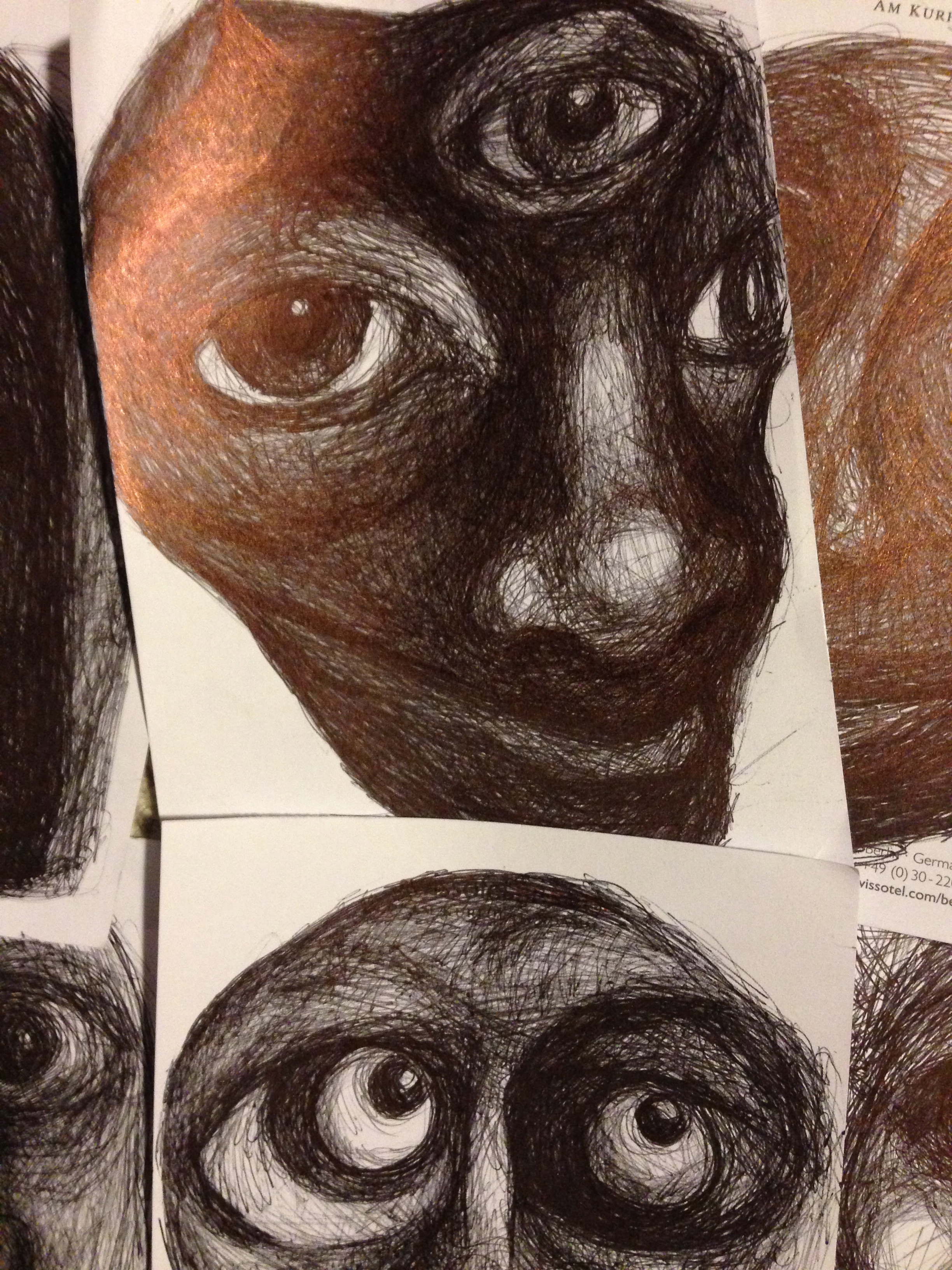 the line that weaves a monster creates a world of possibilities. hopeful monsters, evolution by systemic mutations, as developed by goldschmidt in his theory on “hopeful monsters”, provides, as a metaphorical recourse, the right to hope against all odds that what is uneven – think Kant and the crooked timber of humanity – might be not only necessary but at times preferable to what is normatively expected. (citation after: dartouth.edu/~dietrich/NRG2003.pdf


 Art & Writing