the shadows were moving slowly, swaying like branches in a light breeze or high buildings on a windy day. to detect purpose in these gentle movements required a slight degree of paranoia, and yet there was no apparent natural cause to explain the shift of the shadows away from their corresponding objects and towards the center of the village like water draining from upset glasses.
finally, there were just a bits of shadow left, like drops in a sink adhering to the enamel by their surface tension. these droplets of shadow were sparkling like rainbows, no grayness reflected. the air was still and non-expectant, noon in a depressed small town, and the realization that the world was without shadows had not yet sunk in. in a dirty jeep, parked close to the village center, a woman lit a marlboro
even those who had dismissed the shadows as inessential, felt disconcerted when the birds ceased to sing. on the morning of the third day, after a dawn without luminosity had given way to dull day light, small insects began their crawling procession towards the centers that had swallowed the shadows.
and someone laughed at the gray man in his wrinkle free woolen suit who solicited signatures on retro-active insurance policies. “one day only”, he implored, “an amazing offer”, but they shooed him away while watching the myriad of tiny, scarlet colored spiders tie a living ribbon between the outskirts of the village and the shadow drain.
and yet, the spiders said, too easily do you accept that we form a living ribbon, and wander into oblivion. one by one. what to your eyes a living ribbon is, to ours is a band of pain, and joy, and hope against all odds.
Den Großvater zu verstehen heißt nicht zwangsläufig, eine ganze Generation zu verstehen, heißt nicht, Deutschland während der Zeit des Nationalsozialismus zu verstehen. Aber dennoch scheint es K unausweichlich, auch nach ihrem eigenen Großvater zu fragen. Seit der Lektüre von Hannah Ahrendts Buch “Die Banalität des Bösen”, das sie während ihrer Seminararbeit zum Fall Eichmann studiert hatte, hatte sie die Idee verfolgt, gerade dem Banalen, der Alltäglichkeit in der Biographie ihres Großvaters nachgehen zu wollen. Wobei sie nicht notwendigerweise nach der Alltäglichkeit des Bösen in der Biographie des Großvaters suchte, sondern eher nach der scheinbaren Bedeutungslosigkeit alltäglicher Entscheidungen oder dem kumulativen Effekt vieler scheinbar banaler Entscheidungen zu einem unveränderlichen, verheerenden Ganzen, eben nach der Banalität der Zeit, wenn sie als Gegenwart daher kommt, und vielleicht auch nach ihrer Gewichtigkeit, wenn sie vergangen ist. Nach der banalen Abfolge von als Anekdoten und Geschichten wiedererzählten Ereignissen, die angeblich die Entscheidung für die NSDAP vor 1933 als ein nahezu natürliches Ereignis erscheinen ließ. Weltwirtschaftskrise. Hunger. Hoffnung. Aufrüstung. Krieg. Erzählt in Ereignissen der einzelnen Tage, während derer sie sich zutrugen.
Sie suchte auch nach einer Erklärung danach, warum unter denselben Umständen einer zum Dieb wird und der andere ein ehrlicher Mensch bleibt. Warum Gottfried Benn und ihr Großvater den Nationalsozialisten vorauseilenden Gehorsam geleistet hatten und Klaus Mann die mörderischen Absichten der Partei hingegen von Beginn an verstanden und verabscheut hatte. Die Frage, die sich ihr letztlich stellte, war, ob ihr Großvater nicht doch in die NSDAP eingetreten war, eben weil er das Parteiprogramm und die Absichten der Nationalsozialisten sehr wohl verstanden hatte und sie mit zu tragen bereit gewesen war. Sie wollte verstehen, was den Großvater dazu bewogen hatte, bereits 1931 in die NSDAP einzutreten. Das 25 Punkte Programm der 1922 von Preußen und anderen deutschen Ländern auf Grundlage des Republikschutzgesetzes verbotenen NSDAP hatte als Programmpunkt die Entrechtung der Juden durch den Entzug der deutschen Staatsbürgerschaft schon enthalten.
K entsinnt sich des späten Bekenntnisses des Großvaters , “man habe den Juden Unrecht getan, auch wenn sie keine Deutschen waren. “Dem Wertheim, zum Beispiel,” hatte er anerkennend gesagt, “das war ein ganz ausgezeichneter Geschäftsmann.” Noch über vierzig Jahre später hatte er nicht sehen können oder wollen, dass die in Deutschland verfolgten Juden Deutsche gewesen waren. “Die Nationalsozialisten haben den Juden in Deutschland doch die deutsche Staatsbürgerschaft überhaupt erst entzogen.” hatte sie eingeworfen. “Das musst Du als Juristin doch einsehen, Katja,” hatte der Großvater erwidert, “Es war ja ein wirksames Gesetz, auch wenn es manchen nicht gefiel, aber Gesetz war es doch.”
K konnte dem Großvater höchstens zu Gute halten, dass er sich nie mit der Floskel verteidigt hatte, “man habe von all dem doch gar nichts gewusst.” Vielmehr hatte er, allerdings auch unter Verwendung des neutralen Infinitivpronomens, gesagt: ” Man habe sich geirrt.” Als habe es sich um einen Rechtschreibfehler gehandelt. Ein Aktenversehen. Und eben: “Das kann Deine Generation gar nicht mehr verstehen, Katja.” Und dann hatte er das Thema gewechselt und wieder aus seiner Kindheit als Lehrersohn erzählt.
Erst jetzt, mit dem Abstand von zehn Jahren seit dem letzten Gespräch, mit dem Abstand des Todes, der zwischen ihnen liegt und der sich weitet wie ein Fluss, der über die Ufer tritt, und dessen anderes Ufer schwerer und schwerer erkennbar wird, erst jetzt, mit dem Abstand von einem Kontinent und einem Meer, kommt es ihr in den Sinn, dass in diesen Geschichten aus dem Dorf, den Geschichten von dem Jungen Nick Rieper vielleicht etwas von dem Alltäglichen der Zeit zu finden ist, das sie damals vergeblich aufzuspüren versucht hat.
All jenen, die meinen, man habe nicht wissen können, dass die jüdischen Nachbarn, die abgeholt wurden, ganze Familien, die in der Nacht auf Ladeflächen von Lastwagen fortgebracht wurden, mit dem Ziel ihrer Ermordung fortgebracht wurden, denen sei die Lektüre dieses Tagebuches eines vierzehnjährigen polnischen Mädchens, Rutka Laskier, empfohlen, ermordet 1943 in Auschwitz. Rutka Laskier führte ein Tagebuch, das erst 60 Jahre später bekannt wurde, ein Zeugnis der Zeit, aus dem unmissverständlich hervorgeht, dass dieses Mädchen, 14 Jahre alt, sehr genau wusste, welches Leid und Elend ihr zugedacht waren. Ich reblogge diesen Artikel aus dem exzellenten blog “Wortspiele” in Anknüpfung an die Diskussion darüber, mit welchen Zeitdokumenten der Holocaust an den Schulen unterrichtet werden sollte. Die vorgestellte Ausgabe enthält ein Nachwort von Miriam Pressler.
“Writers must oppose systems. It’s important to write against power, corporations, the state, and the whole system of consumption and of debilitating entertainments. I think writers, by nature, must oppose things, oppose whatever power tries to impose on us. … You know, in America and in western Europe we live in very wealthy democracies, we can do virtually anything we want, I’m able to write whatever I want to write. But I can’t be part of this culture of simulation, in the sense of the culture’s absorbing of everything. In doing that it neutralises anything dangerous, anything that might threaten the consumer society. In Cosmopolis Kinski says, “What a culture does is absorb and neutralise its adversaries”. If you’re a writer who, one way or another, comes to be seen as dangerous, you’ll wake up one morning and discover your face on a coffee mug or a t-shirt and you’ll have been neutralised.” Don DeLillo (Panic #1, Nov. 2005, pp. 90-95.)
And is it not at the same time a cynical paradox and the hybris of writers, artists and maybe even lawyers, yes, now that I mentioned it, certainly lawyers as well, that in striving to be effective, successful, sharp, persuasive, unveiling, exposing, revealing, uncovering the workings of the machine we also strive for the kind of recognition that neutralizes our very effort. This is still the romantic idea of the individual rebel, the genius writer, the brilliant artist, a sly title afforded with societal approval by the very system that is being accosted, criticized and opposed just because this honor neutralizes, even castrates the very effort it lauds. Don DeLillo writes accordingly in Underworld that true proof of existence lies with the recorder not the recorded, the one who does not have a name but the authority to write the code which makes time tick. My words, his idea, by the way.
If you did indeed value the corrosive of your intellectual ability you would choose to remain unknown behind a work that was known for its efficiency. you would not buy the idea of the genius writer who ends up on a t-shirt or, for that matter, on Facebook where you can democratically and to no specific end be approved of by the click of a button, but you would anonymously and in a group of like-minded minds labor towards the specific end of a realization of your ideas.
this is, coming round from yesterday’s etude on the privacy of data, another appeal to keep private if you can and claim the right and authority to do so.
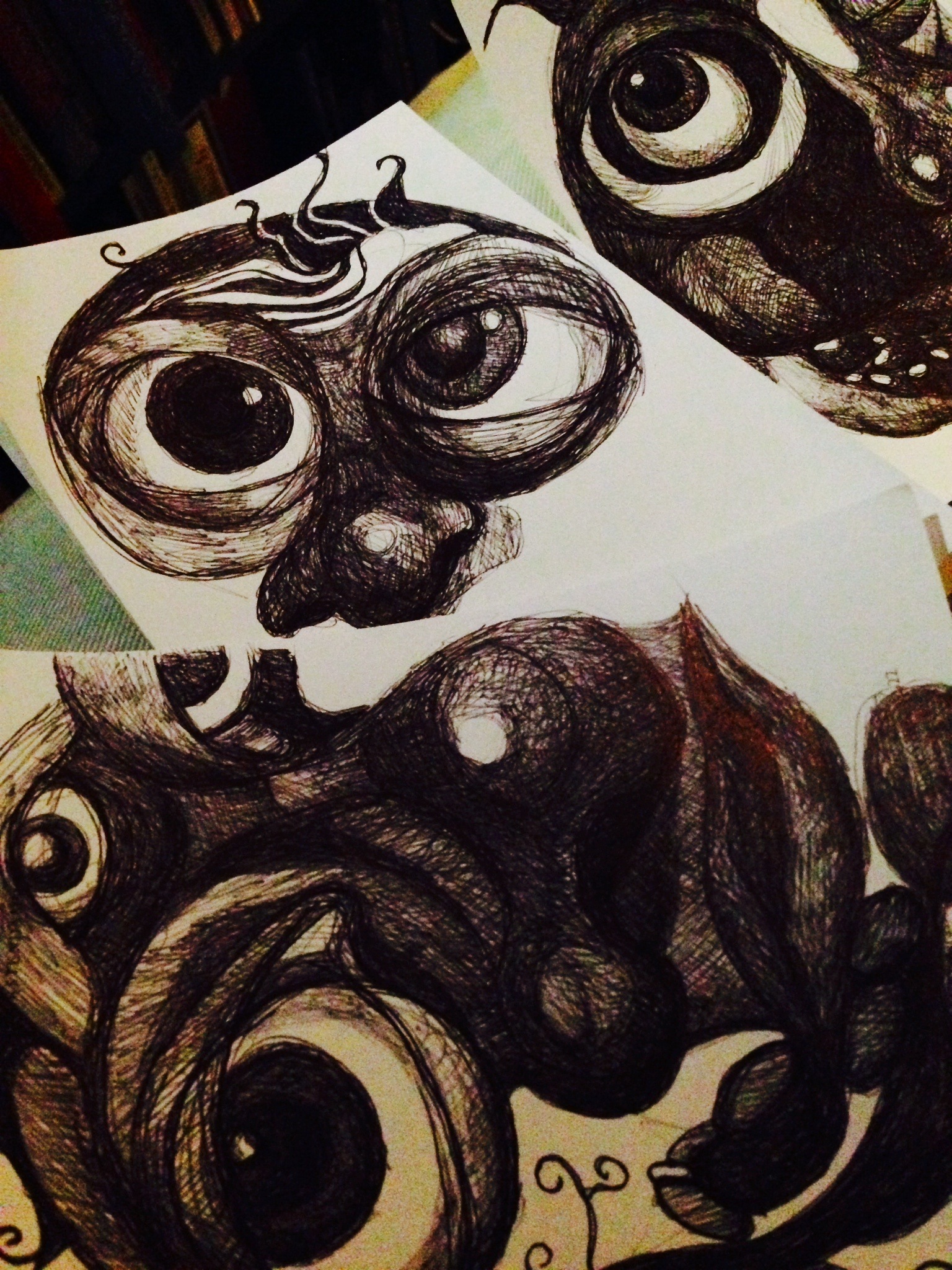
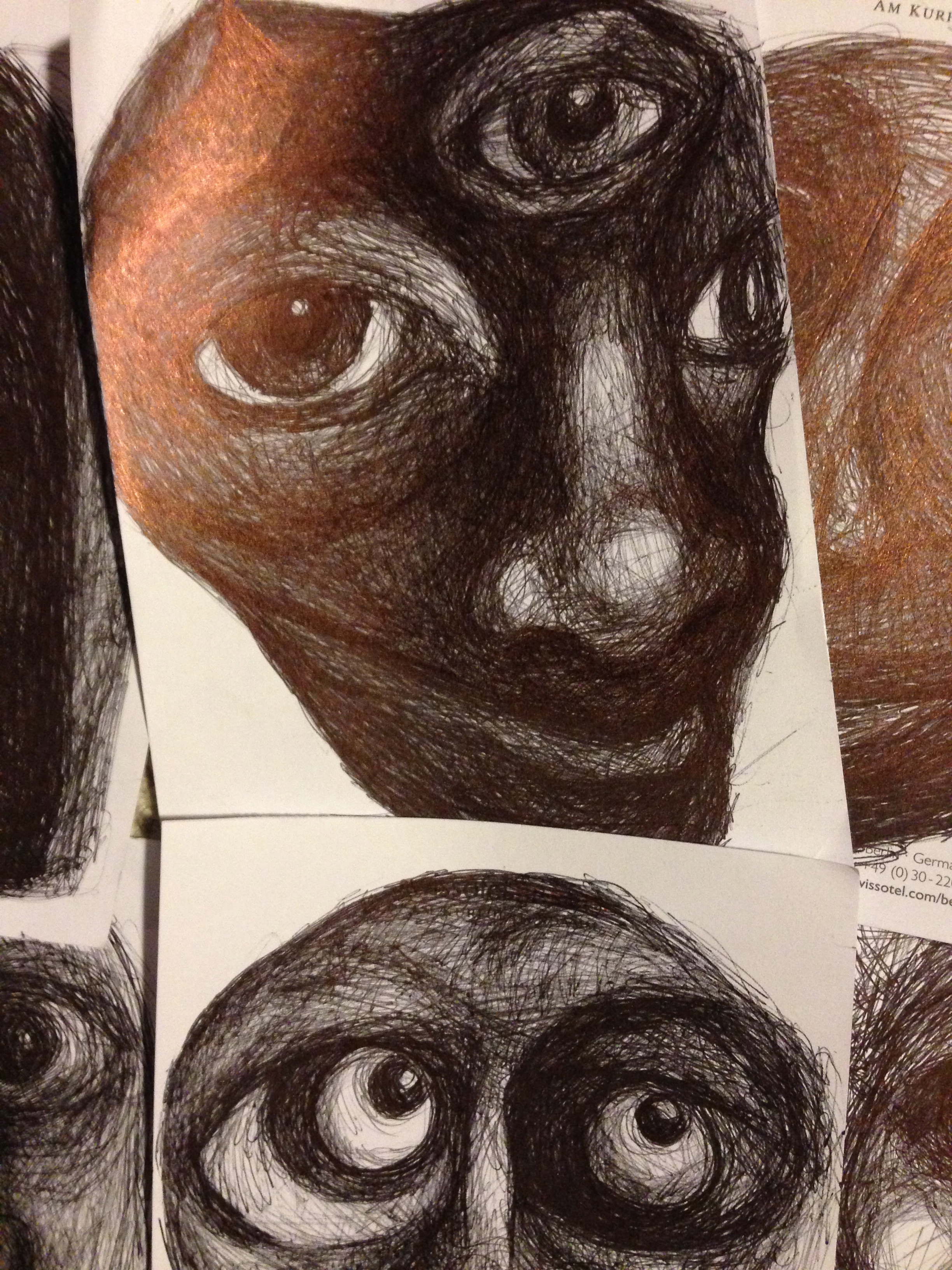
the line that weaves a monster creates a world of possibilities. hopeful monsters, evolution by systemic mutations, as developed by goldschmidt in his theory on “hopeful monsters”, provides, as a metaphorical recourse, the right to hope against all odds that what is uneven – think Kant and the crooked timber of humanity – might be not only necessary but at times preferable to what is normatively expected. (citation after: dartouth.edu/~dietrich/NRG2003.pdf
“a single mutational step affecting the right process at the right moment can accomplish everything, providing that it is able to set in motion the ever-present potentialities of embryonic regulation” Goldschmidt, R. The Material Basis of Evolution (Yale Univ. Press, New Haven, Connecticut, 1940).
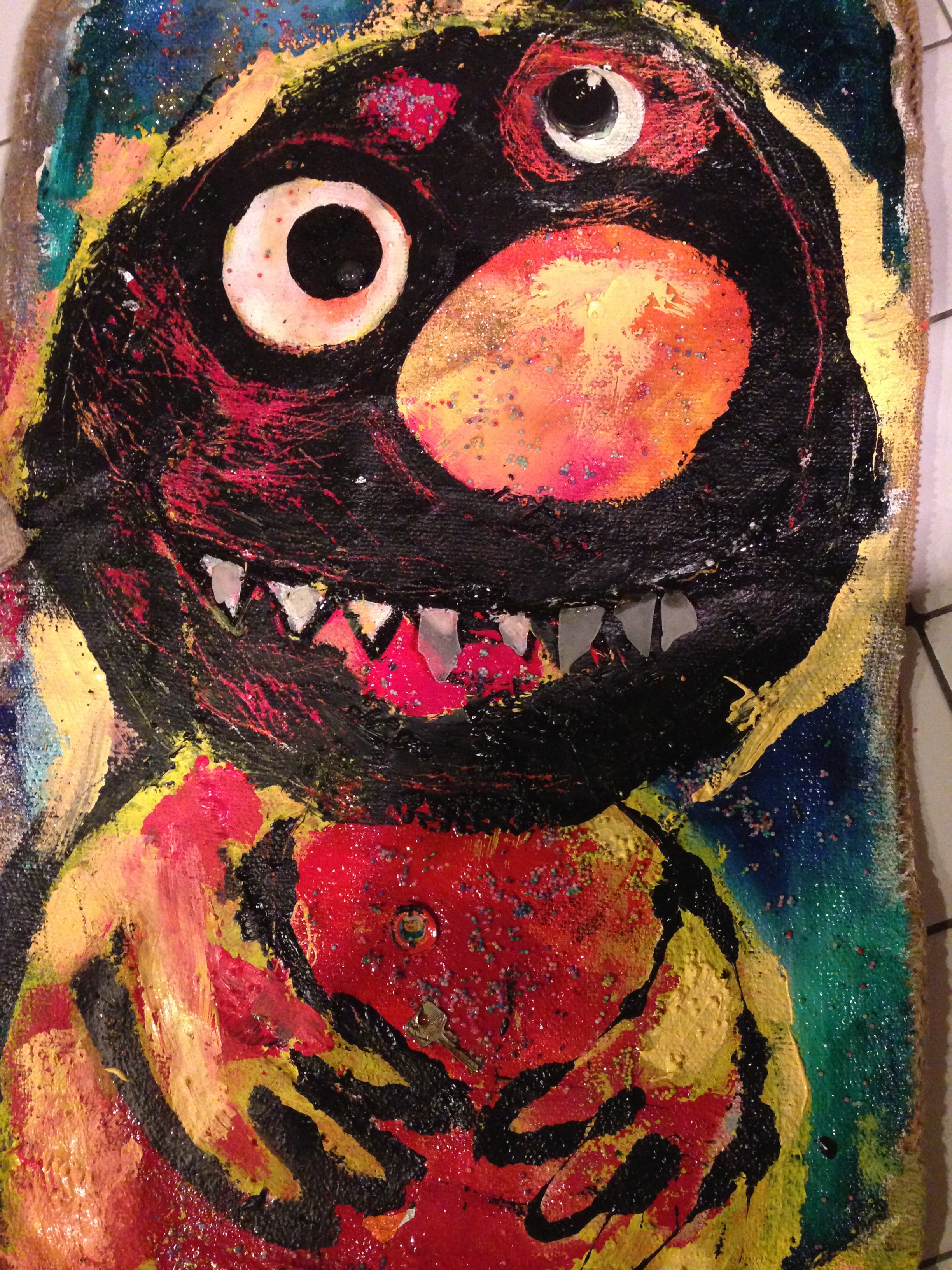
One wild thing: on closer inspection of these canvases you’d find bits and pieces of found objects enclosed such as children cherish. Pieces of beach glass substitute for teeth, small beads, glitter, all children I know love glitter!, keys and bottle caps and lost and found buttons.
When did we forget to spin the dream, when did our world cease to hold small promises of meaning and adventure, a life time of stories still to be told? How did we grow up to forget the sensual richness of the world, the intense pleasure we can find only in simple things and moments? When did we cease to live today in order to reach for a tomorrow that we never truly know will exist – and if it does, it comes only to be given up and traded in for yet another tomorrow until there is no tomorrow left? When did we start squandering our present moments for squalid projections of who we could be if only? When did we tire of that what we have , right here and right now, the word, the discovery of nothing and everything, the breath of boredom and adventure alike?
Ask an expert, a child no older than six, what life could be like if you’d find it again, go hunt for chestnuts and bottle caps and pieces of this and that, lost and found. Talk to a stranger and ask for their story, smile every once in a while even if convention doesn’t require it, lift your eyes up and look at the disorderly lines of roof shingles, chimneys and antennas and in your mind create a stage for a play that involves precarious acts of balance and skill. Think “Karlsson” by Astrid Lindgren.
Go down to your knees, seeking the perspective of a five year old, and pick something from the ground that glitters just because it catches your eye – without whisking out a disinfectant afterwards. Be a MONSTER. Breathe. Laugh without any particular reason. Be the absolutely unremarkable, remarkable YOU you were born to be. Nothing more, nothing less. MONSTER Nr. 23
It only occurred to me some years after first meeting him that his brain had been on fire probably day and night, during waking moments and during sleep. He was, I could see that right away, back then, high wired, hyper intelligent, super sensitive, coy, cornered, cynical. In was apparent in the first conversation one would have with him that he was constantly computing any kind of informational offering of his environment for bits and pieces of useful knowledge, useful in his own sense, not ruling out the value of overheard conversations of strangers, visual clues of bill board advertisement, the color scheme of the dioxin polluted NJ marsh lands, conspiracy theories and their opposites, math, astronomy, information technology, Shakespeare, even the CNN news ticker. He was reading, forever reading, and then reading some more, his brain was speed feeding itself knowledge, and he could recover this knowledge with the casual speed of a trained illusionist. When I knew him better he showed me the encyclopedic if highly individual work he was dedicated to, a work in many volumes bound in blue linen as soon as a new one was considered completed. A friend who worked at a university library did this for him volume by volume, one for the shelf in his den, and a twin one that he archived openly secretely in said library, for everyone to see and no one to find in maybe another century. It was a work so biased and yet so beautiful that it was unquestionable that I had been admitted to a unique work of art though he preferred to call it a scientific study of random code.
And still, it was only years later when in the course of an increase of my English language skills I could not only read but also hear all the different voices merging in “Infinite Jest” by David Foster Wallace that I realized I had actually met a man who is – if that is at all possible considered who Wallace was – the dark twin of David Foster Wallace, sharing his semantics, his obsession, his socioeconomic circumstances, his despair, his addiction, his near autistic ingenuity to gain access to ever deeper layers of information and information encoded within this information,and that he was the man who had to be expected to exist in the margins of literary history, never to be found, as we know that there is never just one genius at any given time, but often just one to emerge to public consciousness , maybe to his own destruction. so that, with other words, i know there to be one other living madman, or genius, or whatever you’d like to call a man with a brain on fire, to weave the net still, to still find the words, to write the chronic of what is and was and will be in all its Borgean implications, thereby freely accepting the responsibility of calling the world into existence.
In the meantime I discovered the places “where the seams come undone”, as my mother called it. Every classroom in my school had a clock on the wall right over the door, and all the clocks had identical clock faces, and every one of them showed a slightly different time.
I don’t know whether clocks in classrooms today are all connected to one central, totalitarian time piece as I suspect might be the case, though I hope it is not so. I always loved the way time oscillated between classes, obstinately refusing to be tamed. Officially, students had three minutes to walk to the next classroom after a period ended. But for the way from science to math, for example, you’d better made do with 1 minute and 29 seconds – the clock in Ms. Kirsch’s class was as fast as our teacher’s ability to conjure numbers out of the back entrance to Hilbert’s Hotel and as inexorable as her refusal to admit to time measured outside her class room.
On the other hand, you could afford to leisurely stroll to French after that, using not only the 1 minute and 31 leftover seconds from math but also the 40 seconds the French clock was late, giving you an ample 5 minutes and 11 seconds (not counted the additional minute or two Mme. Petite rustled with her papers, ignoring her students’ ongoing conversation). The clock in language arts had the peculiar and infamous habit of stopping at exactly 12.01 pm every couple of weeks and could only be persuaded back into service by Superintendent Segrob who, for that very reason, was particularly fond of it, and year after year insisted on repairing rather than replacing it.
Every day for a few moments just before noon instruction in language arts paused and everyone’s eyes followed the unhurried second hand making its way from 11.59.59 am to just after 12.01.02 pm. It was almost like a pagan ritual, these approximately sixty-three seconds of silence, as if we were paying our respects to the spirit of the clock, Time. Time, sputtering, fleeing, stopping, resuming its course, divided itself up over the 79 clocks in our school according to its own preference. With other words, it seemed to be on our side and refused to be institutionalized.
I know that the language art clock did not stop on that day. I don’t think it would have been possible for it to stop while I was willing it on. Apart from Time herself though nobody noticed that I counted every second of the school day, 24,000 seconds in all, stops, gains and losses, until, at last, the 2.47 pm bell wrapped it all up hurriedly and dropped the leftovers for the time dogs.
on an early winter’s day a small girl is contemplating the fine layer of ice that, over night, has been glazing over the surface of the fjord. the fine glass is firm enough to carry a duck sliding more that waddling on her webbed feet, making towards the dark canal of open water a fisher boat has left in its wake this morning. it is a comical sight to watch the duck struggling to make progress on the polished ice, the bird looks like harpo on skates.
a little further off the shore a small lake has been kept open by another group of water birds continuously swimming to keep their hole from freezing over, among them two swans who for the time being have resigned themselves to the company of the more common water fowl as their attempts at escape have been defied by their weight.
the girls narrows her eyes as she tentatively put one foot out on the ice, holding on to the orphaned pole the boat upon its return will bet tied to. a large bubble of air that somehow has been trapped underneath the ice near the pole displaces itself under the weight of the child’s feet and causes the ice to sigh. the child smiles with appreciation.
she is old enough to realize that the surface that will not carry a swan’s weight will not carry her own. furthermore, she has been firmly instructed to never walk on the ice before being told that it is safe to do so.
but no ones knows that she is as fast as lightning. they don’t know that she can make herself as light as a feather by breathing just so. with her eyes she follows the path her light foot would take, by a split second faster than the breaking ice. she would reach the other shore before the fjord could ever hope to claim her, she can see it now, can see herself running out there, triumphantly, defying nature and convention in one glorious run.
A picture taken by Charles Negre in 1853. Of Henri Le Secq near the ‘Stryge’ chimera on Notre Dame de Paris. (Photo credit: Wikipedia)
Embedded in the otherwise raw stone was the face of a little boy. The details were not worked out but still the image unmistakably was that of a child. His eyes were almost closed; he had round cheeks and a high, equally round forehead. The face was still and yet there was something disturbing in these childish, lovely features, a hint of pain not overcome.
After a protracted moment of meditation, like a period of silence between two people who do not know how to talk to each other but do not want to part ways just yet, the mason had taken up his tools and finished his work. Within the hour he had transformed the boy into a beast by adding spiked ears, pointed horns on his head, a hairy body, large hands and feet and a curled-up tail, all roughly fashioned. He then had put down his instruments, and without evaluating his just completed work again, had turned away from the boy and had left.
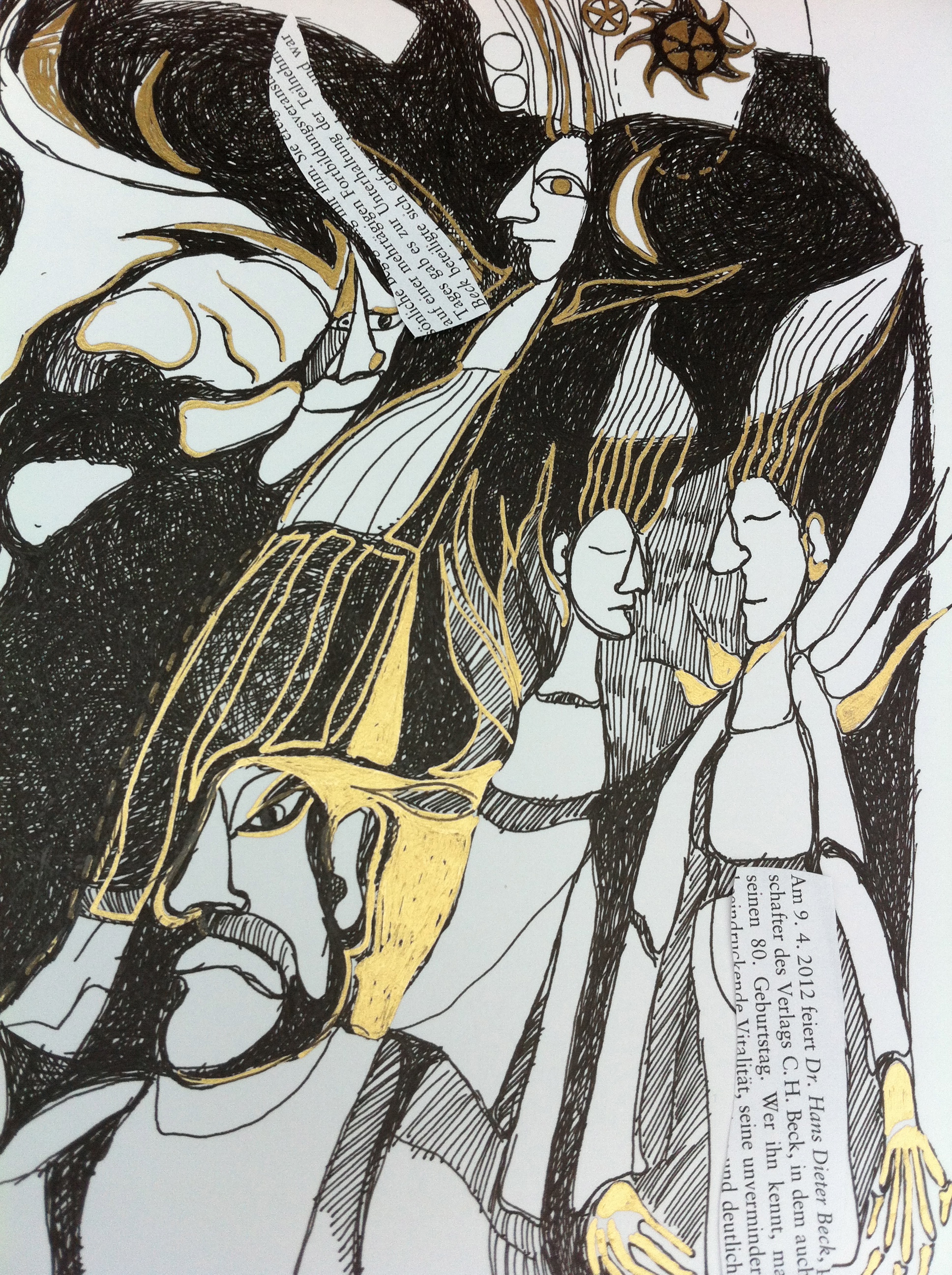 the shadows were moving slowly, swaying like branches in a light breeze or high buildings on a windy day. to detect purpose in these gentle movements required a slight degree of paranoia, and yet there was no apparent natural cause to explain the shift of the shadows away from their corresponding objects and towards the center of the village like water draining from upset glasses.


 Art & Writing