Robert Frost und Hans Albrecht Bethe
Robert Frost und Hans Albrecht Bethe.
Nachtwachen, Stück für Stück …
Robert Frost und Hans Albrecht Bethe.
Nachtwachen, Stück für Stück …
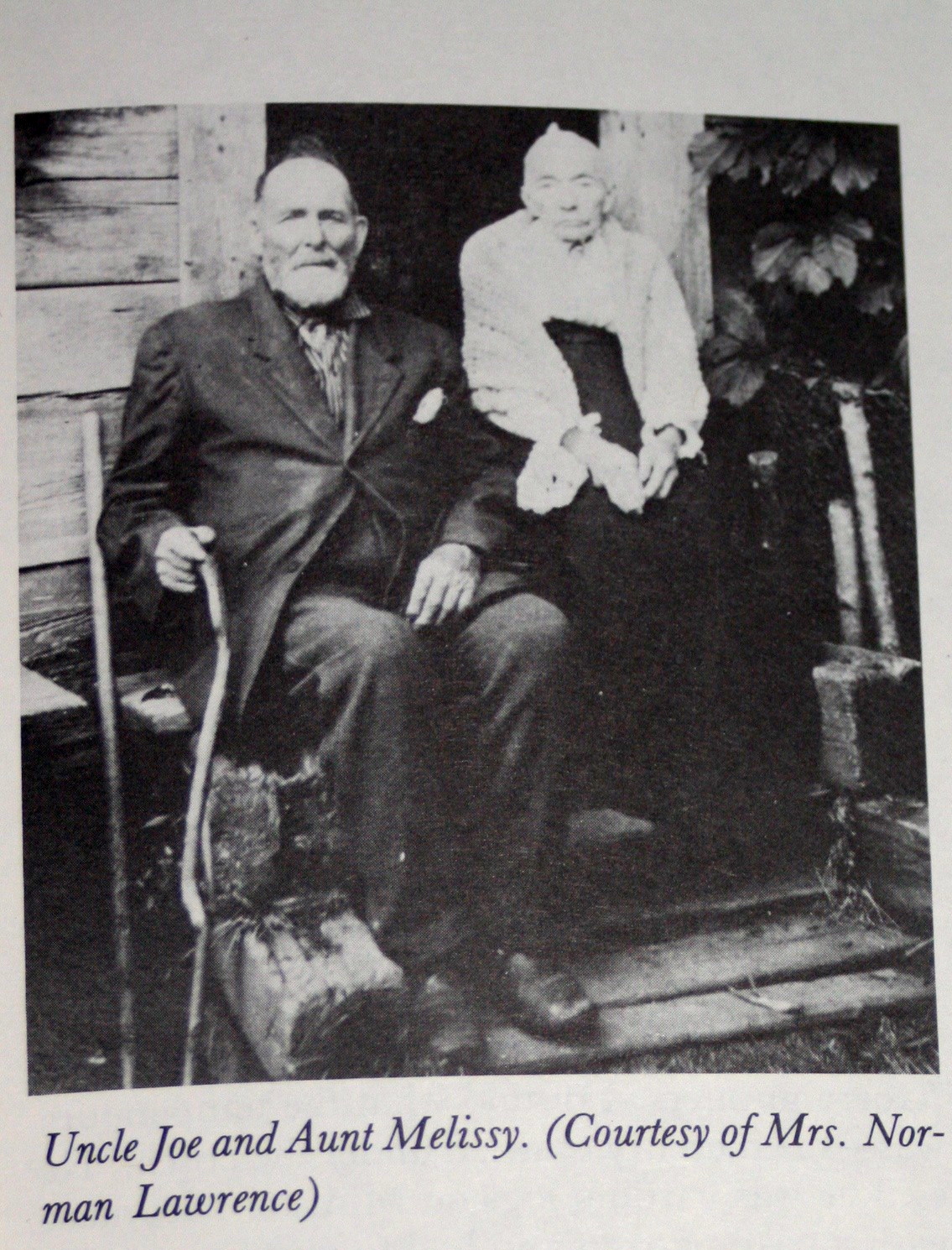
Uncle Joe was as talkative as his wife was quiet – but she had a quick wit, accentuating his stories with dry remarks that he returned with good natured smiles. “The smartest girl in the Northern County she was”, he would sometimes say, “and imagine, she agreed to marry me! But only after I cut my beard and swore off tobacco. She would not have had me otherwise, and I have become a better man for it. “
As I started to get stronger and could sit up in bed, still wrapped up in the blankets, Uncle Joe would entertain me with outrageously funny stories of his youth. He was given to enraptured fits of laughter triggered by his own jokes. When he got too carried away with his stories, Aunt Melissy would look up from her work – for she was never idle – and comment sternly: “Never be rash with your mouth, nor let your heart be quick to utter a word before God, for God is in heaven, and you upon earth; therefore let your words be few.” Then Uncle Joe smiled good-naturedly and continued his story with just as much zest while Aunt Melissy continued with her chores as if the words had not been spoken. Only on Sundays she did not tolerate his spinning of tales but insisted on bible study and quiet prayer and he obeyed her without complaint.
I have never again met a husband and wife who seemed so comfortable in their home and so content with their life and each other. Despite his stockiness Uncle Joe was quick to jump up like a cat when Aunt Melissy entered the cottage and eager to please her with some little errand or kindness. She returned his pleasantries with home baked goods and fragrant meals. Her only love besides Uncle Joe were the snow white chicken in her yard for which she was known in the county. Aunt Melissy and her white hens. Children they had none.
I was so completely startled by this sudden change in behavior that I wasn’t even shocked to feel a hand grabbing my shoulder and yanking me down from my boulder and back to shore.
The hand was firm and muscular. It dragged me away from the shore a few steps, beyond the tree line and I had to oblige, stumbling backwards. When we reached the shelter of the tree, the hand let go. I turned around. The strong and determined grip had been misleading. Standing in front of me, inspecting me gravely with birdlike, black eyes, was a tiny, old woman. She wore a long rough shirt with an apron over a grey flannel shirt. Snow white hair done up in a tidy bun, her narrow shoulders wrapped in a grey woolen, triangular shawl, she seemed to be right out of a historical reenactment society. “And what did you think you were doing there, laddie,” she inquired with an authoritative voice. Apparently she mistook me for a boy, addressing me as laddie. “Speak up,” she demanded, quite clearly being used to be obeyed immediately and not one prone to put up with any nonsense. I shivered. She stepped closer again, then reached out and pushed my tangled hair out of my face. Taking a sharp look at my face she murmured to herself: “In a bad shape we are, aren’t we.” And inspecting me a few more moments she added: “A girl in a lad’s clothes, if I ever saw such a thing, lost too, I take it.” She put her hand on my forehead. I started shaking violently. “You are burning up,” she observed, again more to herself than to me. If I had had any more strength left in me, I might have inquired right there and then why she had yanked me away from the boulder. If I had been in my own time and place, I would have protested most decidedly about being ordered about by a woman who was a complete stranger to me. But here I was, meek, shivering with fever and cold and lost. The tiny lady took off her shawl and wrapped it around my shoulders. “That’s more like it,” she stated grimly, referring to my state of clothing, I am sure. Then she simply took my hand and pulled me along.
I lay curled up like a cat and I could feel the curve of my spine, I could feel my knees against my chest and my hand underneath my cheek. Without opening my eyes, I carefully and with a sense of controlled terror extended my other hand to feel the surface of my quilt. I would know the stitching of its pattern, the softness of the filling having long since relaxed against the fabric. My fingers gently touched the surface. I hesitated. It felt grainy. Not grainy like cookie crumbles. Grainy, like sand. When I thought “sand”, I shoved my fingers deeper into the surface. They did not meet much resistance. I pushed easily into the sand like I would, aimlessly, on a beautiful day on the beach. All the while the surface underneath me was breathing. I had to open my eyes to find myself. I wondered whether I was still dreaming, and for a moment considered trying to drift back into nothingness, but I felt wide awake, too awake.
So I did. I opened my eyes. It was not dark at all as I had fully expected, yet the sun was pale, far away in the winter sky, just so illuminating the grey mists rising up from the water. I knew where I was. I was most definitely not on my bed in Summerville, NJ. I was curled up, like the sole survivor of a ship wreck, on the shore of a lake. I sat up, stunned, on the wet sand, numb with cold as much as with surprise. I knew the beach. It was small. I had spent many summers here with my family. I was sitting on the North Shore Beach of Lake Willoughby.
All things considered, it was strange that my mind accepted this truth so readily. I didn’t think: I must be dreaming. I didn’t look for an explanation.
How hard my mind had to work to keep control, to still try to make sense out of a wealth on information that had long stopped to be apprehensible by any rules I had been led to understand applied. But only submission to the world of grown-ups would have you believe that they were – in general – truthful about the world. I didn’t believe this anymore but tried to rely on my own senses instead. It was treacherous ground.
For example that night. As I lay in the dark, eyes closed though wide awake, the surface of my bed felt soft as was to be expected, but it felt soft in the way I had experienced and shied away from before. It seemed to be soft in an organic, breathing way. I tried to distinguish between my own breathing pattern and the breathing of that soft, pliable surface I felt underneath my body. It was an uncanny feeling – but just ask yourself how many sensations you can really clearly distinguish besides soft and hard, warm and cold, pain and pleasure. Truth is, you constantly rely on additional sensations and context to tell you about the thing you are experiencing through just one of your senses to make sense of something.
What was it that I was feeling? Something that I feared, but I didn’t know why I feared it or whether I had reason to fear it in the first place as I was completely unaware of its nature. All I knew was that last time I checked my bed had not been breathing. As before it felt actually – and it made perfect sense to think those words as irrational as they might seem – that the earth itself, underneath my feet, my body, was a breathing organism, like a gigantic whale you find yourself stranded on. It didn’t make sense and I couldn’t explain to myself where that strange idea actually orginated. Nothing I had read or talked about lately had pointed in that direction. Remember, there was no internet and but little TV. None in our house, by the way.
And yet, I just felt it, right there and then, the surface underneath me belonged to something alive, and I knew I had to open my eyes to find out what was going on, but I was entirely too scared to live up to my own imaginative ability. All I could manage to do, pathetically, was to continue breathing slowly just as I had done during those long ago nights when I had led some non-existing intruder to believe that I was asleep. And with each moment the sensation of a sighing, breathing surface underneath my body was getting stronger.
When I thought about the idea of god waking me (or not) I became afraid. There was a German lullaby by Brahms that my then ancient great-grandmother used to sing to me when I was really very little which ended with the words: “Tomorrow morning, if God wants so, you will wake once again.…” Our family life was altogether politically non-theistic, except for the great-grandmother who passed away when I was about four, but the idea of god deciding about my waking in the morning was still disconcerting. What if he did not want to? On a whim? Would I just sleep forever? Would I die? What if he plain forgot about me?
When I had asked my mother about the song she had explained to me that the lyrics dated to a time when it was understood that everything – everything – happened only with god’s consent and that these lines, by their content, did not deal primarily with the idea of god remembering to wake people or not.
I don’t know whether that explanation did much to put my anxiety to rest, I think probably not. But it certainly was with relief that one day I realized that I actively did not believe in god. That was an easy attitude to acquire in my family, by the way, and an easy attitude in that decade following the sixties, a decade ending with the brief and delirious ruling of acid freaks, post feminists and de-constructors of language which left a lasting impression on western societies and which was my intellectual parents’ undeniable contribution to a new cultural value system, a system that allowed for people like them to unfold their wings and discover entirely new horizons and ideas. I don’t remember that we had ever attended any church service. Even wedding ceremonies in my parents’ circle of friends and family were civil ceremonies. No baptisms. Still, God remained a quaint distant relation who, after a history of misfortunes, had found asylum in old nursery rhymes and lyrics. All but forgotten and without charitable visitors, but hanging on.
My parents’ were avidly confessing atheists for many years until older age and the dawning sense of their own mortality softened their rhetoric. And yet, my childish sense of superstition, during the phase of their most decided and articulated stand on the topic, detected an ominous quality to the concept “god” and it took some years and my awakening intellect to overcome the threatening taste the fear of that forgotten but lingering god left in my mind. Maybe god explained and explored would have been easier to understand but I was pretty much left to my own devices to figure out what the idea of god stood for. I vaguely feared god until I shed that fear pretty much like I had shed the fear of the nightly intruder eventually. Only much later did it occur to me that the elimination of god did not erase the randomness and with it the terror of the unpredictable nature of death.
I took out my small compact powder out of my jacket pocket. I clipped it open and looked into the little mirror in the lid. My face glowed sickly pale under the fluorescent lights. Winter pale. I clipped the lid down, got up from my chair and stepped into U – Z. As I had expected, there was no one there. Velasquez, Varese and The Venetian School, gigantic volumes, with soft, yellow pages lingered pompously yet with a limp attitude between smaller books, waiting to be released from the boredom of their shelf lives. This is what immortality means, I thought, sitting on a shelf as an afterthought to your own life. Maybe to be lifted down every few years to be perused briefly for some kids’ art assignment. I touched the laminated, slightly deformed backs with my fingers. Books do not endure lamination well, a laminated book resembles a plastic covered sofa. One cannot enjoy it. I apologized to the volumes that were sighing with age and discontent …
I have been working on this novel for a while now. There are passages that I really love, snippets, impressions that convey the atmosphere I want to create. There is also, almost surprisingly, some real plot (unusual for me) and a couple of protagonists I can vividly picture like I can picture friends. The novel could be read as science fiction – or it could be an account of a delusion. I don’t quite know which one it is, but so far it could coherently be read as either and it will depend on the conclusion to point in one direction or the other. Any kind of science fiction could of course be an account of the protagonist’s delusions if one chose to read it like that. This is one reason I chose the genre for this particular coming-of-age story in the first place. Another one is that I have been craving for a playing field for my interest in ephemeral science and have been having a ball researching and reading up on all kinds of science projects with marginal news interest from marine bioluminescence to quantum physics to astronomy.
“Recordings of what?” I inquired. His smile faded. Again it seemed like he was listening to my voice retreating in the library. “She said you were smart,” he remarked, more to himself. I was not sure that was supposed to be a compliment or a reminder to himself. “Who said?” I cut in. I had the uncomfortable feeling of him looking at me again and I felt reprimanded without him saying a word. “Sir, please, who said that?” I rephrased my words.
“Never leave a question before it has been answered,” he advised me, not answering either one of my questions. He fell silent. I stared at him, then lowered my glance, then looked up at him again. He could sit perfectly still, looking very much like the archetypical image of a blind man. It seemed to me, again, that I noticed more visual detail than one should notice. More than I could process. The crease of his pant legs, the way the fine wool fabric folded itself, the nuanced shadows in those folds. His white, chiseled hands, holding on to the walking cane even as he was sitting. And yet, despite or maybe because of the rich details I had an increasingly hard time focusing on him. It was like reading a book when you are very tired already and you can’t focus on the words. You are still reading them mechanically but you do not get their meaning. He faded or rather he diminished in size. He diminished in size but gained in clarity. I wanted to protest. I had a million questions. He looked like an illustration, I thought, feeling very tired, like one of my mother’s illustrations, done in a myriad of very fine, sharp lines. And each of these lines was emanating a fine, very precise, white light.
As a matter of fact, Dr. Hausner had started talking again. The low drone of his voice brought me back from my existential self-doubt to the mundane world of the Summerville library. Or not so mundane as I had just recently discovered. I drifted off again as if lured away by my own obsessive thoughts. What was real? What was dream? Where was I when I wasn’t aware of myself? Where was I when I was asleep in my bed? I pinched myself hard to make myself listen to the melodic voice of the blind man by my side.
“Normally they go about their own business, “ Dr. Hausner concluded at that moment. “But of course they are bored.” He seemed to be thinking for a moment, folding his elegant white fingers in his lap. Then he added: “Even in the library.“ He sounded incredulous as if that was an incomprehensible idea. “But what are they doing here?,” I ask. “Where do they come from?”
Dr. Aaron Hausner cocked his head as if he was listening to the retreating sound of my voice slowly travelling into the distance of the library, finally getting caught in some shelves, its individual corresponding vibrations disintegrating and archiving themselves alphabetically in the juvenile fiction section somewhere between Susan Cooper, E.L. Königsburg and Madeleine L’Engle. “Dr. Hausner,” I whispered, “do you remember me?” He smiled. “You sound tired,” he observed instead of an answer, “I say, you don’t sound well at all.” I felt a brief wave of frustration and annoyance. No one ever answered my questions. But then the warmth of compassion in his voice reached me and to my surprise I felt my eyes filling with tears. I swallowed hard. It had been a while since someone had showed an interest in how I was feeling. We sat in silence for a while. Dr. Hausner didn’t press for an answer, and I sat back, not feeling the pressure to make any kind of conversation. There was a strange, comforting feeling that he kept me in his focus even though he didn’t inquire any further. We sat almost next to each other in silent company. I felt real and alive.
I don’t know whether I was crying. I might have been. There were a few moments when I felt peaceful. But after a while the questions came sneaking back to my mind. They were destructive and very smart about it. And I started feeling agitated again. Hell, I didn’t even know whether this grandfather, his reassuringly old fashioned, three piece suit clashing with his white skinned, bare feet in biblical sandals, who was providing me with his compassionate company, whether this man actually existed. He immediately sensed my aggravation and shifted in his seat as if releasing me from his interest. Maybe my breathing pattern changed. Or maybe he was just a part of my mind, responding to me because he was me. I briefly contemplated if I could ask some other visitor whether Dr. Hausner existed, but the problem was really, that everybody I would maybe choose to ask could equally be a fabrication of my mind. I couldn’t prove anybody’s existence. Not even my own. I just had to operate on the assumption that I existed and that people I talked to existed, too.
The Art of Psychogeography
Hinter den Kulissen des Hamburger Modelabel NUSUM.
A little something for you.
und die Armut des Geldes
I have people to kill, lives to ruin, plagues to bring, and worlds to destroy. I am not the Angel of Death. I'm a fiction writer.
Astronomy, space and space travel for the non scientist
I read whilst commuting and post the reviews here.
Stich um Stich. Mode und Handarbeit.
Arts, Crafts, Illusions, Photography, Surreality and Humanities
Blog zum Arbeitsrecht seit 2009 - Fachanwalt Andreas Martin
der inhalt meines buchregals
inger-kristina wegener, artist, writer, lawyer
Visual Arts from Canada & Around the World
Musings on a mad world
Lese- und Lebensdinge
 Art & Writing